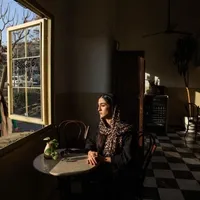
A woman stands in front of a painting in Tehran's Museum of Modern Arts, July 2025
Iran is awash in voices claiming to speak for its people: state loyalists, opposition figures and self-styled experts of every stripe drowning out the non-extreme yet critical voices with their din.
Most people I see in Tehran feel suspended in uncertainty, struggling with daily water and electricity outages while fearing the return of United Nationas sanctions and another war. They want change, but can’t see it on the horizon.
Worst of all, they feel they can’t express their concerns and thoughts.
“These days, you have to declare your political stance before you can say anything. And what you say must fit the dominant binaries, even if it’s about the price of beef.”
Shahriar is 36. He was laid off from his HR job just after the Iran-Israel ceasefire. He now delivers food while looking for work.
“There’s no voice that represents us,” Shahriar says. “And by us, I mean those who hate the Islamic Republic but don’t want to see the country destroyed by war. The atmosphere of accusation, labeling and hate online is so intense that I stopped posting on X and Instagram two weeks ago.”
That hostility, he says, has spilled beyond the screen.
“I’ve seen this toxicity enter friendships and family gatherings. If you criticize the war, people assume you support the regime—even though that same regime has imprisoned anti-war activists. Even supporters of the regime can’t tolerate anti-war views.”
Pick a side
Since the widespread protests of 2022, many activists have been calling for unity between those who want to see fundamental change in Iran. But solidarity remains fragile and elusive. A coalition of six high-profile opposition figures offered a glimmer of hope. But the effort quickly collapsed, widening divides and deepening mistrust.
“There’s this illusion that only two camps exist. Either you follow a scripted, militant vision of regime change or you’re a regime collaborator,” says Shiva, a civil society activist in Tehran.
The polarization, she believes, has erased nuance and pushed those like her out of conversations.
“Say Israel committed crimes, and one group calls you a regime apologist. Say the same thing to the other side, and they’ll ask why you’re silent about Iran’s military achievements. You find yourself defending your integrity instead of your argument. Constantly. It’s exhausting—and sad.”
•
•
Repeat the line
A recent study by LifeWeb, an analytics group operating under restrictions in Iran, offers a partial window into online activity during and after the Iran-Israel war.
The report says the hashtag #جانم_فدای_ایران (“My life for Iran”)—promoted by former foreign minister Mohammad Javad Zarif—was used in over 514,000 posts generated by only 17,000 users. That’s an average of 30 posts per user, suggesting coordinated repetition rather than broad engagement.
Likewise, in the final three days of the war, the Trump-associated hashtag #MIGA (Make Iran Great Again) appeared more than one million times from just 30,000 users—again averaging 30 posts each. This peak came during a nationwide internet blackout in Iran, raising further questions about the campaign’s authenticity.
While not conclusive, such patterns underscore how coordinated efforts can dominate digital narratives, often overshadowing the quieter voices who oppose both war and authoritarianism.
A man attending a religious ceremony marking the death of the third Shiite Imam, July 2025
Silence yourself
This “distortion” shapes perception, says Navid, a 28-year-old MBA student.
“These campaigns make it seem like most Iranians supported the Israeli strikes. But around me, most people saw war as a dangerous way to bring change. Sure, some defend it—but when the majority stays silent, the loud minority becomes the dominant voice.”
Navid believes this dynamic makes people fear expressing their views, feeling isolated in their beliefs. His friend Sina nods as he speaks before jumping in to vent his frustration at “losing” the only space he had to talk.
“Social media is the one platform most of us have to express our views. And it has been taken over by aggressive minorities and pressure groups.
“How can we reach a shared understanding, a shared purpose, when all we do is attack and cancel each other,” he asks. “The worst bit is we don’t even know if those shutting us up are real people or bots and cyber mercenaries.”
In 1980, months after Islamists took over what appeared to be everyone’s revolution, Iran’s renowned poet Ahmad Shamlou wrote one of his most recited lines to describe the repression: “They sniff your mouth, lest you’ve said ‘I love you.’”
It’s chilling to hear that line whispered again, not in defiance of power, but in fear of each other.
The Iranian government has allocated at least $67.6 million in foreign exchange subsidies for pilgrims attending the upcoming Arbaeen religious procession while the country faces its worst economic crisis since the founding of the Islamic Republic.
According to the Central Bank, each pilgrim traveling to Iraq for the annual ceremony may receive up to 200,000 Iraqi dinars at a subsidized rate, priced roughly $18 below Tehran’s open market exchange.
The Arbaeen ceremony marks the end of the 40-day mourning period following Ashura, the religious ritual commemorating the death of the third Shia Imam, Hussain ibn Ali.
Pilgrims crowd at the Shalamcheh Border Terminal on the Iran-Iraq border during Arbaeen.
With officials projecting that 3.7 million people will cross the border, the total state subsidy amounts to nearly 62,900 billion rials or $67.6 million.
Although small groups of Iranians had made the pilgrimage in the years after Saddam Hussein’s fall in 2003, the numbers surged after 2010, when official data first recorded 40,000 pilgrims.
By 2019, participation reached three million, before declining sharply during the pandemic. The growth has been fueled by active promotion by the governmentand large-scale government investment in roads, healthcare services, and logistical support for pilgrims.
In addition to currency subsidies, state-affiliated charities, municipalities, city councils, and various government bodies allocate dedicated budgets each year to organize the event and provide services along the route.
These include free meals, subsidized transport, and free Wi-Fi access along the main routes and within Karbala.
Roundtrip tickets from Tehran to Najaf—where many pilgrims begin the walk—range between 130 and 150 million rials (approximately $138 to $159), Adel Nourali of Iran’s Airlines Association said this week.
The large portion of each fare allocated to Iraqi airport fees has intensified concerns over concealed state subsidies.
1,550 tons of subsidised food including lamb, chicken, sugar, and rice will be distributed to religious camp organizers at massively reduced rates, Jebreil Baradari, head of Tehran’s Agricultural Jihad Organization said this week.
The offer comes as the cost of meat in Iran has soared and per capita meat consumption has fallen as over one third of the country is now living below the poverty line.
A group of leading Iranian tech entrepreneurs has warned President Masoud Pezeshkian that mounting state interference has left emigration the only remaining option for technology firms trying to survive.
“Some security agencies, through official letters, have prohibited government institutions from cooperating with the country’s major startups. This trend has continued with the sealing of central offices of certain companies, revocation of licenses, arrest of investors and executives, forced exit of shareholders and investors, and prevention of platforms from entering the stock market,” the letter said.
In the letter signed by the founders of Iran's largest e-commerce platform Digikala, travel agency Alibaba, streaming service Filimo, Android App Store Cafe Bazaar, and classifieds platform Divar, the group accused security bodies of executing a systematic effort to subdue and dominate the startup ecosystem and warned of the sector's imminent collapse.
They wrote that increasing political pressure has extinguished motivation among young professionals and forced a shift toward mass organizational migration.
“Now, today, we witness an unprecedented move: the same forces have issued an order to halt the operations and remove the founder of one of the major local platforms. The result of this process is the shutdown of one of the most exceptional innovation ecosystems in Iran’s history…. We are losing our human capital, financial investments, and the motivation of the new generation.”
The letter was referring to the removal of Divar’s founder, which the authors called an “extraordinary sign of security institutions asserting full control over the private sector.” They said the process had moved from interference to outright takeover.
IRGC officials informed regulators that the company’s IPO could proceed only if founder and CEO Hessam Mir Armandehi was removed—an instruction Armandehi later published in full.
The Washington Post on Wednesday reported that the Islamic Revolutionary Guards’ Corp (IRGC) intelligence wing intervened this spring to block Divar’s stock market listing.
The move came after the company’s refusal to hand over user data or sell shares to firms tied to Supreme Leader Ali Khamenei’s economic network, according to the report.
“This leads to lower investment, of course, and it leads to capital flight not only from investors in Divar but also in many other digital companies,” Mahdi Ghodsi, an economist at the Vienna Institute for International Economic Studies, told The Washington Post.
“If they continue these kinds of policies, they are helping the collapse of the Islamic Republic.”
In their letter, the tech founders warned that countries such as the UAE and Saudi Arabia are actively recruiting Iran’s skilled workers and positioning themselves as regional centers of innovation. Iran, they wrote, is forfeiting its greatest asset: its people.
They urged Pezeshkian to end the securitization of the sector and restore trust before the remaining foundations of Iran’s innovation economy fall away.
A young woman in a loosely draped hijab, strands of hair framing her face, flashes a peace sign while holding a photo of a slain Revolutionary Guard commander.
The improbable image fills the front page of hardline daily Vatan-e Emrooz, presented as part of the Islamic Republic’s “new generation of resistance.”
But analysts told Iran International it is less a reflection of reality than a carefully crafted narrative aimed at shoring up support for Tehran after its 12-day war with Israel — the worst direct military confrontation in their fraught history.
The war left hundreds of civilians dead, damaged infrastructure and deepened economic strain. In its aftermath, the Iranian establishment has worked to project resilience and unity, even among citizens who defy its strict social codes.
The Vatan-e Emrooz cover accompanied a story built around a Foreign Policy article by an Iranian-American academic which argued that some young Iranians are rallying behind Tehran’s anti-West, anti-Israel stance in the war’s aftermath.
Following the bruising conflict, Tehran embraced nationalist symbols it long suppressed, with mythological tales and ancient monarchs adorning public billboards.
For author Arash Azizi, whose book What Iranians Want: Woman, Life, Freedom examines political and social change, this type of imagery is part of a familiar playbook.
Referring to a domestic militia and Iran's Islamic Revolutionary Guard Corps, he described Vatan-e Emrooz as “a hardliner outlet, traditionally close to the Basij, which is a section of the IRGC … known for a very sensational sort of tabloid-style headlines.”
The paper, he added, has long featured stylish young who appear supportive of the establishment to imply that “even sections of the population that flout the hijab rules … nevertheless supports its foreign and military policies.”
Holly Dagres, a senior fellow at the Washington Institute for Near East Policy, studies Iran’s younger generations and regularly tracks Gen Z and Gen Alpha trends.
She said that while this visual contrast between appearance and ideology is not new—women without hijab have backed hardliners, and chador-wearing women have voted reformist—the cover is nonetheless a strategic push.
“It’s for the regime to make a point, especially at a time when it has historically high anti‑regime sentiment, that ... we have the support of these individuals too that don’t usually fit the stereotypical box of what a good Islamic citizen in our view is," Dagres told Iran International.
Visual communication expert Siavash Rokni, who holds a PhD in communication and researcher in popular music at McGill University, sees deliberate messaging in the picture’s design: the woman’s ear “out of her scarf,” the bright blue clothes “evoking kind of happiness and rejuvenation and the future,” and her phone with a peace sign “as kind of the representation of Gen Z.”
Rokni also points to the way she holds her phone — not in a natural texting or scrolling posture, but almost like a prop, gripped sideways with fingers loosely wrapped around it. The position, he suggests, looks staged.
It’s an example of what Rokni calls the Islamic Republic’s turn to “soft war”—countering Western “soft power” via curated cultural imagery. The same effect is visible, he added, in rap lyrics and music videos where some artists are either funded or influenced by the IRGC to echo establishment talking points, while others openly align themselves with them.
Gen Z beyond reach?
Activist Tara Dachek, part of Iran’s Gen Z and now living abroad, sees the image as a sign of weakness, not strength. “The Islamic Republic is drowning — these are its last desperate gasps,” she told Iran International. Such visuals, she says, reflect “fear, repetition and desperation” rather than genuine engagement.
Having left Iran six years ago, Dachek believes the cover only affirms that her “generation is on the right path — the regime has already lost us.”
"Even back then, I didn’t trust state media. I never followed their news because I knew it wasn’t truth — it was survival wrapped in a lie," said Dachek.
Among younger Iranians, the dissatisfaction runs deep.
Surveys show that nearly 75% of Iranians—including many Gen Z individuals—opposed mandatory hijab, with 84% favoring a secular state over the Islamic Republic, according to GAMAAN — a Netherlands-based research organization that conducts large-scale online surveys of Iranians.
Gen Z, who wasn't yet born at the time of the 1979 revolution, frequently expresses opposition to both political Islam and compulsory dress codes while embracing global cultural values.
Despite Tehran’s efforts to project unity, young Iranians may not be as passive or easily swayed as officialdom believes. Shaped by years of protest and repression, they remain among the most vocal critics of the Islamic Republic.
Ali Larijani’s reappointment as secretary of Iran’s Supreme National Security Council (SNSC) may appear to mark a return to moderation, but it is better understood as a tactical facelift.
Behind the tailored suits and diplomatic polish lies the same system preparing for confrontation, not compromise.
The SNSC, one of the Islamic Republic’s most powerful institutions, is ultimately controlled by Supreme Leader Ali Khamenei. All senior appointments fall under his direct authority.
Larijani, who previously served as SNSC secretary from 2005 to 2007 and was parliament speaker for over a decade, is one of the regime’s most enduring insiders. A longtime adviser to Khamenei, he has often served as a bridge between rival factions.
With his neatly trimmed beard, sharp gaze, and preference for suits over uniforms, Larijani offers a stark contrast to his predecessor, Rear Admiral Ali Akbar Ahmadian of the IRGC Navy, who often appeared in fatigues and had a distinctly harder edge.
But the change is stylistic, not strategic. Tehran’s broader posture remains intact.
Image over substance
The reshuffle comes as Iran faces mounting pressure over its nuclear program and prepares for the possibility of renewed military conflict with Israel or the United States.
Even journalists aligned with the reformist camp have voiced skepticism over Larijani’s return, calling it “too little, too late.” That skepticism is echoed by Nour News, affiliated with former SNSC chief Ali Shamkhani, who issued a thinly veiled warning on Wednesday:
“National security bodies complement the decision-making process, not replace it. If management and structural changes at a national security body are paired with unrealistic expectations, it will lead to the institution losing its operational credibility.”
Contained rivalries
Larijani and Shamkhani represent rival power centers within the Islamic Republic, each vying for influence over national security and foreign policy.
They may trade blows in public—or, in Iranian political parlance, compete for a bigger “share of the revolution’s spoils.” But when faced with internal unrest or foreign threats, such rivalries are quickly subordinated to regime survival.
Three veterans of Iran's security establishment Ali Larijani (left), Ali Shamkhani (right), Mohsen Rezaei (front) at an event to mark the death of President Ebrahim Raisi, Tehran, Iran, May 31, 2025
Their behavior is captured by a Persian proverb: “We might tear each other limb from limb, but we are brothers. Therefore, we will always bury the bones.”
The Islamic Republic’s first supreme leader Ruhollah Khomeini put it more bluntly: “Preserving the regime is everyone’s highest religious duty—even more important than the life of the (Promised Savior).”
Echoing the Supreme Defense Council of the 1980s, the new body is tasked with streamlining security decision-making in wartime.
It will be chaired by the president—or an SNSC member appointed by him—and will include the heads of Iran’s three branches of power, the intelligence minister, the chief of the General Staff, commanders of the IRGC and Artesh, two Supreme Leader representatives, and the head of the Khatam al-Anbia Central Headquarters.
The formation of the new body is a sign that Tehran sees confrontation as imminent.
Larijani’s return should be viewed in that context: not the return of a moderate to power, but the placement of a loyal, presentable veteran into a structure recalibrating for crisis.
As another Persian proverb puts it: “When the adversary rains arrows down on you, take shelter. Rush from one column to another, and buy yourself time—until chance provides you with an opening to fight or flee.”
Iran has established a new Defense Council under the Supreme National Security Council (SNSC), aiming to centralize military decision-making and prepare for crises ranging from war to potential leadership transition.
According to the SNSC Secretariat’s August 3 announcement, the council’s core responsibility is to enable swift, centralized defense decisions in wartime or national emergencies.
While it functions under Article 176 of Iran’s constitution alongside other SNSC sub-bodies—analysts say its timing and composition signal deeper institutional concerns.
Why now?
The move comes amid heightened tensions with Israel and the United States, and growing doubts over Iran’s ability to respond quickly in moments of crisis.
Abdulrasool Divsalar of the United Nations Institute for Disarmament Research said on X that Iran’s delayed response to Israel’s June attacks exposed “a crisis in the strategic military decision-making structure.”
Without secure digital infrastructure, he said, assembling the full SNSC during wartime could be dangerously slow and vulnerable to decapitation strikes.
The new council, by concentrating authority in a smaller group of key officials, is designed to reduce those risks.
MP Mohammad-Esmaeil Kowsari told Jamaran the Defense Council avoids the SNSC’s sluggish consensus model, replacing it with a “smaller, more focused group—allowing for faster and more effective decision-making.”
Lawmaker Mohammad Seraj added that in wartime, “any decision made by the Defense Council is equivalent to one made by the SNSC.”
Function and composition
The council will be chaired by the President and include the heads of the Judiciary and Parliament, two SNSC representatives appointed by the Supreme Leader, the Intelligence Minister, and the Chief of the General Staff.
A key difference from the SNSC is the Defense Council’s permanent inclusion of the top commanders of the Army, the IRGC, and the Khatam-al-Anbia Central Headquarters, which oversees joint military operations.
Though officially a sub-body, some observers see the council as more than a bureaucratic fix.
Writing in Ham Mihan, journalist Ahmad Zeidabadi called it “a move to re-centralize fragmented political authority amid a time of crisis,” alluding to doubts over what might happen if Supreme Leader Ali Khamenei becomes incapacitated.
In that case, the President—who chairs both the SNSC and Defense Council—would be the highest-ranking official in the country.
Institutional context
While the SNSC has long held final authority over Iran’s national security matters, its broad membership—spanning political, military, and economic leaders—makes it unwieldy in urgent situations.
Several lesser-known sub-councils already function under its umbrella, including the Passive Defense Council for critical infrastructure, the Intelligence Coordination Council made up of agency chiefs, and the National Security Council chaired by the Interior Minister.
The Defense Council is distinct in its mandate and composition: focused exclusively on defense, it aims to function as a standing wartime command center. Like the SNSC, its decisions require final approval from the Supreme Leader.