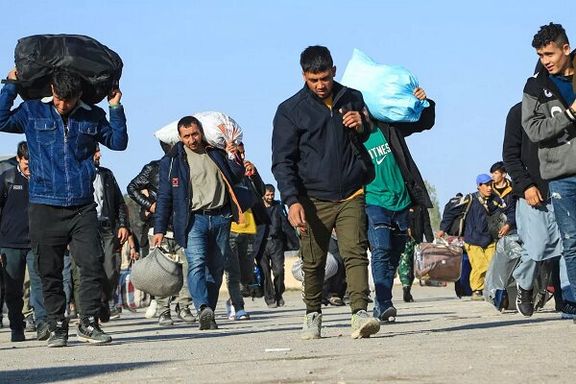
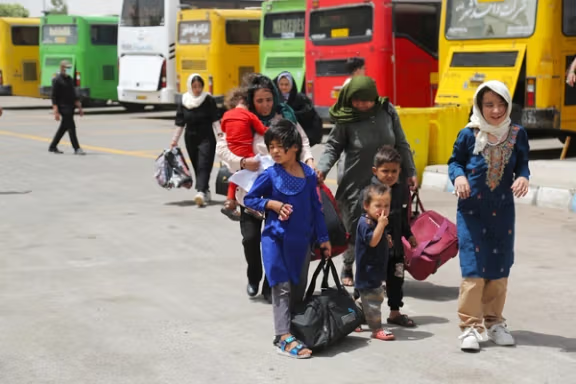
Iran’s economy is reeling from an acute labor shortage following the mass deportation of undocumented Afghan migrants, with key industries such as construction and agriculture struggling to function.
For decades, Afghans have formed the backbone of Iran’s low-wage workforce, filling jobs few Iranians were willing to take.
Their sudden absence now threatens both growth and jobs.
Conservative economist Mohammad-Hossein Mesbah called the push to send Afghans home “economic suicide.”
“Abbasabad industrial town [south of Tehran] was almost entirely closed today,” he posted on X. “Why? Shortage of labor. Job ads everywhere … Not a single worker to be found.”
From open borders to expulsions
Before the Taliban’s return to power in 2021, the Afghan population in Iran rarely exceeded two million, including about 780,000 with official refugee status. Under former President Ebrahim Raisi’s “open borders” policy, that number surged to more than seven million.
President Masoud Pezeshkian has since reversed course under public pressure.
Officials say more than one million migrants have left in the past 100 days, though an estimated six million remain—four million without legal status.
The government has vowed to enforce labor laws, including fines of around $20 per day for undocumented workers, doubling for repeat offenses. Yet enforcement remains patchy in sectors long dependent on informal labor.
Iran has sent back more than a million Afghans to Afghanistan in the past few months
Afghans’ role in the Iranian workforce
According to the Ministry of Cooperatives, Labor, and Social Welfare, 433,000 registered Afghan workers were active as of June 2025—roughly 2 percent of the total labor force.
More than half worked in construction, while others were employed in industry (19 percent), agriculture (11 percent), and mining (less than 1 percent).
A Chamber of Commerce study noted that Afghans, once concentrated in unskilled jobs, had increasingly moved into skilled and technical roles.
Their disappearance is now raising alarms about productivity and output across the economy.
Industry and construction hit hardest
The owner of an industrial workshop in Boumehen, near Tehran, told Shargh newspaper that even legally employed Afghans have left in fear. “We still haven’t found replacements, and nobody responds to our job ads,” he said.
Construction has been hit hardest.
In 2024, estimates suggested that Afghans made up three-quarters of Iran’s 1.5 million construction workers, and nearly half of those in Tehran.
With deportations underway, projects have stalled, and labor costs have jumped by 30–50 percent. The spike is expected to push housing costs even further out of reach.
Rising costs for food and services
Agriculture has also been disrupted. Farmers report delays in harvesting summer fruits and other perishable produce, including pistachios and saffron—two of Iran’s top non-oil exports.
Higher labor costs threaten to drive up food prices at a time when inflation is already high.
Urban services are showing strain as well.
In Tehran, the deportation of hundreds of Afghan street cleaners employed by municipal contractors has left piles of garbage and recyclables in some neighborhoods. Overflowing trash has become a visible sign of how deeply the deportations are reshaping daily life.
Some contractors have lost up to 80 percent of their workforce, according to city official Naser Amani.
Iran hanged a man in public on Tuesday after he and his wife were convicted of murdering a mother and her three children during a robbery in October 2024, judiciary's outlet Mizan reported.
“One of the perpetrators of the brutal murder of four members of a family in Beyram, in Fars province, was hanged in public on Tuesday,” Mizan said.
Earlier in February this year, Iranian authorities hanged a man from a bridge in the northeastern city of Esfarayen, in the country’s first public execution of the year.
Iran remains one of the few countries to conduct public executions, a practice widely condemned by human rights groups.
Public hangings were halted in 2021 due to COVID-19 restrictions but resumed in 2022. That year, two people were hanged in public, increasing to seven in 2023 and four in 2024, according to Oslo-based rights group Iran Human Rights.
Iran has executed 800 people in less than eight months since the start of the year, including 30 political prisoners, according to Norway-based rights group Hengaw reported on Monday.
In June, Amnesty International warned that following the Iran-Israel conflict, Iranian authorities have called for expedited trials and executions, raising concerns over arbitrary use of the death penalty.
Last year, at least 975 people were executed in Iran, marking a 17% increase from the 834 executions recorded the previous year.
A fierce battle has erupted inside Iran’s political establishment over the country’s future, with moderates urging sweeping reforms and hardliners branding their proposals a thinly veiled bid for regime change.
The dispute was set off on August 15 when former foreign minister Mohammad Javad Zarif published an essay in Foreign Policy titled “The Time for a Paradigm Shift Is Now.”
Zarif urged Iran to embrace “a new approach rooted in domestic reform,” warning that “warmongers benefit from closing every window to democracy.”
He called for a shift to a “possibilities paradigm” based on negotiation rather than confrontation.
Hardliners reacted with fury.
‘Delusional’
Outlets close to the Supreme Leader and the Revolutionary Guards — including Kayhan, Javan, and Vatan Emrooz — denounced the proposals as treasonous, delusional, and "capitulation" to the West.
Zarif was labeled an “anti-resistance liberal” who welcomed US and Israeli aggression as “blessings in disguise.”
Hardline commentator Abdollah Ganji accused moderates of “prioritizing personal power over national interests,” while Kayhan’s chief and supreme leader appointee Hossein Shariatmadari charged they were “ignoring global power dynamics.”
The clash comes as economic strain, political discontent, and renewed external pressure after the war with Israel sharpen the stakes for both camps.
‘Will of the people’
In recent weeks, former prime minister Mir-Hossein Mousavi and allies have issued open letters demanding democracy, while the Reform Front — an umbrella group of moderate and reformist figures — called for measures including suspension of uranium enrichment.
Former president Hassan Rouhani has also weighed in, advocating a “national strategy based on the will of the people.”
Beyond politicians, 180 economists urged a reordering of “Iran’s economic and political paradigms,” and 78 former diplomats pressed for a foreign policy more in tune with public sentiment.
The apparently concerted effort has been met by increasingly harsh reactions from the opposite camp.
In parliament, ultraconservatives such as Amir Hossein Sabeti and Hamid Rasai insisted the Islamic Republic must rely on resistance, not diplomacy, to survive.
Ganji also went after Rouhani personally, reminding readers that he once called for executing monarchy-era army officers in 1979, and warning he could “ultimately betray the revolution” like some of the Prophet’s disciples.
The battle is likely to intensify as pressure mounts, with the looming prospect of UN sanctions snapping back into place, the shadow of another war with Israel, and growing public frustration at home.
But as the reformist outlet Rouydad24 concluded, the exchanges have left “conservatives enraged, reformists uncertain, and the idea of national reconciliation in a state of lull.”
Iran’s capital and several provinces will see a full-day closure of government offices due to a worsening electricity crisis, officials said Monday.
The Tehran governor’s office confirmed all provincial offices will close on Saturday, August 23, as part of energy conservation measures.
The Tehran Electricity Distribution Company also said power would be cut to 100 high-consumption government offices. Provinces including Kerman and North Khorasan declared they would shut down on the same day.
Iranian media reported that the shortages are crippling industrial production and disrupting communications and internet services.
Industry at a standstill
“Units operating three shifts have lost nearly half their shifts entirely," Iran's trade chamber chief Arman Khaleghi told ISNA. "Overall, industries have lost 30 to 60 percent of their production capacity solely due to power shortages."
Khaleghi urged officials to adopt policies of engagement to ease sanctions pressure.
“The country must either engage with the world and leverage regional and international opportunities, or continue oscillating between selling resources to neighbors and importing from them.
This path is neither sustainable nor befitting Iran's economy,” he said.
'Expect internet outages'
The crisis has also taken a toll on daily life.
Dozens of citizens have reported internet disruptions, outages, and slowdowns in recent weeks, compounding the strain from inflation, unemployment, and shortages of power and water.
“We should expect that in the near future, just as we have daily power outages, we’ll also face three-hour daily internet outages,” warned Alireza Rafiei, head of mobile operator Irancell.
He said electricity shortages have rendered backup batteries ineffective, leading to frequent service breakdowns.
“Batteries aren't a viable solution for recurring power cuts, and with such frequent outages, we often can't recharge them. Two hours of daily outages equate to 2 percent of sites being offline 24/7, causing significant dissatisfaction,” Rafiei added.
Sanctions, corruption, and economic mismanagement have deepened the crisis, with Iran’s rial losing more than 90 percent of its value since U.S. sanctions were reimposed in 2018.
A court in Tehran has sentenced women’s rights defender Hasti Amiri to three years in prison on charges that include propaganda against the state and appearing unveiled in public, she said in a post on Instagram.
Amiri said a Revolutionary Court in Tehran sentenced her to two years in prison and a 500-million rial ($562) fine for “spreading falsehoods.”
She received an additional one year for “propaganda against the state” and a 30.3-million rial ($37) fine for appearing without a hijab in public.
“When simply opposing the death penalty is considered propaganda against the state, then execution itself is a political tool of intimidation,” Amiri wrote.
Amiri, a graduate law student at Tehran’s Allameh Tabataba'i University and a campaigner for students’ rights, previously served seven months of a one-year prison sentence in 2022 for her advocacy against the death penalty and for women’s rights in Iran.
“Speaking about the situation of prisoners and Evin prison has also been considered spreading falsehoods," she added in her post.
The court also imposed additional punishments, including a two-year ban on leaving the country and joining political or social groups.
Reflecting on the ruling, Amiri said her struggle is about standing up for ideals, supporting fellow prisoners, and resisting executions.
"At the end of the day, a person should know how many steps they have taken… With the hope that one day we burn all the gallows and execution scaffolds,” she wrote.
Amiri's sentence comes amid a broader clampdown, with student activist Khashayar Sefidi last year receiving a one-year prison term for propaganda against the state after opposing the death sentence of dissident rapper Toomaj Salehi.
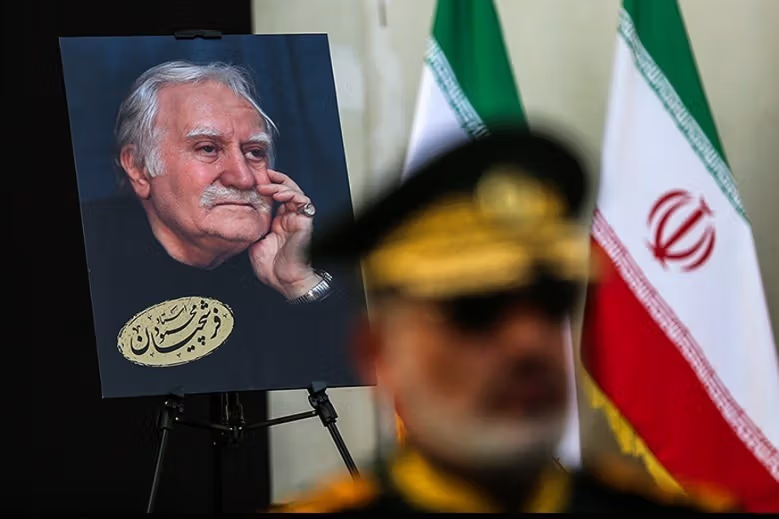
The state funeral of renowned miniature artist and "national treasure" Mahmoud Farshchian drew large crowds in Isfahan on Monday, reigniting heated debates on Persian social media over the notion of “state-affiliated artists.”
Farshchian, 95, passed away on August 9 in Englewood Cliffs, New Jersey, where he had lived since 1983. His body was returned to his hometown for burial beside the poet Saeb Tabrizi, in accordance with his wishes.
At the funeral, mourners filled the streets as Farshchian’s coffin was carried from the Conservatory of Fine Arts. Culture Minister Seyyed Abbas Salehi praised him as both a “sage of artists” and a creative genius who gave “a special color and flavor to Iranian art.” President Masoud Pezeshkian also issued condolences, underscoring his stature as a national figure.
The tributes highlighted Farshchian’s towering legacy, even as questions over his relationship with the Islamic Republic continue to spark controversy online.
Asr-e Ashura (Evening of Ashura) by Mahmoud Farshchian
Public reactions
On social media, responses ranged from praise to condemnation.
“He held the hands of those from whose hand the blood of the country’s youth flowed,” one post on X read. “The people’s historical memory never fades. We will neither forgive nor forget.”
“Without a doubt, the Islamic Republic used him for its propaganda, and sadly, he complied and showed no resistance,” another user wrote.
Others defended him: “Farshchian has painted several panels from the Shahnameh, each more beautiful than the other. His beliefs are his own. We don’t have the right to question his art even if we assume he was a government-affiliated artist. Leonardo da Vinci and Michelangelo were also court artists, serving the monarchy and the Christian Church.”
Panel depicting a scene from Shahnameh, Iran's national epic
Themes in Farshchian’s work
His miniatures often explore Shiite traditions, while others interpret Persian literature, including the national epic Shahnameh. He also designed new metal lattice enclosures for Shiite shrines in Mashhad and Karbala.
Farshchian’s works are on permanent display at a museum named after him in Tehran’s Saadabad Palace.
Iran's polarized cultural landscape
Collaboration or opposition to the state carries heavy personal and professional consequences in Iran.
Artists who work with state entities, like television, are often labeled “state-affiliated” by dissidents and exiled communities, while appearing with political leaders can spark backlash.
A notable case is singer Alireza Eftekhari, whose embrace of the populist President Mahmoud Ahmadinejad during a concert went viral and provoked outrage among critics, resulting in his isolation in the artistic community and loss of his fans.
Conversely, artists challenging the official narrative risk being blacklisted, banned from work, or imprisoned.
One prominent example was the legendary traditional vocalist Mohammad Reza Shajarian.
He performed a song urging security forces to lay down their weapons during the widespread anti-government protests of 2009. This act of defiance drew the ire of authorities.
The state media banned the broadcast of Shajarian’s songs, image, and his name. Even his iconic Ramadan prayer performance—beloved among religious audiences—was permanently removed from radio and television broadcasts, and he was barred from concerts or album releases.
"Curse the Islamic Republic, which always pits the people against each other … Artists like Farshchian or Shajarian—whatever they may have been—were ultimately artists. The Islamic Republic has even violated the very concept of art and the artist," a post on X stated.