Small bomb explodes outside state building west of Tehran
File photo of Robat Karim municipality
A small bomb detonated outside the municipality building of Robat Karim in Tehran province on Tuesday evening, causing a loud blast but no injuries or significant damage, according to the county governor.
Authorities are investigating the explosion that occurred outside the municipality headquarters, Reza Aghaalikhani told Revolutionary Guards-affiliated Tasnim News, adding that the incident caused no casualties or serious material losses.
He said the device was “probably a sound bomb,” a type of low-impact explosive used mainly to create noise rather than destruction.
The official added that the blast triggered a loud shockwave that prompted the immediate deployment of security and emergency teams to the scene.
Technical and forensic examinations were underway to determine the type of device used and whether any group or individual was behind the explosion, according to the local governor.
No arrests or claims of responsibility have been reported so far. However, similar incidents have happened before mainly as acts of protest against the Islamic Republic.
Last week, Iran's Supreme Court upheld the death sentence of Manouchehr Fallah, a 42-year-old laborer from northern Iran for allegedly detonating a small sound bomb outside a local courthouse in Gilan province.
The explosion caused minor damage estimated at 150 million Iranian rials or about $138 to a metal door and the building's stone facade. No injuries were reported, and public services were not disrupted.
Authorities have charged him with "moharebeh" or war against God, a charge that carries the death penalty.
Iran’s presidential office said a government-affiliated body is reviewing requests from expatriates described as members of the country’s “benign opposition” who have expressed interest in returning to Iran.
Alireza Khamsian, communications and media adviser to First Vice President Mohammad Reza Aref, told the official news agency ISNA on Monday that the move aligns with President Masoud Pezeshkian’s policy of “national accord,” aimed at bridging divides inside and outside the country.
“Some Iranians abroad, who in recent years have expressed attachment to their homeland and even supported the nation during the recent 12-day war with Israel, have asked to return,” Khamsian said. “Their requests are being reviewed by a competent authority.” He did not name the institution involved.
Khamsian referred to these Iranians as the “so-called benign opposition,” distinguishing them from more hardline anti-government activists.
He said the administration seeks to create conditions for their reintegration, adding that “a beautiful sense of unity” had emerged between citizens inside and outside Iran during the recent conflict.
The comments mark one of the first public indications that the Pezeshkian administration is exploring ways to re-engage with parts of the diaspora historically viewed with suspicion by authorities. Large numbers of Iranians left the country in waves after the 1979 revolution and in the following decades.
Khamsian added that the government is also working to facilitate the return of artists, athletes, and professionals who wish to invest or resume work in Iran.
“Many of these people have a deep affection for their homeland,” he said, citing coordination between the Vice President’s Office, the Ministry of Culture and Islamic Guidance, and other state bodies.
He emphasized that the government’s broader goal was to transform the concept of “national accord” into a social and political discourse, saying the administration “acts in coordination with other branches of power to reduce tension” and “avoid placing unnecessary costs on the system.”
The Pezeshkian government has presented itself as a reform-minded administration seeking pragmatic engagement both at home and abroad. But any potential return of exiled Iranians, especially those with past political activity, would depend on decisions by other state institutions.
Mourners in the western Iranian city of Aligoudarz chanted slogans against Supreme Leader Ali Khamenei on Monday during the funeral of Omid Sarlak, a young man found dead hours after posting a video of himself burning the leader’s photo.
Videos received by Iran International show large crowds attending Sarlak’s burial in Lorestan province, chanting “Death to Khamenei” and “Death to the dictator.”
Others cried, “We will kill whoever killed my brother,” and “This flower that has withered is a gift to the homeland.”
Several mourners recited verses from the Shahnameh -- the Persian national epic written by the 10th-century poet Ferdowsi, which celebrates heroism and resistance to tyranny -- comparing Sarlak’s courage to that of ancient Persian heroes.
Sarlak’s father appeared in a widely shared video at the site where his son’s body was found, saying, “They killed my champion here.” Another man in the clip can be heard saying Sarlak was “surrounded and shot.”
Mourners carry the body of Omid Sarlak during his funeral in Aligoudarz on November 3, 2025.
The funeral followed comments from Ali Asadollahi, the police commander of Aligoudarz, who said on Sunday that the body of a young man had been discovered inside a car near Arsalan Goodarzi Stadium, adding that he “took his own life with a handgun.”
Authorities did not identify the victim, but social media users soon named him as Sarlak and accused officials of pressuring the family to endorse the suicide narrative.
A final act of defiance
Before his death, Sarlak had posted videos on Instagram showing a burning photo of Khamenei with an archival recording of Mohammad Reza Shah Pahlavi’s voice playing over it.
In another story tagged “Death to Khamenei,” he wrote: “How long should we endure humiliation, poverty, and being ridden over? This is the moment to show yourself, young people. These clerics are nothing but a stream for Iran’s youth to cross.”
Activists described Sarlak as a patriotic youth and said he was “killed under torture by Iran’s Intelligence Ministry” hours after sharing the video.
Another user wrote he had been “arrested by the IRGC Intelligence Organization and his bruised, tortured body was later returned to his family.”
Iran International cannot independently verify those remarks. Judicial and security authorities have not provided clarification on the circumstances of his death, and the lack of transparency has intensified public skepticism.
In recent years, officials have repeatedly attributed suspicious deaths to suicide -- a statement widely doubted by the public, who often use the phrase “he was suicided” to express disbelief.
One such case was that of former political prisoner Sara Tabrizi, found dead at her parents’ home last year after pressure from security forces.
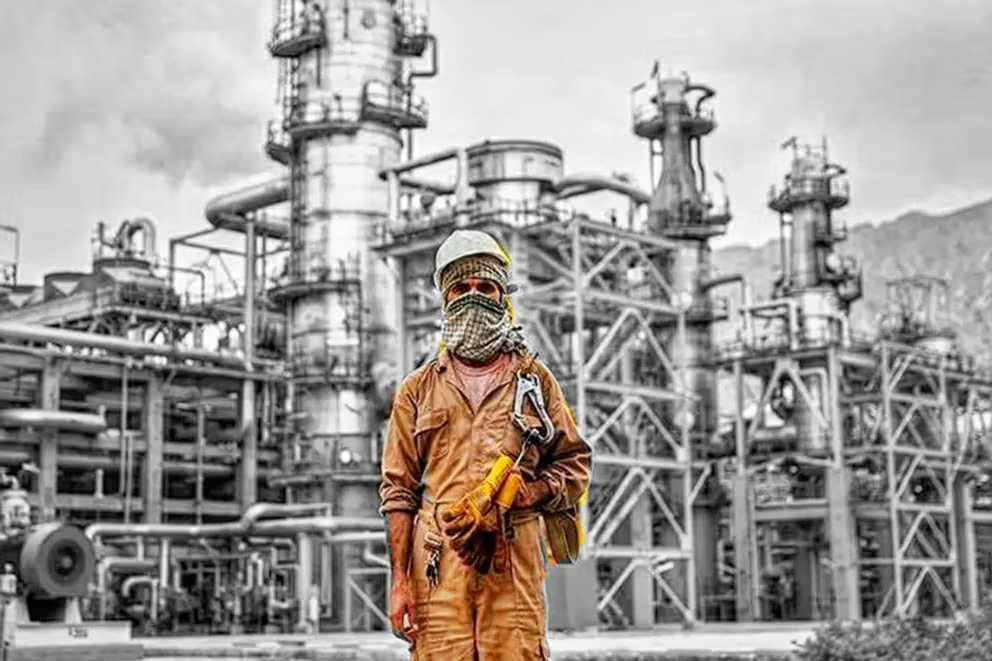
Oil industry contract workers gathered outside Iran’s presidential office in Tehran on Saturday to protest what they said were unfulfilled government promises to eliminate private contractors and secure direct employment with state energy companies.
Workers, who had traveled from oil-producing provinces to the capital, said the administration of President Masoud Pezeshkian had failed to deliver on its commitments to improve their job status and pay. Protesters chanted slogans including, “Enough with the promises – our tables are empty,” as they called for the government to honor pledges made earlier this year.
They cited Pezeshkian’s promises to abolish intermediary contracting firms, convert contract positions into permanent ones, and implement an equal pay system for all workers across the oil ministry’s subsidiaries. “These promises remain only on paper,” protesters said, adding that the result has been “continued discrimination and job insecurity for thousands of experienced workers.”
Workers demand direct employment
The demonstrators urged the government to sign direct contracts with oil workers rather than outsourcing them through third-party companies. They said contract employees, who perform the industry’s core operational work, have been excluded from key benefits and protections enjoyed by officially contracted staff. “The main burden of the oil industry lies on our shoulders, but we are denied fair pay and job security,” they said.
Organizers warned that if their demands are not met by the end of November 2025, they will expand their protests, holding weekly demonstrations outside the presidential office from December onward. They vowed to continue until the government delivers on its pledges to standardize pay and eliminate intermediary contractors.
Broader labor unrest
The Tehran protest followed other recent labor actions across Iran’s energy and industrial sectors. Electricity distribution workers from several provinces, including Ahvaz, joined the oil demonstrators to demand improved job conditions.
Separately, petrochemical workers in Chovar, Ilam province, staged their second protest in a week over low wages and what they described as management indifference to their living conditions. In September, steel workers at the National Iranian Steel Industrial Group in Ahvaz also held strikes over unpaid wages and job insecurity.
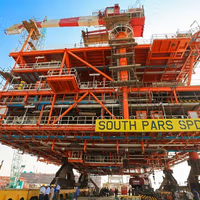
Workers in the Pars Special Economic Energy Zone in Assaluyeh have likewise pressed for fair pay and formal employment status, showing the persistence of labor unrest across Iran’s key energy hubs.
Iran’s Supreme Court has overturned death sentences issued against five Kurdish men from Boukan who were arrested during the Woman, Life, Freedom protests in 2022, ordering a retrial in a local revolutionary court, according to rights organizations.
Iran’s Supreme Court annulled the death sentences of Rezgar Beigzadeh Babamiri, Pejman Soltani, Ali (Soran) Ghasemi, Kaveh Salehi, and Tayfur Salimi Babamiri, five Kurdish citizens from Boukan detained during the 2022 anti-government protests.
The Kurdistan Human Rights Network (KHRN) reported Saturday that Branch 39 of the Supreme Court reviewed the appeal filed by the defendants’ lawyers and referred the case back to the Mahabad Revolutionary Court for retrial.
In July, the Urmia Revolutionary Court had sentenced Babamiri and Ghasemi to three death sentences each, Soltani and Salehi to two each, and Salimi to one. They were charged with baghi (armed rebellion), moharebeh (enmity against God), and forming a rebel group.
Attorney Atman Mazin, representing Babamiri, said his client and 13 others were arrested after protests in Boukan and held in “very harsh conditions.” Nine others in the same case received prison and fine sentences.
Salimi was released in September 2023 after 18 months of pretrial detention and has since left Iran, while the other four remain imprisoned in Urmia.
Mazin noted that the trial violated due process — defendants were denied access to family, lawyers, and medical care, and some hearings were held without all accused present. He added that the alleged crimes were not legally proven.
According to his lawyer, the Supreme Court cited procedural flaws and the lack of local jurisdiction as grounds for overturning the sentences, sending the case to a new competent court.
Mazin expressed hope that “the new prosecutor and court will uphold the law and ensure fair proceedings.”
He added that last week a criminal court in West Azerbaijan acquitted the same defendants of “terrorism financing” through medical aid distribution, though appeals on other sentences are still pending.
Amnesty International warned on October 16 that more than 1,000 people have been executed in Iran so far in 2025, many following unfair trials aimed at silencing dissent.
The rights group urged UN member states to take immediate action, calling the executions “a shocking spree” averaging four per day.
Iranian President Masoud Pezeshkian said on Thursday there is no doubt that gasoline prices must rise, signaling that long-anticipated fuel reforms are moving closer despite fears of renewed public unrest.
Speaking during a visit to West Azarbaijan province, Pezeshkian acknowledged that raising fuel prices is unavoidable to address Iran’s worsening energy shortages but cautioned that any decision would require “careful planning” to avoid deepening economic hardship.
“There is no question that gasoline must become more expensive,” he said, according to state media. “But it is not a simple decision. We cannot act overnight or create more difficulties for people.”
His comments came amid intensifying debate over Tehran’s plans to introduce a new pricing system aimed at curbing soaring fuel consumption and smuggling.
Over the past two weeks, Iranian media have reported that the government is reviewing several reform scenarios, including multiple pricing tiers and possible changes to fuel quotas.
Last week, Khaneh Eghtesad published what it said was a leaked cabinet decree outlining a roadmap for “gradual correction” of gasoline prices. The government initially denied the report but later confirmed that the issue was under study by cabinet working groups.
Cabinet secretary Kamal Taghavi-Nejad said this week that fuel reform had been discussed but “no final decision” had been taken. A lawmaker, Amirhossein Sabeti, said the debate over introducing three fuel price tiers had become serious in parliament.
Energy officials say domestic gasoline consumption has surged well beyond refining capacity, forcing costly imports and draining subsidies that analysts estimate at more than $30 billion annually.
Pezeshkian has pledged to overhaul Iran’s energy subsidy system, arguing that maintaining the current artificially low prices is unsustainable. “Even water costs more than gasoline in Iran,” he said earlier this week.
The last major fuel price hike in November 2019 sparked nationwide protests that were met with a violent crackdown. Rights groups and Reuters reported that at least 1,500 people were killed.
Officials have since stressed that any future reform would be gradual and paired with compensation measures for low-income households. The administration insists it will not repeat the sudden price shock of 2019.
Economists warn that aligning prices with real production costs could sharply raise inflation but may also help reduce smuggling and waste. The government is expected to unveil its energy reform framework before submitting next year’s budget in December.