Winners Of Iran Deal Are Khamenei And Putin - US Senator

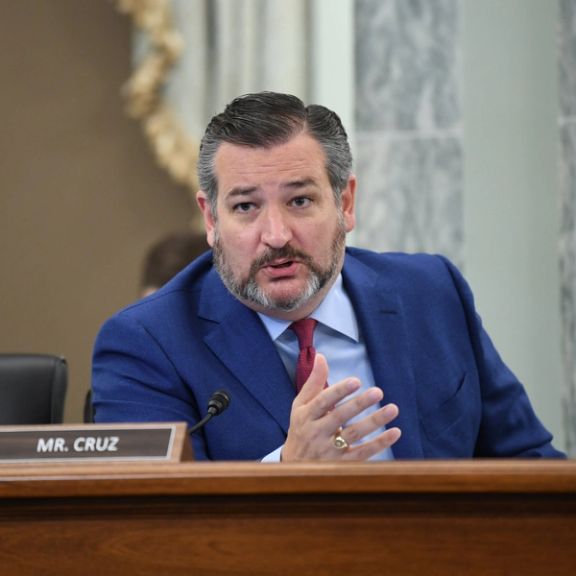
US Republican Senator Ted Cruz says Russian President Vladimir Putin and Supreme Leader Ali Khamenei are the major winners of the renewed deal with Iran.

US Republican Senator Ted Cruz says Russian President Vladimir Putin and Supreme Leader Ali Khamenei are the major winners of the renewed deal with Iran.
He emphasized that the Islamic Republic is “the same regime that chants ‘Death to America’, has killed hundreds of Americans, and conducts terrorism around the globe”.
He also shared a video of his remarks last week, saying, “In Vienna, Biden diplomats have been furiously bending over backwards to surrender to the Ayatollah (referring to Khamenei), the same Ayatollah who is a theocratic despot who regularly chants ‘Death to America’ and ‘Death to Israel’”.
“This administration wants nothing more than to give them hundreds of billions of dollars in sanctions relief, money that will inevitably be used to -- number one -- murder Americans… and number two – to develop nuclear weapons”, he said.
Iran “may be only weeks away from being able to develop a nuclear weapon”, Cruz warned, noting that “our enemies are stronger because of the weakness of this administration.
In a statement from Senate Republicans released on Monday, 49 Senators told the Biden Administration they oppose a revived deal as it can reduce limits on Tehran’s nuclear program.

Washington could now seek an “alternative” to the 2015 Iran nuclear deal, the State Department spokesman Ned Price said Monday.
With 11-month talks in Vienna struggling to reach agreement on reviving the 2015 deal, a complication was added March 5 when Russia foreign minister Sergei Lavrov announced Moscow wanted assurances that any sanctions over Ukraine would not affect its economic and other relations with Iran.
Price said that while “we are not at that point, and…hope not to get there,” Washington was open to “engage bilaterally [with Iran] on these pressing and urgent matters.”
Russian Foreign Minister Sergei Lavrov meeting with visiting Iranian foreign minister on Tuesday said US suggestions that Moscow was blocking efforts to revive the Iran nuclear deal were untrue, following talks with his Iranian counterpart Hossein Amira-Adollahian in Moscow.
Lavrov made a surprising statement saying Russia had received written assurances from Washington that sanctions against Moscow over Ukraine would not hinder cooperation within the framework of the deal, which lifted sanctions on Tehran in return for curbs on its nuclear program.
Washington has not mentioned any assurance granted to Moscow, whether just to facilitate the implementation of a revived JCPOA or otherwise.
Rising tensions with talks paused
Tensions in the Middle East have been raised with the pausing of the Vienna JCPOA talks, leaving US ‘maximum pressure’ sanctions on Iran continuing and the expanded Iran nuclear program running.
Israel and the United Arab Emirates, both lukewarm over the US approach to the Ukraine crisis, have made a joint approach to Washington seeking greater military aid.
Iran, which fired missiles Sunday at an alleged Israeli base in Erbil, northern Iraq, Sunday in retaliation for an Israeli airstrike March 7 in Damascus that killed two Iranian soldiers. Tehran has also paused talks with Saudi Arabia after the Saudis announced the beheadings of 81 people, around half of whom the United Nations High Commissioner for Human Rights Michelle Bachelet said were Shia who had taken part in political protests.
Greater impunity
Price said Monday that the Iranian missile strike was “clear violations of Iraq’s sovereignty” and a taste of how Tehran might act “with far greater impunity if it were not verifiably and permanently constrained from obtaining a nuclear weapon.”
Noting that the Vienna talks over JCPOA revival had involved “complex negotiations” that could now be “something close to the finish line,” Price stressed there were still “outstanding issues… the hardest issues” left to resolve.
Added to these, Price said that there were “now some external factors that are weighing on where we are” –a reference to Lavrov’s demand that any sanctions over Ukraine should not affect JCPOA implementation, in which Russia has been expected to play a central role, especially in shipping out Iranian enriched uranium in excess of JCPOA limits.
JCPOA ‘best vehicle’
“You may have seen the statement from the E3, our French, our German, our British partners, that came out over the weekend,” Price explained. “It said, ‘Nobody should seek to exploit JCPOA negotiations to obtain assurances that are separate to the JCPOA.’ We would certainly endorse that statement.”
In stressing that Washington’s preference was for agreement in Vienna as “the best vehicle to achieve our policy objectives,” Price echoed the statement from Antony Blinken March 9 that Washington and Moscow had a common interest in limiting the Iranian nuclear program through reviving the JCPOA.
Price floating the notion of a bilateral US-Iran agreement might be an attempt to upset Moscow or disorientate Tehran. But the spokesman gave no indication as to why bilateral talks with Iran outside the Vienna process might suddenly overcome the outstanding issues that negotiators have failed to resolve in 11 months.
Iran’s foreign minister Hossein Amir-Abdollahian has arrived in Moscow to hold talks with Russian officials, on Iran's nuclear issue and the Ukraine crisis.
At the start of talks on Tuesday Amir-Abdollahian expressed hopes his visit would lead to Russian support for a "good, stable and strong nuclear deal," Iran's semi-official ISNA news agency reported. Russian Foreign Minister Sergei Lavrov told his Iranian counterpart that agreement on the revival of the 2015 nuclear deal known as JCPOA, was in the finishing straight.
Amir-Abdollahian’s visit was announced on Monday, days after negotiation in Vienna came to a halt after Russia made a last-minute demand. On March 5, Lavrov said that along with an agreement in Vienna Moscow should get written guarantees from Washington that sanctions imposed for the invasion fo Ukraine will not impact its relations with Tehran.
The United States and Europe have rejected the Russian demand, saying that a nuclear agreement with Iran is not related to the Ukraine crisis.
The official IRNA news website quoted the foreign minister as saying that he will also discuss the Ukraine crisis with Russian officials. On Monday, Ukrainian foreign minister Dmytro Kuleba tweeted that he has spoken with his Iranian counterpart and asked him to pass on a message to Moscow: “Russia must stop bombing civilians, commit to the ceasefire, and with draw from Ukraine.”

Forty-nine US Republican Senators have told the Biden Administration they oppose a revived Iran nuclear deal as it can reduce limits on Tehran’s nuclear program.
Recent reports, claiming to be based on insider information, have indicted that the Biden Administration plans to lift non-nuclear sanctions in the Vienna talks aimed at reviving the 2015 Joint Comprehensive Plan of Actions, or JCPOA. Sanctions said to be lifted include terrorism related designations, possibly including entities and individuals affiliated with Iran’s Revolutionary Guard.
“According to press reports, the Biden Administration may soon conclude an agreement with Iran to provide substantial sanctions relief in exchange for merely short-term limitations on Iran’s nuclear program. By every indication, the Biden Administration appears to have given away the store,” a statement from Senate Republicans released on Monday said.
Republicans have been warning the Biden Administration from the time it assumed office not to seek to revive the JCPOA, which they regard as a weak agreement that would not stop Iran from producing nuclear weapons in the future and does not address other threats the Islamic Republic poses to regional countries.
“The administration has thus far refused to commit to submit a new Iran deal to the Senate for ratification as a treaty, as per its constitutional obligation, or for review under statutory requirements that passed on a bipartisan basis in response to the 2015 deal. Additionally, despite earlier promises to the contrary, the administration has failed to adequately consult with Congress,” the statement said.
The issue that might make an agreement in Vienna more controversial is what it would allow Iran to do with advances it has made in the past two years, including deploying more sophisticated uranium enrichment machines and the highly purified fissile material it has stockpiled. Some reports say that Tehran will be allowed to keep the machines called centrifuges, which would allow for a quick resumption of enrichment.
It is also expected that an agreement will require Iran to ship the highly enriched uranium to Russia, which on March 5 made demands to be exempted from Ukraine sanctions in its dealings with Tehran. The sudden request forced diplomats to freeze the Vienna negotiations indefinitely. The United States and its European allies have refused the Russian demand.
These are new elements beyond the Obama-era deal concluded 7 years ago and critics argue that it is could be considered a new agreement, which would need Congressional review of some sort.
“Republicans have made it clear: We would be willing and eager to support an Iran policy that completely blocks Iran’s path to a nuclear weapons capability, constrains Iran’s ballistic missile program, and confronts Iran’s support for terrorism. But if the administration agrees to a deal that fails to achieve these objectives or makes achieving them more difficult, Republicans will do everything in our power to reverse it,” the Senate Republicans said.
Some Democratic lawmakers have recently joined the opposition to the Biden Administration’s drive to reach a new agreement with Iran. The Russian invasion of Ukraine seems to have raised more concern about the Vienna talks in which Moscow has played an important mediating role.

Iran will stay in the Vienna nuclear talks until its demands are met and a "strong agreement" is reached, Iran's top security official Ali Shamkhani said Monday.
Talks to revive the 2015 Iran nuclear pact face the prospect of collapse after a last-minute Russian demand forced world powers to pause negotiations for an undetermined time despite having a largely completed text.
Russian foreign minister Sergei Lavrov demanded on March 5 that his country’s economic and other ties with Iran to be exempted from Western sanction related to the invasion of Ukraine. The United States and its European allies have rejected the demand.
Iran, which blames the United States and NATO for the Ukraine invasion, has not criticized Moscow’s last-minute demand.
"We will remain in the Vienna talks until our legal and logical demands are met and a strong agreement is reached," Shamkhani, secretary of the Supreme National Security Council, which makes the decisions in the Vienna talks, said in a tweet.
Tensions have risen since Iran attacked Iraq's northern city of Erbil on Sunday with a dozen ballistic missiles in an unprecedented assault on the capital of the autonomous Iraqi Kurdish region that appeared to target a new building for the US consulate in the city.

Iranian Foreign Minister Hossein Amir-Abdollahian is scheduled to travel to the Russian capital Moscow on Tuesday, the ministry spokesman announced on Monday.
In his weekly media briefing on Monday, Saeed Khatibzadeh announced the visit, repeating that the nuclear talks hinge on decisions by Washington.
“We are now waiting for the American response”, he said, adding that “consultations continue at various levels, and the foreign ministers of the countries are in constant contact with each other, and the senior negotiators are also in touch with each other”.
After 11 months of negotiations in Vienna, talks to revive the 2015 nuclear agreement with Iran paused last week after Russia demanded exemptions from Ukraine sanction in its dealings with Iran.
Russian foreign minister Sergei Lavrov said on March 5 that Moscow was looking for guarantees that any sanctions against Russia over Ukraine would not affect “the regime of trade-economic and investment ties embedded in the Joint Comprehensive Plan of Action [the 2015 deal] on the Iranian nuclear program.”
Tehran, however, which has tacitly supported the Ukraine invasion, has not criticized Russia's demand.
Some media and politicians in Iran continue criticizing Russia for “obstructing” the nuclear talks in Vienna while hardline media defend Russia's aggression and tend to minimize the impact of Moscow's demand for exemption from Ukraine sanctions on Iran's nuclear deal with the West.