Israel Launches Strike Against Targets Around Syrian Capital
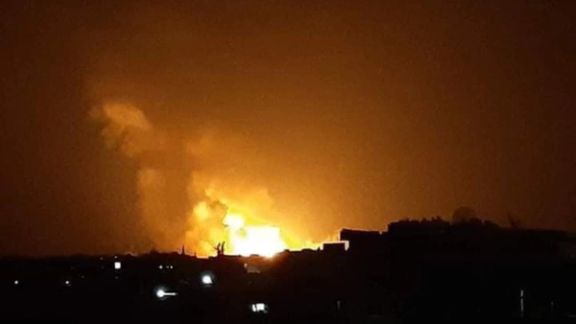
Israel launched its third strike against targets around the Syrian capital Damascus in the early hours of Wednesday, Syrian government media reported.

Israel launched its third strike against targets around the Syrian capital Damascus in the early hours of Wednesday, Syrian government media reported.
The strike was reportedly carried out with missiles launched from northern Israel, although the Israeli government rarely acknowledges such attacks.
Syrian state media said four soldiers were killed, three wounded, and some material damage inflicted. Israeli strikes usually target bases where there are Iranian or Iran-backed forces.
In early March, two Iranian Revolutionary Guard officers were killed in a similar attack that Tehran in a rare move acknowledged and vowed a severe response. Days later Iran fired ballistic missiles at the northern Kurdish city of Erbil, claiming it targeted a secret Israeli operations center there.
State media also claimed to have shot down most of the incoming missiles, a claim Israeli sources dismiss as rhetoric.
One of the attacks this month was a rare daytime strike near the town of Masyaf, which is believed to have an Iranian base hosting both IRGC forces and pro-Iran militias.
Iran has been involved in the Syrian civil war since 2011 in support of the Bashar al-Assad government. It has supplied tens of thousands of ground forces, mostly Afghan and other militias, that were key to the defeat of opposition forces.

US federal prosecutors say a New Jersey software developer lived a double life as a “sleeper agent” for Iran-backed militant group Hezbollah, and scouted terror targets in New York City.
Assistant US Attorney Sam Adelsberg said on Monday during the start of his trial that the 45-year-old kept up appearances as a “normal” law-abiding US citizen, while also gathering intelligence and researching targets including Rockefeller Center, Grand Central, all three New York-area airports and other high-volume locations as well as buildings in Boston, Washington DC and abroad in France, Turkey and the Czech Republic from 2000 to 2005.
“He posed as a regular guy” working as a software engineer... but by night he was “a terrorist and spy” he said, adding, “In reality, he was a sleeper agent for Hezbollah ready to strike”.
The attorney added that he moved to the United States in 2000 from Lebanon with a secret mission to apply for citizenship and plan a future attack on behalf of the militant group, designated a foreign terrorist organization, so Hezbollah “could kill Americans if Americans threatened Iran, Hezbollah's main ally”.
Saab -- a US citizen since 2008 -- was arrested by the feds in July 2019 and after being questioned during 11 sessions over several weeks with FBI agents he was charged with several counts, including support for a terrorist group, citizenship fraud, receiving military training from a terrorist group, and fraudulent marriage.
Saab's lawyer Marlon Kirton said his client had long cut ties with Hezbollah and ceased all Hezbollah-related activity and communication in 2005.

Videos circulating on social media show Iran is dispatching military units to the border area with Afghanistan following tensions with Taliban border guards.
A video published by Khabar Online website early on Tuesday shows the 88th Armored Division of Zahedan – part of the ground forces of the Army – is being deployed to the border.
The video shows several Iranian tanks and armored vehicles moving towards the Afghan border.
Some users also shared a video showing the evacuation of a parking lot at Dogharoon (Dowqarun) border customs, with someone saying in the video that area is being evacuated "because they said there was going to be a war tonight."
Some accounts in Afghanistan also posted a video of Iranian military helicopters stationed at the border.
In reaction to the videos, semi-official news agency ISNA said that some of these videos were not related to the Iranian army, adding that "the ground forces are [always] stationed and patrolling the eastern borders around the clock”.
On Monday, Iranian foreign ministry spokesman Saeed Khatibzadeh confirmed tensions between Iran and the Taliban on the Dogharoon border, saying that Tehran has informed Kabul about its concerns.
"We hope that the restraint by our border guards on the Iranian-Afghan border has not led to a misunderstanding of the other side... the repetition of these issues is a matter of serious concern," he added.
Following a “dispute” between Iranian and Afghan border guards on Saturday, the border crossing was temporarily shut down.
There have been some incidents at the border since the Taliban seized control in Afghanistan last year.

Iran has increased its military expenditure for the first time in four years to become the 14th largest military spender last year.
According to the latest report by Stockholm International Peace Research Institute (SIPRI) released on Monday, the Islamic Republic raised its military spending to $24.6 billion -- an annual increase of 11 percent -- and for the first time in two decades is among the top 15 countries in terms of the military budget.
The budget allocated for the country’s Revolutionary Guard, or IRGC, grew by 14 percent compared to 2020 and now accounts for 34 percent of Iran’s total military spending.
The estimated increase came despite continuing dire economic conditions caused by many years of sanctions and systematic corruption and is based on official figures in the budget that does not reflect the hidden costs, including funding militia groups across the region.
Iran’s budget is a hard-to-decipher document that often spreads allocations under obscure line items, especially for politically sensitive topics such as military and religious expenditures.
Global military spending continues to grow in 2021, topping $2 trillion for the first time as Russia beefed up its military capabilities ahead of its invasion of Ukraine.
Top five spenders were the United States, China, India, Britain, and Russia. The US accounted for 38 percent of world military spending last year, followed by China with 14 percent.
Iran's archenemy Israel also increased its military budget by 3.1 percent, to $24.3 billion, and is now ranked one stop lower than the Islamic Republic.

Over 100 Iranian state-owned and private websites were targeted by a cyberattack and their systems’ data were stolen, the government confirmed on Sunday.
Claiming responsibility for the attack, the hacking group "Uprising till Overthrow" sent pictures and videos to Iran International showing that about 50 domains of the Agriculture Ministry and its affiliated offices have been hacked.
A deputy director for the security of Iran’s information center, Meysam Maghsoudi Goudarzi, said late on Sunday that a security loophole in a software frequently used by governmental organizations made the large-scale cyberattack possible.
He said that the attack was “neutralized” in its early stages, noting that “The hackers obtained information from the websites but did not obtain the basic information of these government centers”.
Maghsoudi Goudarzi also claimed that no damage was done to the infrastructures of the organizations, adding that “This cyberattack was designed like a 'time bomb’ to attack more than 100 [online] services of the country at a certain time and date to disrupt their activities”.
He said the IPs used for the cyberattack belonged to the Netherlands, Britain and the United States, and that due legal action will be taken in the future.
In mid-March, the portal of the Ministry of Culture and Islamic Guidance (Ershad) and its affiliated websites were hit by a cyberattack.
Hackers posted on the website photos of leaders of the Mujahedin-e Khalq (MEK) opposition group, Maryam and Masoud Rajavi, as well as a photo of Supreme Leader Ali Khamenei with a large red X, drawn on his face.

The Russian embassy in Tehran has denied that Iranian networks help smuggle munitions and military hardware sourced from Iraq to Russia for the war in Ukraine.
The embassy said in a tweet on Sunday, “The information that appeared in some media about the supply of Iranian weapons to Russia is fake and does not correspond with reality”.
The Guardian had quoted Iranian-backed Iraqi militias and regional intelligence services on April 12 as saying that undercover networks were used in the past month to supply rocket-propelled grenades (RPGs), anti-tank missiles and Brazilian-designed rocket launcher systems to Russia.
The embassy rejected the report about 12 days later probably because reports have emerged saying that flights by Iranian military-affiliated planes to and from Russia have increased since the beginning of the Russian invasion of Ukraine on February 24.
The Iranian embassy in London also dismissed the Guardian article as “baseless storytelling”.
A source who helped organize the transport said the Iranian authorities had also donated an Iranian-made Bavar 373 missile system, similar to Russia’s S-300, to Moscow. Tehran also returned an S-300 to Russia, the source said.
Earlier in April, The Telegraph reported that Russia was running out of some weapons because critical parts were made in Ukraine, including Kh-55 nuclear capable cruise missiles that are also used by Iran and China.