Cost Of Baking Bread Doubles In Iran Amid Anti-Government Protests
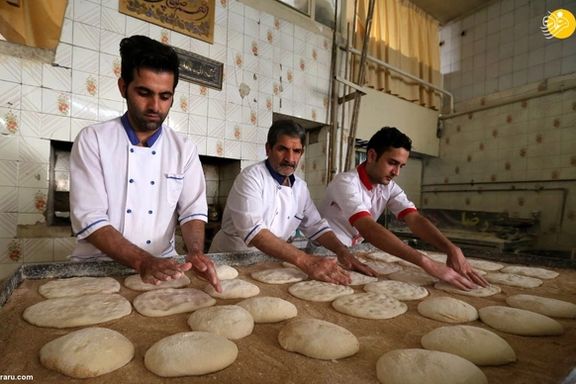
Amid nationwide antigovernment protests with no end in sight, officials have announced that the cost of baking bread has doubled in the country.

Amid nationwide antigovernment protests with no end in sight, officials have announced that the cost of baking bread has doubled in the country.
The head of bakeries union, Mohammad Soleimani, told ILNA Saturday that the costs of labor, raw materials including oil, and other additives increased significantly, but the price of basic bread did not go up accordingly.
He said that more and more people are replacing many other foodstuff with bread given food price inflation, adding that the increasing prices for pasta and grains have led to the rise in bread consumption.
In response to a question about long queues at bakeries, he said the prices of traditional breads have not increased contrary to other types, so the consumption of traditional bread has increased by 30 percent.
The administration of Ebrahim Raisi increased the price of flour 10-fold this year, but claimed that the price of items made from flour will not increase. The price hike was a result of a government decision to scrap the subsidy for imported wheat, flour and other essential items.
Annual food inflation has reached 100 percent in parts of Iran, according to the latest figures published by the Statistical Center of Iran. The overall nationwide point-to-point annual food inflation rate in June 2022 compared with the same period in 2021 was 87 percent, SCI reported in August, but in four provinces the rate reached almost 100 percent.

Two media outlets and a German research center have announced in a joint report that a German company is helping to censor the Internet in Iran.
According to these reports the Softqloud GmbH company in the city of Meerbusch, near Dusseldorf, is helping Iranian regime to run its intranet known as the national information network.
The research by Taz and Netzpolitik as well as Correctiv research center said that Softqloud GmbH is a branch of Arvancloud or Abr Arvan, an Iranian company which helps to disconnect the internet in Iran. It is not even clear if Softqloud has any other contracts in Germany or is simply a front company.
In an interview on Thursday, German Foreign Minister Annalena Baerbock called the case “very surprising” and said security officials would investigate the matter.
The German foreign minister said that if the allegations are true, it could have punitive consequences.
According to this joint research, Softqloud GmbH is one of the four digital connection gates that connect Iran to the global Internet.
This company has set up several data centers in Europe which can guarantee the operation of the intranet in Iran in case of internet shutdown by Iran’s government.
In the past years, Abr Arvan was criticized by many people on social networks due to signing an agreement with the Iranian government to censor the Internet.
The reported project is about the Iran Cloud project, which is intended to help build the national Intranet and further isolate the country from the global network. That would mean that Abr Arvan is involved in setting up internet censorship and surveillance in Iran.
However, Arvancloud has rejected its involvement in the censorship saying that “A cloud service provider is not able to play a role in censorship of the Internet, neither in Iran nor in any other part of the world.”
It further said that the German company was an “international partner”, and this contract was terminated by Softqloud on September 30, 2022.
Arvancloud did not provide any further information on the reasons of termination and the German company Softqloud is yet to respond.
If these accusations are true, it could mean that European firms have facilitated the oppression of Iranian citizens.
While this report could have wide repercussions around the world, the Iranian regime keeps using the Internet to launch disruptive acts to hack information.
The FBI on Thursday announced it has obtained information that an Iranian cyber group called Emennet Pasargad has conducted hack-and-leak cyber operations.
The FBI says since at least 2020, Emennet targeted entities primarily in Israel with cyber-enabled information operations that included an initial intrusion, theft and subsequent leak of data, followed by amplification through social media and online forums, and in some cases the deployment of destructive encryption malware.
Although Emennet’s latest attacks have primarily targeted Israel, the FBI warns the company could attack US entities like in 2020 when Emennet targeted the US Presidential election.
In another development, The US Department of State released a statement on Thursday condemning Iran’s restrictions to internet access during nationwide protests over the death of Mahsa Amini last month.
“The United States is pleased to join the Freedom Online Coalition’s consensus Joint Statement on Internet Shutdowns in Iran,” reads the statement.
The Freedom Online Coalition is made up of 34 governments that collaborate to advance internet freedom worldwide.

Iran’s Oil Minister Javad Owji says the Islamic Republic needs some $80 billion in domestic and foreign investment to avoid natural gas shortage in winters.
On Tuesday Owji once again warned that the country would face a 200-million cubic meter daily shortage of natural gas this winter.
Speaking at a parliament session he said this amount is needed “in upstream and downstream to resolve the issue within the next three to four years,” something which is impossible due to lack of foreign investment.
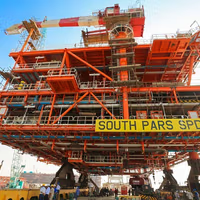
Iran needs to develop its oil and gas sectors by technology from Western energy giants to boost production which is gradually falling. For instance, as natural pressure in the South Pars gas fields is dropping Tehran needs billions of either partnership deals or cash investments to build larger platforms to extract more gas.
More than 70 percent of Iran’s energy is supplied by natural gas and the South Pars field is responsible to provide around 75 percent of this amount, reiterated the oil minister underlining that the lack of investment to develop gas fields is the main cause of this shortage.
It was interesting to observe that Iranian officials and government-controlled media were claiming in August and September that as winter approaches in Europe, the West will need Iran's energy and might make more concessions in the nuclear talks.
Not only the oil minister but a host of other officials and local experts constantly highlight the need for foreign investments, but they have no say in the country’s foreign policy, which is the exclusive domain of Supreme Leader Ali Khamenei.
Director of Tehran Chamber of Commerce Investment Services says foreign investors are reluctant to enter a country in which even domestic investors cannot work and capital outflow is on the rise.
Speaking to ILNA News Agency, Faryal Mostofi said on Tuesday that apart from Western sanctions, lack of security in investment and economic freedoms in Iran have also dissipated investors’ enthusiasm to release funds, stating that Iran could become a suitable place for foreign investors if conditions were right.
Summarizing the reasons for the crisis, Mostofi added that “inflation, sanctions, mismanagement, corruption, and strict regulations” have forced even Iranians to invest their capitals in housing sector in countries like Turkey and the United Arab Emirates.
According to her, something between $30 to $100 billion capital has left Iran in the past ten years due to inability of government to control inflation, while countries like Afghanistan and Iraq have been able to fix it below five percent.
Since the Islamic Republic was established in 1979 Iran’s rate of growth has been relatively low averaging less than 3 percent per year, this comes as experts say it needs around six percent annual growth to solve its endemic unemployment problem.
It is not just the nuclear dispute and its resulting sanctions that prevent the involvement of Western firms, it is also Iran’s overall foreign policy as an anti-West ‘revolutionary’ state, with an unpredictable behavior and a closed economy.
Iran has the second largest natural gas reserves in the world, holding more than 17 percent of global discovered gas fields. However, without foreign investment and technology, it will become a natural gas importer while the US sanctions would not allow Western companies to have any business dealings with the country.

Millions of Iranians who depended on social media advertising fear losing their livelihood as authorities block Internet access amid antigovernment protests.
Authorities argue that the stricter social media and internet restrictions are required due to what they call “riots” across the country over the past month. They blame protesters, who they invariably refer to as “rioters” for the perils of millions of people whose businesses, have been affected.
These small businesses, particularly those run from homes by women or small farms in rural areas, very heavily relied on Instagram for advertising and WhatsApp for communication with potential customers. The number of these businesses exponentially grew after the Covid pandemic.
Larger e-commerce companies such as online retailers, hotel and transportation bookings and food delivery services have lost large market shares.
The government has blocked access to Internet to prevent the spread of news and images about protests disrupt contact among protesters by blocking Instagram and WhatsApp. Last week they went one step further and even shut down the normal mobile messaging (SMS) services and resorted to jamming foreign-based Persian language satellite TV channels when activists called for one day of nationwide demonstrations.
These measure, many say, have largely failed as protesters persevere and post footage of protests as soon as they can connect to the internet through their mobiles or broadband.
“We have undergone the severest filtering and internet disruption over the past month but news [of the protests] have reached everyone, from the blaze at Evin Prison to the confiscation of passports of [dissident] artists,” one of the many tweets on this topic said.
“It just showed that government’s understanding of [the concepts of] media and cyberspace is very limited, and their measures have made no difference apart from damaging businesses. Moreover, Starlink is on the way too!” the tweet said.
Speaking at an event in Mazandaran Province in the north of Iran on the National E-Commerce Day on Sunday, Mahmoud Leiaei, deputy communications minister said during his visit to the province people had complained to him about the filtering of Instagram.
Leiaei added that their complaints made him realize that even in rural areas people had depended on Instagram for selling their produce. He blamed these people whose businesses are suffering because, he said, they should have heeded authorities’ warnings and migrated from foreign social media and messaging platforms to those developed in Iran.
Social media users in Iran have largely shunned domestically developed social media platforms and applications such as Wisgoon and Nazdika, designed to replace Instagram, and Rubika, a messaging application. People know that security services control the domestic apps and can spy on them.
Experts also warn that these platforms are very vulnerable to censorship and there are serious safety and privacy concerns.
For years, many in Iran have relied on VPNs and anti-filtering software to navigate through government censorship and blocked social media and websites. But authorities have been regularly shutting down mobile internet which completely stops any kind of access. The use of VPNs surged by 30-fold following the recent nationwide protests.
All Iranian mobile carriers now only offer their internet services when permitted by authorities who are imposing a curfew style control. Access to mobile internet is much more important than broadband which only 10 percent of Iranians subscribe to. The government has also cut off access to the global web and limited online activities to those allowed by a very heavily controlled intranet, called the National Information Network (NIN).

An economist says if Tehran fails to revive the 2015 nuclear deal, the country’s economy will suffer further and see an inflation of over 50 percent next year.
Fararu, which is a pro-reform website, interviewed Iranian economist Vahid Shaqaqi Shahri who said if the regime fails to clinch an agreement with the West over its controversial nuclear program and revive the JCPOA, the country may experience higher inflation that might bring its economic growth to zero in 2023.
Shaqaqi told Fararu that while Iran’s neighbors including Turkey and Saudi Arabia have experienced double-digit growths in the past few years, the economy of the Islamic Republic has shrunk in the face of sanctions and skyrocketing inflation.
Iran’s economy is almost completely state-run and the decision-makers in the country show no flexibility or interest in reform even though many warn the system needs drastic changes. The average annual inflation in the sixth months of the current Iranian year reached 42.1%, the Statistical Center of Iran announced in a report in September.
As the streets of many cities have turned into scenes of antigovernment protests since mid-September in the latest wave of anger at the totalitarian approach of the clerical regime towards cultural, political, and economic issues, there seems to be no glimpse of hope for any reforms by the authorities.
The people who are currently venting anger against the Islamic Republic in the streets and demand regime change are fed up with economic pressure and see a gloomy future for themselves; however, the government keeps cracking down, showing no interest in reforms.

In his Saturday interview with the Fararu news website, Shaqaqi said that the Iranian “economy has no more capacity to tumble down further.”
This university professor also referred to a recent report by the International Monetary Fund (IMF) which has forecast high energy and food prices and tougher economic conditions in 2023, warning that without “economic reforms, empowering the private sector, development of non-oil exports, and increase in investments,” Iran might see a more crippled economy next year.
Earlier this week, the IMF reported that with “Russia’s invasion of Ukraine, and the lingering COVID-19 pandemic all weigh heavily on the outlook, global growth is forecast to slow from 6.0 percent in 2021 to 3.2 percent in 2022 and 2.7 percent in 2023.”
This Iranian expert further noted that there are two more possible scenarios for the Iranian economy next year. “The optimistic scenario is that the JCPOA will be revived, and with the removal of the sanctions, the inflation rate will decrease to 20 percent and an economic growth of five percent could be achieved.”
With a slight increase in oil sales, Iran's economy has gained about 40 billion dollars from non-oil exports and imported a total worth of 45 billion dollarsin goods, Shaqaqi said, adding that the country has achieved economic growth of two to three percent, as predicted by the International Monetary Fund. However, he said, “if the conditions remain the same and sanctions are not increased,” one or two percent economic growth along with a 40 percent inflation can also be seen for Iran in 2023.
Iran’s economy is mostly influenced by political power. The government believes that in case of losing control over the economy, it will lose political authority.
A notable example is the Revolutionary Guard that plays a very significant role in the economy by monopolistic practices. Several cases of corruption and mega-size embezzlements have diminished popular trust in the regime.

Lebanon and Israel have finally agreed on a US-brokered proposal over a disputed maritime border in a rare cooperative move since 1948 when Israel was established.
Israeli Prime Minister Yair Lapid said on Tuesday that "This is a historic achievement that will strengthen Israel's security, inject billions into Israel's economy, and ensure the stability of our northern border," referring to the significant compromise that would open the way for offshore energy exploration and easing a source of tensions between states with a history of war and hostility.
In Lebanon, President Michel Aoun said the terms of the final US proposal were satisfactory and he hoped the deal would be announced as soon as possible.
The agreement is meant to resolve a territorial dispute in the eastern Mediterranean Sea in an area where Lebanon aims to explore for natural gas. Israel is already producing natural gas at fields nearby. The deal establishes a mechanism for both countries to get royalties from TotalEnergies' exploration of the offshore gas field that straddles the boundary.
Last week, Lapid instructed negotiators to turn down Lebanon’s requested modifications, saying that any further negotiations would cease permanently if Lebanon's Iran-backed Hezbollah movement threatens or attacks Israel's Karish gas rig.
Earlier in October, Lapid said that as per the arrangement gas would be produced by a company under a Lebanese license in the disputed Qana prospect, with Israel receiving a share of revenues.
“Such a field would weaken Lebanese dependency on Iran, restrain Hezbollah and bring regional stability," he said.