Israeli Airstrikes Hit Targets Near Syrian Capital Damascus
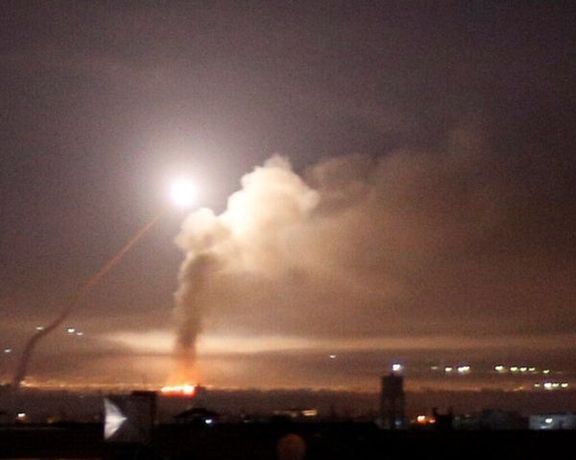
Israel conducted airstrikes in areas near the Syrian capital Damascus on Monday, hitting targets presumably affiliated with Iran in a rare daytime attack.
Israel conducted airstrikes in areas near the Syrian capital Damascus on Monday, hitting targets presumably affiliated with Iran in a rare daytime attack.
According to a Syrian military source, the "bursts of rockets” were fired from north of Israel at about 02:00 p.m. local time, claiming that “the army air defenses intercepted the missiles and downed most of them.”
The source told SANA that one soldier was injured as the result of the attack, and some material damage was also inflicted to the targets.
There are unconfirmed reports that a senior member of Iran’s Revolutionary Guards was killed in the Monday attack. Iran International cannot independently verify the reports.
Israel has been attacking Iranian and Iran-backed targets in Syria since 2017, but recently it has intensified attacks on Syrian airports -- including Damascus International Airport -- to disrupt Tehran’s increasing use of aerial supply lines to deliver arms to allies in Syria and Lebanon including Hezbollah, regional diplomatic and intelligence sources say.
In addition to Iran’s support for militants in Syria and Iraq, Tehran’s military support for the Russian invasion of Ukraine has also ruffled feathers in the international community.
Earlier in the day, Israeli Prime Minister Yair Lapid told The Jerusalem Post that Israel is growingly concerned by the “dangerous closeness” between Russia and Iran over the supply of drones by Tehran and is holding close consultations with American and Ukranian officials about the developing situation.

The Islamic Republic’s Foreign Ministry Spokesman claimed Monday that relations between Iran and Russia are not against any party and do not violate the international legal framework.
Naser Kanani told a news conference that “those who accuse Iran of supporting one side of the war are sending weapons to a warring side themselves,” implicitly referring to large Western military assistance to Ukraine.
Ukraine, the United States and Western countries say Iran has supplied military drones to Russia that are being used to attack civilian and infrastructure targets, and have begun imposing sanctions on Tehran.
Kanaani also rejected accusations that Iran has sent forces to Russian-occupied Crimea saying that “this is a media war to distract minds from the destructive role of Westerners in the Ukraine war.”
The US had earlier said that Iranian experts were in Crimea helping the Russians use Iranian supplied drones.
His comments come as Iran’s Supreme Leader in a meeting with Russian President Vladimir Putin back in July clearly expressed support for the Russian invasion of Ukraine.
While describing war as “brutal and hard,” Iran’s leader suggested that had Russia not “taken the initiative, the other side, with its own initiative would have created a war anyway.”
In that meeting Khamenei said “NATO is a dangerous creature [that] didn’t recognize any limits or borders. If you cannot stand up to them in Ukraine, then a little while later, with the excuse of Crimea, they would have started this war anyway.”

Elsewhere in his remarks, Kanani accused US officials of “telling lies and being hypocritical” regarding the talks over reviving the 2015 nuclear deal.
“If the Americans say the negotiations have stopped, why do they send messages through intermediaries?” reiterated Kanani, adding that “it is clear Washington wants to return to the agreement but not pay its costs.”
His allegations come as US State Department spokesperson, Ned Price, on October 19 said reviving the 2015 nuclear deal is “not our focus right now.”
“Nothing we’ve heard in recent weeks suggests they have changed their position. And so right now our focus is on the remarkable bravery and courage that the Iranian people are exhibiting through their peaceful demonstrations,” he stated.
During his Monday statements, the Iranian spokesperson also claimed that the West is supporting anti-regime protests in Iran saying, “If Americans have bet on the domestic developments of Iran these days, they have made a mistake.”
Tehran routinely blames the West and Israel for negative events in Iran, not willing to admit that many of its citizens oppose clerical rule.
He also criticized recent sanctions by the European Union and the United Kingdom imposed for the brutal crackdown on protesters in Iran, stating that “supporting disorder, insecurity and instability is an illegal behavior. It is an irresponsible act to support rioters and those who have a history of terrorist activities.”
This comes as the Islamic Republic is designated by the US as a state sponsor of terrorism since 1984 for supporting and organizing militant groups around the region.
In another part of his comments, Kanani claimed that relations between Tehran and the International Atomic Energy Agency (IAEA) are on the right track and the sides are having “constructive ties.”
However, Wall Street Journal correspondent Laurence Norman says there has been zero significant contact between Iran and the IAEA recently calling the claims “a heap of falsehoods”.


The US 5th Fleet said on Friday that the reports are not true whatsoever, adding that the fleet continues to operate its systems across the Middle East consistent with international law and without disruption.
Earlier in the day, the Iranian Army's Navy commander Shahram Irani had claimed that the Islamic Republic's Navy had seized two American sea drones. He made the remarks announcing the homecoming of the 84th IRIN Information and Operation Naval Fleet at the end of their 86-day mission in free and international waters.

The development came two days after the US military made an unusual disclosure, revealing the location of its submerged nuclear-powered ballistic missile submarines in the Arabian Sea near Iran’s waters.
The US Central Command (CENTCOM) released photos showing its commander General Michael “Erik” Kurilla onboard West Virginia. It has been described as a rare decision, as the US military seldom, if ever, acknowledges where its ballistic missile subs are operating, particularly when they are stationed near an adversary's shores. Kurilla's visit may be seen as sending a message to US adversaries in the region, including the Islamic Republic, of Washington's capabilities, including submarines that can carry up to 20 ballistic missiles with multiple warheads.
Late August, the US Navy prevented an IRGC navy support ship from capturing an unmanned vessel operated by the US 5th Fleet in the Persian Gulf.