US Iran Envoy Reacts To Activist Criticism Over His Tweet
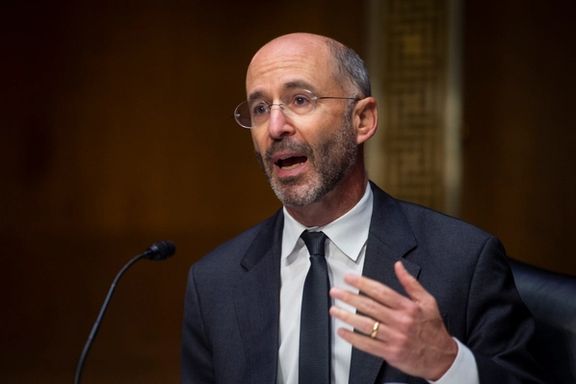
The US Special Envoy for Iran, Rob Malley says he cannot claim to speak for protesters, after one of his earlier tweets led to a strong reaction by Iranian activists.
The US Special Envoy for Iran, Rob Malley says he cannot claim to speak for protesters, after one of his earlier tweets led to a strong reaction by Iranian activists.
“Neither I nor the US government can claim to speak for protesters,” Malley told Iran International. “Only they can do that, and I’d never intend to imply otherwise.”
Malley in a tweet earlier Sunday had said that Iranians were protesting to have the Islamic Republic “respect their human rights and dignity.”
Iranian activists objected to this sentence, saying Iranians have proven in the past five weeks that they reject the clerical regime and want a new, democratic government and not respect from an oppressive regime.
Some Iranian activists, including NY-based Masih Alinejad demanded Malley resign. “By continually misrepresenting Iranian’s rejection of Islamic Republic, he is hurting the US administration standing among the people of Iran.,” Alinejad said.
Malley also told Iran International that “What we can do and have done since the protests began is take strong steps to support fundamental rights of Iranians, make sure they have the means to communicate with themselves & outside world, and sanction the regime… for their brutal crackdown.”
Most Iranian opposition activists view Malley as someone who is soft on the Islamic Republic and was ready to make too many concession during the Vienna nuclear talks, which after 18 months have failed to revive the 2015 nuclear accord with Tehran.

Konstantin Simonov, head of the National Energy Security Center in Moscow, said this week that more sanctions by the West on Tehran will give Russia a very good opportunity to invest largely in Iran’s oil and gas sector.
During a TV program he said Russia’s relations with Iran have been very complicated both during the Soviet and post-Soviet eras.
“We see that Iran has made a serious political choice and as a result it is sanctioned. The European Union is going to impose new sanctions, but I must honestly say that it is good news for us,” said Simonov.
He attested that the sanctions have given a good chance to Russia to invest in oil and gas sector of Iran which is worth over 40 billion dollars.
Ahmad Zeidabadi, a reformist regime insider, criticized the Islamic Reublic’s pro-Russian approach saying that “no one is allowed to criticize Moscow and it seems the country has forgotten its independence in international relations.”
In a TV debate on Friday, Zeidabadi declared it is not in Iran’s national interest to have a strategic relationship with Russia and China, but not with the United States.
Regarding the reported use of Iranian drones in Ukraine by Russia, he asserted that if Iran has not provided the drones, then why its dossier is being sent to the UN Security Council.

“As far as I know, Iranians want a balanced relationship with world powers. If you consider someone as an enemy, others will abuse you, like China and Russia. You have involved yourself only with one of the centers of power,” stressed Zeidabadi.
Ex-lawmaker Ali Mottahari had also censured Tehran’s decision to get involved in the Ukraine war stating that, “It is not clear who has decided to involve Iran in the war between Moscow and Kiev. Such a decision must be taken by the parliament.”
Slamming the comments by Foreign Minister Hussein Amir-Abdullahian regarding Iran’s impartiality in Russia-Ukraine conflict, he tweeted on Wednesday saying that “if it is true, why Ukraine claims several have been killed in the attacks launched by the Iranian drones.”
It was on Thursday that Foreign Minister Hussein Amir-Abdullahian rejected claims of Iran supplying Russia with drones to use in Ukraine.
In a telephone conversation with the European Union Foreign Policy Chief Josef Borrell, he claimed Iran is opposed to war and although it has defense cooperation with Russia, it does not send arms. But Tehran’s denials have never been explicit about drones for Russia. It says it opposes the war and does not take sides. Lately, it has said reports about Iranian drones being used in Ukraine are false, but it has never clearly denied supplying them to Russia.
However, the European Union and Britain slapped sanctions on Iranian individuals and a weapons company that they say have supplied Iranian kamikaze drones to Russia to kill Ukrainian civilians and destroy its infrastructure.
On Friday, top British, French and German diplomats urged the UN Secretary General to investigate the Islamic Republic’s transfer of drones to Russia, saying that the move violates a UN Security Council resolution.
The drone issue has compounded problems faced by the Islamic Republic amid negative publicity generated by its brutal reaction to peaceful protests at home.

The attack by the IRGC left more than 90 unarmed Baluch citizens dead as reported by human rights watchdogs in Iran and abroad. The comments by the Sunni leader came as EU and US officials are reportedly considering sanctions against Khamenei and President Ebrahim Raisi for violations of human rights.
Sunnis in Iran comprising at least 10 percent of the population have had a rocky relationship with the Shiite clerical regime for four decades. Abdolhamid has often complained of systemic discrimination by the government, to the extent that Sunnis are not permitted to have a proper mosque in the capital Tehran.
In his sermons on Friday, October 21, Mawlana Abdolhamid said: "Beating and killing the people is not the solution to the provinces problems." He further reminded that "No one can evade their responsibility for the massacre of the people of Zahedan," and reiterated that all top Iranian officials, particularly Supreme Leader Ali Khamenei who is the commander of the Revolutionary Guard (IRGC) are also directly responsible for the massacre.
Responding to the allegations that those who were killed were armed, Mawlana Abdolhamid asked: "If the people in the mosque were armed, how many of you [the security forces] have been killed?" The Sunni leader then reiterated that "The people of Baluchistan have been the victims of discrimination for 43 years," that is since the 1979 Islamic revolution that brought Shiite clerics to power in Iran.

Meanwhile, reminding President Ebrahim Raisi that he and millions of his followers supported him in the 2021 presidential election and helped him rise to power, Abdolhamid told Raisi: "You got the people's vote and even did not try to condole them" after the massacre. Mawlana's remarks were summarized in an October 21 tweet in his Twitter account.
Saying that "plainclothes officers shot unarmed people in the head or heart," Mawlana Abdolhamid characterized the massacre of Sunnis in Zahedan as "a catastrophe and an unprecedent major act of oppression" in his remarks on October 2, a few days after the attack. He also stated that IRGC special force units were placed at the local police station before the attack.
The religious leader said that a group of youngsters threw stones at the police station before the deadly attack started. "In return, the special units shot those youngsters as well as others."
The Belgium-based Iran Human Rights Organization (IHR NGO) condemned the massacre in a strongly worded statement calling the attack a "crime against humanity." At the same time, IRGC-linked Tasnim news agency claimed that five IRGC members were also killed during the attack.
Responding to Mawlana Abdolhamid's sermons on Friday, Majid Mirahmadi, the Deputy Interior Minister for Security Affairs said on Saturday that "Mawlana Abdolhamid's remarks were provocative."
He added that "after the sermons, some 150 local thugs attacked Sunni people's cars and shops, but the situation was quickly controlled." He said “Mawlana's statements were regrettable because counter-revolutionaries and the enemies of the country's security took advantage of them."

Rioters take part in the protests because they are well-fed," added Assembly of Experts member Mohsen Haydari, another Iranian cleric who enjoys a luxurious life without having worked for even one day in his lifetime, while the middle class has been wiped out due to 40-percent inflation in the past three years.
These are just two examples of what Iranian pro-government clerics who are paid by the Islamic Republic regime to echo Supreme Leader Ali Khamenei's arrogant rhetoric against his own people, many of whom no longer want to submit to his dictatorship
But they are not alone in bragging against the protests. Some military figures also spoke about the uprising on Friday. Brigadier General Hamid Abazari, an adviser to the commander of the IRGC opined that young women and men taking part in the protests have been deceived by "the enemy," which means the United States in the Islamic Republic's political jargon.
All this, and more, have been said while, an Iranian sociologist, Mohammad Reza Javadi Yeganeh, has warned that the window of opportunity for the regime to open a dialogue with the country's angry youths is not going to remain open for long as the regime increasingly isolates itself within its hard core.

In the meantime, others such as the Tehran Province Governor Mohsen Mansouri have tried to help the regime out of its biggest crisis in 43 years by offering to allocate certain places in big cities where people can protest. Mansouri has made the remark in the disguise of a lawful and democratic proposal. However, Iranian protesters believe this is a trick to make sure that the security forces are aware of all the demonstrations beforehand and can practice various ways to crackdown based on the specifications of every location.
The current protests take place at different locations during daytime and night and gatherings are fairly mobile in a bid to evade dangerous confrontation with security forces who are willing with no reservation to shoot to kill.
In his interview with ISNA, Mansouri said that his office has considered the requests for holding protest gatherings and has responded to those requests. However, it is clear that no such permit has been issued so far even for pro-government "reformist" parties that have recently complained that the Governor's Office and the Interior Ministry have ignored all of their requests.
At the same time, some political figures appear to be fishing in troubled waters by trying to garner support for the next parliamentary election. Mohammad Hassan Asafari, a lawmaker from Arak in the Central Province, told the press that taking part in the protests is a lawful activity, adding that protesters come to his office and talk with him about the situation. He is probably referring to another country as most lawmakers, including Parliamentary Speaker Mohammad Bagher Ghalibaf are known for their opposition to the protests and their comments about cracking down on dissent.
Asafari, however, has acknowledged that people have grievances about the government's economic and foreign policies. This comes while Sociologist Yeganeh, who agrees with the lawmaker on the causes of the protests, wrote in a series of tweets on Thursday that the regime should "recognize the protests and stop behavior that irritates the people," or a gloomy future is s possibility.


Syunik includes Armenia’s narrow southern strip called Zangezur where it has a land border with Iran and it launched a free trade zone there in 2017 to attract more investments to boost its exports to Iran.
Azerbaijan backed by Turkey demands a transit corridor through Syunik province to have access to its Nakhichevan Autonomous region without Armenian checkpoints.
However, Yerevan objects to the concept saying that it is a breach of the ceasefire signed after 2020 Nagorno-Karabakh war, that Azerbaijan won, taking back vast territories that Armenia had conquered in the Nagorno Karabakh conflict in the early 1990s.
Iran supports Yerevan in this dispute as it might lose its only joint border with its de facto ally Armenia and Caucasus.
During the opening of its consulate on Friday in Syunik’s capital city of Kapan, the Islamic Republic’s Foreign Minister Hossein Amir-Abdollahian said that Tehran will not accept any changes to historical borders in the region.
“That is our redline and we will take all steps to resist every such intention,” noted Amir-Abdollahian.

Meanwhile a deputy commander of Revolutionary Guard said on Friday that Iran would respond to any move threatening its land corridor to Europe.
“Azerbaijan achieved what it was looking for, and Karabakh was liberated, and we also congratulated it, but today, if there is any aggression we will deal with it,” threatened Ali Akbar Jamshidian.
On the other hand, Azerbaijan and Turkey also inaugurated an international airport here Thursday in Zangilan near Iran-Armenia border.
This is the second airport run in the territories Azerbaijan retook after the 2020 war with Armenia. Last year, another airport was inaugurated in Fizuli in the same region.
At this event, Turkish President Recep Tayyip Erdogan said concerns by some circles are not accepted over the land corridor Ankara and Baku seek.
Apparently referring to Iran, Erdogan said “In my opinion, fears and worries among some circles about the Zangezur Corridor, which will connect Nakhchivan to Azerbaijan, are unfounded. There is no place for such fears after the steps taken in all Karabakh.”
Earlier this week Iran’s Revolutionary Guards (IRGC) launched a large-scale military drill in the northwestern region of Aras along the borders of Armenia and Azerbaijan.
In September 2021 tensions flared up between Iran and the Republic of Azerbaijan after Baku arrested two Iranian truck drivers, accusing them of going to Nagorno Karabakh that lies within its international borders.
The tensions led to military drills by each side and political mudslinging, including Iranian accusations that Azerbaijan allows an Israeli military and intelligence presence on its territory.