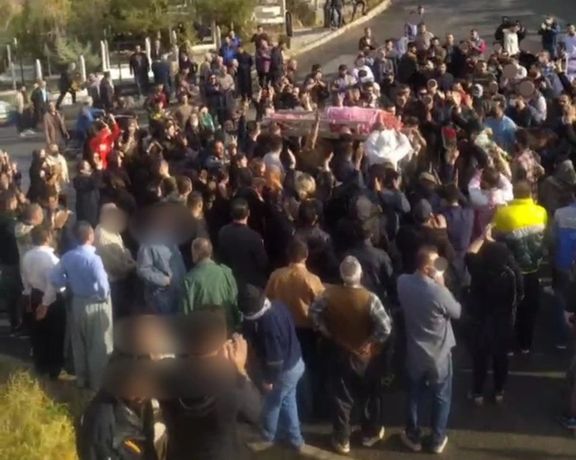
Large crowds that took to the streets in the Kurdish city of Mahabad in northwestern West Azarbijan Province Thursday morning have reportedly taken control of the governorate and some other buildings.
Residents of Mahabad took to the streets after participating in the funeral ceremony of 35-year-old Esmail Moloudi who was killed during nationwide protests the night before after security forces opened fire at the chanting crowd to disperse them.
Participant in Moloudi’s funeral chanted anti-government slogans such as “Death to the Dictator” and “A martyr does not die”.
Moloudi, father of one, was shot dead Wednesday night duringprotests in Mahabad.
Protests were held in over thirty cities and towns across the country on Wednesday to honor Mahsa Amini whose death in custody sparked the current protests on the traditionally significant 40th day of her death.
According to Hengaw Organization for Human Rights another 21-year-old man named Mohammad Shariati was also killed in Sanandaj by security forces’ direct fire Wednesday evening.
Iran Human Rights, a Norway-based rights organization, said Tuesday that at least 234 people, including 29 children have been killed in the ongoing nationwide protests in Iran.
The protests which erupted in Mahsa Amini’s hometown of Saqqez and the capital Tehran after her death in hospital soon spread to many other towns and cities across the country. Protests in Iran have garnered massive support from expatriate communities around the world as well as foreign governments and officials.
The European Union on Thursday dismissed sanctions that the Islamic Republic imposed on several EU individuals and media outlets in a tit-for-tat move as "purely politically motivated."
Expressing concerns about the clerical regime's ongoing violent crackdown on antigovernment protests, EU’s lead spokesperson for foreign affairs Peter Stano told journalists Thursday that contrary to Tehran’s sanctions, “when you take the EU sanctions (on Iran), they are adopted on clear legal grounds, based on the evidence of human rights violations in Iran."
In reaction to the EU’s October 17 sanctions targeting Iranian individuals and entities over their role in the brutal suppression of peaceful protests,Tehran announced Wednesday sanctions against eight institutions and 12 individuals based in the EU.
Iran’s Foreign Ministry claimed that the Islamic Republic’s sanctions were imposed due to “deliberate actions in support of terrorism and terrorist groups, encouraging and inciting terrorism, violence, and hatred, which has caused riots, violence, terrorist acts, and human rights violations against the people of Iran.”
Iranian authorities, including the Supreme leader and the president, accuse Western countries and Israel of being behind the current wave of antigovernment protests, ignited by the death in custody of 22-year-old Mahsa Amini.
The new list of sanctions includes the Persian-language services of Germany’s Deutsche Welle and France’s RFI, extending Iran’s animosity against foreign-based channels that it says are promoting an uprising such as BBC Persian and Iran International. Two directors of the German newspaper Bild were also blacklisted.
The UN Special Rapporteur on the Human Rights Situation in Iran has called for prompt establishment of investigative mechanism into human rights violations in Iran.
In a statement on Wednesday, Javaid Rehman said current investigations and domestic accountability channels had failed to meet the minimum standards of transparency, objectivity and impartiality, urgingan independent mechanism into all human rights violations leading up to and since the death of Jina Mahsa Amini, who died in hospital after being arrested by the morality police.
He said that the Islamic Republic is monitoring, harassing, and sometimes beating women on a daily basis in the pretext of its mandatory dress code -- implemented through the morality police.“This is meant to instill an atmosphere of fear,” he noted.
“Chronic impunity and lack of redress for previous violations have culminated in today’s events as we see protests throughout the country calling for justice and accountability for Amini’s death but also demanding respect for fundamental socio-economic and political rights and particularly freedom of expression,” he added.
Also on Wednesday, a group of UN human rights experts condemned the killings and the crackdown by security forces in Iran on protesters, including alleged arbitrary arrests and detentions, gender-based and sexual violence, excessive use of force, torture, and enforced disappearances.
They also urged that the reports be thoroughly and independently investigated and those responsible held to account, adding, “An alarming number of protesters have already been detained and killed, many of whom are children, women and older persons. The Government must instruct police to immediately cease any use of excessive and lethal force and exercise restraint.”
A government-sponsored rally was held outside the British embassy in Tehran Thursday, trying to shift the blame over the current antigovernment protests on the UK’s “hostile policies.”
Fars news agency – affiliated with Iran’s Revolutionary Guard – reported that scores of pro-regime students gathered outside the embassy building “in protest to the British government's hostile actions against the security of the Iranian nation.”
The participants also chanted slogans against the United States and Saudi Arabia as well as the United Kingdom. They also carried banners against the London-based Persian news channels such as BBC Persian. In their banners, they also changed the main motto of the current wave of protests from “Women, Life, Liberty” to “Women, Life, Martyrdom.”
These included Tom Tugendhat, Minister of State for Security, Commodore Don Mackinnon, British naval commander in the Persian Gulf, and Steve McCabe, member of parliament ad Chair of Labour Friends of Israel, as well as media outlets and their owners including BBC Persian and Iran International.
A group of Canadian and British lawmakers and politicians have urged their respective governments to take measures to stop Iran’s brutal crackdown on protesters.
ISIS has taken responsibility for the Wednesday attack on a shrine in Shiraz but many Iranians are not convinced the regime had no part in it, saying it is a scenario for cracking down harder on protesters.
The attack which the authorities call a “terrorist attack by Takfiris” killed at least 15 people and injured dozens more. Iranian state media say two people linked to the incident have been arrested and a manhunt is underway to capture the third.
Hours after the raid, Reuters quoted a statement from ISIS telegram channel saying that the group claimed responsibility for the attack. The group has also released their statement through its affiliated Amaq news agency that said one of its members had “targeted groups of Sunni refusal infidels inside the shrine with his machine gun, causing the death of tens of them.”
Many Iranian, however, have accused the regime of being behind the attack or orchestrating it to blame protesters at home for causing unrest and insecurity and justify harsher crackdown on protesters.
“Which ISIS force has ever launched an attack without an explosive belt? Why don’t security forces consider the possibility of an explosive belt when arresting the attackers?” a tweet posted by one of the sceptics asked.
“The incident at Shahcheragh is a self-inflicted damage by the Islamic republic to prevent gatherings at the tomb of Cyrus the Great on his birth anniversary on October 29th. Don’t be fooled by their tricks and don’t be distracted from your revolution,” another tweet said.
Others have questionedthe easy entrance of the attacker into a shrine despite the usual heavy security measures. “Which stupid terrorist takes such a big weapon with him for an operation without any security cover? Doesn’t the Shahcharagh shrine have [security] at its gate?”
“Let’s suppose the protesters were complicit in the attack on Shahcheragh, but whose fault is it that a significant part of the society does not accept your narrative?” journalist Hadi Mousavi asked in a tweet.
“This time, the child-killing and terrorist regime opened a new chapter in its terrorist acts by desecrating the holy shrine of Shahcheragh and killing defenseless people. Our slogan as of today would be ‘IRGC is ISIS, It is the one who kills pilgrims’, “ an anonymous group called the Youth of Isfahan Neighborhoods tweeted.
Meanwhile, Masoud Kazemi, a political activist, in a tweet accused the Islamic Republic of perpetrating this terrorist act saying that, “The survival of the Islamic Republic is in jeopardy and the regime’s has escalated its fake and abusive actions.”
Fariborz Karimi Zand, a former police officer and one of the opponents of the Islamic Republic, in a tweet called the attack “psychological warfare” and sacrificing insiders or civilians to eclipse news of protests. “Nothing should distract us from our main goal which is to overthrow the Islamic Republic.”
Some people have noted a similarity with a 1994 terrorist attack on the shrine of Imam Reza in Mashhad which killed and injured dozens of people. Although a Sunni group claimed responsibility, the Iranian government laid the blame on the People’s Mujahedin Organization of Iran (MEK). However, the former Interior Minister Abdollah Nouri claimed said in his trial in 1999 that it was a false flag attack by the Iranian regime to discredit MEK.
Authorities have been claiming that “separatists” and “instigators” are behind the efforts to overthrow the government and break Iran into areas controlled by ethnic groups
After weeks of intense protests in Iran, some factions within the regime seem to realize that a dialogue is needed with social groups to regain control of the country.
More frequent articles appear in government-controlled media about how to start public discussion and to listen to opponents. But academic Najafgholi Habibi, the former chancellor of Allameh Tabatabai University says the main precondition for a such a dialogue is immunity for individuals who take part in public discussion with hardliners close to the core of the regime.
In an interview with ISNA, Habibi maintained, however, that holding dialogue at the current juncture may not be effective at all.
Najafgholi Habibi, the former chancellor of Allameh Tabatabai University
Discussions advocated by some hardliner individuals and organizations including Judiciary Chief Gholamhossein Mohseni Ejei and the Iranian state TV controlled by the office of Supreme Leader Ali Khamenei have their roots in Khamenei’s idea of “free thinking” or “open mindedness” that he put forward in the 2010s which initially aimed at the Iranian universities.
However, even then students who tried to be open minded in meetings with Khamenei found themselves in jail or were harshly criticised by hardliners after they disagreed or came up with new ideas that were not consistent with Khamenei’s rigid mind frame. In other words, he supported open mindedness as long as open-minded people echoed his own words.
Habibi said in the interview that the universities shelved the idea after a short while as they found it impractical under the circumstances. But he did not say that Khamenei’s toleration for different ideas have become even less in recent years after he decided that the entire government should be monophonic with no room for any idea other than his own hardline conservative doctrines.
What Habibi also failed to mention is that the political atmosphere has become so intense that when some traditional reformists recently were given a tribune on state TV, their mild comments infuriated many people on social media who simply reject the Islamic Republic.
In a recent case, social media users harshly criticised Ahmad Zeidabadi for suggesting the idea of communicating with the government on state TV. He said in a tweet after his first ever TV appearance that he “was sleepless that night because of fear of getting arrested.” But this was not his only fear, he said in the tweet that he was afraid of criticism for taking part in a debate at the state TV no matter what he said.
Iranian journalist Ahmad Zeidabadi
Zeidabadi explained that he was even criticized for talking about non-violent struggle against a regime that attacks peaceful demonstrators with shotguns. Many also criticised him for talking with a regime thug, hardliner Sadeq Koushki, while security forces attacked young children in schools.
Addressing the government, academic Habibi said that the regime should have thought of maintaining dialogue with the people when there was still hope in improving the situation. Now, he said, we can only think of discussions only when confrontation with the people comes to an end.
Nonetheless, he said that the government is planning to launch Dialogue Houses within the universities. This, he said was too late. Universities now are the venues of the most radical demonstrations and harshest slogans with many F-words against Khamenei.
Meanwhile, knowing that the Supreme Council’s idea of a dialogue is nothing more than voicing the Supreme Leader’s ideas, Habibi reiterated that “all academics should be able to voice their ideas, not just one group of them, and all students have a right to have their ideas heard.”
“The society can decide what is right and what is not only after all sides have voiced their ideas,” he said, adding that “This is in the interest of the country.” Habibi stressed that using force against the youths is useless and will not solve any problem.