Iran To Send Delegation To Vienna For Talks With IAEA

As chances of reviving the 2015 nuclear deal remain dim, Iran's foreign minister says Tehran will send a delegation to Vienna in the coming days for meetings with IAEA officials.

As chances of reviving the 2015 nuclear deal remain dim, Iran's foreign minister says Tehran will send a delegation to Vienna in the coming days for meetings with IAEA officials.
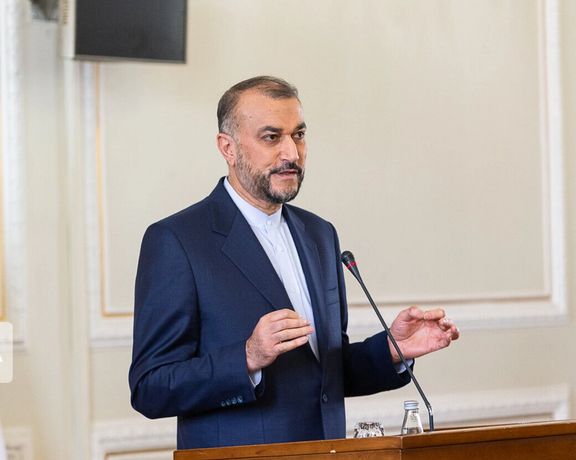
Hossein Amir-Abdollahian said Wednesday that the aim of the visit is to try to narrow differences with the UN nuclear watchdog. "We will send a delegation from Iran to Vienna in the coming days to start talks with the International Atomic Energy Agency (IAEA) and we hope to resolve remaining issues based on what we have agreed in the past days," he said.
He added that he would speak to the European Union’s foreign policy chief Josep Borrell, to discuss efforts to revive the JCPOA, the Joint Comprehensive Plan of Action.
In an interview published on Wednesday, Bijan Djir-Sarai, the general secretary of Germany’s liberal Free Democrats (FDP) -- a junior partner in the ruling coalition – said the deal with world powers "has no future and is not in line with reality." He noted that continuing talks would mean "negotiating with an inhuman regime that has completely rejected by its own people and has no legitimacy whatsoever".
On October 18, United States’ officials reiterated their support for the ongoing protests in Iran with Special Envoy Robert Malley saying that the talks to revive the nuclear deal are no longer on the agenda. Malley said on October 31, the Biden administration is not going to "waste time" on trying to revive the nuclear deal at this time considering Tehran's crackdown on protesters, Iranian support for Russia's war in Ukraine, and Iran's positions on its nuclear program.

While new British prime minister Rishi Sunak is expected to concentrate on pressing domestic issues, he may change emphasis in Middle East policy.
A member of parliament since only 2015, Sunak has suggested the 2015 Iran nuclear agreement – the JCPOA, Joint Comprehensive Plan of Action – should be strengthened, that Britain should consider moving its Israel embassy to Jerusalem, and that it should strengthen links with Arab monarchies in the Persian Gulf.
Reports of Sunak’s views of Iran come partly from close allies. Former defense secretary Liam Fox told the National newspaper in August said that Sunak was “more hawkish” than the foreign office.
“He would want to see maximum sanctions put on to see whether Iran could be persuaded or forced into a wider agreement that goes beyond just the nuclear program,” Fox said.“He believes the JCPOA doesn’t actually stop Iran's nuclear program, it merely delays it...”
Fox did not explain whether Sunak saw a wider agreement – sometimes called ‘JCPOA+’ and covering security issues like Iran’s ballistic missiles – as a next step from a revived JCPOA or rather as an alternative.
Another ally, Conservative member of parliament Theresa Villiers wrote in the London-based Jewish News in August that Sunak had told her of “his concern that the UK government has not taken the threat posed by Iran seriously enough.”
Sunak has clearly expressed desire for tight relations with the Arab Gulf monarchies and for encouraging more to follow Bahrain and the United Arab Emirates in ‘normalizing’ tries with Israel despite the absence of a Palestinian state. “The UK is in a strong position to leverage its historic relationships with other Gulf states to widen the accords and I would like to see UK diplomats place a greater focus on this,” Sunak told the Jewish Chronicle in August.
Sunak told the Conservative Friends of Israel, also in August, that the UK should consider moving its embassy in recognition of Jerusalem as Israel’s capital. This has been done only by the Guatemala, Honduras, Kosovo, and the United States. Other states, and the European Union, say this pre-empts settlement over Palestinian statehood.
Sunak has also spoken out against rights organizations, including Amnesty International and Human Rights Watch describing Israeli occupation ‘apartheid.’ He has accused the Palestinian Authority of “glorification of terror attacks.”
‘Friends and allies’
Sunak was outspoken over the August 12 attack on author Salman Rushdie in New York state, which he described as a “wake-up call for the west.” But his suggestion as a leadership candidate that those who “vilify Britain” or who were “vocal in their hatred of our country” should be closely monitored proved controversial, at least beyond members of the Conservative Party.
Keeping James Cleverly as foreign secretary, despite a wide reshuffle from the short-lived administration of Liz Truss, may signal Sunak’s desire for continuity in foreign policy at a time of severe domestic challenges and when his government is deeply unpopular.
While Sunak supported Britain leaving the European Union in the 2016 referendum, his early telephone call as prime minister to European Commission president Ursula von der Leyen, when he spoke of “working together as friends and allies,” suggests he may seek a conciliatory relationship.
While the EU has not followed the US over Jerusalem, it has moved closer to the US over Iran policy since Joe Biden became president in January 2021. Rob Malley, the White House Iran envoy, on Monday emphasized the value placed by the Biden administration on the US this improved relationship, both over Iran and the Ukraine crisis, given the divisions of the Trump presidency.
Some suggest that talks to revive the 2015 Iran nuclear deal may revive after the November 8 US mid-term elections. Others feel the talks are at an end. Either way, Sunak’s input may be maintaining close British relationships with both the US and EU.
The hacktivist group Black Reward published a throve of documents from Iran’s nuclear program Saturday after a 24-hour deadline it had given the government expired.
The group said Friday it had hacked the email system of Iran’s Nuclear Power Production and Development company threatening that it will release the documents if the government does not stop its clampdown on protesters. It also said that a total of 50 GB data was obtained.
Black Reward earlier had warned that it will publish the data it has obtained within 24 hours unless the Islamic Republic releases all political prisoners and detained protesters.
“The published documents contain the contracts of Iran Atomic Energy Production and Development Company with domestic and foreign partners, management and operational schedules of Bushehr power plant, identity details and paystub of engineers and employees of the company as well as passports and visas of Iranian and Russian specialists of Bushehr power plant,” stated the group on social media.
The hacktivists have also mentioned that “unlike Westerners, we do not flirt with criminal clerics, and if we promise something, we fulfil it 100%.”
As the published documents are reviewed and analyzed, we will provide an overview in the coming days.
They further called on experts in related fields and the media to publish investigative reports on these documents.
Earlier in the week, the group also announced that it hacked the emails of managers and employees of Press TV, the government’s international English news channel.

While US officials have said that Iran is not ready to revive the 2015 nuclear deal, Tehran says these comments are made to incite more antigovernment protests.
Hossein Amir-Abdullahian claimed that “such statements have domestic use and are aimed at provoking some of their agents in Iran.”
He claimed on Saturday that “not only reaching a deal is a priority for the Americans, but they are also in a rush for it.”
His allegations come as US State Department spokesperson, Ned Price, on Wednesday said reviving the 2015 nuclear deal is “not our focus right now.”
“It is very clear, and the Iranians have made very clear that this is not a deal that they have been prepared to make. The deal certainly does not appear imminent,” Price told a briefing.
“Nothing we’ve heard in recent weeks suggests they have changed their position. And so right now our focus is on the remarkable bravery and courage that the Iranian people are exhibiting through their peaceful demonstrations,” he stated.
“Our focus right now is on shining a spotlight on what they’re doing and supporting them in the ways we can,” noted Price, referring to the anti-regime protests across Iran sparked after the death of 22-year-old girl Mahsa Amini by morality police in mid-September.
However, Amir-Abdullahian alleged that Tehran and Washington have exchanged some messages “three days ago” regarding the nuclear agreement.
He said these remarks by US officials are meant to give them an upper hand in the talks through “psychological and political” pressure.

US officials have reiterated their support for the ongoing protests in Iran with Special Envoy Robert Malley saying that the talks to revive the nuclear deal are no longer on the agenda.
“This is grass roots, this is bottom up,” Antony Blinken, the Secretary of State said in remarks tweeted by the State Department Tuesday, referring to protests that began mid-September. “This is a reflection of huge frustration and anger towards the direction of their country and their leadership. This is not made in the USA, it’s not made anywhere else…”
Malley told CNN on Monday that "Right now the talks on revival of JCPOA are not on the US agenda; the focus is on what's happening in Iran as the talks are stalled," adding that “Iran has taken a position in those talks for the past two months, which is simply inconsistent with a return to the deal.”
However, he insisted that “diplomacy is the way” to prevent Iran from acquiring a nuclear weapon, noting that “We will see whether this is a government that is interested in reaching a deal.”
Malley said Iran’s leaders should “stop pointing the finger at external actors who have nothing to do with what’s happening in their country and listen to their people…” President Ebrahim Raisi Sunday said the US was “inciting chaos,” while Iranian politicians have generally denounced foreign-based media and social-media operations.
Malley went on to say that in a struggle of “peaceful protestors” against “a government using brutal repression” there was “no doubt” where the US stood. Malley denied that the US sought “regime change [in Iran] instigated in the US.” He said Washington supported human rights in Iran “just as we support human rights of citizens across the globe.”
Malley also defended the approach of President Joe Biden in seeking to revive the 2015 Iran nuclear agreement, the JCPOA (Joint Comprehensive Plan of Action), arguing the talks were “stalled” because Tehran was “making demands that have nothing to do with the JCPOA.”

France said Thursday that any sale of Iranian drones to Russia is a violation of the UN Security Council resolution that endorsed the 2015 nuclear accord, the JCPOA.
The French foreign ministry announced that it was coordinating with EU partners on how to respond, while earlier the Ukrainian officials said three Iranian-made drones were used by Russia to attack the small town of Makariv overnight targeting critical infrastructure.
"There was an overnight drone bombardment by invaders on the Makariv community," Andriy Nebytov, head of the Kyiv region police said. Russia had used more than 20 Iranian drones in its large-scale bombardment of infrastructure and cities on October 10, Ukraine said.
According to the United States, Iran has supplied Shahed 136 suicide drones to Russia and Ukraine has reported swarms of these UAVs launched against civilian targets. The drones have a low speed of 120-150km per hour and many have been shot down by Ukrainian air defenses and warplanes.
On Tuesday, October 11, President of Ukraine Volodymyr Zelensky said Russia has ordered 2,400 Iranian-made Shahed drones from the Islamic Republic.
Diplomatic efforts to reach a solution to the Iranian nuclear issue culminated in the Joint Comprehensive Plan of Action (JCPOA) on 14 July 2015 by China, France, Germany, Russia, the United Kingdom, the United States, the High Representative of the European Union (the E3/EU+3) and the Islamic Republic of Iran. On 20 July 2015, the Security Council unanimously adopted resolution 2231 endorsing the JCPOA.