Islamic Republic Seeks To Export Oil To India
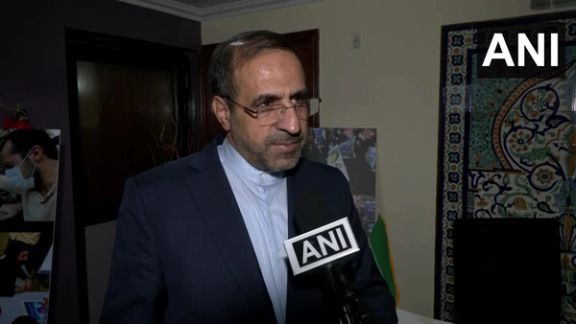
The Islamic Republic’s envoy to India Iraj Elahi said Friday that Tehran wants to sell oil to India and is ready to deliver it, despite US sanctions.

The Islamic Republic’s envoy to India Iraj Elahi said Friday that Tehran wants to sell oil to India and is ready to deliver it, despite US sanctions.
In an interview with Asian News International, Ambassador Elahi said, “We always express our readiness to increase our economic ties with India. It's up to India, we are ready to deliver oil.”
Noting that the US sanctions have been an obstacle for the export of oil to India, he said that “India and Iran should find a way to solve this problem according to their national interests, and not according to illegal US sanctions.” The Islamic Republic’s independence is the “best guarantee for India,” he added.
India abided by US sanctions when former US president Donald Trump withdrew from the 2015 nuclear agreement known as JCPOA and gradually imposed a full ban on purchase of Iranian oil by third countries. But China continued buying small volumes until November 2020 when it began noticeably increasing imports of illicit Iranian shipments.
However, according to an analysis published by Reuters in July, China’s growing imports of Iranian oil has made India not follow Western sanctions on Russian crude as it did regarding the Islamic Republic.
Indian officials said, “New Delhi wants to avoid repeating what it sees as the mistakes of the past: abiding by sanctions on Iran and winding down oil imports, only to see its main regional rival China continue unpunished and benefit economically.”

Iran sits amid a crowded agenda at the G7 meeting in Munster, Germany, as the bloc grapples with multiple challenges centered on Ukraine.
After tensions during the Donald Trump presidency, the two-day gathering concluding Friday shows a tight relationship between the United States and Germany, currently chairing the G7 bloc that also includes Canada, France, Italy, Japan and the United Kingdom.
German foreign minister Annalena Baerbock, from Alliance 90/The Greens, has spoken out over protests in Iran since mid-September, and Thursday Berlin warned citizens in Iran to leave due to a “concrete risk of being arbitrarily arrested.” In another sign of deteriorating relations, Iran-Iraq war veterans gathered outside the German embassy in Tehran this week to highlight German firms helping Saddam Hussein with chemical weapons.
At a US-German Futures Forum Friday in Munster with Antony Blinken, Baerbock described the US Secretary of State, whom she has met ten times since taking office ten months ago, as a friend. Blinken praised as “extraordinary” the “the leadership of the German foreign minister.”
Blinken said that in setting “rules for how technology is used,” the US and Germany had to “make sure that the values we stand for…carry the day.” He noted that the “vast democratization of information technology” and highlighted recent US decisions to lift any threat of sanctions against those supplying internet-access technology to Iran.
Baerbock referred to opportunities for online education she had recently seen in Egypt, where the COP27 United Nations climate conference begins Sunday. The German foreign minister said the G7 meeting had linked information technology to “democracy and freedom,” which she said underlay Berlin’s approach to Iran.
Baerbock pledged to bring “atrocities” to UN bodies and said “democratic economic powers” needed a majority on UN human rights bodies. The US has called for Iran to be removed from the UN Commission on the Status of Women.
In recognition of recent blows to Germany and European Union expectations of trade bringing states together politically – which underlay both Russian energy supplies and the 2015 Iran nuclear agreement – Baerbock said “we have learned” this was not always true.
Tanks, jets, drones
The US and Germany, respectively the largest and second largest arms supplier to Kyiv, appear to be the same page over Ukraine. Wary of Russian escalation, both have resisted calls for advanced weapons, with Ukraine seeking Leopard 2 tanks and Marder armored infantry vehicles from Berlin, and F-16 jets from Washington.
The US and Germany, along with France and the UK, have raised the issue of Iranian-made drones at the UN Security Council, arguing that any supply contravenes the 2015 Iran nuclear agreement and justifies ‘snapback’ of UN sanctions on Tehran. Given vagaries over ‘snapback,’ and experts’ disagreements as to whether drones as relatively light weapons violate the 2015 agreement, the move may be intended to deter Iran from sending missiles.
In an interview with Dubai-based al-Arabiya published Friday, Rob Malley, the US Iran special envoy, said Iran was “embarrassed” as it had become “clear to the world” that it had “sided with Russia and its war of aggression against Ukraine.”
Domestic criticism
Further underlying US-Germany cooperation is shared experience of center-left governments facing domestic criticism. With US aid to Ukraine at $50 billion so far, House minority leader Kevin McCarthy last month ruled out a “blank check,” and some Republican candidates in November 8 Congressional elections are critical of such support for Ukraine when Americans face rising bills. In Germany opposition politicians have queried the €200 billion allocated to citizens and companies over energy price hikes due to the Ukraine war.
A further complication facing both the German-US relationship and the G7, is the rise of China. While the US has cautioned other countries over Beijing’s involvement in key sectors, German Chancellor Olaf Scholz, a Social Democrat, arrived in China Saturday seeking “economic ties as equals, with reciprocity.” Chinese-made parts in globally manufactured items may include some, alongside European and US components, in Iranian drones, the Institute for Science and International Security said in a recent report.

The US State Department has condemned Iran’s celebration of the 1979 embassy hostage taking and its claims that the US is still working on a nuclear deal.
Iran’s foreign minister Hossein Amir-Abdollahian repeated accusations that the United States is encouraging “violence and terror” in popular protests across the country. In a tweet Thursday, he also claimed that Washington is still trying to reach a nuclear agreement.
Iran routinely accuses "enemies" for most of its problems and has presented no evidence of any foreign power being involved in its antigovernment protests.
Since August when a last-ditch effort by the European Union to bridge gaps in 18 months of talks to revive the 2015 nuclear deal, the US has said that Iran is not serious about an agreement, putting forth demands outside the scope of the accord known as JCPOA.
The US official dismissed Amir-Abdollahian’s claim, saying, “We have been clear that by adopting positions inconsistent with a deal, Iran has taken the JCPOA off the agenda, and that we have sent no messages otherwise. Iran can repeat the claim as often as they want. We have no need to comment further on it.”
The official also condemned Iran’s celebration of the anniversary of the kidnapping of American diplomats as repugnant. “That they in the same breath accuse anyone else of terrorism is doubly so,” the official said.
In November 1979, a group of leftist students backed by the new revolutionary government occupied the US embassy in Tehran and took 54 Americans hostage for 444 days. Iran has never condemned the attack that ruptured bilateral relations.

The G7 foreign ministers meeting in Germany concluded its busy two-day agenda Friday with a 3,500-word statement including a 500-word section on Iran.
Stressing the importance of universal human rights, the bloc called on Iran to honor international law, including the International Covenant on Civil and Political Rights, the General Assembly resolution adopted in 1966 and in force since 1976.
The wide-ranging G7 statement expressed support for efforts at the United Nations to hold both Iran and Russia accountable for “blatant violations” of UN Security Council Resolution 2231, which endorsed the 2015 Iran nuclear deal. The US, France, Germany, and the United Kingdom – G7 members along with Canada, Italy and Japan – have argued that any Iranian supply of military drones to Russia would breach the agreement, the JCPOA (Joint Comprehensive Plan of Action).
As the G7 statement held Iran responsible for not making the “necessary decisions” needed in international talks to restore the JCPOA, the American network CNN Friday cited “US intelligence officials” claiming Tehran had sought Russian help in acquiring “additional nuclear materials and with nuclear fuel fabrication” should JCPOA talks fail.
Russia has consistently expressed support for the JCPOA, and alongside China and three western European signatories criticized the US over its 2018 withdrawal, prompting Iran by 2019 to begin expanding the program. CNN gave no details of the assistance Iran had reportedly sought, nor why it needed Russian help given it is already enriching uranium to 60 percent and has stockpiled uranium well in excess of JCPOA limits.

While not confirming the CNN story, National Security Council spokesperson Adrienne Watson told the network the US was “working with partners to expose the growing ties between Iran and Russia – and hold them accountable.” She said that while “the JCPOA is not on the agenda… we will be firm in countering any cooperation that would be counter to our non-proliferation goals.”
‘Unabated expansion’
While the G7 statement expressed concern at the “unabated expansion of Iran’s nuclear program, it made no specific reference to the JCPOA while calling on Iran to “fulfill its legal obligations and political commitments in the field of nuclear non-proliferation without further delay.”
The statement pledged to continue work between the G7 and “other international partners…to address Iran’s nuclear escalation and insufficient cooperation with the IAEA [International Atomic Energy Agency] regarding its [Nuclear] Non-Proliferation Treaty (NPT) safeguards agreement.” One of the issues holding up progress in JCPOA talks has reportedly been Iran’s demand that the IAEA drop a probe into unexplained uranium traces found in sites related to Iran’s nuclear work before 2003.
The G7 statement also condemned Iran “destabilizing activities in and around the Middle East,” including “transfers of…advanced weaponry to state and non-state actors,” apparently a reference to Iran’s links with Syria’s President Bashar al-Assad, Hezbollah in Lebanon, armed Palestinian groups, and Ansar Allah in Yemen.
The statement deplored “the Iranian government’s erosion of civil space, and independent journalism, its targeting of human rights defenders, including by shutting down the internet and social media.” It urged Iranian authorities to “treat women as equal, respecting the universal rights provided to them under the relevant international human rights treaties.” It called for the release in Iran of “unjustly detained prisoners, including recently arrested protesters, children, journalists and human rights defenders, and... accountability for perpetrators of human rights violations and abuses.”

Ukraine is seeking logistic information regarding the Moscow-Tehran weapons trade, while Israel is softening its opposition to providing military aid to Kyiv.
The Ukrainian Defense Ministry issued a public notice on its website Wednesday requesting information on logistical routes used to facilitate weapons trade between Russia and the Islamic Republic, including delivery points, warehouses railway stations, military officers and other infrastructure.
“We remind you that all persons involved in the supply of Iranian weapons for use in the war against Ukraine violate international law and become complicit in crimes committed by the Russian Federation on the territory of Ukraine,” the ministry stated.
Meanwhile, Bloomberg reported on Friday that Israel is apparently changing it long-maintained policy of strategic neutrality regarding the Russian invasion of Ukraine after months of reluctance, implying that it may start selling weapons, including air defense systems, to Ukraine.
According to the report, a turning point came late last month, when Israeli Defense Minister Benny Gantz took a long-requested call from his Ukrainian counterpart Oleksii Reznikov, in which Israel committed to help Ukraine develop an early-warning system, similar to one that alerts Israelis to incoming fire from the Gaza Strip.
Israel has also begun to share its intelligence, Ukrainian President Volodymyr Zelenskiy said late in October, welcoming what he called a “positive” trend.
The cooperation, however, is harshly criticized by Russian officials, such as former President Dmitry Medvedev who warned Israel in October against sending weaponry to Ukraine, saying it would destroy all diplomatic relations between Jerusalem and Moscow.

US President Joe Biden on Thursday vowed to "free" Iran and said that protesters who oppose the Islamic Republic would soon succeed in freeing themselves.
"Don't worry, we're gonna free Iran. They’re gonna free themselves pretty soon," Biden said during a wide-ranging campaign speech in California, as dozens of demonstrators gathered outside holding banners supporting Iranian protesters.
Biden did not expand on his remarks or specify what additional actions he would take during the remarks at MiraCosta College near San Diego.
Iran’s President Ebrahim Raisi reacted on Friday during a pro-government rally on the anniversary of the occupation of the US embassy in Tehran in November 1979 that resulted in taking dozens of Americans hostage for 444 days. In harsh anti-US remarks, Raisi said that he came across Biden’s statement “that he might have uttered in a state of wackiness.”
Raisi responded to Biden’s remark saying that “He said standing behind the official podium that they are supposed to free Iran. Mr. President, Iran was freed 43 years ago and vowed not to be enslaved by you.”
Raisi went on to mock US attempts to block Iran’s oil exports, saying that Washington’s plans were defeated. “Today we have influence in the region and no equation can succeed without Iran’s agreement, and America also knows this very well.”
The White House's National Security Council did not immediately respond to a request for comment.
Iranian Americans opposed to the clerical regime in Tehran have viewed the Biden Administration as weak and ready to make deals with Tehran. Before his election in 2020, Biden announced that he would seek to restore the 2015 nuclear deal, known as JCPOA, that his predecessor had abandoned.
Eighteen months of negotiations before the current upheaval started in September failed to produce a result, and Iran even began supplying drones to Russia to use in Ukraine, the administration has said.
Seven weeks of demonstrations in Iran were ignited by the death of a 22-year-old woman, Mahsa Amini, in the custody of Iran's morality police.
The protests triggered by Amini's death on September16 have shown the defiance of many young Iranians in challenging the clerical dictatorship, overcoming fear that has stifled dissent in the wake of the 1979 Islamic Revolution.
Demonstration on Thursday in many cities once again shocked the clerical regime which does not know how to end the nationwide protests that have become a daily occurrence. Its security forces cannot be everywhere at all times and protesters rejecting the whole political system are becoming bolder, attacking police, anti-riot forces and government vigilantes called Basij.
The United States on Wednesday said it will try to remove Iran from the 45-member U.N. Commission on the Status of Women (CSW) over the government's denial of women's rights and brutal crackdown on protests.
Iran is just starting a four-year term on the commission, which meets annually every March and aims to promote gender equality and the empowerment of women.