US Military Thwarts More Attacks By Iran’s Houthis In Yemen
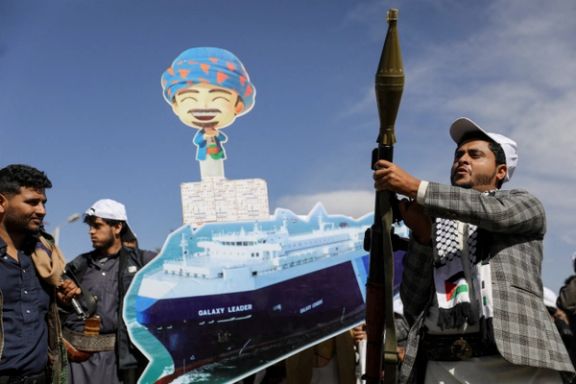
The US military thwarted upcoming attacks to merchant vessels and US navy ships by Iran’s Houthi militia in Yemen amidst its Red Sea blockade.

The US military thwarted upcoming attacks to merchant vessels and US navy ships by Iran’s Houthi militia in Yemen amidst its Red Sea blockade.
Central Command, via its official X account, announced the operations, saying, “CENTCOM forces identified the USVs and missiles in Houthi-controlled areas of Yemen, as well as the UAV over the Red Sea, and determined that they presented an imminent threat to merchant vessels and to the US Navy ships in the region.”
Iran's longstanding support for the Houthis has come into focus once again. Despite Iranian assertions of the Houthi group's autonomy, recent events suggest Tehran wields substantial influence over their actions.
Analysts point to parallels between the relative decrease in conflicts in Syria and Iraq following targeted attacks on high-ranking Iranian commanders and US airstrikes. This suggests Iran's adeptness in controlling its proxies when deemed necessary.
Despite a temporary hiatus in Houthi attacks earlier in February, recent incidents indicate a resurgence in targeting commercial vessels, including those of British and American origin.
President Biden's warnings over the past three months have failed to deter the intensifying attacks, with the Houthi group expanding its blockade to include ships from the US and the UK, in addition to those linked with Israel, in allegiance with Hamas in its war against Israel.
Iran-backed Hamas invaded Israel on October 7, spamming a Tehran fueled proxy war.

The United Nations’ fact-finding mission, set up in December 2022 following Iran's bloody crackdown on protesters, will release its comprehensive report on March 18.
The mission is also scheduled to release its preliminary report on the International Day of Women (March 8).
In his address to the 55th session of the United Nations Human Rights Council (HRC) in Geneva on Monday, Iran's Foreign Minister Hossein Amir-Abdollahian accused the UN of double standards and criticized it for setting up the fact-finding mission for Iran but not taking any serious action on Israel’s killing of civilians in Gaza.
“We will not forget the outcries in this place months ago under the pretext of an Iranian girl’s death and the formation of a so-called fact-finding mission,” he said.
In her address to the same meeting Monday, the German Foreign Minister Anna Baerbock called for extending the mission’s mandate. “I want to be crystal-clear to those who claim that calling out violations is an interference in internal affairs: Human rights are universal. A life is a life,” she said.
Mahmoud Amiri-Moghadam, director of Oslo-based Iran Human Rights Organization, told Iran International on Monday that it is the outcome of the mission’s investigations that is of great significance and expressed hope that its mandate would be extended for another year.
“The Islamic Republic has always accused human rights organizations and the UN rights bodies of being politically motivated and has never been accountable to them, he said. “But the mission’s report will be a very important message to [Iranian] people who will know the world has heard them …, especially if the mission concludes that [the regime’s actions] were crimes against humanity,” he added.
The UN Human Rights Council voted November 24, 2022, to launch an independent investigation into Iran's deadly repression of peaceful anti-government protests during the Woman, Life, Freedom movement. The motion to form the mission passed with 25 votes in favor, six opposed and 16 countries abstaining from the vote. The following month, members of the mission were announced.
The death of 22-year-old Mahsa Amini in September 2022 in the custody of the morality police unleashed a wave of protests across Iran that lasted until February 2023.
During the protests, security forces killed more than 550 civilians including tens of children. Security forces also blinded scores of protesters with shotgun pellet aimed directly at their faces, and tortured many of the tens of thousands of protesters that were arrested. Many of the victims also claim to have been sexually assaulted during interrogations and in prison.
In the past year Iran has also hanged nine protesters despite widespread pleas at home and abroad not to carry out the death sentences after sham trials held behind closed doors and without due process.
Despite these documented atrocities, Tehran almost immediately announced that it did not recognize the fact-finding mission and would not cooperate with it and summoned the German envoy Hans-Udo Muzel to the foreign ministry to protest Berlin’s key role in urging a special Human Rights Council meeting and the formation of the mission.
The UN Special Rapporteur on Iran Javaid Rehman said in November 2023 that the mandate of the mission goes beyond Iran’s human rights violations during 2022 protest crackdown and even extends into the mass execution of political prisoners in 1980s as well as violations of minority rights.
Members of the mission have not been allowed to visit Iran to collect evidence and speak to victims of the violence or their families. The Islamic Republic has also refused to allow UN special rapporteurs on human rights to visit the country since 1992.

Israeli airstrikes struck Lebanon's Bekaa Valley on Monday; the deepest point targeted since hostilities began in mid-October resulting in the deaths of two members of Iran-backed Hezbollah.
The strikes mark a significant escalation, representing attack on targets that are almost 100 kilometers from the traditional front.
Iran provides significant support to Hezbollah, as well as several other groups in the region designated as terrorist organizations, including Hamas and Islamic Jihad in Gaza, and the Houthis in Yemen.
The Israeli military confirmed that the airstrikes targeted Hezbollah's air defenses in the Bekaa Valley in response to the downing of an Israeli drone by Hezbollah using a surface-to-air missile.
In retaliation to the air strikes, Hezbollah launched 60 Katyusha rockets at an Israeli military headquarters heightening tensions in the region amidst the ongoing conflict in Gaza.
Hezbollah politician Hassan Fadlallah said in televised remarks delivered at the funeral of a Hezbollah fighter killed in recent days that "Its [Israel’s] aggression on Baalbek or any other areas will not remain without response."
Lebanese television station Al-Jadeed broadcasted images of smoke rising from the area, depicting the aftermath of the airstrikes. Additionally, an Israeli airstrike targeted a car in southern Lebanon, resulting in at least one death, as reported by Hezbollah's al-Manar TV.
Hezbollah has been actively targeting Israeli border positions since the October 7 raid from the Gaza Strip by its Palestinian ally, Hamas, purportedly in support of Palestinians facing Israeli attacks in Gaza.
Earlier on Monday, Hezbollah claimed responsibility for shooting down an Israeli Hermes 450 drone over Lebanese territory.

In response to the escalating threat posed by Iran, the Israeli Air Force (IAF) has established a unit dedicated to countering Tehran's growing hostility towards Israel.
Led by Major General Tomer Bar, the newly formed Iran unit is a show of force not only to Iran but also to the United States, highlighting concerns over perceived gaps in addressing Iran's nuclear aspirations and its support for terrorism.
The unit's mandate encompasses overseeing military preparations for potential Iranian threats, with a particular emphasis on countering Iran's nuclear ambitions. Moreover, it signals Israel's preparedness to confront Iranian-sponsored terrorism across multiple theaters, including Yemen, Iraq, Lebanon, Syria, the West Bank, and the Gaza Strip.
Iran is currently at the helm of a regional proxy war which has seen its militias come out in support of the Hamas attack on Israel on October 7, in a war which has escalated to draw in international players including the US and UK.
In recent years, Israel has ramped up its airstrikes on Syria in a bid to thwart Tehran's growing reliance on aerial supply routes for delivering arms to its allies in Syria and Lebanon, notably Hezbollah.
The news of the new unit counters claims from former Israeli Prime Minister Ehud Olmert who said last week that Israel's air force lacks the necessary resources to halt Iran's nuclear program through military action amid the two nations' shadow war.
In an interview with The National, Olmert, a long time rival of Prime Minister Benjamin Netanyahu, said, "We can destroy their headquarters, important projects, railways, roads, and airports .. Israel can do a lot to damage Iran's infrastructure, but Israel has no means to be able to destroy the nuclear program of Iran."

Recent attacks on cargo ships by Iran-backed Houthi rebels have affected British retailers and exporters, with more than half feeling the impact.
According to a survey by the British Chambers of Commerce (BCC), the shipping costs from Asia to Europe have surged by up to 300% for certain businesses, while logistical delays have extended delivery times by three to four weeks. Such delays are causing cashflow challenges and shortages of components on production lines, impacting the economy at large.
The Houthi rebels, backed by Iran and controlling significant parts of north-western Yemen, have been targeting merchant vessels in the region since November. They claim the actions are in solidarity with Palestinians amid the conflict between Israel and Hamas in Gaza.
In response to the disruptions, the US and the UK have conducted airstrikes against 18 Houthitargets in Yemen over the weekend, including weapons storage facilities. However, despite the efforts, the disruption persists with no sign of abating.
William Bain, the head of trade policy at the lobby group, is urging the government to provide support for exporters in the upcoming budget, citing weak global demand and rising costs.
“There has been spare capacity in the shipping freight industry to respond to the difficulties, which has bought us some time. And recent [government] data also indicates the impact has yet to filter through to the UK economy, with inflation holding steady in January,” Bain said.
Furthermore, disruptions at the Suez Canal have forced shipments from China to Europe to take longer routes around Africa, doubling shipping costs since December. Issues at the Panama Canal, stemming from low rainfall, have also led to restrictions on traffic passing through its locks, exacerbating the challenges faced by businesses.

The US military said early on Monday that Iran-backed Houthis launched one anti-ship ballistic missile likely targeting the MV Torm Thor, but missed the US-flagged, owned and operated oil tanker, in the Gulf of Aden on February 24.
The US military also shot down in "self-defense" two one-way unmanned aerial attack vehicles over the southern Red Sea on Sunday, Central Command (CENTCOM) said. This followed joint US and British air strikes on a string of Houthi targets in Yemen.
Iran accused the United States and Britain of escalating tensions on Sunday, following the two countries' joint strikes. The Houthis have received extensive Iranian military support and control a substantial part of Yemen.
This was the fourth round of joint strikes to “degrade” the capabilities of the Houthis and came after a marked increase in attacks by the Iran-backed group on ships in the Red Sea and Gulf of Aden last week.
Shortly after the attack, Iran’s foreign ministry issued a statement, accusing the US and Britain of seeking to “escalate” regional tensions and “expand the scope of war and instability.”

“This kind of arbitrary and aggressive military operation, aside from aggravating insecurity and instability in the region, will not achieve anything for these aggressor countries,” said Iran’s foreign ministry spokesman Nassar Kanaani.
Iran is known to be the prime sponsor of the Houthis, funding, arming, and even “serving side by side” their forces on the ground. Iranian officials maintain that the Houthis don’t take orders from Tehran, but the relative quiet in Syria and Iraq following the targeted assassinations of a few high-ranking IRGC commanders and US air strikes show that Iran may hold just enough leverage to stop its proxies if and when it finds the alternative too costly.
The Houthis too had all but stopped their attacks for a couple of weeks since early February. But they resumed targeting commercial vessels last week, including a US-owned, flagged and operated ship and a UK-owned, Belize-flagged cargo ship, which remains anchored half-sunk in the Red Sea, leaving behind a 30 km oil slick.
In just three days last week, the Houthis targeted or hit more ships than the preceding 3 weeks combined. Some experts linked the sudden rise in attacks to Iran’s spy ship Behshad resuming operation in the region after 17 days anchoring near a Chinese port-base in Djibouti.
The extensive, joint strike early Sunday (Yemen Time) seems to have been a direct response to the resumption of Houthi attacks –and the targeting of US and UK ships, in particular. About 18 sites across a number of locations were hit in the recent strike, targeting missiles, launchers, rockets, drones and unmanned surface and underwater vehicles, according to US officials.
"We will continue to make clear to the Houthis that they will bear the consequences if they do not stop their illegal attacks,” US defense secretary Lloyd Austin said following the operation, reiterating that the objective was to “further disrupt and degrade the capabilities of the Iranian-backed Houthi militia."
Critics of the Biden administration say the said objective is too conservative as it does not aim to stop and deter. Therefore, they argue, it’s a failure even if it succeeds. Iran can (and does) attempt replenishing the ‘degraded’ capabilities, despite US disruptions –such as their seizure of Iranian weapons shipment to the Houthis.
For more than three months –since the Houthis began their attacks in support of Palestinians following the Israeli onslaught on Gaza– President Biden has been warning that he will not tolerate Houthi attacks against commercial shipping.
But the attacks have continued and have even escalated, taking into account the recent targeting of British and American ships, and the Houthi announcement that the blockade of the Red Sea has been extended from Israel-related vessels to those of the US and the UK.