Iran's Nuclear Program Has No Credible Civilian Purposes, US Repeats
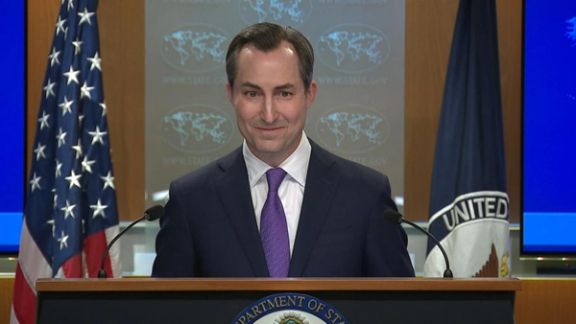
US State Department Spokesman Matthew Miller
US State Department Spokesman Matthew Miller said the US remains "seriously concerned about Iran’s continued expansion of its nuclear program in ways that have no credible civilian purpose".
During his Monday briefing, he said Iran's continued production of highly enriched uranium remains a major policy concern. The statements came as two confidential reports from the UN's nuclear watchdog were distributed to member states on Monday, providing a grim assessment of Iran's nuclear program.
Persistent obstacles to thorough inspection procedures continue to obscure the true nature of Iran's activities, heightening concerns about the intentions of the Tehran regime.
IAEA head Rafael Grossi said that "public statements made in Iran regarding its technical capabilities to produce nuclear weapons" have only increased "concerns about the correctness and completeness of Iran's safeguards declarations".
Iran's enriched uranium stockpile has now exceeded 5.5 tons, representing an increase of one ton since October. Within the stockpile are 712.2 kilograms of uranium enriched up to 20 percent and 121.5 kilograms enriched up to 60 percent. Notably, the latter category has seen a decrease of approximately 7 kilograms over the past hundred days.
The Wall Street Journal reported that Iran has decided to reduce its stockpile of 60 percent enriched uranium over the last three and a half months "by deliberately diluting the material by mixing it with low-grade 2 percent material", noting that it is the first time the International Atomic Energy Agency has reported a quarterly drop in Tehran's highly enriched stockpile since Iran started production.
According to definitions established by the International Atomic Energy Agency (IAEA), Iran would require a minimum of 42 kilograms of uranium enriched to 60 percent to produce a nuclear bomb.
Iranian authorities have consistently asserted that Iran's nuclear program is solely intended for peaceful purposes. However, nuclear experts overwhelmingly argue that the levels and quantities of enrichment undertaken by Iran since 2021 cannot be justified in the absence of a weapons program.
The US military thwarted upcoming attacks to merchant vessels and US navy ships by Iran’s Houthi militia in Yemen amidst its Red Sea blockade.
Central Command, via its official X account, announced the operations, saying, “CENTCOM forces identified the USVs and missiles in Houthi-controlled areas of Yemen, as well as the UAV over the Red Sea, and determined that they presented an imminent threat to merchant vessels and to the US Navy ships in the region.”
Iran's longstanding support for the Houthis has come into focus once again. Despite Iranian assertions of the Houthi group's autonomy, recent events suggest Tehran wields substantial influence over their actions.
Analysts point to parallels between the relative decrease in conflicts in Syria and Iraq following targeted attacks on high-ranking Iranian commanders and US airstrikes. This suggests Iran's adeptness in controlling its proxies when deemed necessary.
Despite a temporary hiatus in Houthi attacks earlier in February, recent incidents indicate a resurgence in targeting commercial vessels, including those of British and American origin.
President Biden's warnings over the past three months have failed to deter the intensifying attacks, with the Houthi group expanding its blockade to include ships from the US and the UK, in addition to those linked with Israel, in allegiance with Hamas in its war against Israel.
Iran-backed Hamas invaded Israel on October 7, spamming a Tehran fueled proxy war.
Israeli airstrikes struck Lebanon's Bekaa Valley on Monday; the deepest point targeted since hostilities began in mid-October resulting in the deaths of two members of Iran-backed Hezbollah.
Iran provides significant support to Hezbollah, as well as several other groups in the region designated as terrorist organizations, including Hamas and Islamic Jihad in Gaza, and the Houthis in Yemen.
The Israeli military confirmed that the airstrikes targeted Hezbollah's air defenses in the Bekaa Valley in response to the downing of an Israeli drone by Hezbollah using a surface-to-air missile.
In retaliation to the air strikes, Hezbollah launched 60 Katyusha rockets at an Israeli military headquarters heightening tensions in the region amidst the ongoing conflict in Gaza.
Hezbollah politician Hassan Fadlallah said in televised remarks delivered at the funeral of a Hezbollah fighter killed in recent days that "Its [Israel’s] aggression on Baalbek or any other areas will not remain without response."
Lebanese television station Al-Jadeed broadcasted images of smoke rising from the area, depicting the aftermath of the airstrikes. Additionally, an Israeli airstrike targeted a car in southern Lebanon, resulting in at least one death, as reported by Hezbollah's al-Manar TV.
Hezbollah has been actively targeting Israeli border positions since the October 7 raid from the Gaza Strip by its Palestinian ally, Hamas, purportedly in support of Palestinians facing Israeli attacks in Gaza.
Earlier on Monday, Hezbollah claimed responsibility for shooting down an Israeli Hermes 450 drone over Lebanese territory.
Iran has diluted some of its near weapons-grade uranium for the first time, but its total stock of nuclear material stands at 27 times the limit agreed in the 2015 JCPOA nuclear deal.
Two confidential reports by the UN nuclear watchdog, sent to member states on Monday, paint an overall bleak picture of Iran’s nuclear program with persisting obstacles to proper inspection casting a shadow over its nature and raising concerns about the intentions of the regime in Tehran.
“Only through constructive and meaningful engagement can these concerns be addressed,” International Atomic Energy Agency (IAEA) chief Rafael Grossi wrote in one of his two quarterly reports. “Public statements made in Iran regarding its technical capabilities to produce nuclear weapons only increase the Director General’s concerns about the correctness and completeness of Iran’s safeguards declarations.”
According to the reports, seen by several news outlets, Iran now has more than 5.5 tons of enriched uranium, up by a ton from October. This includes 712.2 kilograms of uranium enriched at up to 20 percent and 121.5 kilograms at up to 60 percent. It’s this latter stock that has decreased by about 7 kilograms in the past hundred days.
International Atomic Energy Agency (IAEA) Director General Rafael Grossi attends a press conference, amid Russia's attack on Ukraine, in Kyiv, Ukraine February 6, 2024.
Iran needs a minimum of 42 kilograms of uranium enriched to 60 percent to make a nuclear bomb, based on definitions set by the IAEA. It had enough of this material at the end of 2023 to produce three nuclear bombs. The dilution last quarter means that stock is still more than enough for two.
It’s unclear why Iran decided to get rid of some of its highly-enriched uranium in the last three months. And IAEA has offered no explanation in its reports. It is hard to ignore the fact, however, that the timeframe of this ‘downblending’ matches the timeframe of the recent crisis in the Middle East, which began with Hamas’ rampage of border areas of southern Israel and the ensuing –and ongoing– Israeli onslaught on Gaza last October.
"Maybe they don't want to increase tensions (with the West). Maybe they have an agreement with somebody. We don't know," Reuters quoted a senior diplomat. "At the beginning of the year they decided to do a downblending... A couple of weeks later they did another downblending, this time with a smaller amount."
Whatever the reason behind the decision, the reduction in Iran’s near weapons-grade uranium would likely offer some relief to American and European leaders who have been struggling to find a convincing response to Iran’s nuclear ambitions.
President Joe Biden spent the first half of his term trying to revive the 2015 nuclear deal with Iran –and failed. He then turned to chasing an informal agreement, looking the other way as China purchased tens of billions of Iran’s sanctioned oil, and releasing at least $16 billion of frozen funds, all to encourage the Iranian regime to limit its enrichment program, even temporarily.
As a result of those secret talks, Iran slowed its enrichment of uranium to up to 60 percent last summer. In November, however, it resumed its pre-slowdown activities, according to an IAEA report last December.
Iranian officials have always maintained that Iran’s nuclear program is purely for peaceful purposes. But nuclear experts are almost unanimous in their assessment that enrichment to the levels and in the amounts that Iran has been doing since 2021 cannot be justified in the absence of a weapons program.
Successive US administrations, including the current one, have publicly vowed to prevent Iran from ever obtaining a nuclear weapon. In private, however, politicians and experts say that it’s near impossible to stop the Iranian regime if it ever decides to make a bomb.
Recent attacks on cargo ships by Iran-backed Houthi rebels have affected British retailers and exporters, with more than half feeling the impact.
According to a survey by the British Chambers of Commerce (BCC), the shipping costs from Asia to Europe have surged by up to 300% for certain businesses, while logistical delays have extended delivery times by three to four weeks. Such delays are causing cashflow challenges and shortages of components on production lines, impacting the economy at large.
The Houthi rebels, backed by Iran and controlling significant parts of north-western Yemen, have been targeting merchant vessels in the region since November. They claim the actions are in solidarity with Palestinians amid the conflict between Israel and Hamas in Gaza.
In response to the disruptions, the US and the UK have conducted airstrikes against 18 Houthitargets in Yemen over the weekend, including weapons storage facilities. However, despite the efforts, the disruption persists with no sign of abating.
William Bain, the head of trade policy at the lobby group, is urging the government to provide support for exporters in the upcoming budget, citing weak global demand and rising costs.
“There has been spare capacity in the shipping freight industry to respond to the difficulties, which has bought us some time. And recent [government] data also indicates the impact has yet to filter through to the UK economy, with inflation holding steady in January,” Bain said.
Furthermore, disruptions at the Suez Canal have forced shipments from China to Europe to take longer routes around Africa, doubling shipping costs since December. Issues at the Panama Canal, stemming from low rainfall, have also led to restrictions on traffic passing through its locks, exacerbating the challenges faced by businesses.
Iran's foreign minister arrived in Geneva on Sunday to address the UN's Human Rights Council and participate in the disarmament conference amid the regime's ongoing repression back home.
Hossein Amir-Abdollahian's being given a platform amid the worst rights abuses since the Islamic Republic was founded in 1979, has led to criticism of the rights body with many activists boycotting events for which he is scheduled to attend, and calling for those attending to leave on his planned address.
Ladan Boroumand, an Iranian human rights activist and co-founder of the Abdorrahman Boroumand Foundation, said, "You can't stand still and listen to [the] torrents of lies he will unleash to fill [the] UN Human Rights' Council with an abominable alternative reality."
Iranian rights activist Nazanin Boniadi also urged US officials to boycott the session.
Iran is one of the few countries worldwide for which the UN Human Rights Council has appointed a special rapporteur. However, in November, widespread criticism ensued when the presidency of the two-day UN Human Rights Council Social Forum was handed over to the ambassador of Iran.
Iran has a history marred by severe human rights violations including crackdowns on political dissent, arbitrary arrests, torture, and executions. Religious and ethnic minorities, as well as women and LGBTQ+ people, face ongoing discrimination and persecution.
Freedom of expression and assembly are heavily restricted, with journalists, activists, and peaceful protestors frequently targeted. The regime's use of force to suppress protests and dissent has led to hundreds of deaths and injuries.