IRGC Chief Claims Regime's Resilience Amid Sanctions
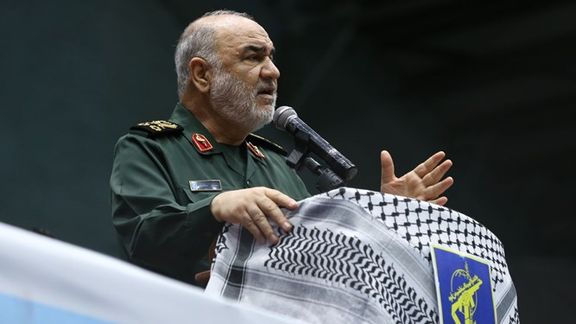
In the face of economic pressure from sanctions, Iran's IRGC Chief says the regime has navigated through the challenges posed by the punitive measures.

In the face of economic pressure from sanctions, Iran's IRGC Chief says the regime has navigated through the challenges posed by the punitive measures.
"Thanks to the forces of the Khatam al-Anbiya headquarters, we have passed through the sanctions", Hossein Salami said, in spite of the fact the country's economy is crippled by the global sanctions, hailing the unit for its role in the likes of the country's oil and construction sectors in which money is generated for the IRGC's military efforts at home and its proxy militias abroad.
Established during the Iran-Iraq War in the 1980s, the Khatam al-Anbiya Construction Headquarter has since evolved into a prominent player in Iran's industrial and developmental landscape, expanding its operations to encompass mechanical engineering, energy, mining, and defense sectors.
Iran has been subject to various sanctions primarily due to concerns about its nuclear program, support for terrorism, and human rights abuses. The United States and other countries including the US, France and the EU, have imposed sanctions on both individuals and government and private entities, at home and abroad, to squeeze the regime into compliance with international law.
In spite of this, the regime continues to fund and arm regional militias, sell drone technology to Russia for its war on Ukraine, and its nuclear program has only accelerated.
However, on the ground, sanctions, which have been a recurrent feature of Iran's economic landscape, have exacerbated the challenges facing the country's citizens. Consequently, Iran has grappled with economic stagnation, inflation, currency devaluation, and unemployment, significantly impacting the well-being of the Iranian people.

Iran's attempt to establish a permanent naval base on Sudan's Red Sea coast has been rejected according to a senior Sudanese intelligence official.
Ahmad Hasan Mohamed, intelligence adviser to Sudan’s military leader, disclosed that Iran sought to construct the base to monitor maritime traffic to and from the Suez Canal and Israel.
“The Iranians said they wanted to use the base for intelligence gathering,” Mohamed said in an interview with the Wall Street Journal. “They also wanted to station warships there.”
Mohamed stated that Iran had offered explosive drones to Sudan's military to combat rebel forces amid the civil war and proposed a helicopter-carrying warship in exchange for permission to build the base. However, Sudan rejected the deal to avoid straining relations with the United States and Israel.
Iran's pursuit of a naval foothold in the Red Sea aims to bolster its influence in one of the world's busiest shipping lanes, aiding Houthi rebels in Yemen to disrupt maritime traffic. Since November, the Iran-backed Yemeni militia has been blockading the route amid the Gaza war, in a bid to force Israel into a ceasefire. Instigated by Iran's supreme leader, the group has targeted Israeli linked ships and more recently, US and UK vessels in response to their support for Israel.
The backdrop of Sudan's 10-month-old civil war has become a battleground for regional powers vying for strategic influence. Sudan's military, engaged in conflict with paramilitary forces, has sought external support, including drones from Iran, to gain the upper hand in the ongoing conflict.
Iran has long been a primary provider of drones to Sudan, steadily enhancing the country's capabilities from surveillance to offensive operations.
The Iranian Revolutionary Guard (IRGC) has faced accusations of contributing to regional destabilization by supporting proxy groups in the Middle East and beyond. Critics argue that the IRGC's involvement in various conflicts raises concerns among international stakeholders about Iran's influence and its potential impact on regional stability.

A cargo ship that was hit by Iran-backed Houthis two weeks ago, sank in the Red Sea early Saturday with thousands of tons of potentially hazardous chemicals.
This is the first time a vessel sinks as a result of Houthi attacks. As of February 25, Houthis had attacked at least 57 commercial and military vessels.
The UK-owned, Belize-flagged Rubymar is carrying “21,000 metric tons of ammonium phosphate sulphate fertilizer,” according to US military, which confirmed earlier reports about the fate of the vessel.

“The ship had been slowly taking on water since the unprovoked attack [on 18 February],” US Central Command posted on X. “The … fertilizer that the vessel was carrying presents an environmental risk in the Red Sea. As the ship sinks, it also presents a subsurface impact risk to other ships transiting the busy shipping lanes of the waterway.”
Rubymar was struck by two Houthi missiles. The crew left the ship that very same day. Attempts to keep it afloat and tow it to a safe port failed eventually, raising concerns about its cargo.
"The release of large quantities of fertilizers into the Red Sea could cause eutrophication, depleting water of oxygen and creating 'dead zones',” said Mohammed Albasha, a senior Analyst at the Navanti Group. “Marine life… will likely suffer due to the toxic effects and reduced oxygen levels. Fishing communities along Yemen's Red Sea coast in Hudaydah and Taiz will be impacted by the contamination".
Iran-backed Houthis have effectively closed off the Red Sea with their missile and drone strikes. They maintain that their attacks are solely in support of Palestinians and would cease if and when there's a ceasefire between Israel and Hamas.
On Saturday, the US Department of State announced that the Houthi attacks on commercial ships in the Red Sea are “doubling shipping costs to the United States”, as major operators re-route and go around the southern tip of Africa.
Commodities experts say grain transit through the Suez Canal has halved while grain ships bound for Iran navigate the Red Sea untroubled.
“The Iran-backed Houthis pose a heightened threat to global maritime activities,” CENTCOM posted on X earlier Sunday. “The United States and coalition partners remain committed to safeguarding freedom of navigation, striving to enhance the safety and security of international waters for merchant shipping.”
The United States and Britain dispatched warships to protect commercial vessels in the Red Sea, shortly after the start of the Houthi attack last November. Both countries then launched a series of airstrikes on Houthi sites in Yemen, hoping to “degrade” the group’s capabilities.
On Saturday, a few hours before Yemen sources declared Rubymar sunk, the head of Houthi supreme revolutionary committee said he held the British prime minister, Rishi Sunak, responsible for the sinking of the UK-owned Rubymar.
In a post on his X account, Mohammed Ali al-Houthi wrote that Sunak still had a chance to recover the Rubymar by allowing aid trucks into Gaza –
an offer that was never meant to be taken and wasn’t.
The consequences of Rubymar’s sinking are unclear. There’s been no official statement, but it’s likely that it would trigger another round of airstrikes and even harsher response in the hope that some form of deterrence is restored.
Biden critics say his administration is to blame for emboldening the Houthis’ and –perhaps more importantly– Iran. US president Joe Biden has admitted that he didn’t think the airstrikes he authorized could end the Houthi attack, who, undeterred, have threatened to further “surprise” the “enemy.”

US Central Command (CENTCOM) announced the successful interception of a surface-to-air missile, poised to be launched towards the Red Sea from Yemen by pro-Iranian Houthi militias.
The intercepted missile on Saturday was identified as a significant threat to US aircraft in the region.
“On March 1, at approximately 12:40 pm (Sanaa time), US Central Command (CENTCOM) forces conducted a self-defense strike against one Iranian-backed Houthi surface-to-air missile that was prepared to launch from Houthi controlled areas of Yemen towards the Red Sea. CENTCOM forces identified the missile and determined it presented an imminent threat to US aircraft in the region,” CENTCOM announced on X.
The incident unfolds amid escalating tensions, with Houthi fighters targeting both commercial and military vessels since November. Initially directed at ships associated with Israel in solidarity with Palestinians in Gaza, the attacks have since broadened to include vessels linked to the United Kingdom and the United States.
Last month, US forces, in collaboration with the United Kingdom Armed Forces and other nations, launched strikes against 18 Houthi targets in Yemen controlled by Iranian-backed Houthi militants.
The multinational efforts, as stated by US Central Command, aim to protect their respective countries, partners, and allies in the region. The heightened insecurity in the Red Sea has prompted major shipping lines to avoid the critical trade route, opting for longer journeys around Africa. The shift has led to increased expenses, raising concerns about global inflation.

Amid recent escalation of military tensions, an Israeli drone strike in south Lebanon killed three Hezbollah fighters on Saturday.
According to security sources in Lebanon, the incident unfolded on a coastal road near the town of Naqoura, targeting individuals traveling in a car. The Israeli military has stated that it is currently assessing the reports surrounding the incident.
The fighters have been reportedly identified as Mohammad Ali Ghobris, alias Karballa, hailing from Tyredebba; Mustafa Hussein Salman, known as Al-Hurr, from Majdal Zun; and Ali Abdul Nabi Qassem, alias Siraj, born in Mahrouna—all towns in southern Lebanon.
The strike marks another deadly episode amid ongoing Israeli airstrikes in Lebanon since October, resulting in the deaths of over 200 Hezbollah fighters and approximately 50 civilians. Hezbollah has been launching attacks from Lebanon into Israel that have claimed the lives of twelve Israeli soldiers and five civilians. The escalating violence has forced tens of thousands of Israelis and Lebanese to flee their homes along both sides of the border.
Israel rarely offers detailed information regarding individual strikes conducted within Syria or Lebanon, yet it has consistently affirmed its resolve to thwart Iran's efforts to extend its influence across the region.
Similar to the Palestinian Islamist group Hamas, Hezbollah maintains close ties with Iran. Hezbollah claims that its operations along the border aim to provide solidarity and assistance to Palestinians enduring Israeli attacks in the Gaza Strip.

A suspected Israeli strike hit a villa in Baniyas, Syria believed to have been inhabited by individuals affiliated with Iran-backed militia, A war monitor reported on Friday.
The Syrian Observatory for Human Rights said that three loud explosions were heard in the southern outskirts of Baniyas at dawn, which were caused by what it said were Israeli air strikes. According to Iranian Student News Agency, Reza Zarei, “a military advisor of the Revolutionary Guards,” was Killed in the attack.
Israel has intensified air strikes in recent weeks targeting Iran’s Revolutionary Guard senior personnel and bases, as well as affiliated militia forces in Syria. On Thursday, there were two suspected Israeli attacks, one targeting a truck belonging to the Lebanese Hezbollah that is a major part of the Iranian-led forces in Syria. Israel also hit a Syrian air defense unit that fired at its aircraft.
There were several attacks in late January and early February on IRGC targets in Damascus and elsewhere in Syria, killing several high-ranking Iranian officers.
Iran intervened in the Syrian civil war more than a decade ago to support strongman Bashar al-Assad against his armed opponents. Israel saw the entrenchment of Iranian forces in Syria as a direct threat and began regularly attacking their bases and weapons concentrations from 2017.