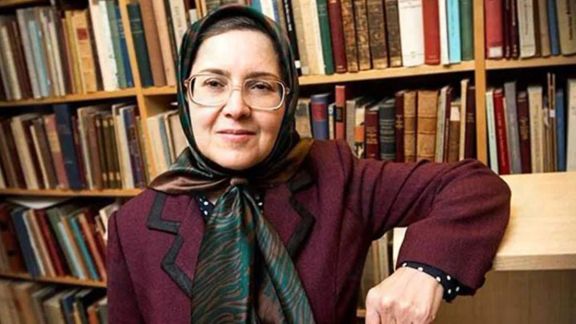
Sedigheh Vasmaghi, a prominent writer and Islamic scholar
Sedigheh Vasmaghi, a prominent writer and Islamic scholar currently held in Tehran's notorious Evin prison, has refused a summons to appear before the Tehran Revolutionary Court branding it "illegal".
In response to the summons, Vasmaghi said, "The Revolutionary Court is not lawful, and defending oneself in this unjust court is meaningless. I will not appear there and I do not want to confront the unjust judges."
She was arrested on Saturday after her ongoing criticism of compulsory hijab laws and her characterization of Ali Khamenei, the Supreme Leader of the Islamic Republic, as a “dictator”, and the ruling regime as “oppressive”.
Vasmaghi's warrant levies accusations against her including "anti-government propaganda on social media" and "appearing in public without Islamic hijab". She has long been an advocate of women's rights. She first gained attention after she removed her own hijab in protest following the death of Armita Geravand, a teenager killed by hijab-enforcement agents in the Tehran metro last year.
Vasmaghi's family now fear for her health as she is deprived of access to adequate medical facilities. A source close to her family told Iran International that her health deteriorated on Monday morning in prison, with her heart rate exceeding 120 and her blood pressure rising above 160.
Evin prison authorities also denied Vasmaghi permission to meet her family on Sunday, citing her refusal to wear a headscarf and comply with mandatory hijab rules.
The Tehran Province Court of Appeals has upheld the five-year sentence for Saeed Azizi, an Iranian-Swedish dual-national, one of several held as part of Tehran's hostage diplomacy policy.
Azizi, 60, was arrested by Iranian security forces on November 12 at his private residence shortly after returning from Sweden to Iran. His lawyer had previously highlighted Azizi's deteriorating health condition, citing prostate cancer and injuries sustained from a fall in prison.
The Swedish government has expressed deep concern over the detention of its citizens, demanding their immediate release. In mid-January, Sweden called for Azizi's release, stating that Iran had detained him "without any specific reason."
Critics accuse the Islamic Republic of Iran of leveraging the detention and trial of Western or dual-national citizens as a means to advance its political agendas and to provoke tensions with Western governments. Last year, the United States unfroze $6 billion of Iran's blocked funds in exchange for the release of five hostages.
It is believed that Swedes and dual nationals have come under fire since 2022 as a result of the life-sentence handed to former Iranian jailor, Hamid Nouri, imprisoned in Sweden for his role in the purge of dissidents in 1988. Nouri, 62, received the life sentence from a Swedish district court in July 2022 for "grave breaches of international humanitarian law and murder."
After months of legal battles, an appeals court upheld the verdict in December 2023, leading Nouri to seek recourse with the Supreme Court, but the appeal was rejected.
UN’s rapporteur on Iran’s human rights and its fact-finding mission have renewed their call to hold Tehran accountable for its violations, including brutal crackdown on dissent and surging executions.
The Human Rights Council hosted members of the UN's fact-finding mission that was established to investigate Iran’s crackdown on the popular protests of 2022, ignited by the death in custody of 22-year-old Mahsa Amini, arrested for allegedly violating the Islamic dress code.
Her death unleashed months of mass protests across Iran, marking the biggest challenge to Iran's clerical leaders in decades. The mission released an initial report last week, stating that the regime’s crackdown on protests amounts to “crimes against humanity.”
"Our investigation established that her death was unlawful and caused by physical violence in the custody of state authorities," said Sara Hossain, the chairperson of the mission told the Council in Geneva on Monday.
A woman holds a placard with pictures of, as Iranian call them, martyrs, during a rally of Iranian diaspora in Europe, on the eve of the first anniversary of the death of Mahsa Amini, which prompted protests across their country, in Brussels, Belgium September 15, 2023.
She said the protests that followed were marked by "egregious human rights violations", including extra-judicial executions, arbitrary arrests, torture and ill-treatment, as well as rape and sexual violence. "These acts were conducted in the context of a widespread and systematic attack against women and girls, and other persons expressing support for human rights."
"Some of these serious violations of human rights thus rose to the level of crimes against humanity," she emphasized, adding that since the protests women and girls in Iran were confronted daily by discrimination "affecting virtually all aspects of their private and public lives".
"It is hard to fathom that in the 21st century, women's access to the most basic service and opportunities, such as schools, universities, hospitals, and courts, or to opportunities for employment in government or other sectors, should be subjected to a wholly arbitrary requirement of wearing the mandatory hijab," she said.
The UN's Iran rapporteur, Javaid Rehman was first to address the 55th regular session of the Human Rights Council in Geneva on Monday, warning of the "deeply concerning" impunity for serious human rights violations in the country.
He expressed concern about the high number of executions in Iran, pointing out that the number of hangings increased 43 percent in 2023 in comparison to a year earlier to over 800. Rehman underlined that many of the executions follow trials that do not meet fair trial standards, particularly highlighting the death sentences related to the 2022 protests.
The rapporteur also decried the regime’s treatment of women who defy the mandatory hijab laws, expressing concerns about the deprivation of their basic rights as a punishment. Iran has intensified punitive measures to enforce its strict hijab laws such as banning defiers from public services and grounding their cars.
Rehman also highlighted the situation of ethnic and religious minorities, who are disproportionately affected by the death penalty, particularly for drug-related or security offenses. He particularly expressed concern about the harassment, intimidation, targeting, arrest, and detention of human rights defenders, lawyers, journalists, and trade union activists, as numbers soared since the 2022 uprising. At least79 journalists alone were arrested in the year after the protests sparked by the death in morality police custody of Mahsa Amini.
He emphasized that his mandate has been a platform to highlight and report on violations committed by state authorities and a voice for the millions of Iranians who are victims of the abuses. He called on the member states for the extension of his mandate for another year.
Rehman has been the UN Special Rapporteur on Iran for six years and the UN Human Rights Council is set to vote on the extension in the coming days. The Iranian government has refused to allow Rehman – or any other UN human rights rapporteurs -- to visit Iran since 1992.
After Rehman, the representative of the Iranian government dismissed his report as biased and politically motivated. Tehran’s deputy ambassador to the United Nations, Zahra Ershadi, reiterated that the country does not recognize Rehman’s mandate and repeated the regime’s propaganda.
Despite mountains of evidence, Iran claims that the human rights conditions in the country is ameliorating and rejects any report that portrays the country’s grim situation. A dominant tool for justification is shifting the spotlight to the situation in Gaza, with Ershadi accusing the West of not taking any serious action on Israel’s killing of civilians in Gaza. The war in Gaza started after Iran-backed Islamist group Hamas invaded Israel and killed 1,200 mostly civilians and took over 250 hostages.
Following Iran's representative, member states took turns delivering brief remarks. With the exception of Iran's allies such as Russia, North Korea, China, and Venezuela — who defend Tehran's human rights record — nearly all envoys condemned the regime's atrocities and advocated for the extension of Rehman's mandate.
At the end of the session, Rehman took the floor for his concluding remarks, during which he called on Iran to change its “contemptuous attitude on human rights.” He rebuffed Iran’s allegations of politicization, prejudice and bias, urging the Islamic Republic to allow him to visit the country.
Rehman also called on Tehran to halt targeting foreign-based media for reporting on the situation in Iran, noting that London-based Iran International and BBC Persian staff as well as their families in the country are under constant threat and persecution and death threats by the authorities.
Just last month,leaked documents revealed that Tehran’s Revolutionary Court convicted 44 foreign-based journalists and media activists in absentia two years ago over the allegation of “propaganda against the government. At the time of the verdict, the journalists were working for foreign-based Persian-language media outlets including Iran International, BBC Farsi, Manoto, Radio Farda, GEM TV and Voice of America. The document was revealed among a trove of files accessed after the hacktivist group Edalat-e Ali, or Ali’s Justice, breached the servers of the Iranian judiciary.
In an appeal to the UN Human Rights Council, Narges Mohammadi, a prominent political prisoner and Nobel Peace Prize laureate, has called for sustained efforts in addressing human rights abuses in Iran.
Mohammadi's message emphasized the urgent need for international pressure on the Iranian regime, notorious for its violations of fundamental rights and perpetration of crimes against humanity.
Mohammadi, speaking from her incarceration, highlighted the nature of the Iranian regime's actions over the past four and a half decades. She underscored the importance of continued scrutiny by international bodies such as the UN fact-finding mission and the Special Rapporteur on Human Rights to reveal the multifaceted dimensions of oppression and gender apartheid perpetrated by the regime.
Formed by the UN Human Rights Council in November 2022 in the wake of widespread protests under the banner of Woman, Life, Freedom that swept across Iran, the fact-finding mission focuses primarily on investigating the nationwide protests that occurred from 2022 to 2023. Despite repeated appeals for cooperation, the mission's experts have expressed disappointment at the Iranian authorities' failure to provide substantial information.
"The despotic religious regime, which violates human rights and commits crimes against humanity, must be systematically and comprehensively pressured by the United Nations and human rights institutions worldwide," Mohammadi declared.
Her plea comes amidst ongoing protests and activism within Iran, including the Women, Life, Freedom movement, which has galvanized public outcry against the regime's repressive tactics. Mohammadi's call resonates with the growing chorus of voices demanding accountability and justice for victims of state-sponsored violence and discrimination.
As Mohammadi continues to endure persecution for her advocacy, her words serve as a reminder of the imperative to stand in solidarity with those fighting for democracy and human rights in Iran.
After a short respite, Iran’s currency, the rial, plummeted on Monday to its lowest-ever level against the US dollar and other major currencies, just two days before the Norouz (Nowruz) holiday.
The Iranian currency had fallen to 605,000 rials per dollar earlier this month and then briefly rose to 590,000. However, despite a US sanctions waiver last week, the rial began to fall when the markets re-opened on Saturday after the Islamic weekend on Friday.
The rial was trading at 607,000 per dollar Monday afternoon local time, with each euro fetching more than 660,000 and the British pound 773,000.
The Biden administration renewed a sanctions waiver for Iraq to import electricity and natural gas from Iran, and also allowed Baghdad to pay Tehran with euros and dollars, providing a few billions of dollars to the crippled Iranian economy. However, local investors and ordinary people expect the economic crisis to deepen and inflation to rise. They buy US dollars and other major currencies to protect their capital and savings. Iran’s current annual inflation rate hovers around 50 percent.
The United States imposed tough sanction in 2018, when former President Donald Trump withdrew from the 2015 JCPOA nuclear deal. The Biden administration initiated talks in early 2021 to restore the agreement, but Iran refused a proposal in mid-2022, increasing its uranium enrichment to near weapons grade.
Iran’s proxies are also attacking Israel and international shipping in the Red Sea, while it also supplies weapons to Russia for its invasion of Ukraine.
Niger has ended its counterterrorism pact with the US over claims of secret talks to grant Iran access to its uranium.
The announcement to halt military cooperation with the US was made by a spokesman for the Nigerien junta on Saturday night, dealing a significant blow to the Biden administration's efforts to combat Islamist insurgency in the Sahel region.
US officials had been striving to salvage their relationship with Niger since the military ousted President Mohamed Bazoum in a July coup, resulting in imposed restrictions on military aid under American law.
Recent intelligence obtained by Western officials indicated that Niger's junta was considering a deal with Iran, which would grant Tehran access to Niger's substantial uranium reserves.
Talks between the two parties allegedly progressed to an advanced stage, with a preliminary agreement reportedly signed, although not finalized.
Molly Phee, US assistant secretary of state for African affairs, raised concerns about the alleged agreement with Iran, emphasizing the necessity for Niger to return to democratic governance and expressing worries over strengthening ties with Russia.
In response to the allegations, Col. Maj. Amadou Abdramane, the junta spokesman, rebuffed the US accusations.
“The government of Niger rejects the false allegations of the head of the American delegation to maintain that it has signed a secret agreement on uranium with the Islamic Republic of Iran,” Abdramane said.
Matthew Miller, State Department spokesman, refrained from commenting on the alleged uranium deal but stated that the US would provide updates as necessary. Meanwhile, Iranian officials declined to comment on the matter.
Niger, the world's seventh-largest uranium producer, exports most of its uranium to France.