US Envoy Extends Norouz Greetings To People Of Iran
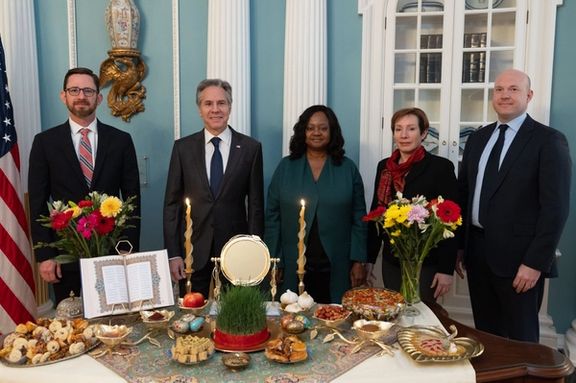
In messages shared on X, US Secretary of State Antony Blinken and Special Envoy, Abram Paley, extended warm wishes for a joyful Norouz (Nowruz), the Persian New Year, to the people of Iran.
In messages shared on X, US Secretary of State Antony Blinken and Special Envoy, Abram Paley, extended warm wishes for a joyful Norouz (Nowruz), the Persian New Year, to the people of Iran.
"As you celebrate Nowruz, we look forward to the day when the people of Iran have a government that works for them," US Deputy Special Envoy to Iran Abram Paley conveyed in his message, emphasizing a hopeful vision for improved governance in the nation.
"Today, on behalf of the US government, I want to wish the people of Iran a happy Nowruz. Nowruz should be a time to celebrate – to celebrate the new year, to reflect on the year that has passed, and to honor Persian history and culture. And, indeed, the Iranian people have much to be proud of, and they have untold potential."
Norouz marks the beginning of spring and is celebrated by millions in Iran, Afghanistan, parts of Central Asia and worldwide.
Paley added, "Iran has been blessed with tremendous natural resources and human talent -- educated, ambitious, intelligent young people -- but unfortunately the Iranian regime continues to squander this human potential through corruption and mismanagement."
"As you celebrate Nowruz and the coming of spring, we look forward to the day when the people of Iran have a government that works for them. In the meantime, the United States will continue to support you in your aspirations for a free and democratic Iran."
US Secretary of State Antony Blinken also congratulated the Persian new year, saying, “Happy Nowruz to all celebrating the arrival of spring and new beginnings. May we cherish the bonds of family and the promise of a brighter tomorrow.”
Last year, US President Joe Biden and First Lady Jill Biden hosted a ceremony at the White House for the occasion of Norouz and issued a statement that acknowledged Iranians' revolt for freedom.
Exactly at 6:36 Tehran time on March 20, the new year begins in Iran.


But, within the limited timeframe of the Biden administration's tenure, Iran finds itself at a critical juncture.
In blatant disregard of Western admonitions, Tehran persists in advancing its nuclear agenda alongside intensifying its proxy conflicts across the Middle East – its pursuits extending to brazen actions such as the killings of US servicemen in Syria.
And all the while, as it employs its own version of a maximum pressure campaign against the West, Tehran remains steadfast in its insistence on sanctions relief.
In the face of Iran's destabilizing actions and ahead of the presidential election, President Biden appears inclined towards appeasement.
Amid the war in Gaza, the US reissued a $10 billion Iran sanctions waiver – with critics arguing loudly that it frees up billions in sanctions relief to Tehran as its proxies continue to destabilize the Middle East.
As the idea of Trump's potential return to the White House casts a long shadow over Iran's diplomatic calculations – warnings from former Iranian officials are seemingly falling on deaf ears.

This week, former Iranian ambassador to the UK, Jalal Sadatian, advocated for improved cooperation with the International Atomic Energy Agency (IAEA) to garner European support – without compromising Iranian sovereignty.
While Iran has failed to cooperate with the IAEA on multiple issues since 2021 – recent points of friction between Tehran and the agency have piled up.
Iran has deactivated surveillance devices, barred senior inspectors and refused to disclose new nuclear facilities.
“Before Trump comes, we could establish a better relationship with the [IAEA] and have more reasonable cooperation. I'm not saying we should fully submit to the agency, but we can improve our relationship in a way that doesn't put Europeans against us," Sadatian said in an interview with the regime’s semi-officials news agency ILNA.
But, this kind of cautionary take from one of their own, has yet to factor into the regime’s calculations – particularly without pressure from the West.
Just this month, Iran again avoided a censure during the meeting of the IAEA Board of Governors. While there were the usual denouncements by the US, France, Germany, and the UK, in essence, Western leaders kicked the can down the road – suggesting a push for action at the June meeting if Iran does not cooperate with the agency.
Iran, meanwhile, has shown no interest in doing so, even as the presidential elections are mere months away.
The window for Iran is indeed narrowing quickly – and in that vein, Sadatian advocated prioritizing a constructive relationship with the IAEA before entertaining negotiations to resurrect the defunct JCPOA.
Concurrently in Iran, and consistent with the desperate desire to lift sanctions, a known narrative persists: the nation's hardships are solely attributed to the sanctions imposed following the US withdrawal from the JCPOA.

It's perhaps unsurprising then, that former Iranian politician and intelligence officer Ali Rabiei joins the ranks of those who conveniently place blame for Iran's economic woes squarely on sanctions.
Be that as it may, he suggests diplomatic efforts to lift sanctions – with a successful resolution to the JCPOA to alleviate some of the hardships faced by the country.
"Undoubtedly, a portion of today's chronic despair and erratic migrations stem from the disappointment of the JCPOA's unfulfillment and the repercussions arising from it," Rabiei wrote in the so-called reformist Etemad.
But, in his assessment, he fails to offer specific details on the necessary components of renegotiation or diplomatic efforts.
Late last year, Heshmatollah Falahatpisheh, the former head of parliament's foreign policy committee, attributed the failure to de-escalate tensions with the US and revive the JCPOA to the government of former President Hassan Rouhani.
This perspective perpetuates the false notion that a President wields decisive authority over significant foreign policy matters, leading some to believe that Iran merely requires a change in presidential leadership – obscuring the fundamental truth that the ultimate authority rests with the Supreme Leader.
In an interview with so-called reformist news site Entekhab, Falahatpisheh argues that negotiating with the Biden administration prior to the US elections is only justified if Iran establishes a framework to prevent the return of maximum pressure policies.

“The only directive that can validate negotiations in the current circumstances is precisely this issue. If Trump returns to power, he would bring maximum pressure, and if Biden manages to resolve the energy issue, he would exert even greater pressure on Iran. Biden greatly needs these negotiations, and Tehran should not raise minor demands in these discussions," he said.
But, a far cry from the chummy negotiations that led to the JCPOA in 2015 – Iran and the US held secret, indirect negotiations in January, with Omani officials acting as the messenger boy between the two.
It’s evident that as Iran braces itself for the possibility of a Trump return to the White House, it is grappling with a lack of clear direction in achieving its objectives.
Despite heavy international sanctions and an immense economic reliance on China, Iran persists in its destabilizing actions across the region.
The notion that Iran might heed the counsel of certain former officials disregards the inherent nature of the clerical regime.
Logic takes a backseat, as the regime's primary objectives are inherently misaligned with the West’s interests – and there is no reason to think that will change.