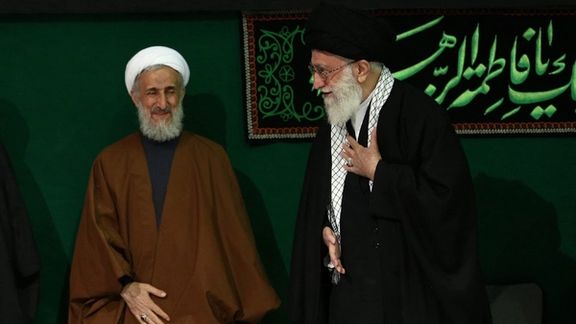
Kazem Sedighi, Tehran's interim Friday prayer imam (left) and Supreme Leader Ali Khamenei
The whistle-blower who exposed the corruption of a prominent cleric appointed as Tehran's Friday Imam by Ali Khamenei has leveled further accusations of corruption against him, sparking public outrage.
Yashar Soltani, a renowned journalist and whistle-blower, recently disclosed that a substantial plot of land valued at around $20 million in a prime location in northern Tehran was transferred to a company owned by Kazem Sedighi, Tehran's ultra-hardliner interim Friday prayer imam, along with his two sons and daughter-in-law.
Official documents reveal that the company was registered as a non-profit organization just four months ago, with Sedighi and his sons holding a 60 percent ownership stake.
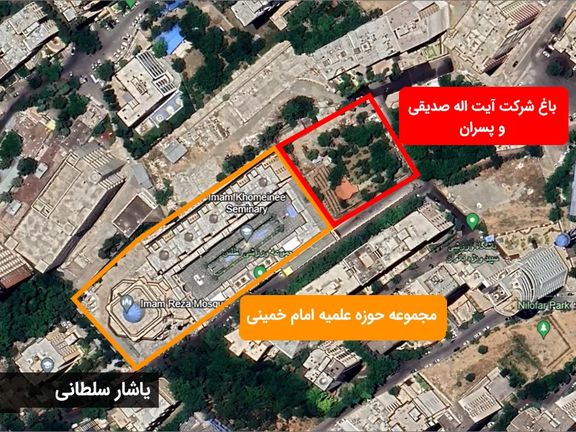
The plot in question was originally part of an aging cherry orchard owned by the Tehran Municipality. In 2003, during the tenure of the current speaker, Mohammad Ghalibaf, Sedighi was granted a 99-year lease to establish a religious seminary on the land. Additional parcels of land used for seminary expansion were acquired over the years, with much of the surrounding property owned by other state entities, including the religious endowments organization.
An aerial photo of the land (circled in red) and Sedighi’s seminary (in orange)
With the municipality's approval, long-standing fruit trees were uprooted to make way for the construction of the seminary (highlighted in orange) and in the neighboring orchard (highlighted in red).
Additionally, Soltani released documents on Sunday revealing that approximately $20,000 in monthly rent from one of the seminary's assets, a hotel in Mashhad, was directly deposited into the personal account of Sedighi and his son, Mohammad-Mehdi.
Pejam Mousavi, journalist, in a tweet posted photos of a luxury gym and swimming poolbuilt in the lower ground of the seminary and asked for clarification about its revenues and their expenditure. There are now also demands for the disclosure of the lease agreement between Bank Mellat, owner of the hotel paying rent to Sedighi, and him.
Sedighi remained silent about the initial allegations for a few days but when he eventually spoke about the matter, he angered the public even more as he claimed that had had no knowledge of a company being established in his name, accused “a formerly trusted person” of forging his signature, and said he would sue “the person referred to and others involved in the matter.”
“They don’t want to destroy me, they have targeted the youth’s belief [in the Islamic regime],’ Sedighi said in an in interview with the state broadcaster (IRIB).
“I keep thinking what it would be like if I had someone to betray my confidence and transfer the ownership of a 4,000 square meter orchard to me [without my knowledge]!”, Vahid Ashtari, a member of Justice Seekers, a student activists group loyal to Khamenei, sarcastically tweeted.
“Will he remain silent? Will he offer an explanation to the public? Or will he return the orchard? It doesn’t matter at all,” he said in another tweet, pointing out that Sedighi of the Islamic Republic’s headquarters for enforcing hijab and morality.
Sedighi is not the only person trusted by Khamenei to be involved in corruption cases in recent years. Whistle-blowers have made highly damaging allegations of against several others, including Parliament Speaker Mohammad-Bagher Ghalibaf who is involved in Sadighi’s case and Ayatollah Ahmad Alamolhoda, his representative in Khorasan Razavi Province who also serves as the custodian of a shrine revered by Shiites, and is also father-in-law to President Ebrahim Raisi.
Sedighi has also come under fire from some fellow clergymen who fear the revelation of his corruption will seriously damage the reputation of clerics. Critics also demand Khamenei to be accountable for the deeds of those he has shown trust in and appointed to high positions, and also the entities under his control.
“On what grounds has the endowments organization given 6,112 square meters of land to Kazem Sadighi? Release the documents for the allocation of the endowed land to Azgol Seminary. Why do the entities under the supervision of Supreme Leader do whatever they want and are not accountable to anyone? Why is the Supreme Leader not responding to the public’s questions?”, Abolfazl Najafi-Tehrani, a cleric himself, asked in a tweet.
Reformist politician and commentator Abbas Abdi in a tweet criticized the state broadcaster, IRIB, which is also headed by a Khamenei-appointee, for giving airtime to Sedighi to defend himself in an interview at the cost of its own further loss of credibility.
Calling the revelation of Sedighi’s corruption “a fatal blow” to the public’s trust in the regime, prominent lawyer Ali Mojtahedzadeh said in a tweet “a hasty legal complaint and a few-minutes long, one-sided TV interview” would not resolve the issue. “There is a simple and clear way if there is really a will to be transparent: holding a public trial.”
Ayatollah Ahmad Alamolhoda, father-in-law of Iran’s President Ebrahim Raisi, has stated that the majority of the population who did not vote in the March 1 election "are inconsequential."
The influential hardliner cleric serves as Supreme Leader Ali Khamenei’s representative in a significant Shiite center located in the city of Mashhad. He oversees extensive religious endowments and rigorously prohibits concerts and similar activities that he deems incompatible with Islam.
Alamolhoda, as quoted by IRGC's Tasnim news agency, stated that those who did not heed Khamenei's call to participate in the elections are regarded as the "disobedient and rebellious" majority, and compared to the devout minority, they are considered negligible.
Iran’s March 1 parliamentary and the Assembly of Experts elections had the lowest turnout in the Islamic Republic’s 45-year history, with the government announcing that 59 percent of the 61 million eligible voters did not participate. Some pundits believe that participation was even lower, in addition to million of people casting blank or invalid ballots.
The low turnout was attributed to the regime's dwindling legitimacy, as many held the government responsible for harshly quelling the 2022-2023 protests, mishandling the economy, and disqualifying even numerous regime insiders from participating in the elections. Even former President Hassan Rouhani was disqualified by the Guardian Council that vets the candidates.
Another former President, Mohammad Khatami, boycotted the elections and did not vote, as many critics blamed Khamenei for the election debacle.
Alamolhoda clearly defined the politically relevant strata of society as those who follow the clerical regime. "In Islam, the majority is not automatically accepted," he said and continued: "By majority, it is meant the majority who are religious and obedient, not the majority who are disobedient and rebellious."
In messages shared on X, US Secretary of State Antony Blinken and Special Envoy, Abram Paley, extended warm wishes for a joyful Norouz (Nowruz), the Persian New Year, to the people of Iran.
"As you celebrate Nowruz, we look forward to the day when the people of Iran have a government that works for them," US Deputy Special Envoy to Iran Abram Paley conveyed in his message, emphasizing a hopeful vision for improved governance in the nation.
"Today, on behalf of the US government, I want to wish the people of Iran a happy Nowruz. Nowruz should be a time to celebrate – to celebrate the new year, to reflect on the year that has passed, and to honor Persian history and culture. And, indeed, the Iranian people have much to be proud of, and they have untold potential."
Norouz marks the beginning of spring and is celebrated by millions in Iran, Afghanistan, parts of Central Asia and worldwide.
Paley added, "Iran has been blessed with tremendous natural resources and human talent -- educated, ambitious, intelligent young people -- but unfortunately the Iranian regime continues to squander this human potential through corruption and mismanagement."
"As you celebrate Nowruz and the coming of spring, we look forward to the day when the people of Iran have a government that works for them. In the meantime, the United States will continue to support you in your aspirations for a free and democratic Iran."
US Secretary of State Antony Blinken also congratulated the Persian new year, saying, “Happy Nowruz to all celebrating the arrival of spring and new beginnings. May we cherish the bonds of family and the promise of a brighter tomorrow.”
Last year, US President Joe Biden and First Lady Jill Biden hosted a ceremony at the White House for the occasion of Norouz and issued a statement that acknowledged Iranians' revolt for freedom.
Exactly at 6:36 Tehran time on March 20, the new year begins in Iran.
Alireza Khari, a protester who was released from prison in Iran, has taken his own life allegedly due to relentless security pressures.
Khari, detained previously for burning a picture of Supreme Leader Ali Khamenei in front of the the Revolutionary Guards (IRGC) headquarters, reportedly faced torture during his captivity.
Having been arrested in September 2022, Khari endured 40 days of solitary confinement and three months in prison. After his release, he was repeatedly summonsed and interrogated by the IRGC.
In the wake of the 2022 protests sparked by Mahsa Amini's death, close to 20,000 Iranians were apprehended by government authorities either during or in the intervals between protest periods. While a number have been subsequently released, a handful have succumbed to mysterious and premature deaths.
In a similar vein, other incidents earlier have happened involving Iranian protesters. Yalda Aghafazli, a 19-year-old protester died in April last year under mysterious circumstances after her release from prison, with tests revealing narcotics in her system. Meanwhile, Arshia Emamgholizadeh, a 16-year-old arrested for a minor offense, ended his life shortly after release, due to the trauma inflicted during his detention.
Amidst the looming prospect of Donald Trump's return to the White House, a small cohort of former Iranian officials is floating a recalibration of relations with the West.
But, within the limited timeframe of the Biden administration's tenure, Iran finds itself at a critical juncture.
In blatant disregard of Western admonitions, Tehran persists in advancing its nuclear agenda alongside intensifying its proxy conflicts across the Middle East – its pursuits extending to brazen actions such as the killings of US servicemen in Syria.
And all the while, as it employs its own version of a maximum pressure campaign against the West, Tehran remains steadfast in its insistence on sanctions relief.
In the face of Iran's destabilizing actions and ahead of the presidential election, President Biden appears inclined towards appeasement.
Amid the war in Gaza, the US reissued a $10 billion Iran sanctions waiver – with critics arguing loudly that it frees up billions in sanctions relief to Tehran as its proxies continue to destabilize the Middle East.
As the idea of Trump's potential return to the White House casts a long shadow over Iran's diplomatic calculations – warnings from former Iranian officials are seemingly falling on deaf ears.
Former Iranian ambassador to the UK Jalal Sadatian
This week, former Iranian ambassador to the UK, Jalal Sadatian, advocated for improved cooperation with the International Atomic Energy Agency (IAEA) to garner European support – without compromising Iranian sovereignty.
While Iran has failed to cooperate with the IAEA on multiple issues since 2021 – recent points of friction between Tehran and the agency have piled up.
Iran has deactivated surveillance devices, barred senior inspectors and refused to disclose new nuclear facilities.
“Before Trump comes, we could establish a better relationship with the [IAEA] and have more reasonable cooperation. I'm not saying we should fully submit to the agency, but we can improve our relationship in a way that doesn't put Europeans against us," Sadatian said in an interview with the regime’s semi-officials news agency ILNA.
But, this kind of cautionary take from one of their own, has yet to factor into the regime’s calculations – particularly without pressure from the West.
Just this month, Iran again avoided a censure during the meeting of the IAEA Board of Governors. While there were the usual denouncements by the US, France, Germany, and the UK, in essence, Western leaders kicked the can down the road – suggesting a push for action at the June meeting if Iran does not cooperate with the agency.
Iran, meanwhile, has shown no interest in doing so, even as the presidential elections are mere months away.
The window for Iran is indeed narrowing quickly – and in that vein, Sadatian advocated prioritizing a constructive relationship with the IAEA before entertaining negotiations to resurrect the defunct JCPOA.
Concurrently in Iran, and consistent with the desperate desire to lift sanctions, a known narrative persists: the nation's hardships are solely attributed to the sanctions imposed following the US withdrawal from the JCPOA.
Iranian politician and intelligence officer Ali Rabiei
It's perhaps unsurprising then, that former Iranian politician and intelligence officer Ali Rabiei joins the ranks of those who conveniently place blame for Iran's economic woes squarely on sanctions.
Be that as it may, he suggests diplomatic efforts to lift sanctions – with a successful resolution to the JCPOA to alleviate some of the hardships faced by the country.
"Undoubtedly, a portion of today's chronic despair and erratic migrations stem from the disappointment of the JCPOA's unfulfillment and the repercussions arising from it,"Rabiei wrote in the so-called reformist Etemad.
But, in his assessment, he fails to offer specific details on the necessary components of renegotiation or diplomatic efforts.
Late last year, Heshmatollah Falahatpisheh, the former head of parliament's foreign policy committee, attributed the failure to de-escalate tensions with the US and revive the JCPOA to the government of former President Hassan Rouhani.
This perspective perpetuates the false notion that a President wields decisive authority over significant foreign policy matters, leading some to believe that Iran merely requires a change in presidential leadership – obscuring the fundamental truth that the ultimate authority rests with the Supreme Leader.
In an interview with so-called reformist news site Entekhab, Falahatpisheh argues that negotiating with the Biden administration prior to the US elections is only justified if Iran establishes a framework to prevent the return of maximum pressure policies.
Heshmatollah Falahatpisheh, the former head of parliament's foreign policy committee
“The only directive that can validate negotiations in the current circumstances is precisely this issue. If Trump returns to power, he would bring maximum pressure, and if Biden manages to resolve the energy issue, he would exert even greater pressure on Iran. Biden greatly needs these negotiations, and Tehran should not raise minor demands in these discussions," he said.
But, a far cry from the chummy negotiations that led to the JCPOA in 2015 – Iran and the US held secret, indirect negotiations in January, with Omani officials acting as the messenger boy between the two.
It’s evident that as Iran braces itself for the possibility of a Trump return to the White House, it is grappling with a lack of clear direction in achieving its objectives.
Despite heavy international sanctions and an immense economic reliance on China, Iran persists in its destabilizing actions across the region.
The notion that Iran might heed the counsel of certain former officials disregards the inherent nature of the clerical regime.
Logic takes a backseat, as the regime's primary objectives are inherently misaligned with the West’s interests – and there is no reason to think that will change.
In a statement marking the arrival of the Persian New Year, the Coordination Council of Teachers Associations called for "the rule of the people" as Iran faces the biggest threat to its theocratic rule since the birth of the Islamic Republic.
Released on their Telegram channel on Tuesday, the council's statement highlighted the necessity of "change and transformation," stating, "With the rule of the people, their solidarity and cohesion, all barriers to a life of emancipation and equality will be removed."
Denouncing the suppression prevalent across various sectors of Iranian society since the uprising of 2022, the council said, "Deliberate sanctions on the sham parliamentary elections indicate the illegitimacy of this institution and the deep dissatisfaction of the people with the authoritarian governance."
Furthermore, the statement pointed out the detrimental effects of ideological and commodified education, leading to “stifled student motivation for learning, increased dropout rates due to poverty, and the reproduction of child labor.”
The council also expressed concern over the "militarization of schools," highlighting the punitive measures faced by protesting teachers and advocates across various fields, including education, employment, women's rights, environment, and arts.
Highlighting the alarming rise in execution rates and pressure on the LGBTQA+ community, the council attributed the occurrences to "non-democratic governance, hegemonic violence, and the lack of accountability of individuals wielding power," highlighted in elections earlier this month, largely boycotted by the majority of Iranians amid mass corruption.
This latest statement from the Coordination Council comes amid reports of dozens of teachers being detained, and summoned over the past year for voicing dissent against the oppressive regime, along with severe pressures faced by council members from the country's security forces.
The statement also acknowledges the pivotal role played by students from various parts of the country in expressing opposition to the policies of the Islamic Republic since the onset of protests triggered by the death in custody of Mahsa Amini in 2022.