Iran Says Its 'Advanced Warship' Crossed Into Southern Hemisphere
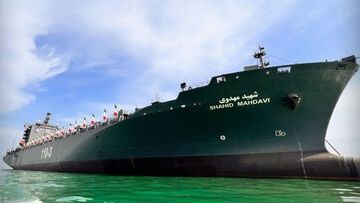
Amid an Iran-backed blockade of the Red Sea, an Iranian warship has crossed the equator into the Southern Hemisphere for the first time, media in Tehran reported on Saturday.
Amid an Iran-backed blockade of the Red Sea, an Iranian warship has crossed the equator into the Southern Hemisphere for the first time, media in Tehran reported on Saturday.
The IRGC-affiliated Tasnim news agency announced the news of Shahid Mahdawi, a container ship converted into a fighting vessel, crossing the equator, for the first time in Iran's naval history.
The vessel, which officially joined the IRGC Navy in March 2023, weighs over 2,100 tons and measures 240 meters in length and 27 meters in width.
In February, the IRGC conducted a test-launch of medium-range missiles from the Shahid Mahdawi, which it claims can strike targets up to 1,700 kilometers (1,050 miles) away. The launch marked the first instance of Iran sending a naval ship on such a long-range mission.
The presence of the heavily armed vessel raises concerns about regional security, particularly in light of Iran's recent hijackings in the Strait of Hormuz and military activity in the Gulf of Oman, and its support for the Yemeni Houthis who have been blockading the Red Sea region since November.
Iran allegedly operates spy ships in the Red Sea, including the commercial cargo ships Behshad and Saviz, which have been linked to espionage activities without any direct confrontation from the US, despite awareness of their operations.

Iran retained its position as the second highest country to imprison writers amid the country's nationwide uprising, second only to China, according to the 2023 Freedom to Write Index.
Released on Friday by PEN America, the latest report echoes the results of last year which found that Iranian authorities continue to detain authors, many of whom are associated with the Woman Life Freedom movement of 2022.
The regime’s crackdown during the Woman Life Freedom movement that was sparked by the death in police custody of Mahsa Amini in September 2022, saw the deaths of at least 550 Iranians and the arrest of tens of thousands, including scores of journalists and writers.
In 2023, Iran remained the leading jailer of female writers in the world, with 15 women being targeted for their writing and advocacy against the mandatory hijab and other laws discriminating against women, according to the Freedom to Write Index. Nobel Peace Prize Laureate Narges Mohammadi and poet and activist Sepideh Rashnu are still behind bars.
Jamshid Barzegar, a former member of the Iranian Writers Association (IWA), told Iran International: “The Islamic Republic has become accustomed to its one-sided narrative, which excludes the voices of others. The regime does not allow writers, artists, and journalists to form and express their opinions.”
Beyond writers, the artistic community has also been targeted, from directors and actresses to songwriters and musicians. In April, Toomaj Salehi, the dissident rapper who had been rearrested in late 2023, was sentenced to death, sparking a global outcry.
The Islamic Republic has a long history of imprisoning writers and artists, including execution. Baktash Abtin died in prison in January 2022 of COVID-19 complications after he was denied timely treatment by officials at Tehran’s notorious Evin prison. The Iranian Revolutionary Court sentenced him, along with two other writers working on a book about the IWA's history, to six years in prison in 2019 for "spreading propaganda against the system" and "assembling and colluding against national security.”
“Incarceration is merely one tactic in a broader array of repressive measures that include short-term detentions, spurious legal charges, and conditions on release such as job losses and restrictions on social media use,” said Karin Deutsch Karlekar, director of PEN America’s Writers at Risk program.
"The problem extends beyond prison walls. The Islamic Republic systematically bans books and thoughts and puts economic strain on its citizens, ultimately leading them to exile,” explained Barzegar.
The Freedom To Write report comes alongside similar figures from the 2024 World Press Freedom Index just released by Reporters Without Borders (RSF). Iran's targeted repression of journalists has led to the country's appalling ranking in the RSF Index placing it 176th out of 180 countries assessed. The RSF ranking places Iran below China, and just ahead of North Korea, Afghanistan, Syria and Eritrea.

The ancient archeological site of Naqsh-e Rostam, located in Iran's Fars Province, risks collapse after severe damage inflicted due to ground subsidence recent heavy rainfall.
The site, close to the famed ruins of Persepolis, is home to the tombs of Achaemenid kings such as Darius the Great and Xerxes and showcases a vast array of rock reliefs from various Iranian dynasties.
Extensive subsidence has occurred with fissures reaching depths of 50 to 70 centimeters and forming within 10 to 15 meters of these invaluable historical monuments. Despite efforts to fill the cracks annually with sand and gravel, they persistently reappear, posing a continuous threat to the stability of the rock face and the ancient artworks it houses.
Iran claims teams specializing in monitoring, protection, restoration, and archeology have been urgently deployed to manage and mitigate the impact of the environmental damage. "We are committed to preserving this cornerstone of Iranian cultural heritage," Alireza Askari, an official of the complex said on Friday.
The preservation of the sites has been a contentious issue in Iran, particularly since the 1979 Islamic Revolution, which saw a shift in the attitude towards relics predating the Islamic era.
Just last month, the Deputy Minister of Iran's Cultural Heritage expressed concern about a lack of funds for maintaining critical sites.
“Last year, the financial resources allocated to the preservation and restoration of historical sites were 900,000 Tomans ($200) and monuments 13 million Tomans ($3,000),” Ali Darabi said. “The fact that all this historical greatness and cultural heritage should be preserved and restored with this minimal budget is beyond me.”
With 27 sites, Iran ranks among the top 10 countries with the most cultural heritage sites in UNESCO's World Heritage List but amid a massive economic crisis, the regime has sidelined the country's cultural past in favor of prioritizing its military budget.

On World Press Freedom Day, the United States paid tribute to Iranian journalists who continue to face severe pressure from the government as Iran is branded the world's second worst country for jailing writers.
Through a statement on the Farsi account of the US Department of State on the social network X, Washington praised the journalists: "Despite the regime's efforts, the courage of journalists like Niloufar Hamedi, Elahe Mohammadi, and Nazila Maroufian is what brings awareness to the Iranians. We admire these journalists and all the journalists around the world who report under difficult circumstances."
Both Mohammadi and Hamedi were previously detained following their reporting on the death of Mahsa Amini, who died in custody of Iran's morality police in 2022—an event that sparked widespread protests. After enduring more than a year of temporary detention, they were sentenced to long prison terms, although the Tehran Appeals Court later converted their bail, leading to their release.
Nazila Maroufian was arrested multiple times since the 2022 uprising, and was sexually assaulted by regime forces in what Iran's Me Too movement calls a systematic weapon against women of sexual abuse and assault.
However, the judiciary has recently opened a new case against them for publishing pictures without the mandatory hijab following their release as crackdowns on the Islamic dress code continue to worsen in what the UN has branded 'gender apartheid' against Iranian women and girls.
Reporters Without Borders this weekend criticized Iran, where at least 23 journalists are currently imprisoned, for its harsh treatment of the press, ranking 176th of 180 alongside countries like North Korea, Afghanistan, Syria, and Eritrea.
Iran remains the second highest country to imprison writers, second only to China, according to the latest 2023 Freedom to Write Index, released on Friday by PEN America, the same as its dismal ranking in last year's report.

The chasm between the Iranian populace and the government has widened to such an extent that it has become a defining feature of the Islamic Republic, serving as a primary driver behind the myriad challenges it currently confronts.
While the leaders of the Islamic Republic have been reluctant to acknowledge the divide, especially in the wake of recurring nationwide protests, their occasional remarks regarding existing problems suggest a growing recognition of the issue.
Supreme Leader Ali Khamenei's this week urged Iranian teachers to try to encourage students to adhere to his brand of anti-Americanism and antisemitism. Was certainly an indication that he knows he is not on the same page with young Iranians who are generally openminded, tolerant and most certainly not antisemitic.
One of Iran's former Higher Education Ministers, Mostafa Moeen, has said based on a major study conducted by the government about prevailing values and attitudes that “60 to 70 percent of Iranians do not trust government institutions and that politicians are among the least trusted individuals among other Iranians."
Moeen also referenced the study's findings, highlighting that 60 to 70 percent of Iranians lack trust in government-controlled media, including state-run television channels that echo Khamenei's rhetoric. Additionally, he noted that the study reveals even greater distrust of the parliament compared to the government in general.
According to conservative commentator Mohammad Mohajeri, although a key reason for the distrust is the government's inability to solve economic problems, even an improvement in this regard cannot mend the divide between the people and government.
Mohajeri remarked that the current divide seems deeper and more profound, with officials attributing the rift to the people's excessive demands, while citizens argue that officials consistently overlook the nation's issues. Furthermore, officials make promises they cannot fulfill.
He emphasized that Iranians' mistrust of state officials is a longstanding issue, not merely a recent development. Mohajeri recalled how observers and experts have cautioned about the widening gap between the people and officials, as well as the decline in the government's social capital since the 1990s.
The conservative commentator added that the difference between the people's liberal ideas and the officials' hardline policies and revolutionary approaches contributed to the crisis. Mohajeri said that the disputed 2009 presidential election and the ensuing bipolar situation was a major turning point in the confrontation between the people and the government. He was referring to Khamenei's biased support for Ahmadinejad while the people and moderate politicians insisted that he was elected in a rigged election.
He noted that following the 2019 protests, during which government forces killed hundreds of protesters, people initiated a negative campaign by abstaining from elections and boycotting government-sponsored political rallies. Simultaneously, the worsening economic crisis and the government's reluctance to implement reforms exacerbated the division. Consequently, society was engulfed by despair, eroding trust in the government and hope for the future.
Meanwhile, prominent sociologist Amanollah Gharai has told Nameh News website in Tehran that the divide between the people and government is the outcome of a decline in Iran's middle class. He said, traditionally, the middle class works like a shield between the ruling class and the working class.
Gharaei pointed out, "Rising prices, inflation, and other economic woes have pushed individuals from the upper middle class into lower socioeconomic strata." He elaborated that educated individuals, academics, entrepreneurs, and businesspeople comprise the middle class, which communicates messages and information to the impoverished lower class. When the middle class becomes discontented, instead of acting as a buffer, it joins protest movements and encourages the lower class to participate."
He further stated, "Today, information dissemination faces no barriers, and everyone is aware of societal happenings. When impoverished individuals learn of corruption among those in power, they are compelled to revolt and protest."

Canada has voiced its concern over a BBC World report detailing the alleged assault and murder of 16-year-old Nika Shakarami by Iran's security forces amid hijab crackdowns.
Shakarami became a prominent figure in the Woman, Life, Freedom uprising following her death in 2022, which came amid nationwide protests. She was arrested after she was filmed burning her hijab.
"Canada reiterates its firm opposition to the suppression of human rights, including rights to freedom of assembly and association, and we continue to stand with the people of Iran as they demand justice and full respect for their human rights," a Global Affairs Canada Corporate spokesperson told Iran International’s Mahsa Mortazavi.
The spokesperson also told Iran International Canada reiterates its strong support for the United Nations Independent International Fact-Finding Mission on Iran, tasked with independently investigating the human rights violations linked to the protests that began in September 2022, with a particular focus on women and children.
A recent BBC investigation has exposed a "highly confidential" document that implicates three security personnel in the direct sexual assault and murder of Shakarami. The investigation revealed a disturbing sequence of events leading to her death, including an officer forcibly restraining her while others sexually assaulted her and beat her with batons. Despite her resistance, the assault ended fatally, and the regime later falsely claimed she had committed suicide.
The death of Shakarami followed shortly after the death of Mahsa Amini in morality-police custody for defying hijab laws which ignited nationwide protests. The Iranian government continues its crackdown on mandatory hijab with ever worsening oppression of women and girls, branded 'gender apartheid' by the UN.