Iran's Capacity to Move Oil Reliant on Malaysian Providers - US official
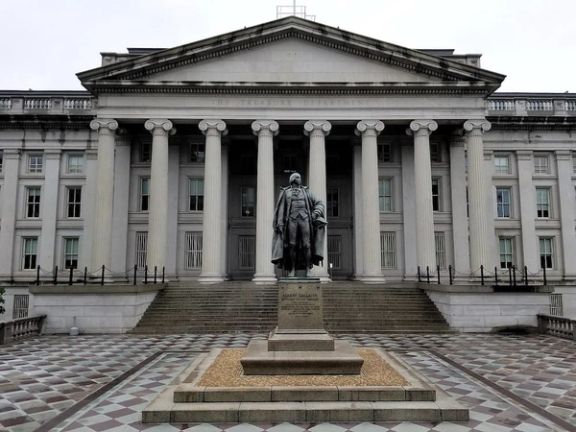
US Treasury Department Building, Washington DC
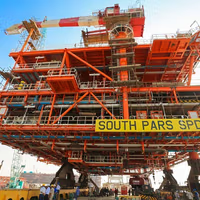
The United States sees Iran's capacity to move its oil as reliant on service providers based in Malaysia, with oil being transferred near Singapore, the US Treasury Department's top sanctions official said on Tuesday.
Brian Nelson, Treasury's undersecretary for terrorism and financial intelligence, was speaking during a four-day visit to Singapore and Malaysia, which the department said aimed to advance its work in countering financing and revenue generation by Iran and its proxies.
The trip comes as Treasury increases its focus on financing for militant groups routed through Southeast Asia, including through fundraising efforts and illicit sales of Iranian oil.
Nelson told reporters the United States was trying to prevent Malaysia from becoming a jurisdiction where the Palestinian militant group Hamas could both fundraise and then move money.
He said the United States saw Iranian oil being transferred near Singapore and throughout the region.
Last December, Treasury imposed sanctions on four Malaysia-based companies it accused of being fronts supporting Iran's production of drones.
Nelson also said sanctions and export controls against Russia were seeing progress, saying the Russian oil price cap was reducing Moscow's capacity to profit from oil sales while preserving the stability of global energy markets.
Singapore is a major shipping hub. Insurance and other maritime service providers operating in Singapore have warned of evasion of the price cap on Russian oil, complaining that it is difficult to confirm that paperwork promising oil is bought at or below the $60 cap is accurate.
Just back to Austria from Iran, the head of UN’s nuclear watchdog, Rafael Grossi, said he did not seal any deal but discussed possible steps to implement measures Tehran had committed to in a joint statement last year.
During Grossi’s last visit to Iran in March last year, the International Atomic Energy Agency (IAEA) and the Iranian government agreed on a statement on how Tehran can increase cooperation with the IAEA. Despite Tehran's sweeping assurances to the UN nuclear watchdog, little progress was made.
Iran committed to cooperating with a long-stalled investigation into discovering uranium particles at undeclared sites and reinstalling removed monitoring equipment. However, IAEA reports to member states indicated that these assurances did not translate into significant actions.
Amidst intense media questioning, Grossi explained his two-day visit to Iran: “My intention was twofold, to re-engage, to have a serious conversation, and to start analyzing a number of concrete proposals that could fit into the different areas that this joint statement covers.”
“There is this expectation that there will be a touch of a magic wand. And we will solve issues. I'm sorry, it's impossible,” he told the press conference.
Without going into the details of Iran’s and IAEA’s expectations, Grossi confirmed that lifting sanctions is one of Iran's demands to cooperate with the agency but that he is: “not the one who has the key to solving these issues” because those problems are outside the scope of his responsibilities.
Hours before Grossi returned to Vienna, he also held a news conference with Iran's atomic chief, Mohammad Eslami, who called the talks “positive and productive.”
Director General Rafael Grossi of the International Atomic Energy Organization, IAEA, left, and head of Iran's atomic energy department Mohammad Eslami
Iran's apparent satisfaction with IAEA visits, while failing to keep any promises, is becoming so repetitive that a journalist asked Grossi whether Iran was selling him the same horse again.
Since the end of November, Iran has been enriching uranium to a purity of up to 60%, which is close to around 90% of weapons-grade uranium. The IAEA estimates that this material could be used to make two nuclear weapons if it were enriched further.
Iran has also hindered the IAEA's ability to perform its duties. The IAEA faces numerous challenges, including Tehran's failure to explain uranium traces discovered at undeclared sites and its exclusion of almost all its top enrichment experts.
However, this isn't the first time Iran has enriched uranium to this level. In April 2021, Iran, as a first, began enriching uranium to this level - its highest purity ever and a technical improvement.
Under the Joint Comprehensive Plan of Action (JCPOA) signed in 2015 between Iran, China, France, Russia, the UK, the US, and Germany, Tehran curbed its nuclear program in return for lifting international sanctions.
Iran gradually began to move beyond the nuclear restrictions of the JCPOA after former US president Donald Trump withdrew from the agreement in 2018 and reimposed sanctions that crippled its economy.
As part of his criticisms of the deal, Trump stated that it wasn't permanent; the restrictions on Iran's nuclear program began to relax about ten years after the agreement was signed (although the commitment not to develop nuclear weapons is permanent). Moreover, the deal did not address Iran's other problematic activities, including its development of ballistic missiles and its support for violent militias in the region.
After Joe Biden defeated Trump in the 2020 US presidential election, he attempted to revive the deal through indirect negotiations in Vienna, but without any significant success, except a short-lived slowdown of Iran’s enrichment in May last year. That was when the Biden administration, through a Qatar-mediated deal, swapped five detainees with Iran and released $6 billion of Tehran's funds in South Korea.
The Biden administration's cautious stance on Iran casts doubt on the strength of the IAEA's position regarding Iran's unfulfilled promises, as Tehran continues to enrich Uranium at high levels and refuses to cooperate with international measures to curb its nuclear activity.
Iranian traders are smuggling more than $1 billion worth of fuel into neighboring Pakistan annually.
According to a Pakistani intelligence report spanning 44 pages, "Smuggling of Iranian Oil," sheds light on a long-standing illegal trade that escalated following US-imposed sanctions on Iranian oil exports a decade ago.
The sanctions pushed Tehran to seek alternative markets, significantly boosting the smuggling operations across the 900-kilometer Iran-Pakistan border.
The report reveals that last year alone, approximately $1.02 billion worth of Iranian petrol and diesel was illegally transported into Pakistan, making up about 14% of Pakistan’s annual fuel consumption.
The smuggling has led to significant financial losses for the Pakistani exchequer, estimated at around $820 million in lost taxes and duties, and has negatively impacted local petroleum businesses.
Daily, around 2,000 vehicles are involved in smuggling barrels of fuel across the border, a practice that has continued despite heightened military tensions between Iran and Pakistan, including reciprocal strikes earlier this year.
The socioeconomic implications of potentially halting the trade are profound, especially for the residents of Balochistan, Pakistan's poorest region, which has been plagued by a violent separatist insurgency.
The report indicates that nearly 2.4 million people in Balochistan depend on this illicit trade for their livelihood, with few other economic opportunities available.
Moreover, the report, leaked to local media, names over 200 individuals involved in the smuggling operations, including government and security officials, highlighting widespread corruption and collusion at border checkpoints.
"The culture of bribes and connivance of [security] officials with smugglers continues at almost all [border checkpoints]," it said.
An official, speaking on condition of anonymity, hinted that the leak of the report might be a strategic move by the government to justify an upcoming crackdown on the smuggling operations. However, skepticism remains about Islamabad's commitment to fully addressing the issue, given past inconsistencies in enforcement efforts.
The scarcity of job opportunities and governmental neglect in the impoverished Sistan-Baluchestan province of Iran are significant factors driving Baluch citizens to engage in fuel smuggling. For many in the border area, selling fuel to Pakistan has become a vital source of income, offering higher returns than the domestic market provides. This trade serves as one of the few available means for residents to earn a livelihood.
Every year, the shooting of fuel smugglers by Iranian military forces results in the deaths of hundreds. Reports indicate that from March 20 to March 30 alone, 27 fuel smugglers lost their lives due to actions by security forces, road accidents, and vehicle fires. The victims were predominantly young, aged between 18 and 28 years old.
In 2023, it was reported that at least 172 Baluch fuel smugglers died, with another 42 sustaining injuries.
An Iranian court has urged France to repatriate members of the exiled opposition group Mujahedin-e Khalq Organization (MEK) amid a new wave of trials against 104 members of the group in Tehran.
The judge on Tuesday asserted that hosting members of the MEK constitutes a “violation of international conventions against terrorism”.
Meanwhile, Iran and its Supreme Leader Ali Khamenei, who sets the regime's policies, have been actively sponsoring terrorism by backing groups such as Hamas, Hezbollah, and the Islamic Jihad of Palestine through financial and logistical support.
The MEK, which was founded with a Marxist-Islamist ideology before the 1979 Iranian revolution, initially supported the new Islamist government. However, the group soon fell out of favor with the ruling clerics, leading to repression and their eventual exile.
Many MEK members found asylum in Iraq under Saddam Hussein, who supported their activities against the Iranian government. After a deadly attack on their camp in Iraq in 2013, which resulted in the deaths of 52 members and seven disappearances, the group relocated to the Camp Ashraf 3 compound in Durres, Albania.
The news comes amid Iran’s record of sham trials and forced confessions, which last year saw the execution of over 800 Iranians amid a brutal and continued crackdown on dissent.
Nasser Kanaani, the Iranian Foreign Ministry spokesperson, condemned the Israeli military's taking control of the Rafah crossing and blocking a critical aid route into the besieged strip.
Kanaani, who was the first official from Tehran to comment on Tuesday's military action, referred to Israel as "the main threat to international peace and security" and blamed the United States for the ongoing conflict between Hamas and Israel, which started when Iran-backed Hamas killed over 1,200 civilians and took 250 hostages on October 7.
Israel has been requesting civilians in Rafah to evacuate since Monday to attack Hamas' infrastructure in the southern town, which it believes to be the organization's last stronghold. According to Israel, tunnels have been discovered in Rafah that allow for the entry of weapons and other supplies for Hamas and other groups.
However, the UN and US have cautioned that an assault on the city could have disastrous humanitarian ramifications, home to over a million Palestinian refugees.
According to Hamas numbers, over 34,000 Gazans in the strip have been killed in Israel's retaliatory attacks after the October 7 invasion.
Hamas on Monday said it had accepted a ceasefire deal proposed by Egypt and Qatar - despite Israel's indication that it would not accept the proposal as it stood. Hamas has been calling for a full withdrawal of Israeli troops from Gaza and the release of thousands of Palestinians in Israeli jails, most on terror charges. Israel's war aims have continued to be that it will not withdraw until Hamas is destroyed and the remaining 133 hostages taken from Israel on October 7 are freed.
Since Tuesday, the Israeli military has taken control of the Palestinian side of the Rafah crossing between Gaza and Egypt. The Rafah crossing is a critical humanitarian route, which is of particular importance to Egypt. The country is anxious to avoid a mass migration of Palestinians into its Sinai desert in case of a major offensive into the city.
With a permanent presence at the crossing, Israel could control all traffic, including aid shipments. It could act as a base for further attacks against the tunnels across the border from which Hamas obtains its supplies.
Iran has long funded, armed and trained Hamas; the US has named Iran as the world's biggest state sponsor of terror. As the Hamas attack took place on October 7, Tehran's top officials and government media celebrated the incident and organized street celebrations immediately. Ismail Haniyeh, the Hamas leader, revealed in March 2022 that the Islamic Republic paid Hamas $70 million to aid it in developing missiles and defense systems and US government research under the Trump administration showed Iran funding Hamas to the tune of $100m annually.
Nasser Kanani, spokesman for Iran's foreign ministry, hailed Hamas's response to the terms of the Gaza ceasefire as "the political intelligence of the resistance".
He claimed that the latest moves were a victory, showing the "field strength" of the Palestinian terror group, designated by countries including the UK, after a phone call with Hamas chief Ismail Haniyeh.
Despite Hamas's agreement to the ceasefire terms set forth by the mediators, Egypt and Qatar, along with the US, the Israeli government said the terms did not meet its demands, leading to ongoing Israeli military actions in Rafah, south Gaza, where the remaining four battalions of Hamas are based, along with remnants of other disbanded battalions. Rafah has also become a shelter for over a million displaced Palestinians amid the conflict.
Israeli Prime Minister Benjamin Netanyahu's office claimed the Hamas proposal was inadequate from Israel's perspective but confirmed that Israel would send a delegation to continue negotiations.
From the outset, Israel's war aims have been to rescue the remaining 133 hostages held in Gaza, of over 250 taken captive on October 7. The Prime Minister has also made it clear that there will be no withdrawal from Gaza until Hamas is dismantled in its entirety, to ensure that the atrocities of October 7, when 1,200 mostly civilians were murdered, can never happen again. Over 100,000 Israelis were displaced after the day now known as the Black Sabbath, the deadliest single day for Jews since the Holocaust.
Hamas is demanding the total withdrawal of troops in addition to the release of thousands of prisoners in Israeli prisons, most incarcerated on terror charges, in addition to the unconditional return of Gazans to the north of the strip without security checks, which Israel will not accept.