Iran Hails 'Intelligence' of Hamas's Proposals for Gaza Ceasefire
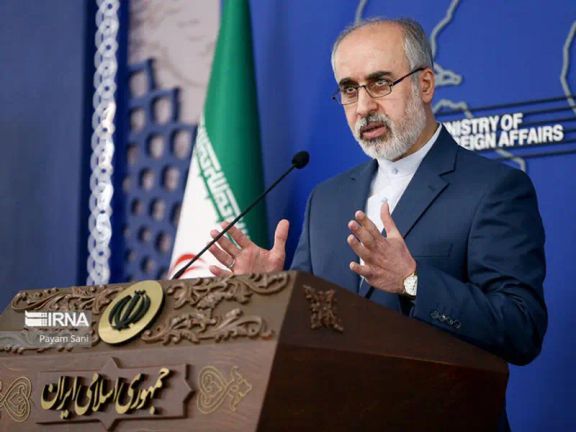
Nasser Kanani, spokesman for Iran's foreign ministry, hailed Hamas's response to the terms of the Gaza ceasefire as "the political intelligence of the resistance".

Nasser Kanani, spokesman for Iran's foreign ministry, hailed Hamas's response to the terms of the Gaza ceasefire as "the political intelligence of the resistance".
He claimed that the latest moves were a victory, showing the "field strength" of the Palestinian terror group, designated by countries including the UK, after a phone call with Hamas chief Ismail Haniyeh.
Despite Hamas's agreement to the ceasefire terms set forth by the mediators, Egypt and Qatar, along with the US, the Israeli government said the terms did not meet its demands, leading to ongoing Israeli military actions in Rafah, south Gaza, where the remaining four battalions of Hamas are based, along with remnants of other disbanded battalions. Rafah has also become a shelter for over a million displaced Palestinians amid the conflict.
Israeli Prime Minister Benjamin Netanyahu's office claimed the Hamas proposal was inadequate from Israel's perspective but confirmed that Israel would send a delegation to continue negotiations.
From the outset, Israel's war aims have been to rescue the remaining 133 hostages held in Gaza, of over 250 taken captive on October 7. The Prime Minister has also made it clear that there will be no withdrawal from Gaza until Hamas is dismantled in its entirety, to ensure that the atrocities of October 7, when 1,200 mostly civilians were murdered, can never happen again. Over 100,000 Israelis were displaced after the day now known as the Black Sabbath, the deadliest single day for Jews since the Holocaust.
Hamas is demanding the total withdrawal of troops in addition to the release of thousands of prisoners in Israeli prisons, most incarcerated on terror charges, in addition to the unconditional return of Gazans to the north of the strip without security checks, which Israel will not accept.

In a move to regulate the employment of foreign nationals, Iran has introduced a daily fine of 12 million rials (approximately 20 USD) for employers hiring unauthorized foreign workers.
The General Directorate of Employment of Foreign Nationals of the Ministry of Labor announced the new directive on Tuesday, targeting employers who utilize foreign labor without the requisite permits.
Iran has experienced a significant influx of foreign workers since the 1980s, attributed mainly to regional conflicts and economic instability in neighboring countries. Despite existing laws aimed at penalizing unlawful employment practices, these have proven insufficient in curbing the reliance on unauthorized foreign labor, thus failing to bolster the employment of domestic job seekers.
Currently, official estimates indicate that about three million foreign nationals are employed illegally within the country. Afghans make up the majority of the foreign workforce, with numbers potentially as high as 10 million, particularly following the Taliban's takeover of Afghanistan in 2021. The surge has ignited debate and controversy, with some media and political figures suggesting that the increase is being facilitated by certain authorities, thereby posing a potential threat to national security.
The growing presence of Afghan nationals has also led to increased anti-Afghan sentiment across Iran, not least as domestic unemployment skyrockets. In the past year, nationalistic campaigns have gained momentum, advocating for the expulsion of all Afghan nationals from Iran.

Iran International was named the winner of the 2024 Geneva Summit Courage Award on Tuesday for "fearlessly” uncovering the daily “abuses of the Islamic Republic of Iran."
The award will be presented during an upcoming event, according to the Geneva Summit for Human Rights and Democracy.
Iran International is receiving the award almost 45 days after its TV host Pouria Zeraati was stabbed while leaving his London residence for work. He survived the attack with leg injuries and decided to return to work after a couple of days in the hospital. As of yet, it is unclear who the attackers were and what their motives were. But it wasn't long after the news broke that fingers were pointed at the Iranian regime, given the Islamic Republic's history of plotting against dissidents as well as foreign officials.
British Prime Minister Rishi Sunak and Foreign Minister David Cameron condemned the attack on him, respectively, which happened following multiple threats from Iranian intelligence aimed at journalists of Iran International.
The Iranian government has long threatened Iran International, with several journalists at the network facing imminent attacks in the years 2022 and 2023. In March, a leaked document revealed that Tehran’s Revolutionary Court convicted 44 foreign-based journalists and media activists in absentia two years ago over the allegation of “propaganda against the government,” which included Iran International's Aliasghar Ramezanpour.

Last year, Iran International's offices were temporarily relocated from London to Washington after threats escalated to the point where domestic security services were unable to ensure the safety of the employees. Just before the incident, Iran's intelligence minister had branded Iran International a terrorist organization, paving the way for all sorts of action against the broadcaster and its journalists.
According to Freedom House, Iran has one of the worst records for press freedom in the world, with more than 70 journalists arrested since the 2022 uprising alone. Among those were the two women who first reported the arrest and subsequent death of Mahsa Amini, whose death in morality police custody sparked the most significant uprising since the Islamic Republic foundation. Figures suggest many more have been arrested amid Iran's secretive regime.
The honor for Iran International will take place at the summit which raises awareness about urgent human rights situations that require global action and provides a platform for human rights activists, former political prisoners, and heroes to give testimony about their struggles for democracy and freedom. It aims to build an international community that can challenge dictatorships.

The Tehran prosecutor's office has initiated legal proceedings against two journalists over their reporting on the death of 16-year-old protester Nika Shakarami.
Hadi Kasaeizadeh, editor-in-chief of Meydan-e Azadi Monthly, and Asal Dadashloo are accused of disseminating content against the regime.
A BBC World report recently revealed the existence of a "highly confidential" document, suggesting that 16-year-old Shakarami was sexually assaulted and murdered by Iranian security forces during the Woman, Life, Freedom uprising.
In response to the BBC's revelations, Iran's judiciary has charged multiple journalists and media activists who disseminated the information, accusing them of broadcasting "false, insulting, content against the regime" in cyberspace.
Journalists Marzieh Mahmoudi and Mohammad Parsi are also facing charges linked to their reporting on Shakarami’s death.
The journalists are part of a larger group of media professionals targeted by the government. Since the 2022 protests, at least 79 journalists have been arrested, including two women who initially reported on the arrest and death of Mahsa Amini. Reports suggest that the number could be as high as 100.
Shakarami’s death, characterized by head injuries, recalls the murder of Kurdish-Iranian Mahsa Amini in September 2022, which ignited a nationwide uprising.
Arrested by morality police for improperly wearing her hijab, Amini's death has led to increased repression by Iran's security forces as they attempt to suppress dissent and unrest, alongside the tightening of hijab laws as the country continues to rebel against the state's Islamic dress code.

At least five doctors in Iran have reportedly committed suicide in the last 50 days, according to a state-run media outlet in Tehran.
The figures provided by Tejarat News, a non-independent news outlet, indicate that a doctor has taken their own life approximately every 10 days since the beginning of the Persian New Year in late March.
While there has been a significant increase in suicides among young doctors, students, teachers and others in Iran, the country’s Ministry of Health has been accused of withholding accurate statistics on suicide rates.
"Unfortunately, there are no official statistics available on doctors' suicides. This has been a problem in previous years too, but now, with the prevalence of online platforms, news spreads rapidly,” the head of the Iranian Nursing Organization, Mohammad Sharifi Moghadam told Tejarat News.
Among those lost to suicide recently are physician Zahra Maleki Ghorbani, rheumatology specialist Samira Al-e-Saeedi, and cardiovascular specialist Parastoo Bakhshi.
The Silence of Iran’s Ministry of Health
Despite acknowledging the rising suicide rates, the government has been criticized for its lack of action and ineffective policies to address the underlying issues driving suicide.
Moghadam emphasized the Ministry of Health's neglect of the challenges faced by young doctors and medical graduates in Iran, highlighting it as a persistent issue.
"Despite years of dedication and education, some individuals have reached a point where they prefer death to life," he said.
Former health minister Hassan Hashemi similarly decried the government’s silence surrounding the suicides, stating that "it is the duty of the Minister of Health and his other colleagues to examine these issues with the help of sociologists, psychologists, and other experts and find a solution as soon as possible to prevent this shocking incident."
Homayoun Sameh Najafabadi, a member of the health committee of the Iranian parliament, acknowledged the gravity of the issue but refrained from elaborating on why the parliament doesn't demand accountability from the Ministry of Health.
Factors Behind Iran’s ‘Suicide Crisis’
Though the exact reasons why someone commits suicide are often complex and multifaceted, and may not be fully understood by others, Tejarat News has suggested some contributing factors to the underlying issues that contribute to the suicide trend in Iran.
The outlet claimed that contributing factors included the separation of married couples due to work and financial struggles, restrictions on alternative employment, and the lack of respect for medical staff in certain hospital settings.
These challenges, the report suggests, culminate in feelings of depression and hopelessness, affecting even the country's elite youth.
"The work pressure is so high that these people lose their footing," Moghadam said, pointing out that livelihood struggles and disrespect from hospital administrators compound the already immense challenges faced by doctors in Iran.
Mohammad Mirkhani, a social consultant at the Medical Council of Iran, attributed the significant increase in doctor suicides in Iran to the challenging working conditions they face. He noted, "Medical assistants sometimes work for 72 hours straight, which poses extreme dangers to their mental well-being. Such conditions often lead to depression."
But, the suicide crisis faced by the medical community also extends to students and other parts of the country’s workforce.
In February, the labor union, the Coordinating Council of Iranian Teacher Trade Associations, described the situation of student suicides as a "tsunami."
Last year, over the course of 283 days, 23 workers committed suicide, according to a report by the ‘reformist’ Etemad newspaper.
That outlet listed poverty, arrears, and demands for wages and dismissal from the workplace as reasons for the suicide rate among workers.
Experts have attributed the increased suicides in Iran to the systemic reluctance and neglect of Iranian authorities to address workers' conditions – identifying it as one of the key underlying causes.
With a history of long-standing human rights violations, experts anticipate that Iranian authorities will continue to neglect the well-being of the country’s workforce and other segments of society, perpetuating a cycle of suffering and injustice.

The United States Commission on International Religious Freedom (USCIRF) has called for intensified sanctions against Iranian authorities for the brutal enforcement of hijab.
In a Monday statement, it condemned the ongoing crackdown on Iranian women and girls who are at the center of a nationwide defiance of the country’s mandatory hijab laws, policies which the UN has branded 'gender apartheid'.
USCIRF Commissioner Susie Gelman said the US must do more to hold Iran accountable amid mass human rights abuses as Iran continues undeterred in spite of global sanctions. Just last year, record numbers of Iranians were executed as the regime fights for its survival in the biggest uprising since the founding of the Islamic Republic.
“Iranian authorities callously violate women’s religious freedom and target any individual advocating for freedom of religion or belief. The US government has continued to support global efforts to hold Iran accountable for its heinous acts."
"However, USCIRF urges additional sanctions on Iranian government agencies and security officials responsible for particularly severe violations of religious freedom by freezing their assets and barring their entry into the United States,” she stated.
The push for increased sanctions coincides with the Iranian regime’s new Noor initiative, an enforcement campaign of the hijab which has increased the severity and frequency of crackdowns on Iranian women.
The initiative is part of a broader effort to stifle dissent across various sectors, including human rights activists, journalists, and students, with a new wave of arrests reported recently.
In its annual report on Thursday, USCIRF advocated for the US government to support the UN Independent International Fact-Finding Mission on Iran and to document human rights abuses.
Furthermore, the USCIRF highlighted the systematic harassment, arrest, and torture of protesters, including minors, underlining an escalation in the enforcement of hijab laws, surveillance, and covert operations by morality police throughout 2023.