Iran Economy is Reeling Under Sanctions, Khamenei Chief Admits
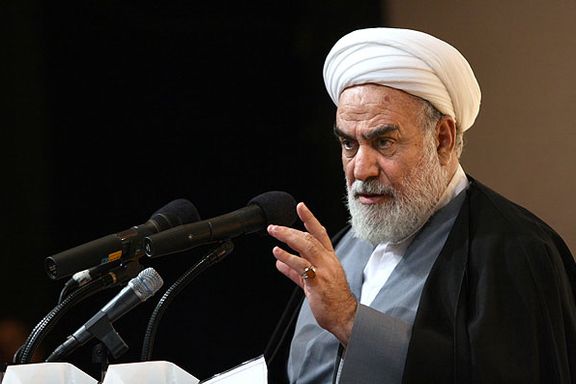
Iran’s economy is struggling as sanctions bite hard, the Supreme Leader’s chief of staff has said in a rare admission by the regime.

Iran’s economy is struggling as sanctions bite hard, the Supreme Leader’s chief of staff has said in a rare admission by the regime.
In unusually frank remarks, Gholamhossein Mohammadi Golpayegani said: "We are facing difficulties due to sanctions; however, the government will find a way to overcome these problems."
His comments to Iranian media on Friday come amid grim data on the state of the economy. The Central Bank of Iran (CBI) last month reported a 52.3% inflation rate for 2023, and there are widespread shortages including of gasoline despite the country’s major oil resources.
The sanctions are being enforced against Iran because of its nuclear weapons programme and support for terror groups, but Supreme Leader Ali Khamenei and his loyalists have been reluctant to acknowledge the strain caused to the economy. Instead, they claim the sanctions are opportunities for growth and development and could foster national unity.
"Weapon developments is an example of turning sanctions into opportunities," Khamenei stated during a speech in April. "Sanctions cannot impact Iranians because they need no external help."
Inflationary pressures have been exacerbated by the plummeting value of the Iranian currency. Over the decades, devaluations of the rial have caused millions of Iranians to fall into poverty.
The recent foreign policy decisions of the Islamic Republic have made things substantially more difficult for the economy. The foreign exchange market in Tehran witnessed an unprecedented surge during the first two weeks of April, with the dollar briefly reaching 700,000 rials amid worsening tensions between Iran and Israel. In 1978, the rial was valued at 70 rials per dollar.
Inflation has eroded the middle class, with tens of millions of people now living on roughly $200 a month, far below what is required to maintain a middle-class lifestyle.

Princeton University has been trying for more than a decade to place itself at the center of US-Iran diplomacy, a new Semafor report has revealed, offering an academic position to a former high-ranking Tehran official.
The university has also liaised with IRGC-connected diplomats for student exchange programs, only to see two of its graduate students detained or kidnapped by the IRGC and its allied armed groups in Iraq.
With its second student still missing, Princeton’s experience is a “cautionary tale of how American institutions can be ensnared in the internal politics of Tehran and Washington and become pawns in those battles,” the report’s author, Jay Solomon, writes. “[The] Congress is now formally probing the school’s ties to Iranian regime officials.”
The report, published Thursday under the headline “How Princeton got burned by its outreach to Iran,” is based on original investigation and makes use of a cache of Iranian foreign ministry emails that were obtained by Iran International and used in two scoops about an Iranian influence network in the US.
Some familiar names from previous reports appear in the new one: Mostafa Zahrani, a senior Iranian foreign ministry diplomat with strong ties to IRGC, and Ariane Tabatabaei, currently at Pentagon, whose close and extensive ties with the regime have raised many eyebrows, and led to calls for revocation of her security clearance –as has happened with her mentor, Robert Malley, who until a year ago was Joe Biden’s Iran envoy.
Once more, Tabatabaei seems to have been at the heart of Iran’s soft war: this time initiating the ‘outreach’.
“I wanted to introduce you to a friend who is in Princeton, and you will see him in Vienna in three weeks,” Tabatabai wrote in a 2014 email, attempting to connect Kevan Harris, the then associate director of the University's Iran Centre to Mostafa Zahrani, an Iranian diplomat with IRGC ties. “[Kevan Harris] is interested in sharing with you a plan to send Iranian students to Princeton and to send American students to Iran.”

The emails obtained by Iran International show that Harris then “arranged to see Zahrani in Austria two weeks later on the sidelines of the nuclear negotiations that were taking place between Iran, the US, and other global powers there.” Early 2015, Princeton picked its first candidate for its nascent Iran program: the Chinese-American student Wang Xiyue.
“Wang was hesitant about going to Tehran,” according to Semafor. “He also raised with Princeton his concerns about security.” Harris told him it would be fine. “It’s a good time to go [to Iran] — looks like they are in a good mood over there.” Six months later, Wang was arrested. He spent more than three years in Tehran’s notorious Evin prison, including in solitary confinement. He was released in a prisoner swap in 2019.
But Princeton seems to have ignored the lessons of Wang’s plight. In March 2023, a second Princeton graduate student, Elizabeth Tsurkov, was abducted by an Iranian-affiliated militia from a cafe in Baghdad. She hasn’t been seen since last November. “Both the US and Israeli governments blame Iranian-backed militia Kataib Hezbollah (KH) for the abduction.”
Elizabeth’s sister, Emma Tsurkov, has been vocal against Princeton’s response –which denied it approved Elizabeth’s travel to Iraq, implying that their student had “gone rogue.” It took the University more than six months to publicly take responsibility “for Elizabeth’s research and travel to Iraq.” Shortly after, in November 2023, KH released a video in which Elizabeth claimed, “she was both an operative for the CIA and Mossad.”

The report in Semafor also addresses the (very much ongoing) controversy surrounding Hossein Mousavian, a top regime diplomat and former nuclear negotiator, who has been at Princeton since 2009. “He fled Tehran that year after being charged with espionage”, but once in the safety of the US, he continued to promote the regime’s talking points and its nuclear positions. The emails obtained by Iran International and reviewed by Semafor shows that Mousavian would consult Zahrani and then-Foreign Minister Javad Zarif to ensure his pieces were on message.
There was very little doubt at this point that Princeton enjoyed “strong ties to the upper echelons of the Islamic Republic’s leadership,” Semafor quotes Wang. Even one of Wang’s advisers at Princeton’s Iran center, Mona Rahmani, had close ties to the regime in Tehran. “Her father ran Tehran’s interest section in Washington.” Wang says Rahmani “declined” to help him when he was thrown into jail in Tehran. Mousavian suggested it would be “counterproductive” to appeal to his contacts. And Princeton advised his wife to keep quiet and “not publicly criticize the Iranian government.”
“Simply put, after encouraging and convincing Mr. Wang to go to Iran, Princeton chose to put their reputation and political interest ahead of Mr. Wang’s personal safety,” reads the lawsuit that Wang filed against his former school in 2021. Princeton has always denied the charge of “negligence”. Last September, the two parties settled out of court with the school giving Wang an undisclosed amount.
Of all those named in the Semafor story, the only character still in Princeton –and almost entirely unaffected by all this– is Mousavian. The school still supports him and defends the decision to hire him in 2009, citing his role “in helping to promote the 2015 Iran nuclear deal, and his efforts to reduce tensions between Washington and Tehran that some Western officials worry could expand into an all-out war,” according to Semafor.
But some in the Congress have raised concerns about his continued presence in the US, with the House Committee on Education and the Workforce formally probing his employment: “Mousavian’s position...raises significant concerns about the influence of foreign hostile regimes on American institutions,” the committee wrote to Princeton President Christopher Eisgruber last November.
This has partly been a result of a grassroot campaign by Iranian-American activists who are pressuring Princeton to sever ties with Mousavian. Their campaign got a boost in March when the National Association of Scholars (NAAS) joined their chorus to get Mousavian dismissed. “His position threatens US national security and cedes academia’s integrity to a hostile regime linked to terrorism and human rights abuses,” the NAAS statement read.
Princeton has also hosted Robert Malley, the Biden administration’s suspended special Iran envoy, as a guest lecturer for the 2023 fall semester–months after his security clearance was revoked. Malley is currently being investigated by the FBI for the possible mishandling of classified information.

Dissident Iranian rapper Toomaj Salehi’s death sentence has been condemned by human rights ambassadors from across Europe.
In a statement calling for the “immediate release” of the 33-year-old singer, the rights advocates urged Iran to “refrain from using capital punishment as a means to suppress critical voices”.
They wrote: “We, the European Human Rights Ambassadors, strongly condemn the death sentence of songwriter and rapper Toomaj.
“Toomaj Salehi is one of the many powerful voices supporting the peaceful protests following Zhina Mahsa Amini's death and demanding freedom and rights for women and girls in Iran.
“Toomaj Salehi's sentencing takes place in a context of severe restrictions against artistic freedom and other forms of expression in Iran, and the continued use of the death penalty as a tool to instill fear and stifle dissent.”
Hillel Neuer, Executive Director of UN Watch, a Geneva-based NGO, tweeted the statement from the human rights ambassadors from 11 European countries, including France, Germany, Spain and the UK.
Salehi was arrested after voicing his support for the protests which erupted across Iran after the death in Mahsa Amini in the custody of the morality police in 2022. The Iranian regime killed over 500 protesters and arrested thousands during the demonstrations.
The singer was sentenced to more than six years in jail in July 2023 only to be released on a technicality last November. He was quickly rearrested and last month was given a death sentence by a revolutionary court in Isfahan, sparking a global outcry and demonstrations in Europe and North America, amid continued outrage over the use of capital punishment by the Iranian government in political cases.

Iran will alter its nuclear doctrine if Israel threatens its nuclear facilities or its existence, an advisor to the country’s ruler said Thursday, in a second similar threat in less than a month.
“If they dare to strike Iran's nuclear facilities, our level of deterrence will change. We have experienced deterrence at the conventional level so far. If they intend to strike Iran's nuclear capabilities, naturally, it could lead to a change in Iran's nuclear doctrine,” Kamal Kharrazi said.
He added that Iran has so far refrained from developing nuclear weapons, “But if Iran's existence is threatened, we are forced to change our nuclear doctrine. Recently, military officials also stated that if Israel intends to attack nuclear facilities, reconsidering Iran's nuclear doctrine and policies, and deviating from past declarations, is possible and conceivable.”
Ali-Akbar Salehi, who was foreign minister more than a decade ago and is still a key foreign policy voice in the Iranian government, also said last month that Iran has everything it needed to build a nuclear bomb, as tensions rose with Israel amid the Gaza war.
In a televised interview in April, Salehi, was asked if Iran has achieved the capability of developing a nuclear bomb. Avoiding a direct answer he stated, "We have [crossed] all the thresholds of nuclear science and technology.”
It is believed that Israel conducted two spectacular sabotage operations in 2020 and 2021 against Iran’s large nuclear facility in Natanz, located in the center of the country.
Tehran has always insisted that its nuclear program is peaceful, and it does not seek to develop nuclear weapons. However, its actions since late 2020 point to a trajectory of escalating its nuclear threat by enriching a substantial amount of uranium to 60-percent purity, which has no civilian use.
Kharrazi's new statements are clearly designed to be a deterrence to any Israeli plans to attack its nuclear facilities. Although he also threatened a change of doctrine if Iran’s existence is threatened, any Israeli attack will most likely be aimed at valuable strategic targets, not at obliterating Iran. It is possible that Supreme Leader Ali Khamenei’s advisor was referring to possible Israeli threats against the regime and its leaders, not the existence of Iran as a country.
Iran is seen as the main military backer of the Islamist Hamas and is suspected of having assisted the planning of the October 7 attack on Israeli civilians that killed more than one thousand people. Since then, Tehran has relentlessly supported Hamas, and has encouraged its Houthi military proxies to attack commercial shipping in the Red Sea to force Israel to back down.
Tensions led to a direct confrontation when on April 13 Iran launched more than 300 drones and missiles at Israel, most of which were shot down by Israeli air defenses and the US, British and Jordanian air forces. Kharrazi expressed his pride on Thursday saying that the myth of Israeli deterrence was shattered both on October 7 and in April.
On April 18, a senior IRGC commander had also warned that Tehran could change its nuclear policies if Israel continues to threaten to attack Iran’s nuclear sites, tacitly suggesting no cooperation with world bodies and building a nuclear bomb.
“If the fake Zionist regime wants to use the threat of attacking nuclear sites to put pressure on Iran, it is possible and conceivable for the Islamic Republic to revise its nuclear doctrine and policies, and deviate from its past declared considerations,” said Ahmad Haghtalab, who oversees the security of Iran’s nuclear sites.

Canada’s government must designate the Islamic Revolutionary Guard Corps (IRGC) as a terrorist group after a unanimous vote by MPs, Iranian dissidents have urged.
On Wednesday, the House of Commons adopted an unopposed motion branding the IRGC as a terrorist organization and expelling approximately 700 Iranian agents operating in Canada. The vote was in response to a report prepared by a House committee and did not constitute a binding obligation on the government.
Canada-based Iranian dissident Hamed Esmaeilion wrote on X on Wednesday: “The time has come for the Canadian government to finally put this motion to action and call the IRGC what it deserves to be called."
Esmaeilion is a member of the Association of Families of Flight PS752 Victims. The group supports relatives of the 176 passengers who were killed when the Kyiv-bound flight was brought down by two IRGC air-defense missiles on January 8, 2020, as it took off from Tehran's Imam Khomeini International Airport. Among those who died were 55 Canadian citizens and 30 permanent residents.
Another prominent opposition activist, Masih Alinejad, asked Canadian Prime Minister Justin Trudeau which side of history he would choose in a tweet on X, "The people or the terrorists?"
"Millions of Iranians are counting on you to do the right thing and stand on the right side of history," Alinejad tweeted on Wednesday.
"The Revolutionary Guards of the Islamic Republic are like a dangerous virus, ready to spread across the globe unless we stop them. If you don’t take a stand against terrorism, it won’t just affect Iranians, but people worldwide will suffer the consequences", she added.
The call to brand the IRGC a terrorist group is only the latest attempt in Canada, stretching back to at least 2012. The mass drone and missile attack by Iran on Israel last month has amplified such calls among Canadian parliamentarians.

Iranian filmmaker Mohammad Rasoulof has been sentenced to eight years in prison and flogging in what opponents of the regime have condemned as punitive “revenge.”
The dissident leading director is being punished for “the signing of statements and the making of films and documentaries” which it is claimed are “collusion with the intention of committing a crime against the country's security”.
Rasoulof’s lawyer Babak Paknia posted on X (formerly know as Twitter) that the director has been sentenced to eight years imprisonment – of which five years are “applicable” – as well as flogging, a fine and the confiscation of property.
The Iranian Independent Filmmakers Association (IIFA) has condemned the sentence.
A statement published on the IIFA's Telegram channel on Wednesday said that the verdict once again indicates that the Iranian "legal system is nothing more than an instrument of revenge" against political dissidents.
"A regime that is built on the suffering of people is destined to crumble soon," the statement read.
The verdict is the latest in a series of harsh sentences handed out to Rasoulof since he was first jailed in 2010 for six years for creating anti-regime content and banned from making films for 20 years. The jail sentence was reduced to one year on appeal.
Despite the ban, he produced There Is No Evil, a drama that captured Iranian society under the Islamic Republic regime and won the Berlinale Golden Bear in 2020.
In 2022, Rasoulof was arrested after signing a letter saying military and security forces "have become tools for cracking down on people" and calling on them not to suppress protesters.
Rasoulof's latest film The Seed Of The Sacred Fig will be screened this month at Cannes.