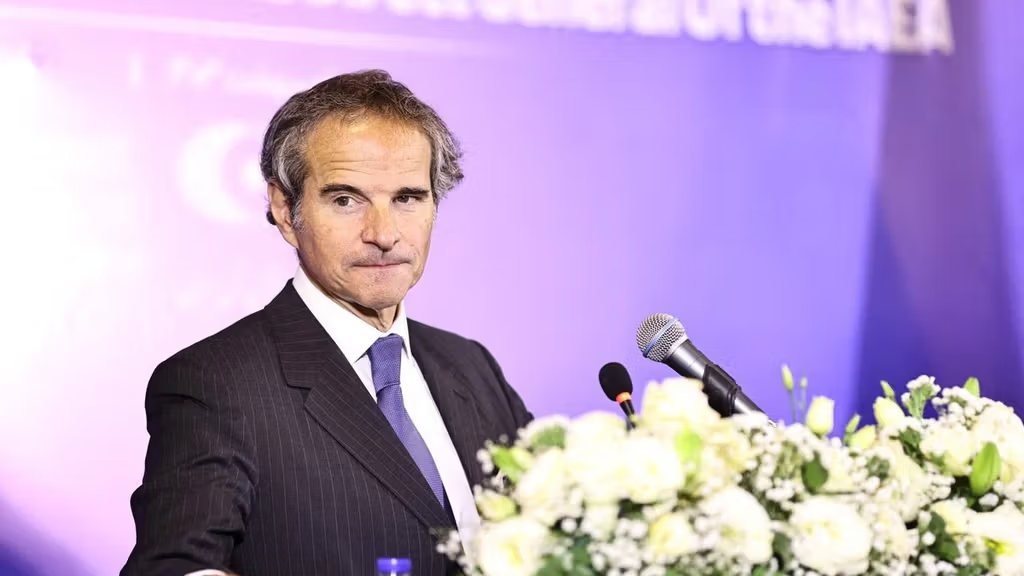
International Atomic Energy Agency (IAEA) Director General Rafael Grossi looks during a joint news conference with Head of Iran's Atomic Energy Organization Mohammad Eslami in Isfahan, Iran, May 7, 2024.
Iran might already possess a nuclear weapon, an insider politician in Tehran said on Friday, after remarks by a senior foreign policy figure the day before about a possible change in nuclear policy.
Ahmad Bakhshayesh Ardestani, re-elected to parliament in March, conveyed to the Rouydad 24 website his belief that Iran's decision to risk attacking Israel in April stemmed from its possession of nuclear weapons.
Moreover, he drew attention to remarks by Kamal Kharrazi, senior foreign policy advisor to Supreme Leader Ali Khamenei on Thursday, who said that Tehran will change its nuclear doctrine if Israel attacks its atomic facilities. For years, the Islamic Republic has insisted that its nuclear program is entirely peaceful, despite enriching uranium to 60-percent purity, which can only have a weaponization purpose.
“In my opinion, we have achieved nuclear weapons, but we do not announce it. It means our policy is to possess nuclear bombs, but our declared policy is currently within the framework of the JCPOA. The reason is that when countries want to confront others, their capabilities must be compatible, and Iran's compatibility with America and Israel means that Iran must have nuclear weapons,” Ardestani was quoted as saying.
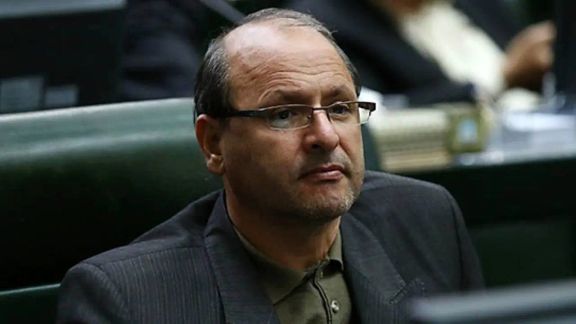
Lawmaker Ahmad Bakhshayesh Ardestani
Clearly putting Iran in the same trench as Russia, Ardestani added, “In a climate where Russia has attacked Ukraine and Israel has attacked Gaza, and Iran is a staunch supporter of the Resistance Front, it is natural for the containment system to require that Iran possess nuclear bombs. However, whether Iran declares it is another matter.”
The conservative politician, hailing from Isfahan Province, representing a district close to the Natanz nuclear facility, is a trusted regime figure, because he was allowed to run and win in the tightly orchestrated March parliamentary elections.
Ardestani, 63, has served in the government in various capacities since his youth from the early 1980s, and was a close ally of former President Mahmoud Ahmadinejad. It is not clear if he is a member of the hardliner Paydari party, dominating the newly elected parliament, but he also served a four-year term from 2012-2016 as an Ahmadinejad supporter. He is known as a foreign policy expert who managed foreign students sent abroad by the government.
On Thursday, Kamal Kharrazi was quoted by the semi official ISNA news website as saying, “If they [Israel] dare to strike Iran's nuclear facilities, our level of deterrence will change. We have experienced deterrence at the conventional level so far. If they intend to strike Iran's nuclear capabilities, naturally, it could lead to a change in Iran's nuclear doctrine.”
Kharrazi's statement seemed designed to be a deterrence to any Israeli plans to attack its nuclear facilities. Although he also threatened a change of doctrine if Iran’s existence is threatened, any Israeli attack will most likely be aimed at valuable strategic targets, not at obliterating Iran. It is possible that Supreme Leader Ali Khamenei’s advisor was referring to possible Israeli threats against the regime and its leaders, not the existence of Iran as a country.
On April 18, a senior IRGC commander had also warned that Tehran could change its nuclear policies if Israel continues to threaten to attack Iran’s nuclear sites.
“If the fake Zionist regime wants to use the threat of attacking nuclear sites to put pressure on Iran, it is possible and conceivable for the Islamic Republic to revise its nuclear doctrine and policies, and deviate from its past declared considerations,” said Ahmad Haghtalab, who oversees the security of Iran’s nuclear sites.
Over 100 prominent voices from the music, cultural, and human rights realms have joined forces to call for the immediate release of Iranian rapper Toomaj Salehi – a dissident sentenced to death over his support of nationwide anti-regime protests.
Signatories include international artists Coldplay, Sting, Jade Thirlwall of Little Mix, writer Margaret Atwood, and former Iranian-British hostage and campaigner Nazanin Zaghari-Ratcliffe.
“No artist should be subject to any kind of judicial harassment for exercising their right to freedom of expression, much less be sentenced to death,” their statement said on the Index on Censorship’swebsite.
Toomaj, known by his first name, has been a long-time critic of the regime in Iran and rose to further prominence when he spoke out in support of the 2022 Women, Life, Freedom protests in Iran.
Over the years,the rapper gaineda considerable following through his music and lyrics, which criticized the Iranian state and its human rights violations.
He was one of the first dissidents abducted and detained in the Iranian authorities’ crackdown on the nationwide demonstrations.
“We are living somewhere horrific. You are dealing with a mafia that is prepared to kill an entire nation in order to keep its power, money and weapons,” the rapper toldCBC Newsin an exclusive interview, shortly before his arrest.
Toomaj spent over a year in detention, which included 252 days in solitary confinement.
"As artists, musicians, writers and leading cultural figures we stand in solidarity with Toomaj Salehi. We call for his death sentence to be immediately and unconditionally quashed and for him to be released from detention without delay, with all other charges dismissed. Art must be allowed to criticize, to provoke, to question and to challenge authority. That is both our right and our duty as artists,” the statement by the world renowned figures read.
Following Toomaj’s release on bail in November 2023, the rapper recounted his experiences of torture in a video posted to YouTube. He was quickly re-arrested on charges of "corruption on earth."
Isfahan’s non-independent Islamic Revolutionary Court sentenced the rapper to death on April 24.
While the May 10 runoff parliamentary election appears to be a non-event for most Iranians, a politician suggests that widespread dissatisfaction with the government may lead to a very low turnout.
Gholam Ali Rajaei, an aide to former President and Expediency Council Chief Akbar Hashemi Rafsanjani told reporters in Tehran that the luckiest winner in Tehran may get through to the Majles with around 50,000 votes.
Explaining the reasons for the general apathy, Rajai said that people know they cannot expect too much from individuals who are elected to the Majles with the votes of only 6 to 7 percent of eligible voters.
According to Rouiydad24, it is not only this reformist politician who is pessimistic about the turnout in the runoff elections. Even Conservative media outlets in Tehran are echoing similar sentiments. They argue that the general public's mood does not reflect the typical enthusiasm seen during election periods. The March first-round elections already recorded the lowest turnout in Iran's post-revolution history.
The official turnout in March was 28 percent in Alborz Province, 30 percent in Kordestan Province, and 34 percent in Tehran. However, observers believe actual turnout figures were much lower.
Rajaei emphasized that runoff elections in Iran historically witness low turnout. However, the exceptionally low participation in March underscored Iranians' protest against the government's management of state affairs.
"There are too many problems that have left no peace of mind for Iranians. Election is no longer an issue of interest for the people who have so many financial problems and their livelihood is shrinking on a daily basis." Rajaei said.
He added that the economic chaos in Iran is directly linked to the government's foreign policy and its attitude toward the international order. Iranians have come to believe that the current government in Iran finds rapprochement with the world impossible.
Only an efficient parliament working hand in hand with an efficient government elected in a competitive electoral system may be able to solve some of Iran's problems, but what can lawmakers who entered the Majles with 6 or 7 percent of the votes in their constituency do, he retorted.
Rajaei also suggested that the government is happy about the current situation because there are no lawmakers who would criticize its performance.
In another development, questioning the legitimacy of the current electoral system, Ali Asghar Pourmohammadi, the former head of the Iranian state TV's Channel 3, who will be competing in the runoff election, told Khabar Online website that the conservative political group Shana (short for the Islamic Council of revolutionary forces) had assured him that he would be elected in the first round with all others on its list but this was not the case. "They told me to enjoy myself and go on vacation and to rest assured that I will be a winner," he said.
Pourmohammadi charged that a number of President Ebrahim Raisi's cabinet ministers make the final decision about who wins in the election. Meanwhile, criticizing the parliament and the government for their failures, Pourmohammadi said Raisi and parliament Speaker Mohammad Bagher Ghalibaf are in the wrong positions: "Ghalibaf would have made a better President," he said but did not elaborate on his views about what kind of Speaker Raisi would be.
He said in an apparent allusion to Supreme Leader Ali Khamenei or his aides, that "prominent individuals in the system suggested that I should run in the election as my presence at the Majles will be helpful."
The US State Department has labeled comments by the advisor to the Iranian Supreme Leader as "irresponsible" after he warned that Iran could change its nuclear strategy if threatened by Israel.
The US is committed to preventing Iran from developing nuclear weapons, State Department spokesman Matthew Miller said at a press briefing on Thursday.
Earlier this week, in an interview with Al Jazeera, Kamal Kharrazi, an advisor to Iran's Supreme Leader Ali Khamenei, warned that "if [Israel dares] to strike Iran's nuclear facilities, [Iran’s] level of deterrence will change."
"As the President and Secretary have made clear, the United States will ensure one way or another that Iran will never have a nuclear weapon. We continue to use a variety of weapons – or sorry – a variety of tools in pursuit of that goal and all options remain on the table," Miller said in response.
Despite the warning from Kharrazi and Iran’s repeated noncompliance on its nuclear program, Miller acknowledged that diplomacy remains the preferred route for achieving a sustainable resolution.
The spokesperson did point out that diplomatic efforts are currently hindered due to Iran's recent escalatory actions and its lack of cooperation with the International Atomic Energy Agency (IAEA).
In recent months, a number of officials close to the Supreme Leader have threatened that the Islamic Republic has the capability to build an atomic bomb.
“We have no decision to build a nuclear bomb but should Iran's existence be threatened, there will be no choice but to change our military doctrine,” Kharrazisaid, who previously served as Iran’s Minister of Foreign Affairs and currently leads the Strategic Council of Foreign Relations.
The statement comes shortly after the visit of Rafael Grossi, the director-general of the UN nuclear watchdog, the IAEA, to Tehran.
Grossi reported thatthere was “no timeframe or deadline” for Iran to resolve its nuclear issues, but he emphasized the expectation for Iran to take swift action.
Malaysia has shrugged off US calls for help to tackle Iran’s illicit oil sales in Malaysian waters, underlining the extent and the nature of US difficulties in stopping the flow of funds to Iran.
This method, widely known as ship-to-ship transfer, has been going on for a while, but Malaysian authorities don’t seem too eager to counter it.
“We conveyed to the US delegates –nicely– that when [it] comes to the issue of sanctions, our position is that we only recognize a sanction imposed by the UN Security Council,” Malaysian Home Minister, Saifuddin Nasution Ismail said in a press conference Thursday.
The minister’s diplomatic rebuke followed a similar albeit subtler message from Malaysia’s prime minister Anwar Ebrahim, who said his country was friends with ‘everyone’ but placed national interest ‘above all else.’
The US delegation had argued that ship-to-ship transfers carry environmental risks, according to Reuters, likely trying to present their request as less political and potentially more palatable for Malaysian authorities.
"Many of these shipments traverse the waters around Malaysia and are loaded onto vessels of questionable legitimacy that may also pose major environmental and safety risks," said Brian Nelson, US Treasury undersecretary for Terrorism and Financial Intelligence.
Nelson took his case to Malaysian lawmakers, who, reportedly, asked for evidence for US claims of illicit activity related to Iranian oil in Malaysian waters.
The Iranian regime had a period of revenue ‘drought’ during President Trump’s “maximum pressure”, but oil sales began growing towards the end of Trump’s term and soared after Joe Biden took office in 2020. In the past year or two, the US treasury has noticed that more money is getting to the regime in Tehran through the Malaysian financial system, Reuters reported last Friday, quoting an unnamed source.
This seems to have happened –partly at least– due to the Biden administration’s reluctance to antagonize the regime in Tehran, which seems to have made the most of its friendly relations with Malaysia in recent years.
Last year, the US treasury sanctioned Iranian Hossein Hatefi Ardakani for overseeing a “transnational procurement network” spanning the Middle East and East Asia. Ardekani was accused of procuring “servo motors, inertial navigation equipment, and other items” for Iran’s drone program through front companies in Malaysia, Hong Kong, and others.
Critics of the Biden administration say abandoning Donald Trump’s “maximum pressure” policy has not only emboldened the Iranian regime to adopt a clearly more aggressive foreign (and nuclear) policy but has enabled the Revolutionary Guards (IRGC) to implement those policies with more money in their coffers.
But officials have rejected the accusations many times, stating that the administration has sanctioned “over 600 individuals and entities”.
Biden’s critics point out that sanctions are effective only if they are enforced rigorously –and across the board. Iran’s biggest trade partner and main buyer of oil is China. Many experts say it’s hard, if not impossible, for any US administration to sanction China.
The Malaysian government's response to the US Treasury delegation can be a case in point, proving that getting other countries to follow the American lead is easy no more, even when that country is infinitely smaller and weaker than China.
An Iranian cleric says that Supreme Leader Ali Khamenei has assured embattled Mohammad Bagher Ghalibaf that he will keep his position as the Speaker of Iran's Parliament, amid a push by hardliners to unseat him.
Abbas Amirifar told reporters in Tehran that Ghalibaf was determined to resign as a member of parliament, but after a meeting with a high-ranking regime official (jargon used to refer to Supreme Leader Ali Khamenei) he has been assured that he can keep his position as the speaker of the Majles.
Amirifar is known as a fundamentalist cleric and the former “exorcist” of ex-President Mahmoud Ahmadinejad.
"The official told him to remain in his position and continue to lead the parliament," Amirifar said, adding that "I am sure that he will retain his position and will win the necessary votes of parliament members."
While Iranians generally show no interest in the issue, distrusting the system altogether since the highly manipulated March 1 parliamentary election, there has been a fierce competition among several hardline lawmakers to win the Speaker's seat. However, the pressure by some of the new MPs to dethrone Ghalibaf is so immense that the incumbent reportedly decided to resign and prepare to run for the next presidential election next year instead.
Iran International has named potential candidates for the post as Ghalibaf, Paydari Party leaders Morteza Agha-Tehrani and Sadeq Mahsouli, as well as outspoken Hamid Rasaei, adding that they have been pushing their own campaign for the election of the Speaker. However, the report pointed out that Khamenei's intervention will always be a possibility as it has been in several cases in the past.
According to Amirifar, the decision has already been made, and other contestants may compete to become Ghalibaf's deputies. Although neither Khamenei, nor Ghalibaf have denied Amirifar's account, it is still not clear whether this is a fabrication by Ghalibaf or the exorcist who might have been hired by him.
Referring to the campaigns of at least two of the contestants - Ghalibaf who threw a large banquet to garner support from among the newly elected MPs last week, and Hamid Rasaei, who has promised to give them houses and cars if he is elected - Hosseini said: "I thought campaigning by throwing banquets belong to the past."
Hosseini, pointing out that Ghalibaf faces an uphill battle, named two other serious contestants for the post: Former Foreign Minister Manouchehr Mottaki, a politician no one takes seriously after he was removed from his post by Ahmadinejad in 2010, and Mojtaba Zolnouri, a lawmaker from Qom who has had too many blunders during his career as a member of parliament.
Hosseini pointed out that since halfway through his career as Majles Speaker, a powerful opposition has been formed in against Ghalibaf. During the final months of the current Majles it has become evident that there is also a serious rift between Ghalibaf and President Ebrahim Raisi, who is Khamenei's favorite official. All of Ghalibaf's political rivals happen to be close to the Raisi administration.
It is quite clear from the dynamics between Ghalibaf and his rivals that not all of them will stop their ambitions if Khamenei makes it clear that he wants Ghalibaf in the post. For instance, Rasaei has twice ignored Khamenei's advice for lawmakers to tame their ambitions and stop infighting. Meanwhile, Khamenei cannot publicly issue an order in Ghalibaf's support and undermine even the appearance of lawful processes at the parliament.
What could potentially work in Ghalibaf's favor is Khamenei's lack of trust in other candidates for the position, most of whom hail from the ultraconservative Paydari Party. While this party generally adheres to formalities, it has demonstrated a tendency to occasionally defy Khamenei's directives. Khamenei has not forgotten how ungrateful Ahmadinejad, Paydari's previous champion, treated him. The competition for the Speaker's seat is partly a move in the succession process after Khamenei, where shifts in loyalties play a pivotal yet unpredictable role.