US Slams Iran's Nuclear Warning as 'Irresponsible'
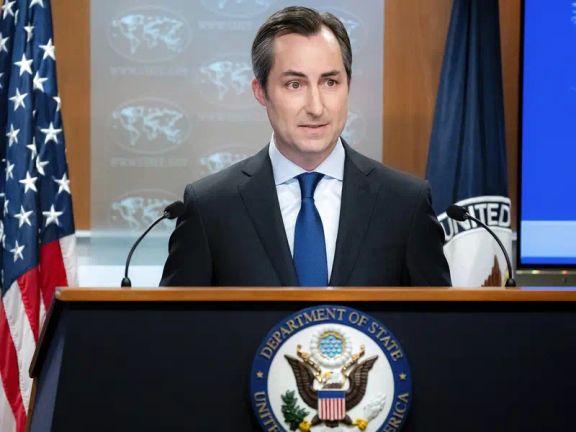
The US State Department has labeled comments by the advisor to the Iranian Supreme Leader as "irresponsible" after he warned that Iran could change its nuclear strategy if threatened by Israel.

The US State Department has labeled comments by the advisor to the Iranian Supreme Leader as "irresponsible" after he warned that Iran could change its nuclear strategy if threatened by Israel.
The US is committed to preventing Iran from developing nuclear weapons, State Department spokesman Matthew Miller said at a press briefing on Thursday.
Earlier this week, in an interview with Al Jazeera, Kamal Kharrazi, an advisor to Iran's Supreme Leader Ali Khamenei, warned that "if [Israel dares] to strike Iran's nuclear facilities, [Iran’s] level of deterrence will change."
"As the President and Secretary have made clear, the United States will ensure one way or another that Iran will never have a nuclear weapon. We continue to use a variety of weapons – or sorry – a variety of tools in pursuit of that goal and all options remain on the table," Miller said in response.
Despite the warning from Kharrazi and Iran’s repeated noncompliance on its nuclear program, Miller acknowledged that diplomacy remains the preferred route for achieving a sustainable resolution.
The spokesperson did point out that diplomatic efforts are currently hindered due to Iran's recent escalatory actions and its lack of cooperation with the International Atomic Energy Agency (IAEA).
In recent months, a number of officials close to the Supreme Leader have threatened that the Islamic Republic has the capability to build an atomic bomb.
“We have no decision to build a nuclear bomb but should Iran's existence be threatened, there will be no choice but to change our military doctrine,” Kharrazi said, who previously served as Iran’s Minister of Foreign Affairs and currently leads the Strategic Council of Foreign Relations.
The statement comes shortly after the visit of Rafael Grossi, the director-general of the UN nuclear watchdog, the IAEA, to Tehran.
Grossi reported that there was “no timeframe or deadline” for Iran to resolve its nuclear issues, but he emphasized the expectation for Iran to take swift action.

Malaysia has shrugged off US calls for help to tackle Iran’s illicit oil sales in Malaysian waters, underlining the extent and the nature of US difficulties in stopping the flow of funds to Iran.
This method, widely known as ship-to-ship transfer, has been going on for a while, but Malaysian authorities don’t seem too eager to counter it.
“We conveyed to the US delegates –nicely– that when [it] comes to the issue of sanctions, our position is that we only recognize a sanction imposed by the UN Security Council,” Malaysian Home Minister, Saifuddin Nasution Ismail said in a press conference Thursday.
The minister’s diplomatic rebuke followed a similar albeit subtler message from Malaysia’s prime minister Anwar Ebrahim, who said his country was friends with ‘everyone’ but placed national interest ‘above all else.’
The US delegation had argued that ship-to-ship transfers carry environmental risks, according to Reuters, likely trying to present their request as less political and potentially more palatable for Malaysian authorities.
"Many of these shipments traverse the waters around Malaysia and are loaded onto vessels of questionable legitimacy that may also pose major environmental and safety risks," said Brian Nelson, US Treasury undersecretary for Terrorism and Financial Intelligence.
Nelson took his case to Malaysian lawmakers, who, reportedly, asked for evidence for US claims of illicit activity related to Iranian oil in Malaysian waters.
The Iranian regime had a period of revenue ‘drought’ during President Trump’s “maximum pressure”, but oil sales began growing towards the end of Trump’s term and soared after Joe Biden took office in 2020. In the past year or two, the US treasury has noticed that more money is getting to the regime in Tehran through the Malaysian financial system, Reuters reported last Friday, quoting an unnamed source.
This seems to have happened –partly at least– due to the Biden administration’s reluctance to antagonize the regime in Tehran, which seems to have made the most of its friendly relations with Malaysia in recent years.
Last year, the US treasury sanctioned Iranian Hossein Hatefi Ardakani for overseeing a “transnational procurement network” spanning the Middle East and East Asia. Ardekani was accused of procuring “servo motors, inertial navigation equipment, and other items” for Iran’s drone program through front companies in Malaysia, Hong Kong, and others.
Critics of the Biden administration say abandoning Donald Trump’s “maximum pressure” policy has not only emboldened the Iranian regime to adopt a clearly more aggressive foreign (and nuclear) policy but has enabled the Revolutionary Guards (IRGC) to implement those policies with more money in their coffers.
But officials have rejected the accusations many times, stating that the administration has sanctioned “over 600 individuals and entities”.
Biden’s critics point out that sanctions are effective only if they are enforced rigorously –and across the board. Iran’s biggest trade partner and main buyer of oil is China. Many experts say it’s hard, if not impossible, for any US administration to sanction China.
The Malaysian government's response to the US Treasury delegation can be a case in point, proving that getting other countries to follow the American lead is easy no more, even when that country is infinitely smaller and weaker than China.

An Iranian cleric says that Supreme Leader Ali Khamenei has assured embattled Mohammad Bagher Ghalibaf that he will keep his position as the Speaker of Iran's Parliament, amid a push by hardliners to unseat him.
Abbas Amirifar told reporters in Tehran that Ghalibaf was determined to resign as a member of parliament, but after a meeting with a high-ranking regime official (jargon used to refer to Supreme Leader Ali Khamenei) he has been assured that he can keep his position as the speaker of the Majles.
Amirifar is known as a fundamentalist cleric and the former “exorcist” of ex-President Mahmoud Ahmadinejad.
"The official told him to remain in his position and continue to lead the parliament," Amirifar said, adding that "I am sure that he will retain his position and will win the necessary votes of parliament members."
While Iranians generally show no interest in the issue, distrusting the system altogether since the highly manipulated March 1 parliamentary election, there has been a fierce competition among several hardline lawmakers to win the Speaker's seat. However, the pressure by some of the new MPs to dethrone Ghalibaf is so immense that the incumbent reportedly decided to resign and prepare to run for the next presidential election next year instead.
Iran International has named potential candidates for the post as Ghalibaf, Paydari Party leaders Morteza Agha-Tehrani and Sadeq Mahsouli, as well as outspoken Hamid Rasaei, adding that they have been pushing their own campaign for the election of the Speaker. However, the report pointed out that Khamenei's intervention will always be a possibility as it has been in several cases in the past.
According to Amirifar, the decision has already been made, and other contestants may compete to become Ghalibaf's deputies. Although neither Khamenei, nor Ghalibaf have denied Amirifar's account, it is still not clear whether this is a fabrication by Ghalibaf or the exorcist who might have been hired by him.
A leading conservative politician, former lawmaker Hossein Naqavi Hosseini has said in an interview with Khabar online website that "It is humiliating for a lawmaker to say that he would resign if he cannot be the Speaker of the Majles."
Referring to the campaigns of at least two of the contestants - Ghalibaf who threw a large banquet to garner support from among the newly elected MPs last week, and Hamid Rasaei, who has promised to give them houses and cars if he is elected - Hosseini said: "I thought campaigning by throwing banquets belong to the past."
Hosseini, pointing out that Ghalibaf faces an uphill battle, named two other serious contestants for the post: Former Foreign Minister Manouchehr Mottaki, a politician no one takes seriously after he was removed from his post by Ahmadinejad in 2010, and Mojtaba Zolnouri, a lawmaker from Qom who has had too many blunders during his career as a member of parliament.
Hosseini pointed out that since halfway through his career as Majles Speaker, a powerful opposition has been formed in against Ghalibaf. During the final months of the current Majles it has become evident that there is also a serious rift between Ghalibaf and President Ebrahim Raisi, who is Khamenei's favorite official. All of Ghalibaf's political rivals happen to be close to the Raisi administration.
It is quite clear from the dynamics between Ghalibaf and his rivals that not all of them will stop their ambitions if Khamenei makes it clear that he wants Ghalibaf in the post. For instance, Rasaei has twice ignored Khamenei's advice for lawmakers to tame their ambitions and stop infighting. Meanwhile, Khamenei cannot publicly issue an order in Ghalibaf's support and undermine even the appearance of lawful processes at the parliament.
What could potentially work in Ghalibaf's favor is Khamenei's lack of trust in other candidates for the position, most of whom hail from the ultraconservative Paydari Party. While this party generally adheres to formalities, it has demonstrated a tendency to occasionally defy Khamenei's directives. Khamenei has not forgotten how ungrateful Ahmadinejad, Paydari's previous champion, treated him. The competition for the Speaker's seat is partly a move in the succession process after Khamenei, where shifts in loyalties play a pivotal yet unpredictable role.

Writers Anisha Asadollahi and her husband Keyvan Mohtadi “do not belong in prison” more than 700 activists have said in a letter calling for the couple’s release.
The two members of the Iranian Writers Association were arrested in May 2022 on charges of "conspiracy and collusion" against national security.
In a statement issued on Wednesday, union, cultural, and political activists stated: "Keyvan Mohtadi and Anisha Asadollahi are caring and thoughtful individuals who do not belong in prison."
Parastoo Foruhar, artist and writer; Keyvan Samimi, political activist; Esmaeel Abdi, member of teachers union; Mehrangiz Kar, women's rights activist; Reza Khandan Mahabadi, writer and Fereshteh Molavi, translator; are among the signatories.
Asadollahi was sentenced to five years and eight months and Mohtadi to six years in prison.
Despite two years having passed since his arrest, Mohtadi has been denied parole. Asadollahi was temporarily released in August 2022, but returned to Evin prison a year later.
According to the 2023 Freedom to Write Index, Iran retained its position as the second most imprisoned country, following China.
PEN America published its latest report last week, which found that Iranian authorities continue to detain Iranian authors, many of whom are associated with the Woman Life Freedom Movement of 2022.
In September 2022, the regime's crackdown on the Woman Life Freedom movement, sparked by the death of Mahsa Amini, resulted in the deaths of at least 550 Iranians, as well as the arrest of tens of thousands, including scores of journalists.

The latest brutal crackdown enforcing hijab comes on the direct orders of Supreme Leader Ali Khamenei, Tehran’s police chief has revealed.
Abbas Ali Mohammadian hailed the repressive measures – dubbed the "Nour [light] Initiative" - as "successful" amid increasing reports of violence committed by morality police agents against women in Iran's cities.
"After the Supreme Leader's directive, the police put this project on their agenda," Mohammadian said on Wednesday.
During a meeting with other police staff, he suggested they have "more patience" and work harder to accomplish their mission "better" without providing details on what that means.
Supreme Leader Ali Khamenei has repeatedly stated that ignoring the hijab is a red line that should not be crossed.
In his speech in early April, he described hijab defiance as "an imposed challenge". He said "the enemies" aimed to revert women's status to pre-Islamic Revolution times when their behavior, attitude, and presence were considered unacceptable.
"The issue of hijab has become a challenge and imposed on our country. They imposed this," he stated.
"Today, they are focused on the issue of removing women's hijab, but this is the first step; it is not the last step. This is not their goal. The enemy's goal is to return the country to the state of pre-revolution when scandalous conditions prevailed," he added.
Morality police have been back on the streets since April 13, when the new hijab restrictions took effect. The extortion and abuse of Iranian women at the hands of hijab enforcement officers have caused even some regime supporters and hardliners to criticize the act or, at times, try to absolve Khamenei of responsibility.
Within a week of the new restrictions being enacted, deputy chief of the Office for the Preservation and Publication of the Works of the Leader of the Revolution, Mehdi Fazaeli, stated that the leader had cautioned some officials to refrain from taking any "irregular and spontaneous" actions regarding the hijab.
Mohammad Safari Malekian, a member of Iran’s parliament, was quoted on state news as saying: “Unfortunately, the country has suffered enormous costs due to the ill-considered enforcement of hijab. Distasteful behavior and an excessive amount of pressure on the issue of hijab will not achieve any results.”
Iran International has been informed of severe violence, including brutal physical assault and sexual verbal abuse suffered by many women arrested by the morality police during the latest crackdown.
Social media has been flooded with videos of Iranian hijab patrol agents forcibly arresting women for not complying with mandatory hijab. On Wednesday, a video surfaced that showed a woman being locked up in a police van as the crackdowns continued.
After the protests following Mahsa Amini's death in the custody of the morality police in 2022, enforcing mandatory hijab became more lax, but there are once again patrols of police, morality vans, and police motorcycle patrols in different Iranian districts.
Amini, a 22-year-old Kurdish-Iranian woman, died from multiple head injuries, triggering the fiercest uprising against the regime since its founding.

The Iranian automobile workers’ leader has protested against a two billion euro deal to buy electric buses from China for Tehran.
The reaction by the head of the Iranian Automobile Workers Union (IAWU) on Thursday came after the capital’s authority agreed the contract with a Chinese firm.
Mojtaba Hajizadeh branded the move an "insult to domestic production" and explained that it was unjustifiable financially because "domestic vehicles and their spare parts are much cheaper than imported models."
He told state broadcaster ILNA that they could not compete with China because of the leverage Beijing enjoys, particularly including its "veto power" in the political arena.
The news of the vast contract with China for buses, other transport and traffic surveillance equipment has been met with a massive backlash even from officials in the past few days.
Tehran city councilors and the media have called for greater transparency, but details of the contract remain undisclosed.
Jafar Tashakori Hashemi, a member of the Tehran City Council, said on Monday: "This is a violation of the municipality's work. As far as I know, bus purchases are not a matter of national security, so we should be able to view the actual contract."
The contract signed by Mayor Alireza Zakani is expected to be funded by proceeds from Iranian oil exports to China, and funds that have accumulated in China while US sanctions have been in effect.
Zakani confirmed that he had signed several agreements during his January visit to China.