Urinals Removed from Tehran Shopping Malls for Being ‘Un-Islamic’
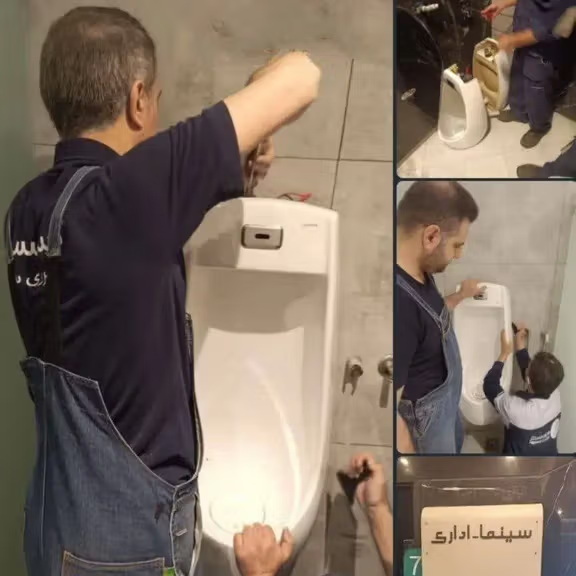
Shopping malls in Tehran are removing urinals, branding them as "un-Islamic" and indicative of "Westoxification."
Shopping malls in Tehran are removing urinals, branding them as "un-Islamic" and indicative of "Westoxification."
A fatwa by Iran's Supreme Leader Ali Khamenei says it is Makrooh (disliked but not sinful) to urinate while standing or on a hard surface, forcing men to use the pit latrines instead.
The move has sparked widespread discourse and critique on social media. One user expressed frustration, remarking, "This is ridiculous! If they'd spend more time worrying about the economy, the starving people, the water shortage, they wouldn't have to worry about how men urinate."
Another user sarcastically said, "I hope the level of your demands always remains this profoundly high, and that your minds never get bogged down with demands for trivial matters like city beautification, increased security, or economic improvements. Demands should only be for issues like hijab and the Islamic way of dressing, as these are what truly elevate people's quality of life."
The removal of urinals is just one example of how the Iranian regime continues to exert control over the minor details of the population's personal lives, from dress codes and family planning to restroom habits.


Ayatollah Nasser Makarem Shirazi, a hardline cleric holding one of the highest ranks in the Iranian regime’s Shiite clerical system, conveyed to President Ebrahim Raeisi during a meeting on Friday the urgent need for the government to curb the “rampant inflation.”
"People are struggling with soaring housing prices. A solution must be found because housing plays a vital role in the nation's well-being," Makarem Shirazi emphasized.
Additionally, he addressed issues such as escalating food costs, dwindling purchasing power, and exchange rate volatility, stating, “the government must tackle these challenges.”

Hossein Noori Hamedani, a conservative grand ayatollah in Iran, echoed similar sentiments on Friday, informing Raisi, “everywhere you go, people lament the high cost and difficulty of life. It has become challenging for individuals to make ends meet."
Yesterday, the Supreme Leader's chief of staff, Gholamhossein Mohammadi Golpayegani, also acknowledged Iran's economic struggles. While attributing them to sanctions, Golpayegani urged Raisi to find a solution: "We are facing challenges due to sanctions, but the government will find ways to overcome them."
Religious figures, who have traditionally supported the Raisi administration and its hard-line policies, have expressed concern amid a backdrop of inflation exceeding 50%.
As of last month, Iran's Central Bank reported a 52.3% inflation rate for 2023, while gasoline remains in short supply despite the country's abundant oil reserves.
Although the economy was already suffering due to international sanctions related to Iran's nuclear weapons programs and support for regional terror groups like Hamas and Hezbollah, which have little connection to Raisi's government, no one seemed to acknowledge the role of the Supreme Leader and instead placed blame on him.
Despite the clergy's criticism of the government and apparent alignment with the people, many harbor pent-up resentment against the clergy as a whole, especially in light of the violent crackdown on women for enforcing the hijab since 2022, which is associated with religious leaders and the harsh, oppressive doctrine of the Islamic Republic.
The dire state of the economy has worsened due to recent foreign policy decisions by the Islamic Republic.
In the first two weeks of April, Tehran's foreign exchange market experienced an unprecedented surge, with the dollar briefly hitting 700,000 rials amid escalating tensions between Iran and Israel. In 1978, a dollar was equivalent to 70 rials.
Over the years, the devaluation of the Iranian rial has pushed millions of Iranians into poverty.


Speaking to reporters, Vahidi stated that this issue is not currently on the government's agenda, despite ongoing discussions and debates surrounding women's access to such licenses in the country.
However, in January, following a cabinet meeting in Tehran, Iran's Vice President for Women Affairs, Ensieh Khazali, had assured reporters that efforts were underway to address the issue of motorbike licenses for women. Despite these assurances, no concrete steps have been taken to address the matter.
The parliament has repeatedly announced the approval of the law on issuing motorcycle licenses for women, but nothing has happened in this regard.

Iran’s laws on women riding motorbikes
Women can participate in motorcycle racing as a sport, but they are not legally allowed to ride on city streets, according to Iran’s Islamic restrictions.
Before the 1979 Iranian revolution, women were permitted to ride motorbikes. However, with the establishment of the Islamic Republic regime, regulations regarding women's motorbike riding, akin to their presence in sports stadiums, became ambiguous and discriminatory. While there are no explicit laws prohibiting women from riding motorbikes, they are generally banned in practice.
In the case of women being banned from riding motorbikes, it comes down to the issue of obstacles in obtaining a license in the first place from the issuing authorities, who may refer to one of the notes of the traffic law that only includes the word “men”.
The Note under Article 20 of Iran’s traffic laws states that "issuing motorbike driving licenses for ‘men’ is the responsibility of Police Force of the Islamic Republic of Iran". According to this Note, in essence women are legally unable to ride motorbikes.
In 2019 an Iranian woman named Fatemeh Eftekhari in Isfahan went to court after being denied a motorbike license based on the Note. The judge ruled in her favor and she was granted a license. However, after the news broke, the traffic police responded to the ruling, by indicating that it was made in favor of the plaintiff on a "case-by-case" basis, did not apply to the general public. In May 2020, in an Instagram post, she confirmed that the ruling was overturned and that she lost her license, while also reporting on being violently attacked by a man in Isfahan simply for being in bike gear.
Moreover, notably in 2016, when Fars News Agency asked Iran’s Supreme Leader Ali Khamenei about the Islamic guidance on women riding motorbikes and bicycles, he stated, "Women cycling in public places and in front of non-mahram [men who are not close family] often attracts the attention of men and can lead to sedition and corruption of society and goes against the chastity of women. It should not happen. But if it is not in front of non-mahram, there is no problem."
Iranian women defy the ban
The push for gender equality in Iran extends to the realm of transportation. Despite these legal complexities, many Iranian women continue to ride motorbikes, defying the restrictions imposed on them by the Iranian authorities.
Particularly after the 2022 uprising following the killing of Mahsa Amini in police custody, images and videos of not only riding motorbikes but also riding their bikes without compulsory hijab circulated online.
The fight for Iranian women's right to ride motorcycles in public spaces persists. Advocates like Nora Naraghi, an Iranian motorcyclist from the Baha’i religious minority, daughter of, formerly imprisoned Shahrzad Nazifi, the first woman in Iran to hold an official rank in motocross and motorcycle racing, leading the charge.