Iran's Escalating Subsidence Threatens Key Infrastructure
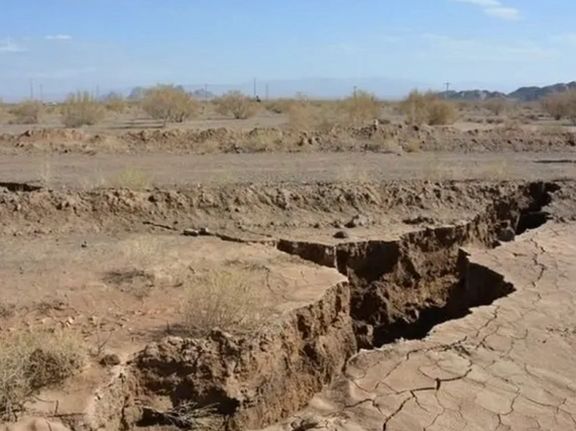
Ali Javdaneh, the head of Iran's national mapping organization, has raised alarm over the escalating issue of ground subsidence affecting urban areas across the country.
Ali Javdaneh, the head of Iran's national mapping organization, has raised alarm over the escalating issue of ground subsidence affecting urban areas across the country.
"The images of cracked roads and collapsed streets are just the surface manifestations of deeper geological processes that might not be immediately apparent," Javdaneh explained, recent scientific assessments showing that subsidence is not merely an above-ground occurrence but happens deep within the earth.
He says the phenomenon, often underestimated in its impact, “could pose challenges even at minimal rates such as two centimeters per year", with approximately 380 cities and 9,200 villages throughout Iran under threat.
The ancient archaeological site of Naqsh-e Rostam in Iran's Fars Province also faces imminent danger. The site, which houses the tombs of prominent Achaemenid kings like Darius the Great and Xerxes, has seen extensive damage due to recent heavy rainfall exacerbating the subsidence. Fissures as deep as 70 centimeters have been reported near the historical monuments, threatening their stability.
The broader implications of subsidence are severe, potentially leading to a depletion of water resources, reduced agricultural outputs, and transformation of fertile lands into barren deserts. The phenomenon has worsened over the past five years, with the affected area in Iran reportedly tripling in size. The situation is so precarious that even a minor earthquake could trigger significant disasters, especially in areas like Isfahan, which supports a population of over 2.7 million.


During his visit, Barzani engaged with key figures of the government, including the Supreme Leader, heads of executive and legislative bodies, the commander-in-chief of the IRGC, the foreign minister, and the secretary of the Supreme National Security Council.
The timing and nature of Barzani's visit, coming months after the IRGC's missile attack on the Kurdistan Region, raise questions about its motives. The high-profile meetings suggest that the discussions likely focused on mutual security concerns.
This trip took place against a backdrop of three significant issues: Firstly, Iran's missile and drone attacks on targets within the Iraqi Kurdistan Region, purportedly aimed at Israeli agents, elicited protests from both Kurdish authorities and the Iraqi central government. Secondly, the upcoming parliamentary elections in the Kurdistan Region, scheduled for June 10, 2024, face controversy as the Iraqi Kurdish Democratic Party (KDP) has announced its intention to boycott the elections. Lastly, the Islamic Republic of Iran (IRI) has made a request for the disarmament and complete expulsion of Iranian Kurdish armed groups sheltering in the Kurdish regions of Iraq.

The backdrop of recent events provides context for the objectives of the Iraqi Kurdish leaders' trip to Iran, though the outcomes remain uncertain due to the reticence of both parties involved.
This visit aimed to achieve three main objectives: 1) renegotiate mutual security arrangements, 2) mitigate threats posed by Tehran against the Iraqi Kurdish region, and 3) facilitate mediation by the Islamic Republic among conflicting political entities to reduce regional tensions.
In the realm of security, the Kurdistan Regional Government, whose high-ranking members have maintained long-standing relationships with Tehran, seeks to halt the regime's missile attacks. For this purpose, President Barzani aimed to reassure Iranian authorities that the regional government would not permit any group, faction, or country to launch actions against Iran or other neighboring nations. Additionally, following the unsuccessful independence referendum in 2017, the Kurdish authorities are attempting to mitigate Iranian threats through dialogue, promoting a narrative of a united Iraq.
In terms of political mediation, the Kurdish authorities are seeking Iran's intervention to reconcile differences between the two major Kurdish parties—the Iraqi Kurdistan Patriotic Union and the Kurdistan Democratic Party—and the Iraqi central government, particularly concerning disputes over regional elections.
Which objectives can be achieved?
The first goal—re-establishing a stable security relationship—seems attainable given the generally tension-free relations between the regional authorities and the Islamic Republic, unless the latter opts to demonstrate its strength by targeting structures within the Iraqi Kurdistan Region. However, there are significant doubts regarding the Iraqi Kurds' ability to fully avoid provocations from the Iranian regime, which sometimes launches attacks on its neighbors for reasons of prestige and maintaining its image.
Regarding the third objective, Tehran’s influence is constrained; it tends to favor military actions over diplomatic engagements with countries like the United States and Israel, and often does not take steps towards easing regional tensions. This preference for military approaches over diplomacy underscores the challenges in achieving mediation and conflict resolution in the region.
Reactions
Two prominent reactions to Barzani’s visit to Iran have emerged on social media. The first comes from Kurds who oppose Iran’s Islamic government; they expressed their discontent with Barzani for seemingly disregarding Tehran’s attacks on Kurds in the region and accused him of pandering during his meeting with Khamenei. Additionally, some Iranian opposition constitutional monarchists are also displeased with the visit, perceiving it as potentially encouraging separatist sentiments among Iraqi Kurds, which they fear might influence Iranian Kurds as well.
In another development, Iraqi journalist Ahmad Abdulsadeh reported that during the visit, Barzani provided a written commitment to the Iranian authorities, wherein Erbil officials pledged to disarm "terrorist groups" and ensure their removal from the Kurdistan Region. This commitment reportedly also includes a promise to curb attacks on the Iranian regime by media outlets like Rudaw and Kurdistan 24, and to control their coordination with foreign media entities. However, implementing these commitments could prove challenging and may lead to internal tensions within the region.


Ayatollah Nasser Makarem Shirazi, a hardline cleric holding one of the highest ranks in the Iranian regime’s Shiite clerical system, conveyed to President Ebrahim Raeisi during a meeting on Friday the urgent need for the government to curb the “rampant inflation.”
"People are struggling with soaring housing prices. A solution must be found because housing plays a vital role in the nation's well-being," Makarem Shirazi emphasized.
Additionally, he addressed issues such as escalating food costs, dwindling purchasing power, and exchange rate volatility, stating, “the government must tackle these challenges.”

Hossein Noori Hamedani, a conservative grand ayatollah in Iran, echoed similar sentiments on Friday, informing Raisi, “everywhere you go, people lament the high cost and difficulty of life. It has become challenging for individuals to make ends meet."
Yesterday, the Supreme Leader's chief of staff, Gholamhossein Mohammadi Golpayegani, also acknowledged Iran's economic struggles. While attributing them to sanctions, Golpayegani urged Raisi to find a solution: "We are facing challenges due to sanctions, but the government will find ways to overcome them."
Religious figures, who have traditionally supported the Raisi administration and its hard-line policies, have expressed concern amid a backdrop of inflation exceeding 50%.
As of last month, Iran's Central Bank reported a 52.3% inflation rate for 2023, while gasoline remains in short supply despite the country's abundant oil reserves.
Although the economy was already suffering due to international sanctions related to Iran's nuclear weapons programs and support for regional terror groups like Hamas and Hezbollah, which have little connection to Raisi's government, no one seemed to acknowledge the role of the Supreme Leader and instead placed blame on him.
Despite the clergy's criticism of the government and apparent alignment with the people, many harbor pent-up resentment against the clergy as a whole, especially in light of the violent crackdown on women for enforcing the hijab since 2022, which is associated with religious leaders and the harsh, oppressive doctrine of the Islamic Republic.
The dire state of the economy has worsened due to recent foreign policy decisions by the Islamic Republic.
In the first two weeks of April, Tehran's foreign exchange market experienced an unprecedented surge, with the dollar briefly hitting 700,000 rials amid escalating tensions between Iran and Israel. In 1978, a dollar was equivalent to 70 rials.
Over the years, the devaluation of the Iranian rial has pushed millions of Iranians into poverty.