Iran's Hijab Bill to Enforce Deportation of Illegal Foreign Nationals

Iranian MP Amir Hossein Bankipour announced that the proposed Hijab and Chastity Bill includes measures for deporting illegal foreign nationals who defy hijab.

Iranian MP Amir Hossein Bankipour announced that the proposed Hijab and Chastity Bill includes measures for deporting illegal foreign nationals who defy hijab.
Bankipour outlined that under the new law, police would have the authority to arrest individuals in five scenarios: “semi-nudity, affiliation with foreign movements, resistance after being cautioned, and foreigners lacking proper documentation.”
The proposed amendment targeting hijab offenders is part of the contentious Hijab and Chastity Bill which Parliament passed in June 2023. However, the Guardian Council, a constitutional watchdog, rejected the bill in October, citing unclear language, and returned it to parliament for revision and clarification.
Following the backlash from the death of Mahsa Amini in September 2022, who died in custody after being arrested for "improper hijab," hardliners are seeking new methods to enforce hijab regulations. The incident ignited the extensive Woman, Life, Freedom protests across the nation, deeply challenging the Iranian regime. The protests led to the deaths of over 550 civilians and the arrest of approximately 22,000 by security forces.
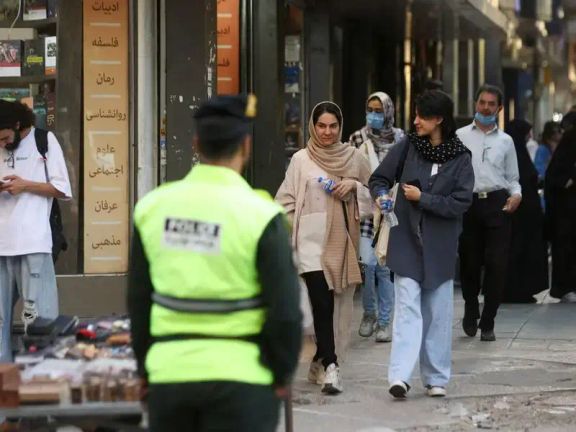
Despite the enforcement attempts, significant resistance persists among Iranian women, who continue to defy the mandatory hijab in public spaces like streets, shops, malls, restaurants, and government buildings in the biggest challenge to the regime since the founding of the Islamic Republic.

A government billboard in Tehran encouraging young girls to be homemakers and mothers has sparked a social media backlash amid the country's violent oppression of women.
The poster, at Valiasar Square in Tehran for Iran's National Girl's Day, depicts a girl sweeping the house, feeding a baby, massaging her father, and helping her brother, titled "The light of the eye," a term of endearment in Farsi.
It comes while there has been a new wave of crackdowns to compel women to comply with compulsory hijab laws under a new initiative called the "Noor [light] Initiative." A user on the X social network wrote, "The irony of the Noor Initiative patrol vans being parked under the same billboard to arrest the ‘the light of the eye'."
The juxtapositioning of the poster has fueled the anger, the area in front of the billboard mainly used as a parking space for morality police vans to enforce hijab on women passing by in Valiasr, one of the capital's main squares.
Since the launch of Noor, social media has been flooded with videos of morality police violence against women rebelling against the hijab. There have also been allegations of police officers extorting money from women in exchange for leniency, as well as accusations of theft and sexual harassment.
Several social media users have written that the girl "The light of the eye" is introduced in this banner. Still, if the same girl, "showing a bit of hair," sets foot outside the house, "she will become a thorn in the eye of the regime and will be taken into those vans at the bottom of the picture."
Some users shared pictures of women killed during the 2022 Woman Life Freedom movement, such as Mahsa Amini, Nika Shakarami, Sarina Alizadeh, and Hadis Najafi. They said that the government of the Islamic Republic is celebrating the day of the girls while "for no other reason than their hair, they torture, rape and kill them."
The death of 22-year-old Amini in morality police custody sparked the months-long nationwide protests. During the movement, regime forces killed around 550 protesters, injured hundreds, and arrested over 22,000 people.
Many progressive Iranians criticized the outdated portrayal of women in a country in which women have fought for their right to education. “Couldn't you show a girl playing sports, studying, having fun, or hanging out with her family?”
Between 2011 and 2022, women outnumbered men on Iran's college and university campuses, yet women in the labor force accounted for only 19 percent in 2020. The government has made “systematic efforts to limit women’s access to the workplace,” according to a 2021 State Department report. The women who are employed reportedly earn 41 percent less than men for the same work.
Iranian leaders have stated numerous times that the primary function of women in society is to bear children, raise children, take care of the household, and serve their husbands.
The wife of Iran's President, Ebrahim Raisi, said it is an example of violence when women study and work like men in an interview with Venezuelan state TV. Jamileh Alamolhoda claimed, "We want women to remain women. Why should we be like men? Why should we study, work or live like men? This is a form of violence". She has continued to call the murder of Mahsa Amini “fake media hype".
During a meeting with women in December, Supreme Leader Ali Khamenei reiterated his views that holding a job shouldn't prevent women from carrying out their “actual duties.” “There is, however, a crucial requirement that women won’t be ‘deprived’ of that important and fundamental ‘feminine task’, housekeeping and childbearing,” Khamenei said.
Just months ago, the United Nations branded Iran's new laws on hijab 'gender apartheid' and rights groups such as Amnesty International have slammed the regime's ongoing gender-based oppression and violence.
Iran’s judiciary has confirmed that political commentator Sadegh Zibakalam has been sent to prison prison on charges including “making false statements and engaging in propaganda activities against the regime.”
Zibakalam recently published a book titled "Why Don't They Arrest You and What Happens in the End?". His arrest came as he was scheduled to attend the book launch event at the Tehran International Book Fair on Sunday.
Zibakalam, a former University of Tehran professor and a figure often described as reformist and neo-liberal, has been a vocal critic of the Iranian government, frequently appearing on international media platforms such as BBC News and Al Jazeera. He has been especially critical of Iran’s nuclear program and has previously acknowledged the State of Israel, citing its recognition by the United Nations, which led to charges of "weakening the system."
His legal troubles include an 18-month prison sentence and a two-year prohibition from participating in political activities online and with various groups due to allegations of “conducting propaganda against the state.”
Another case that led to a one-year prison sentence involved the dissemination of what the authorities deemed “undocumented and false content.” Additionally, a third case, confirmed by the Supreme Court, sentenced him to six months in prison for similar charges.
The legal actions followed a series of statements by Zibakalam, including remarks made during an interview with Voice of America's Persian television. In the interview, he argued that Israel should not be blamed for the January bombing in Kerman, as it typically targets specific individuals and "does not attack innocent people."
On January 3, a memorial service at the grave of former IRGC Quds Force Commander Qasem Soleimani in eastern Kerman, was rocked by two bomb explosions. The attacks resulted in the deaths of over 100 people and left more than 280 others injured.

Iran’s government was widely criticized and mocked Saturday, after the Interior Minister called “epic” the run-off parliamentary elections that recorded the lowest turnout in the 45-year history of the Islamic Republic.
Around eight percent of those eligible showed up at the polling stations on Friday, highlighting the near-complete rupture between the people and the state in Iran –a country where turnouts higher than 50 percent were a given until recently.
“The second round of elections has ended. Thank God people created an epic,” interior minister Ahmad Vahidi posted on X, causing a backlash that was as funny as it was irate.
“Dear minister for interior, is an eight-percent turnout in a run-off election epic,” Mohammad Ali Abtahi, a deputy to the former President Khatami asked. “You either don’t know what 8 percent is, or you don’t know what epic is.”
It wasn’t just the ‘reformist’ Abtahi though. Mohammad Javad Azari Jahromi, a former intelligence man who headed the Ministry of Communications until three years ago, ridiculed the interior minister with a comment right under his original post on X.
“By epic, he likely means those 92 percent that didn’t take part [in the run-off election] in Tehran,” Jahromi wrote. “God bless those who were in charge of this election.”
The scornful tone was echoed by many ordinary users of social media who couldn’t help underlining the irony, the unabashed denial of daylight at noon by the IRGC-commander turned interior minister Vahidi.
“More people have posted a picture of the northern lights than took part in the run-off elections in Tehran,” one said, referring to the natural phenomenon that normally occurs in northern latitudes, but which on Saturday had been spotted in Iran.
Just above half a million voted in the capital Tehran, where eligible voters numbered near eight million, according to official data. The candidate with the most votes got around 270,000 or 3.5 percent of those eligible to vote. It was more or less the same story in 21 other constituencies that had to hold a run-off, including major cities such as Mashhad, Tabriz and Shiraz.
The ultra-hardline daily Kayhan, which is widely believed to be the unofficial voice of the Supreme Leader Ali Khamenei, and which splashes on its front page any election story, gave this one a side box with a small-font headline. More interestingly, it rephrased Vahidi’s “epic” statement so that the much-ridiculed word would not feature on its own.
The elections Friday, the “epic” statement, and the reactions to it, put together, were a telling example of all that’s wrong with the regime in Iran: lack of legitimacy, blundering incompetence, factionalism, and above all, widespread scorn for official politics and the institutions of state.
The turnout –historically and strikingly low– no longer seems to be a backlash against the Guardian Council and its blocking of ‘reformist’ candidates. It looks much more like a complete and final abandonment of the game, no matter who gets (or doesn’t get) to play.
A ‘parliament’ filled with Members elected by one-digit percentages of eligible voters is obviously not representative. More important, however, and more ominous for those ruling Iran, perhaps, is that hardly anyone speaks about representation any more.

On Friday, prominent Sunni Muslim cleric Mowlavi Abdulhamid called on the Iranian government to investigate the murder of Baluch singer Bilal Nasruyi, amid mutual distrust and tensions.
The 29-year-old from Zahedan was stabbed by unidentified assailants close to the Intelligence Department on Tuesday and died from his injuries, according to Haalvsh news, which covers the events in Sistan-Baluchestan province.
Abdulhamid urged the authorities to “investigate and clarify this matter as soon as possible since the murderers have not been arrested, and this has further agitated the people.
“Whoever committed this crime and stabbed the heart of Bilal Nasruyi should be arrested and punished,” said the top religious leader of Iran’s predominantly Sunni Baluch minority population in his Friday prayer sermons.
According to the report of Haalvsh News, after singing a protest song about two years ago, Nasruyi was "sought after" by the intelligence agencies of the Islamic Republic and "threatened with assassination several times." He ultimately had to leave Iran but returned recently after the “clan's elders stepped in to help”. A huge number of dissident artists and celebrities are persecuted under the regime, most recently, rapper Toomaj Salehi was sentenced to death.
According to the UK-based Baloch Activists Campaign, Nasruyi had repeatedly told his relatives that if "I die, understand that I had no enemies and that the forces of the Islamic Republic killed me."
In Iran's mostly Sunni Baluchistan province, the Baluch community has been among the most persecuted in Iran, with the highest execution rate.
In December, the UN Special Rapporteur on Iran stated that the level of killings, torture, and brutality against the Baluch minority in Iran was “shocking.”
Javaid Rehman pointed out that the Iranian criminal justice system disproportionately targets and executes Baluchis.
Zahedan has been in turmoil since security forces, under the command of the Islamic Revolutionary Guard Corps (IRGC), killed an estimated 80-90 civilian protesters in the Bloody Friday massacre.
However, tensions took a steeper turn recently due to the increased terror activities of the Sunni Baluch insurgent group Jaish al-Adl (Army of Justice), which advocates for enhanced Baluch rights and improved living conditions.
Retaliatory attacks have been launched by the IRGC against Jaish al-Adl following attacks attributed to the group.

Iran’s naval commander, Shahram Irani, claims the military has the capacity to safeguard the country's land, sea, and aerial borders amid Iran’s shadow war with Israel and the US.
"The army, relying on the capabilities of domestic experts, is fully capable of securing the country's maritime, terrestrial, and aerial boundaries," Irani stated on Saturday.
He also stressed on the importance of securing Iran’s regime amid the ongoing uprising, a task he described as “significant that must be pursued by all armed forces at every level.”
Despite claims of progress in domestic military technology, a notable gap persists between Iran's capabilities and those of technologically advanced nations, potentially exposing it to vulnerabilities in modern warfare, including cyber threats.
Last month, Israel and a US-led coalition intercepted the majority of an onslaught of 350 or more drones and missiles in Iran’s first direct attack on Israel.
Domestically, Iran’s government is facing a legitimacy crisis. Iran continues to grapple with internal unrest, economic hardship, widespread corruption, and social restrictions which have sparked widespread protests since 2022.
Regionally, Iran's funding of proxy groups has seen much needed funding diverted from Iran to its militias abroad.