British PM Warns of Escalating Threats From Iran
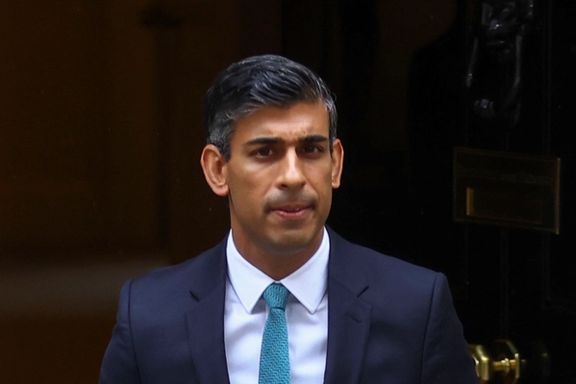
British Prime Minister Rishi Sunak underscored the escalating threats to Britain posed by what he termed the "axis of authoritarian states," including Iran.
British Prime Minister Rishi Sunak underscored the escalating threats to Britain posed by what he termed the "axis of authoritarian states," including Iran.
In a major speech on Monday, he named Russia, China, Iran, and North Korea as countries working to “undermine” the UK’s values and warned that the threat is not distant, with hostile states already operating within the UK.
"These are not far away problems. Iranian proxies are firing on British ships in the Red Sea, disrupting goods destined for our high street," Sunak added, referring to the blockade initiated in November.
Iran-backed Houthi rebels have intensified their attacks on shipping lanes begun in November in support of Iran-backed Hamas in Gaza, specifically targeting vessels linked to Israel and its key allies, such as the United States and Britain. They claim to be forcing Israel into a ceasefire but have killed several non-Israeli seamen and taken dozens more hostage.
Moreover, speaking about conflicts around the world including the Middle East, Sunak highlighted Iran’s military and drone attack on Israel on April 13.
“War rages, too, in the Middle East as Israel defends itself not only against the terrorists of Hamas but a barrage of missiles fired – for the first time – directly from Iran,” Sunak stated.
The attack came in response to an alleged Israeli airstrike on Iran’s consulate in Damascus in which one senior Quds force commander was assassinated along with several senior IRGC figures.
Last year the chief of British security service MI5 named Iran as one of the UK’s biggest state threats. Attacks of Iran International journalists have taken place multiple times, mostly foiled but endangering the reporting team on British soil.


Suspected Israeli warplanes bombed Iran's consulate in a strike that killed seven Iranian military advisers, including the Quds Force Commander Mohammad Reza Zahedi.
According to four military and intelligence sources, Zahedi departed from Mehrabad Airport in Tehran at 5 AM aboard an Antonov An-74. He landed at Khmeimim Air Base in Latakia, a Russian facility protected by the S-300 missile defense system.
Delivered to Syria in 2018, the S-300 defense system poses challenges for Israeli airstrikes, potentially hindering its aerial capability to strike Iranian targets.
A joint investigation with Intelli Times showed that Zahedi arrived at Khmeimim Air Base at 11 AM and flew to Damascus on the same plane. Iran International could not find out which airport in Damascus Zahedi traveled to. According to intelligence sources, the Commander landed either at Mezzeh Military Base or Bly around 4:45 PM. The Mezzeh base is a five-minute drive from Iran’s consulate building.

Known as Abu Mahdi, Brigadier General Mohammad Reza Zahedi was the highest-ranking Iranian military official to be killed since IRGC General Qasem Soleimani was assassinated in January 2020.
Zahedi was a senior commander in the Quds Force, the IRGC’s clandestine foreign operations wing, which is designated as a terrorist entity by countries such as the US and Canada. His pivotal role in Iran's support of “terrorism”, including backing groups like Hamas and Hezbollah, led to him being subjected to US sanctions.
Last year, information obtained by Iran International showed that Mohammad Reza Zahedi, among his many significant roles in Iranian foreign operations, was also supervising the deployment of air defense equipment in Syria.
On the evening of March 31, Zahedi was in his hometown of Isfahan in central Iran. His friend Masih Tawanger reportedly told him that he was worried for his safety.
Zahedi responded with a laugh, recounting a similar warning he had given to Hezbollah's senior figure, Imad Mughniyeh, before Mughniyeh was assassinated in 2008. Despite the warning, Zahedi remarked that he would proceed with his journey to Syria the next day.
Iranian news agencies reported that following this meeting, Zahedi flew to Mashhad to visit the tomb of the 8th Shiite Imam. There, he informed Supreme Leader Khamenei’s close associate, Ahmad Marvi, about his intention to travel to Syria
According to information available to Iran International, Zahedi then traveled to Tehran, arriving at Mehrabad Airport at 1 AM – where the IRGC has a dedicated terminal to transfer weapons to Syria and Iraq.
This terminal is managed under the supervision of the Quds Force Unit 190 of the IRGC, led by Behnam Shahriari, another US-sanctioned commander.
Iran International learned that Zahedi reportedly used an Antonov An-74 aircraft for his journey from Tehran to Latakia port in northwest Syria.
This revelation contrasts with the earlier assumption that he had headed directly to Damascus.
The Antonov An-74 is operated by Yas Air, which the UN Security Council has identified as an entity affiliated with IRGC.
Moreover, in 2012, the US sanctioned the cargo airline since it was used to transport illicit cargo, including weapons and IRGC Quds Force personnel, under the cover of humanitarian aid to the Levant.
The weapons that are brought with Antonov planes are then given to Hezbollah's Unit 4400, previously called Unit 108, which is responsible for arms shipments. The unit is operated under Muhammad Ja’far Qasir, known as Shaykh Salah, a key Hezbollah financier. The US is offering a reward of up to $10 million for information about him.
Zahedi’s plane landed at Khmeimim Air Base, the Russian base whose skies are protected by the S-300 missile defense system, protected from Israeli strikes.
From the Khmeimim Air Base, which also has a domestic flight terminal, Zahedi would fly to Damascus in the same Antonov An-74 plane, though he did not land at the international airport.
Suspected Israeli warplanes attacked the consular building adjacent to the main Iran embassy complex in Damascus' upscale Mezzeh district at 5 PM on April 1.

Zahedi, along with his deputy, General Mohammad Hadi Haji Rahimi, and five other IRGC forces, who were later identified as Hossein Amanollahi, Mehdi Jalalati, Mohsen Sedaghat, Ali Agha-Babaei, and Ali Salehi Rouzbahani were killed.
Iran responded over two weeks later, launching an unprecedented round of 300 missiles and combat drones in retaliation against Israel.
Israeli officials said that over 99% of Iran’s projectiles and missiles used in the attack were intercepted.
In retaliation, an Israeli strike targeted the air defense system at Isfahan's 8th Shekari Air Base six days later, resulting in no reported casualties.
While reports showed that an essential flap-lid radar had been "damaged or destroyed" by the attack, Iran replaced destroyed radar installation within hours of the attack to make it appear as though the damage had been minimal
Iran, according to reports, downplayed the severity of Israel’s strike to “save face” – and refrained from retaliating again.