Amid Secularization in Iran, Officials Push Islamic Academic Program
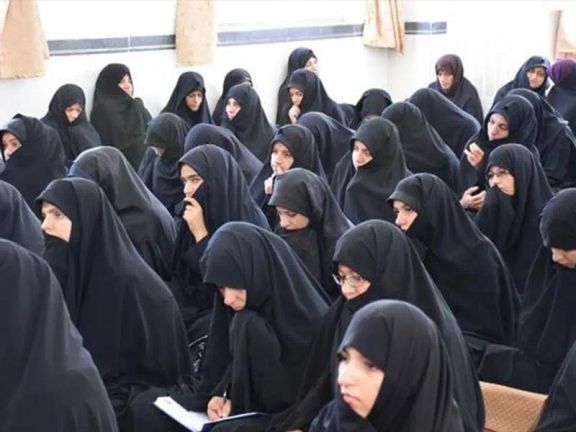
Iranian authorities have announced plans to establish an academic program that centers on the Islamic doctrine known as the "promotion of virtue and prevention of vice."
Iranian authorities have announced plans to establish an academic program that centers on the Islamic doctrine known as the "promotion of virtue and prevention of vice."
While the "promotion of virtue and prevention of vice" (PVPV) is a teaching rooted in the Quran and a guiding principle of behavior for Muslims, it also refers to a key Iranian regime institution tasked with determining and enforcing its strict Islamic behavioral norms in society.
This week, Mehran Samadi, the head of the PVPV Office, confirmed the launch of the new university program, which is intended for master's and doctoral levels of study.
Though he admitted that the PVPV’s work often focuses on the hijab and chastity, he emphasized that other areas also require attention and enforcement of Islamic principles.
The PVPV Office, also known as the Headquarters for Enjoining Right and Forbidding Evil, has been sanctioned by the EU over serious human rights violations.
In 2022, it was instrumental in setting new and stricter “morality” codes for women that are in clear violation of their human rights.
It also plays a central role in setting up the monitoring and often brutal sanctioning of women and men who do not respect these codes. The behavioral codes are subsequently brutally enforced by sanctioned entities, primarily the so-called morality police.
The news comes amid unprecedented discontent with the Islamic establishment. According to the most recent polling, the “Iranian populace has undergone a secularization and liberalization faster than any society in the Islamic world, despite having lived under the rule of Islamists for decades.”

Iranian media widely reported that Zibakalam, a former professor of political science at Tehran University, was arrested on Sunday by security forces while en route to the Tehran International Book Fair to unveil his new book, titled "Why Don’t They Arrest You and What Will Happen Afterwards?".
In a tweet after the news of Zibakalam’s arrest broke, Mehdi Keshtdar, managing director of the state’s judiciary news agency Mizan, denied the reports that he had been arrested on the street.
The judiciary insists that the 66-year-old academic was “summoned” to serve multiple sentences totaling three years for “propaganda against the state” as well as “spreading falsehood” on social media to affect the public’s opinion.
Zibakalam is known for speaking to foreign media on controversial matters.

His 18-month prison sentence for “propaganda against the state” by the Revolutionary Court in 2018 was for an interview with Germany’s Deutsche Welle which the court said was a "counter-revolutionary and hostile website."
In the interview, Zibakalam commented on the "disappointment of anti-government protesters with the entire regime apparatus" and said 70% of Iranians would say no to the Islamic Republic if there were a referendum to decide the type of government in Iran.
The title of his book alludes to allegations suggesting that, unlike other 'reformist' critics like former official Mostafa Tajzadeh, Zibakalam has been "immune" to arrest despite making controversial remarks over the past decade. These include his criticism of the country's nuclear policies and its anti-Israel rhetoric.
This immunity was believed to be due to Zibakalam never advocating for the overthrow of the Islamic Republic.
“Who says we should destroy Israel?” Zibakalam who openly voiced his recognition of the State of Israel asked in an interview with historian and filmmaker Hossein Dehbashi in 2014. “It’s no joke when you write ‘Israel must be destroyed’ on your missiles’,” he said.
Zibakalam refusing to step on American and Israeli flags in 2021
“Israel has never said it wants to destroy us ... Even Palestinians recognize Israel. We are more catholic than the pope,” Zibakalam, who is supportive of the right of the Palestinians to have their own state, said in a debate in 2015.
In April last year he said “annihilation of Israel and fighting America” were not among the goals of the Islamic Revolution of 1979 and these slogans were often used by authorities to justify their failures.
In January, Zibakalam came under massive attacks from hardliners after he said Israel “does not kill innocent people” in an interview.
Many dissidents argue that not being arrested after such bold criticism is evidence that Zibakalam is “the regime’s safety valve” and his activities serve the authorities’ wish to show that freedom of expression exists in the Islamic Republic.
“Good! Zibakalam is NOT opposing the mullah regime in Iran but [is] in fact a willful propaganda stooge & proud Jew-hater. The regime parades him out in front of TV cameras often to claim they allow ‘criticism’ of their policies. He's a regime loyalist & a FRAUD!,” California-based Iran commentator Karmel Melamed tweeted after Zibakalam’s arrest.
Others, including some of his critics, have risen to his defense in principle.
"Now that he has fallen from grace, I have always been opposed to #SadeghZibakalam, from explicit criticisms in class to heated debates face-to-face at conferences, and later by denying and rejecting his positions and track record in public. But today, I definitely say that his arrest is unacceptable, and he should be released,” Tirdad Bonakdar, a member of the Central Committee of the banned National Front, founded by nationalist Mohammad Mosaddegh in 1949, wrote on X.
Recently, Zibakalam said in a tweet that the security outfit at Allameh Tabataba'i University had not allowed him to enter the campus to participate in a debate to which he was invited by the hardliner Students Basij militia.
Within a day of his arrest this weekend, Zibakalam’s book became unavailable on Tehran's Digikala online shop – an Iranian e-commerce company. It’s unclear whether the book sold out or if the retailer was instructed to remove it from its online platform.


“[We were] sending a message, saying we can completely destroy their air defense on this site, and we can freely attack whenever we want,” said Brigadier General (ret.) Amir Avivi, the founder and chairman of the Israeli Defense and Security Forum (IDSF). His organization is a powerful political and cultural force in Israel – which is made up of more than 30,000 former IDF soldiers and officers.
Avivi, a close friend and Caesarea neighbor of Prime Minister Benjamin Netanyahu, is regularly consulted by key government ministers.

This is the first time an Israeli insider so closely connected to the government details the country's attacks on the Russian-made S-300 air defense system near Iran's Natanz nuclear enrichment facility, and explains the motivations behind the strikes.
On April 19, in the early hours of the morning, Israel’s arm reached far into Iranian territory into the province of Isfahan, just a few days after the Tehran launched more than 300 drone and missile attacks on Israel.
It seemed years of a shadow war between the two nations had ended - and what appeared to be the impossible - a direct conflict between the two nations - suddenly became a reality.
Iranian officials sought to downplay the attack - with Iran’s Foreign Minister Hossein Amir- Abdollahian claiming in an interview with NBC news in April that what happened “was not a strike.”
On May 5, weeks after the retaliation, a member of Israel’s security cabinet and Minister of Transportation, Miri Regev, officially confirmed the strike on an Iranian air base in Isfahan on Israeli TV Channel 14. That marked the first time the attack had ever been even publicly acknowledged by Israel.
Israel’s response, for many, seemed rather limited, but according to Brigadier General Avivi, it was anything but.
Avivi said in an interview with Iran International in Tel Aviv that the attack destroyed the defense system in Isfahan in a “minute” - which he argues tells the Islamic Republic of Iran “you are nothing.”
“In any moment we want to deal with you, in 10 minutes we are going to destroy all your air defense, and then we are going to attack you and that’s it,” Avivi said.
During his service, Avivi held a number of senior roles in the Israeli Defense Force (IDF). He was the deputy division commander of the Gaza Strip, Deputy Comptroller of the Security Forces, Director of the Office of the Chief of Staff, Commander of the Sagi Division, Commander of Battalion 605 and Commander of the School of Combat.
He said he realized two years ago that Iran was “on the way to war.” He wrote a 300-page Israeli national security assessment - sending it to the Israeli government, Mossad and military, claiming “there will be war in the coming years.”
What’s next for Iran and Israel?
Avivi said Israel was currently prioritizing the war against Hamas and bringing the hostages home with the nation fighting on 7 fronts. Iran, Avivi said, was an issue that he believes Israel will deal with - but later.
“We can deal with this. What can they do? Shoot another 400 missiles?”
As a General - Avivi has for years been discussing what an attack from Iran would look like. Now that it’s happened, he said Israel was more likely to go in later and attack Iranian nuclear sites.
He suggested that Netanyahu’s government would likely go to war with Iran in November if there is a change in US administration after the election.
“Our top priority is winning in Gaza. The dealing with Iran will happen in a month or two when we deal with Hezbollah. If we have to go to a full-scale war with Hezbollah, then it would be worthwhile attacking Iran. But this is a difficult decision to make when America is not on board. I think Netanyahu is thinking maybe it’s worthwhile to wait till November, maybe there will be a change in administration. Maybe with the next administration we will attack Iran together and not alone,” says Avivi.
While Iran and Israel continue to engage in proxy fighting and a potential direct war looms - Avivi said Israel has not yet shown even 1 percent of its capabilities.
He said April’s attack in Iran showed two things: “One, we can deal with your capabilities. Two, you cannot deal with ours.”
Amidst that backdrop, the country’s Supreme Leader Ali Khamenei, initiated the “Noor Plan” this year – a campaign aimed at stepping-up the already strict enforcement of hijab laws, which are considered by clerics a part of PVPV.
Under the directive, the “morality police” have increased their physical presence in Tehran’s central districts, patrolling the streets more frequently along with an expansion of the deployment of vans and motorcycle units.
The increased activity of law enforcement, including plainclothes agents, has led to a spike in violent confrontations, especially involving women who resist wearing the mandatory hijab.
The UN has labeled the Iranian authorities' crackdown on the hijab and the overall oppression of women as “gender apartheid”, while Amnesty International has called it a “War on Women”.
This renewed crackdown occurs nearly two years after the death of 22-year-old Kurdish-Iranian woman Mahsa Jina Amini, who died in the custody of the "morality police" after sustaining severe head injuries allegedly for not wearing a "proper" hijab.
Amini's killing ignited the most substantial wave of anti-regime protests since the inception of the Islamic Republic in 1979.