Panama-flagged Oil Tanker Hit Near Yemen - Report
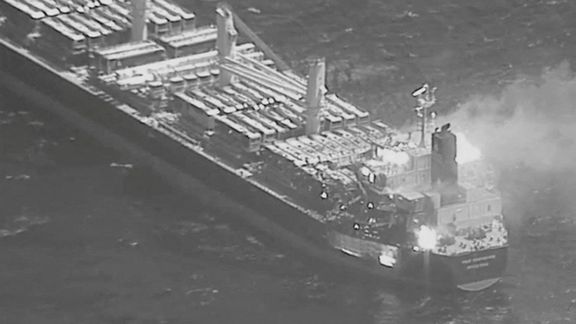
British security firm Ambrey said on Saturday it had received information that a Panama-flagged crude oil tanker had been attacked approximately 10 nautical miles southwest of Yemen's Mokha.
British security firm Ambrey said on Saturday it had received information that a Panama-flagged crude oil tanker had been attacked approximately 10 nautical miles southwest of Yemen's Mokha.
Ambrey said a radio communication indicated the vessel was hit by a missile and that there was a fire onboard. It did not provide details of the communication.
Ambrey later added that the tanker had received assistance and one of its steering units was reportedly functional. It did not indicate who provided the assistance.
Yemen's Houthi militia, which controls the most populous parts of Yemen and is aligned with Iran, has staged attacks on ships in the waters off the country for months in solidarity with Hamas fighting Israel in Gaza. The attacks began after Iran’s Supreme Leader Ali Khamenei called on Muslims in early November to boycott Israeli trade.
Vessels in the vicinity were advised to exercise caution and report any suspicious activity, Ambrey added in an advisory note.
Earlier on Saturday, the United Kingdom Maritime Trade Operations (UKMTO) agency said a vessel in the Red Sea was struck by an unknown object and sustained slight damage.
"The vessel and crew are safe and continuing to its next port of call," UKMTO said in an advisory note, adding the incident occurred 76 nautical miles northwest of Yemen's Hodeidah.
Months of Houthi attacks in the Red Sea have disrupted global shipping, forcing firms to re-route to longer and more expensive journeys around Southern Africa, and stoking fears that the Israel-Hamas war could spread to destabilize the wider Middle East.
The United States and Britain have carried out strikes against Houthi targets in response to the attacks on shipping.


The IRGC-linked Tasnim News Agency has published a series of interview articles about the life of Quds Force deputy commander Mohammad-Hadi Haji-Rahimi, who was killed in an apparent Israeli attack on Iran's consulate in Damascus on April 1. The destruction of the building triggered unprecedented aerial attacks on Israel by Tehran.
Tasnim has dubbed Haji-Rahimi the "Commander Without Borders," providing details about his life and crediting him with pioneering certain military tactics.
Haji-Rahimi is introduced as the commander of the Imam Ali Unit, about which little public information is available. Tasnim, however, claims it is the largest unit within the Quds Force.
It is mentioned that Haji-Rahimi played an active role in training militias for Afghanistan, Syria, Iraq, and Lebanon.
“He also went to Afghanistan to set up a training center, which was very successful. When he returned, he looked very muddled due to poor living conditions. However, it did not bother him, as he took all the hardships to fulfill his mission,” an ex-commander reportedly told Tasnim.
“The core of Lebanese Hezbollah forces were trained in Imam Hossein Garrison in Iran,” an ex-Imam Ali Unit commander told Tasnim.
Lebanese Hezbollah, sanctioned by Western governments including the US and regional states like Saudi Arabia, is part of the "Axis of Resistance." This group consists of Tehran-sponsored militias in the region, including Hamas, which attacked Israel on October 7, the Houthis in Yemen, and various Shiite militias in Syria and Iraq.
According to another interview, “Even during the first round of training Iraqi militias in Iran, thousands attended.”
“Martyr Haji-Rahimi had forces everywhere in Syria. The unit under his command was present from Damascus to the front line of the battle in Hama and Aleppo and carried out missions. They were present with the army commanders and gave them military advice,” another commander told Tasnim.
Quds Force Modeled After US Army’s Green Berets
Farzin Nadimi from the Washington Institute notes that the IRGC Quds Force was largely modeled after the US Army’s Green Berets.
“The Green Berets' motto is the Latin 'De Oppresso Liber,' which means to free the oppressed around the world. They were also called soldier-diplomats,” the security and defense analyst told Iran International.
Providing a more complete picture, Nadimi elaborated that, like today's Quds Force, the Cold War-era Green Berets aimed to train, organize, and advise guerrilla wars against communist enemies worldwide, including foreign internal defense, security force assistance, and unconventional warfare.
“Haji-Rahimi was an influential figure in Quds Force; some would argue that he was Qasem Soleimani’s right-hand man. He had a significant role in training and organizing proxy forces,” the analyst specializing in Iran's security and defense affairs explained.

Former IRGC Quds Force commander Soleimani was killed in a US drone strike near Baghdad International Airport in January 2020, under the order of then-President Donald Trump. Washington stated at the time that Soleimani was planning attacks on US diplomats and service members in the region.
Nadimi explained that the Quds Force functions more like an umbrella organization rather than a typical military structure.
"It possesses the skeleton of an organization with units and commanders, but you can't confidently say that it has X number of forces. It could sometimes recruit forces from Basij and the army for specific missions," he said.
Qasem Soleimani described the force in 2018 saying that while “it has a structure, statutes, rules, and regulations” it is “an intellectual system” in reality.
Tasnim’s Portrayal of Haji-Rahimi as a ‘Pioneer’
According to Tasnim's chronicles about Haji-Rahimi, he was a pioneer in airdropping in Iran and Syria.
But, Nadimi debunks that fact.
“Airdropping in Iran started during the Mohammad Reza Shah era when Lockheed C-130 Hercules was introduced to Iranian service in 1962. In the region, including in Syria, the US was the first to initiate dropping aid,” Nadimi said.
As part of the 1991 mission to aid Kurdish refugees in northern Iraq, the US and the international community conducted humanitarian airdrops. In 2014, the US and UK airdropped aid to Yazidis fleeing IS forces on Sinjar Mountain in Iraq. A few months later, supplies were airdropped to Iraqi military forces near the town of Bayji in northern Iraq. Additionally, between 2014 and 2015, the US airdropped tons of weapons and ammunition to Kurdish and other anti-regime troops in northern Syria, according to the Washington Institute.
In response to Tasnim's portrayal of Haji-Rahimi as a pioneer in using drones for artillery spotting, Nadimi expressed skepticism.

“Using drones for artillery spotting is nothing new, but specifically in the Syria region, was it common? It’s hard to say,” Nadimi said.
Even so, this does not qualify as pioneering the tactic, as British forces used drones for reconnaissance and artillery spotting during the Gulf War in 1991.
Timing of Haji-Rahimi’s Profile in Iranian State Media
According to Tasnim, “Haji-Rahimi's name and face were never revealed before,” but they are being publicized now to “analyze the various aspects of the personality and management of this ‘great’ commander.”
Experts say the decision to reveal details about a previously clandestine wing of the IRGC aligns with a recent shift in the commanders' approach, marked by more public warnings and boastful statements.
Initially, the strategy to keep details about IRGC officials secret was designed to protect officers and help them evade responsibility. However, this recent shift appears to be part of a broader communication tactic.
In a sign of this change, IRGC commanders have recently intensified their direct threats to Western nations and leveraged the US position to their advantage.
Esmail Qaani, the commander of Iran's Quds Force, issued a threat on Wednesday against France, Germany, and the UK for supporting Israel to intercept Iranian missiles and drones.
“The American president, who is devoted to defending the Zionist regime, officially announced to the Israelis, ‘I will not enter the conflict,’” Qaani said. He urged regional leaders "who rely on America" to be "more sensible." "Will America defend them more than the Zionist regime?"


Iran's unprecedented attack overnight between April 13 and 14, repelled by Israel's multi-tiered defense shield with the help from allies, included more than 100 ballistic missiles.
The Arrow system, according to Israel's air force, "carried out the main part" in their interception. Nearly 99% of Iran’s 300-plus projectiles were shot down, with negligible damage inflicted on the ground.
That success immediately drummed up global interest, Boaz Levy, CEO at state-owned Israel Aerospace Industries ISRAI.UL (IAI), the project's main contractor, told Reuters.
The US is a partner in the Arrow project and Boeing BA.N is involved in its production.

"A number of countries have approached us asking for information," Levy said. "I'm very optimistic that there will be more deals for the Arrow system, especially after the very special demonstration we did."
He declined to name any of the countries since talks are in the early stages.
Arrow is the upper layer of Israel's missile defenses, together with the Iron Dome, which takes out short-range threats like mortars and rockets, and mid-range defender David's Sling.
Arrow-2 has been around for years and intercepts ballistic missiles at long range. The newer Arrow-3 specializes in knocking out missiles while they are still outside Earth's atmosphere. The main threat to Israel emanates from Iran and its armed proxy groups in the region. Iran has developed an array of missiles, some with a range of up to 2,000 kilometers.

Israel, with US approval, agreed last year to sell the Arrow-3 system to Germany in a $3.5 billion deal, its biggest ever defense sale. The agreement comes as Germany and its neighbors in Europe are boosting defense spending in the wake of Russia's war in Ukraine.
The Germany deal took almost two years to sign, Levy said, and that would likely be the time frame of new deals in the works. The process is handled between governments and again would need US approval, he said.
Each Iron Dome interceptor, used frequently to shoot down rockets from Gaza and Lebanon, is estimated to cost about $50,000. The Arrow missiles are on a different level.
"The cost of the Arrow interceptor is on par with similar interceptors around the world, even cheaper. The amount passes a million dollars," Levy said, without elaborating.
Iran's attack spurred IAI to boost both production of current Arrow systems and also the development of its next generation, the Arrow-4, which will replace Arrow-2.
"It's in a very accelerated process towards the start of production. And we are doing this in full coordination with the security establishment here in Israel and the Missile Defense Agency in the United States," Levy said.
With reporting by Reuters