Iran's Boasts of Escalation in Arms Exports
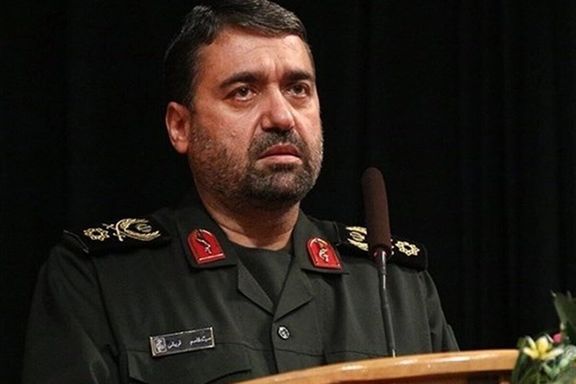
The deputy commander of Iran's paramilitary Basij, Ghasem Ghoreyshi, boasted about Iran's transformation from an arms importer to an exporter.

The deputy commander of Iran's paramilitary Basij, Ghasem Ghoreyshi, boasted about Iran's transformation from an arms importer to an exporter.
"There was a time when sanctions were imposed to prevent us from obtaining weapons, but today we have transformed from an importer to an exporter of arms," Ghoreyshi stated on Saturday.
"One world power asks us to give them this capability in a conflict, while another pleads with us not to."
Since mid-2022, Tehran has supplied Russia with hundreds of Shahed Kamikaze drones. The drones have been used against civilian targets and infrastructure in Ukraine, exacerbating the humanitarian crisis.
Despite denials from Iranian officials, evidence from recovered drone parts suggests a direct line of supply from Iran to Russia and there are emerging signs that Tehran might also be supplying long-range missiles to Russia.
The United Nations Security Council's arms embargo on Iran expired in October 2020 amid geopolitical tensions and failed attempts by the United States to extend it.
Last year, the US named Iran the world’s primary state-sponsor of terror as it arms proxies in countries including Lebanon, Syria, Iraq and Palestine.
In Yemen, the Houthi rebels, supported by Iran, have used an array of Iranian missiles and drones to disrupt international shipping in the Red Sea, prompting military responses from both the US and the UK.
In its first direct assault on Israeli territory, Iran fired more than 350 drones, missiles, and ballistic missiles on April 13. Most of the attack was intercepted by Israeli defenses and a US-led coalition.

Iran’s Interior Minister announced plans to divide the Sistan-Baluchestan province, one of Iran’s largest, into several smaller regions with threats to relocate millions of the predominantly Sunni minority population.
“This is a large province, and managing a province of this size may require more divisions,” Ahmad Vahidi stated.
He said on Saturday that a technical review is underway, and should the Iranian parliament pass the proposal, the Ministry of the Interior is prepared to implement the changes.
The proposal under discussion aims to split the predominantly Sunni-inhabited Sistan-Baluchestan into four distinct areas. The region, adjacent to Afghanistan and Pakistan, is economically underdeveloped and has been a hotspot for ethnic tensions and government neglect.
Controversially, plans reportedly include relocating 10 million people and transferring control of the province's coasts to other regions, raising fears among the Baluch community of an "occupation of the coast of Baluchestan" and threats to their existence.
The government asserts that the division is intended to promote development. However, the Baluch people view it as an attempt to fragment Baluch lands and alter the ethnic composition of the region.
Recently, Sistan-Baluchestan saw significant unrest during nationwide protests following the death in custody of Mahsa Amini, recording the highest number of casualties among Iran's 31 provinces.
The province continues to be a focal point for protests driven by unemployment, water shortages, and security policies perceived as targeting the Baluchi minority.

Prominent filmmaker Mohammad Rasoulof explained that the reason he recently fled Iran was to share the brutal truth of life under Iran’s theocratic regime.
In his first interview after leaving Iran, the Award-winning artist, now in Germany, told the Guardian that, due to his legal status, he had "no choice" but to leave the country because he was determined to continue telling his people's story.
His latest film, The Seed of the Sacred Fig, will be screened at this year's Cannes Film Festival. It explores Iran's protest movements following Mahsa Amini's death in 2022, in which security forces killed over 550 protesters. The UN found the Iranian regime responsible for the physical violence that led to Amini's death - after she was detained and beaten by "morality police" for reportedly wearing her hijab improperly.
Iran's Culture Minister, Mohammad Mehdi Esmaeili, condemned the production and distribution of his film, calling it "illegal."
“My mission is to be able to convey the narratives of what is going on in Iran and the situation in which we are stuck as Iranians. This is something that I cannot do in prison,” He told the Guardian, “like any other dictatorship or totalitarian system, they want absolute control over images they don’t like that confront the reality of their own being and their own system.”
The dissident filmmaker fled Iran on foot, crossing rugged mountainous borders after receiving an eight-year prison sentence, a flogging, a fine, and property confiscation for “the signing of statements and the making of films and documentaries,” which the regime claimed are “collusion to commit a crime against the country's security.”
Although his prison sentence was first announced by the court in January and sent for execution this month, Rasoulof told the Guardian he only had a few hours to decide whether or not to stay in Iran.
A friend advised him to cut off all communication via mobile phones and computers and walk to the border. “It was a several-hour long, exhausting and extremely dangerous walk that I had to do with a guide,” Rasoulof said.
Rasoulof first announced his departure on Monday in a statement: “I arrived in Europe a few days ago after a long and complicated journey. About a month ago, my lawyers informed me that my eight-year prison sentence was confirmed in the court of appeal and would be implemented on short notice,” he said.
“Knowing that the news of my new film would be revealed very soon, I knew that, without a doubt, a new sentence would be added to these eight years. I didn’t have much time to make a decision. I had to choose between prison and leaving Iran. With a heavy heart, I chose exile. The Islamic Republic confiscated my passport in September 2017. Therefore, I had to leave Iran secretly.”
First jailed in 2010, Rasoulof was banned from making films for 20 years for creating anti-regime content. An appeal reduced the jail sentence to one year. Despite the ban, he produced There Is No Evil, a drama that captured Iranian society under the Islamic Republic regime and won the Berlinale Golden Bear.
Rasoulof was arrested in 2022 after signing a letter in which he called on military and security forces not to suppress protesters, released later that year.
He is one of dozens of celebrities punished for supporting the uprising, with several arrested, suffering travel bans, salary cuts, property confiscation and in the extreme case of dissident rapper Toomaj Salehi, the death penalty.

German flagship airline Lufthansa has declared a continued suspension of its flights to and from Tehran until June 16, responding to ongoing instability in the Middle East.
The company, on Saturday, also confirmed that it would avoid Iranian airspace during the period.
The initial suspension followed heightened tensions after an Israeli attack on Iran on April 19, leading several other airlines to reroute their flights to avoid the area.
The move by Lufthansa and its subsidiary, Austrian Airlines—both notable for being among the few Western carriers operating flights to Tehran—follows aerial hostilities.
On April 13, Iran executed its first direct assault on Israeli territory, launching over 350 drones, missiles, and ballistic missiles, most of which were intercepted by Israeli defenses and a US-led coalition.
The airspace over Iran, critical for numerous major carriers including Emirates and Qatar Airways for flights to Europe and North America, remains a geopolitical flashpoint.

British security firm Ambrey said on Saturday it had received information that a Panama-flagged crude oil tanker had been attacked approximately 10 nautical miles southwest of Yemen's Mokha.
Ambrey said a radio communication indicated the vessel was hit by a missile and that there was a fire onboard. It did not provide details of the communication.
Ambrey later added that the tanker had received assistance and one of its steering units was reportedly functional. It did not indicate who provided the assistance.
Yemen's Houthi militia, which controls the most populous parts of Yemen and is aligned with Iran, has staged attacks on ships in the waters off the country for months in solidarity with Hamas fighting Israel in Gaza. The attacks began after Iran’s Supreme Leader Ali Khamenei called on Muslims in early November to boycott Israeli trade.
Vessels in the vicinity were advised to exercise caution and report any suspicious activity, Ambrey added in an advisory note.
Earlier on Saturday, the United Kingdom Maritime Trade Operations (UKMTO) agency said a vessel in the Red Sea was struck by an unknown object and sustained slight damage.
"The vessel and crew are safe and continuing to its next port of call," UKMTO said in an advisory note, adding the incident occurred 76 nautical miles northwest of Yemen's Hodeidah.
Months of Houthi attacks in the Red Sea have disrupted global shipping, forcing firms to re-route to longer and more expensive journeys around Southern Africa, and stoking fears that the Israel-Hamas war could spread to destabilize the wider Middle East.
The United States and Britain have carried out strikes against Houthi targets in response to the attacks on shipping.

In the early hours of Saturday, five Iranians convicted of drug-related offenses were hanged at Urmia Central Prison, northwest of Iran, as authorities have significantly accelerated executions.
Hengaw Human Rights Organization, a Kurdish rights group, says the executed prisoners were identified as Parvin Mousavi, 50; Mansour Naseri, 45; Parviz Ghasemi, 35; Yousef Saeidi Chehreh, 32; and Ramin Lavandi, 27.
The prisoners had been jailed for four to five years, separately accused of involvement in drug trafficking.
Parvin Mousavi, who developed cancer while imprisoned, was the ninth woman executed in Iranian prisons since the start of the year amid a rising wave of execution.
The execution day was marked by protests from fellow prisoners during Mousavi’s transfer to solitary confinement, leading to altercations with prison guards.
Sareh Sedighi Hamedani, a former fellow inmate, spoke to Voice of America, asserting Mousavi’s innocence and questioning the fairness of the trial that saw a co-defendant acquitted despite a criminal record.
Amnesty International has highlighted a significant uptick in executions related to drug offenses in its latest report, stating that over half of the 853 death sentences issued in Iran in 2023 were for drug-related crimes. This marks a return to stringent anti-drug measures, a contrast to the relatively lower rates of execution for such offenses recorded between 2018 and 2020.
The organization's report titled "Don't Let Them Kill Us" calls for urgent international intervention to halt the surge in executions, which it describes as transforming Iranian prisons into grounds for mass executions. The report also warns against the disproportionately impact of such policies on impoverished and marginalized communities, urging a reconsideration of the approach to drug-related offenses.
In his November 2023 address to the United Nations General Assembly, UN Secretary-General Antonio Guterres highlighted the “alarming” rise in executions in Iran. The concern was widely shared both within and outside Iran, prompting calls for the Iranian government to halt the "state killings," and sparking numerous global protests.
In February, Iran’s Supreme Leader Ali Khamenei responded to the global condemnation by minimizing it as "some noise," and categorizing the executed individuals as "criminals." He further exploited the Gaza war between Israel and Hamas to criticize Western reactions. "Those in the West who protest the execution of a criminal turn a blind eye to the killing of 30,000 people in Gaza," he stated.