Iran Scrambles to Boost Election Turnout Amid Leadership Vacuum
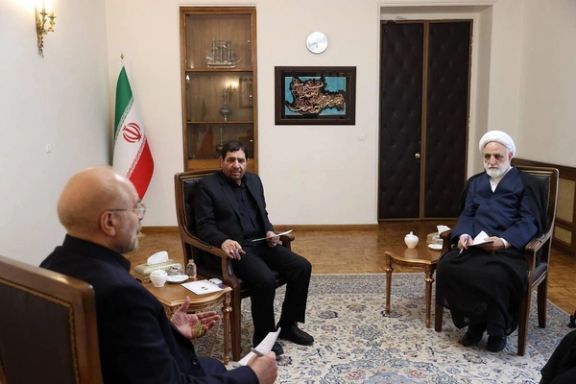
After the sudden death of President Ebrahim Raisi in a helicopter crash, Iran is strategizing ways to increase voter turnout for the impending snap elections amid mass discontent.
After the sudden death of President Ebrahim Raisi in a helicopter crash, Iran is strategizing ways to increase voter turnout for the impending snap elections amid mass discontent.
Tuesday's meeting of the heads of state branches, led by interim President Mohammad Mokhber and other top officials, focused on strategies to galvanize a disillusioned electorate suffering the country’s worst economic crisis since the beginning of the Islamic Republic.
A possibly record low turnout in the March parliamentary elections are believed to have seen as few as eight to ten percent of Iranians vote. Similar lows were seen in the 2021 elections which brought Raisi to power.
During the meeting, also attended by Parliament Speaker Mohammad Bagher Ghalibaf and Judiciary Chief Gholam Hossein Mohseni Ejei, there was a review of recent amendments aimed at decoupling council elections from presidential elections, purportedly to streamline the electoral process.
The upcoming elections are clouded by uncertainty, with no popular candidates on the horizon and skepticism about whether the Guardian Council will allow any non-hardliner contenders to run.
Statements from the meeting stressed the need to continue the system’s policies and maintain a staunch stance against perceived “enemies”, signaling no shift in Iran's political and social controls both at home and on the global stage.
According to the 1979 Constitution, Vice President Mohammad Mokhber has assumed the role of acting president, following approval from Supreme Leader Ali Khamenei, until the snap elections scheduled for June 28.
The Guardian Council spokesman, Hadi Tahan Nazif, confirmed that the newly elected president will serve a four-year term.


Human rights advocate and founder of Stop Child Execution Nazanin Afshin-Jam and actress and human rights activist Nazanin Boniadi both told the House of Commons Subcommittee on Human Rights that Iran is "waging a war on women and girls."
"Girls are beaten, dragged, screaming into police vans and raped for not wearing a hijab," said Afshin-Jam via remote video.
"There's a surge in executions of peaceful protesters. And there's a crisis in Turkey where bona fide Iranian refugees like Shilan Mirzaee are sent notices of deportation back to Iran despite lethal outcomes," said Afshin-Jam.

Mirzaee is an Iranian activist based in Turkey who was forced to flee for being an outspoken critic of the Iranian regime. She's supported other Iranians seeking asylum in Turkey since 2016, but now she's in danger of imminent deportation to Iran where she could face the death penalty.
Authorities in Turkey have yet to explain why this activist was arrested and transferred to a Turkish detention center.
Afshin-Jam made reference to the results of the UN fact-finding mission on Iran's response to the Woman, Life, Freedom movement, which was presented on March 18 to the UN Human Rights Council during its regular session in Geneva.
The council established that the fact-finding mission in Iran to document the deteriorating situation of human rights two months after the in-custody death of Mahsa Jina Amini sparked nation-wide anti-regime protests.
The UN fact-finding mission said it uncovered murders, torture, and rape amounting to "crime against humanity" during Iran's brutal crackdown on protestors following Amini's death.
Afshin-Jam encouraged Canada to exercise its universal jurisdiction, where a state can investigate and prosecute crimes that happened in another country, committed by people of a different nationality against victims of a different nationality.
She said it gives "an international crime grounds for the International Criminal Court and grounds for UN member states with universal jurisdiction, like Canada, to try the perpetrators of these crimes in a tribunal. The report recommends this to open structural investigations for these crimes against humanity."
"It's a gender apartheid state that is waging a war on women and girls," said Boniadi who echoed Afshin-Jam's calls to end gender apartheid.
Repress, Deflect and Divide
"These woman-life-freedom protests were yet another reminder that the Islamic Republic is incapable of reform. Instead, it stays in power using a three pronged survival strategy repress, deflect, and divide. Repression is at the core of the strategy," said Boniadi via remote video.
The antidote, she said, is to have ‘resolve, accountability and unity.’
She said the Islamic Republic holds the "appalling record of having the highest per capita execution rate in the world, and ranks 177 of 180 countries on the World Press Freedom Index."
"Domestic repression includes censorship, blinding, rape, torture and arbitrary detention. Ethnic, religious and sexual minorities face systemic persecution and discrimination."
Iranian parliament, she said, has allocated $2.9 billion to a government institutions responsible for intensified hijab enforcements.
Iran has seen an intensive crackdown on policing women bodies, with the UN Fact finding mission confirming that the regime uses AI technology to track and monitor women.
Canada: A Safe Haven for Regime Affiliates
Iranian human rights activist Atena Daemi testified in person in parliament.
She spent six years in prison for her activism, where she said she was tortured both physically and mentally. In 2022, after being diagnosed with multiple sclerosis (MS) she escaped illegally to seek medical care abroad, taking her from Tehran to St John's, Canada.
Daemi described to members of parliament, though a translator, her perilous journey to escape Iran through Kurdistan and how she found smugglers to take her to Iraq.
She's grateful to be in Canada but said "agents of the regime view Canada as their sanctuary."
Boniadi and Afshin-Jam agree.
Canada, they said, has become a safe haven for the Iranian regime.
"Global News did an investigative piece revealing 700 such regime affiliates in Canada, nine of which have been called to be deported. But instead of deportation, they could be on trial. Setting the precedents for accountability," said Afshin-Jam.
A recent year-long Global News investigation uncovered upwards of 700 regime-linked associates operating on Canadian soil and threatening the lives of some Iranian dissidents.
In February, Canada's Immigration and Refugee Board (IRB) ordered the deportation of Majid Iranmanesh, who was director general of Iran's Vice-Presidency for Science and Technology.
A month later, the (IRB) ordered the deportation of Salman Samani, Iran's deputy minister of interior during Hassan Rouhani's administration.
"With each of these regime affiliates comes a trail of dirty, laundered money and evidence of foreign interference, including threats to Iranian Canadians and political interference," said Afshin-Jam.
Afshin Jam, who is the member of the Iranian Justice Collective (IJC) announced a disturbing revelation during Tuesday's session.
"My organization, Iranian Justice Collective, was here a couple of weeks ago on the Hill providing policy recommendations on foreign interference. The PS752 file upping the number of Iranian refugees, actions on listing the IRGC on the terrorist list, and expansion of sanctions. We called to much sanctions. Shortly after the trip to Ottawa, my colleague received a call by a regime official in her family's home in Iran, threatening how she would end up like the woman she was trying to defend if she continues with her activism."
Repression of Iranian artists
The repression of Iranian artists, in particular Toomaj Salehi, who faces death for his rapping critical of the regime, was a topic brought up by all speakers testifying.

Arash Sohrabi, an artist now living in exile in the West, said the targeting of Iranian artists has been part of a "cultural purge" in Iran since the 1979 revolution.
"Between 1988 and 1999, aged over 80, writers, translators, poets, political activists and ordinary citizens were killed in what became known as the 'Chain Murders'," said Sohrabi.
Since nationwide protests erupted in 2022 sparked by Amini's death, Sohrabi said more than "100 Iranian filmmakers, actors, and musicians have been detained, banned from working or face travel bans for supporting the 2022 protest."
Boniadi referenced Mohammad Rasoulof, a dissident filmmaker who was sentenced to eight years in prison by the Islamic Revolution Court, and escaped the country earlier this month.
She said he "issued a defiant message to the regime if geographic Iran suffers under the boot of your tyranny, cultural Iran is alive in the collective mind of millions of Iranians who are forced to leave Iran because of your oppression and barbarity."
Boniadi said that repression extends beyond Iran's borders.
"Human rights abuses are among the regime's primary exports, including assassination plots, abductions and hostage taking of dual and foreign nationals," she said.
In January, two Canadian men with ties to Hells Angles were charged in what US authorities called "a murder for hire" plot allegedly coordinated by Iran.
Recommendations Made to Canada
What can Canada do?
Everyone who gave their testimony urged Canada to follow the lead of the US and proscribe the Islamic Revolutionary Guard Corps (IRGC) as a terrorist entity.
"To echo my fellow witnesses, Canada should immediately implement the motion to brand the IRGC, a terrorist organization, and expel Islamic Republic agents," said Boniadi.
Earlier this month, the Canadian House of Commons unanimously adopted a Report to designate Iran’s IRGC as a terrorist entity, but the motion is not binding.
Afshin-Jam also stated the Government of Canada can exercise universal jurisdiction to prosecute perpetrators of the regime on Candian soil.
Both Afshin-Jam and Boniadi called on Canada to recognize Iran as a gender apartheid state.
"We hope you support our campaign to end gender apartheid in Iran and Afghanistan, as Canada did, to end racial apartheid in South Africa," said Afshin-Jam.
Another recommendation made by Boniadi is to support Iranian civil society by "establishing a dedicated immigration stream to annually provide refuge to at least 200 Iranians fleeing the regime's persecution."
Boniadi concluded with a message to the people of Iran to stand united.
In the words of Toomaj, she said, "if you and I become us, we are limitless."