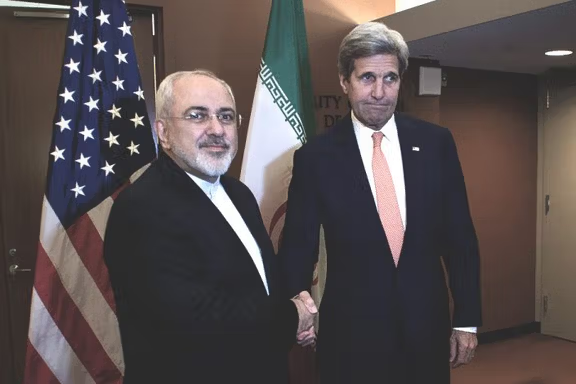
Kerry shakes hands with former Iranian Foreign Minister - File photo
An exclusive report by Fox News reveals the Obama-Biden State Department "actively interfered" to prevent the FBI from arresting individuals illegally in the US who allegedly supported Iran to develop weapons of mass destruction.
Whistleblowers reportedly told Sens. Chuck Grassley and Ron Johnson, according to a Fox News. Grassley also posted a news release on his senate website exposing the allegations
Gabriel Noronha, a former Special Advisor to the US State Department on Iran from 2019-2021, posted portions of the letters Grassley, R-Iowa, and Johnson, R-Wis sent to Secretary of State Antony Blinken, FBI Director Christopher Wray, and Attorney General Merrick Garland, on social media.
The Whistleblowers’ emails reveal John Kerry blocked the FBI and DOJ from arresting Iranian terrorists and agents on US soil in order to protect his Iran deal.
There are reports that Grassley and Johnson received unclassified and legally protected whistleblower disclosures revealing what they alleged as "then-Secretary of State John Kerry actively interfered with the Federal Bureau of Investigation executing arrest warrants on individuals in the US illegally supporting Iranian efforts, including financial efforts, to develop weapons of mass destruction and its ballistic missile program."
This allegedly took place in the backdrop of crucial talks and dealings for the Iran nuclear deal when the Obama-Biden administration vowed to prevent Iran from acquiring nuclear weapons.
The senators alleging then-Secretary of State John Kerry repeatedly halted FBI arrests of high- risk Iranians during negotiations with Tehran.
Grassley has been a known critic and skeptic of the Iran nuclear deal, stating publicly that it would not increase national security in the US.
According to senators, Grassley and Johnson, "the records show that Justice Department and FBI leadership, to include then-Attorney General Lynch and then-FBI Director Comey, failed to take the necessary steps to stop Kerry’s obstructive efforts against law enforcement."
In the letter, it's alleged that "unclassified FBI email records from August 25, 2017, detailed at least eight instances connected to the Iran deal where the “FBI/DOJ/USG could have moved forward with the cases but the State Department chose to block them.”
It's alleged by the senators that records indicate that in six of these instances, the FBI lost the opportunity to arrest the main subject.
One of the men, according to the email, was “on the Terrorism Watch List” and another “returned to Iran.”
"The email further says that in another instance the State Department “blocked [FBI’s] plan to arrest while the subject was mid-flight and the subject was forced to leave the US immediately upon arrival," according to the letter uncovered by Fox News.
Grassley wrote that the failure to arrest was due to "political reasons."
An email from May 3, 2016, described tensions between the AG Loretta Lynch and Kerry, stating that "Kerry packed up his stuff and rushed out without engaging with the AG at all. ”
Grassley and Johnson wrote that the records provided to their office reportedly show that the "Obama/Biden administration’s State Department, under the leadership of John Kerry, actively and persistently interfered with FBI operations pertaining to lawful arrests of known terrorists, members of Iranian proliferation networks, and other criminals providing material support for Iran’s nuclear and ballistic missile programs."
"The records also show that DOJ and FBI leadership apparently allowed it to happen until the Trump administration altered course."
Iran International has reached out to the FBI and US State Department for comment.
The Iranian state media's coverage of the helicopter crash that killed President Ebrahim Raisi has been chaotic, with numerous conflicting reports leaving the public confused and questioning the reliability of the information provided.
The initial news was marked by inconsistencies, with various accounts of how and when the crash site was discovered.
It remains unclear whether these conflicting reports were intentionally released to distract the populace. Some analysts suggest it might be a tactic to manage public reaction and prepare them for more significant news.
This report aims to provide a clearer picture of what may have transpired by analyzing different sources and the varying accounts of the events.
State Media’s Initial Conflicting Reports
Fars News, linked to the Islamic Revolutionary Guards (IRGC), first reported on the incident in the form of a denial.
Its website refuted the “unsubstantiated claim” circulating on social media about "an incident involving the three helicopters carrying the president and his entourage.”
Fars News further claimed that the helicopter carrying President Raisi had an emergency landing due to heavy fog in the northern region of East Azarbaijan, and that the entourage’s return journey by car was underway.
Fars News published this picture, claiming Raisi had an emergency landing
Later, it retracted its initial statement and instead reported that one of the helicopters carrying Raisi’s entourage experienced a "hard landing.”
Iran’s interior minister was one of the first officials to repeat that claim, during a live interview with official state broadcaster IRIB. He also stated that communication had been established with some individuals on board, and rescue teams were en route to the crash site.
On IRIB, Iran’s Deputy President for Executive Affairs, Mohsen Mansouri, said that two members of the President’s entourage in the same helicopter had successfully contacted the rescue teams. Mansouri emphasized that this communication indicated the air “was not as severe” as initially feared.
Complicating the narrative, sources from the President’s office reportedly revealed that Mohammad Ali Al-Hashem, the Friday Prayer Leader of Tabriz, was on board with Raisi.
Al-Hashem allegedly contacted individuals, claiming he could hear rescue teams nearby. This claim raises questions about the later assertion that rescue teams could not locate the crash site due to a lack of functional GPS. If Al-Hashem's communication was accurate, the contradictory statements regarding the GPS and the proximity of rescue teams warrant further scrutiny.
President Ebrahim Raisi (L), the Friday Prayer Imam of Tabriz Mohammad Ali Al-Hashem (R)
The deputy governor of East Azerbaijan also confirmed that three helicopters were involved; two landed safely, and one crashed.
State Media’s Shifting Narrative on Cause for Helicopter Crash
Nearly two hours after the initial reports surfaced, the IRGC-affiliated Tasnim News Agency announced that they had identified the approximate location of the helicopter crash involving President Raisi.
Using a map, they pinpointed the rough area of the wreckage but noted that severe weather conditions and challenging terrain were preventing rescue teams from reaching the site.
Tasnim News claims the "exact location" of helicopter crash, pinpointing it on a map
Initially, the interior minister and state media outlets like IRIB attributed President Raisi's helicopter crash to bad weather conditions. However, as reports continued, mentions of the other two helicopters in the president's entourage were gradually minimized.
This shift in the narrative raises questions. If the weather was indeed the primary cause, it is unclear why the other two helicopters reached their destination safely.
The evolving coverage by state media appeared to downplay these inconsistencies, continually focusing on the challenges posed by the weather instead.
His comments about Raisi and the country's future without him as president caught the attention of analysts. Khamenei also said that the people should not be worried about the country's future in any case – and that the administration of the state would proceed without disruption.
Analysts compared the lack of warmth in Khamenei’s tone while talking about Raisi as opposed to a similar situation in 2020 when he was filmed crying over the death of the Islamic Revolutionary Guard Corps (IRGC) Quds Force Qasem Soleimani, who was killed on the order of then-US President Donald Trump.
Conflicting Wreckage Claims by Iran and Turkey
A few hours after news of the crash, IRGC-linked news agencies such as Tasnim claimed to have knowledge of the exact location of the wreckage.
However, this assertion contrasts sharply with statements from Red Crescent rescue teams, who stated they were still searching for the site based on their estimations – with no success at that stage.
Adding to the confusion, Hossein Hatami, an MP for Kaleybar in East Azerbaijan, refuted claims of any contact with individuals inside the helicopter. Hatami declared that there had been no communication with anyone aboard President Raisi's helicopter, emphasizing the impracticality of such contact under the circumstances.
Rescue team members at the scene of the crash of a helicopter carrying Iran's President Ebrahim Raisi
The search finally concluded after more than 15 hours, and Iranian authorities announced the death of President Ebrahim Raisi. Despite international offers of assistance, Iran firmly denied any foreign involvement in locating the wreckage.
Initial Struggles and International Aid: Iranian rescue teams initially faced difficulties finding the crash site, prompting Turkey and Russia to offer assistance. Turkey deployed a night-vision drone to help Iran locate the site.
Conflicting Claims:Despite the Turkish drone's efforts, officials in Iran, including Red Crescent head Pir-Hossein Kolivand and IRGC Commander Asghar Abbasgholi, asserted that the coordinates provided by the Turkish drone were incorrect. They claimed that Iranian forces ultimately discovered the crash site. This position was echoed by the state-run Islamic Republic of Iran Broadcasting (IRIB).
Anadolu News Agency's Contradictory Broadcast: Adding to the complexity, the Turkish Anadolu news agency broadcast a live operation of the Turkish drone, indicating active Turkish involvement in the search efforts, which contradicts the Iranian state’s narrative.
Local Discoveries and Video Evidence: Complicating the story even further, a video allegedly showed the moment rescue teams found the wreckage. In the video, a voice is heard stating that motorcyclists found the site first. This suggests that local motorcyclists played a crucial role in locating the wreckage. In an interview that appeared on social media, these locals described the wreckage as "completely exploded and everything was burned."
The conflicting accounts between Iranian officials and foreign sources raise questions about the true sequence of events in the search for President Raisi.
Confusion Over Condition of Recovered Bodies
In addition, there are conflicting reports about the condition of the bodies recovered from the crash. Mohammad Hassan Nami, the head of Iran's Crisis Management Organization, stated that all individuals on board were burnt but could still be recognized.
In contrast, IRGC Commander Asghar Abbasgholi asserted that President Raisi’s body was not burnt. These contradictory statements intensified the confusion and uncertainty surrounding the incident, prompting further questions about the crash's circumstances and the response efforts.
IRGC's Media Tactics: Strategic Confusion or Incompetence?
Sina Ghanbarpour, a seasoned journalist with experience at Etemad Daily, has shed light on the reporting tactics of IRGC-affiliated media in Iran.
According to Ghanbarpour, these media outlets are often the first to report significant events because other news sources lack access to such information. This strategy aims to prepare society for potentially major news developments gradually.
Strategic Preparation: Ghanbarpour explains that by releasing conflicting or preliminary reports—termed 'anti-news'—the IRGC-affiliated media are easing the public into major announcements, thus preventing societal shock.
Information Control: This approach highlights the control the IRGC exerts over the flow of information, ensuring that news is presented in a way that aligns with their objectives and mitigates public reaction.
Not everyone agrees with this interpretation. In a piece published in the Telegraph, UANI’s Kasra Aarabi and Mark Wallace argued that the chaotic nature of the reporting revealed the "utter incompetence" of the authorities.
They asserted that the government failed to control communications, did not adhere to well-rehearsed emergency protocols, and ultimately entered into full panic mode.
This perspective highlights a critical view of the government's handling of the situation, suggesting that the conflicting reports result from mismanagement rather than a deliberate strategy.
Suspicious Protocol Breach in Helicopter Crash, Says Founding IRGC Member
Mohsen Sazegara, a former Iranian deputy prime minister and a founding member of IRGC, has since disclosed crucial information to Iran International.
According to Sazegara's intelligence from his sources inside the IRGC, a series of events unfolded during the incident, further complicating matters.
Protocol Breached: Sazegara revealed that the standard protocol for such missions involves three helicopters: one called the leader in the front, another for high-ranking officials in the middle, and a third for support in the back. However, in a last-minute twist, the official's helicopter was swapped with the leader's, deviating from the established procedure.
Rescue team members carry a body following the crash of a helicopter carrying Iran's President Ebrahim Raisi
Pilot's Distress: During the flight, the pilot of the primary helicopter carrying Raisi reported feeling nauseous.
A chopper witness: Those onboard the other helicopters witnessed a cloud of black smoke emanating from the main chopper before it ultimately crashed.
Given the Islamic Republic's history of removing high-ranking officials during pivotal moments and their production of contradictory news, speculation naturally arises regarding the true cause of President Raisi's helicopter crash. Many observers find it difficult to dismiss the possibility of foul play, considering the regime's track record and the conflicting narratives disseminated.
Whether this uncertainty is intentional on the regime's part or not remains to be seen.
The head of the UN nuclear watchdog says the deaths of Iran's president and foreign minister in a helicopter crash have caused a pause in nuclear talks with Tehran – just two weeks after the IAEA chief’s visit to Iran for discussions.
"They are in a mourning period which I need to respect," International Atomic Energy Agency (IAEA) chief Rafael Grossi said in Helsinki, speaking at a nuclear conference.
It’s not clear when the “mourning period” may end and when the nuclear talks between the agency and Tehran may resume – though Grossi said his hope was that it would be “over in a matter of days.”
President Ebrahim Raisi, who before his death had long maintained an uncompromising stance on nuclear talks, was not involved in meetings with the IAEA head when Grossi visited Iran earlier this month.
The IAEA chief did meet with Foreign Minister Hossein Amir-Abdollahian on the second day of his visit.
Grossi’s statement comes just a day after IAEA Chief Rafael Grossi ignited backlash from Iranians, when he opened a nuclear security conference by calling for a moment of silence to “honor” both Raisi and Amir-Abdollahian.
“Our thoughts are with their families and the people of Iran during this difficult time,” Grossi later said onX.
Some Iranians dubbed it an inappropriate statement, made to appease Tehran, which has relentlessly pursued sanctions relief with minimal compromise on its nuclear program.
Others questioned why the IAEA Chief sent condolences to Iranians when reportsindicated that many within the country were celebrating the death of the man known as the "Butcher of Tehran" for his involvement in crimes against humanity.
After Grossi’s recent visit to Tehran and Isfahan earlier this month, he said he did not seal any deal but discussed possible steps to implement measures Tehran had committed to in a joint statement last year.
In addition to Raisi’s hard stance on the nuclear issue, backed by the Supreme Leader, talk inside Iran recently floated the notion of abandoning the country’s so-called “fatwa” on nuclear weapons. Grossi previously said that the chatter was “very worrying” and “needs to stop.”
Grossi, who two weeks ago said he wanted to start to see concrete results on improved cooperation from Iran soon, repeated that hope but said a more wide-ranging deal would require "a bit more time".
The IAEA faces numerous challenges regarding Iran’s nuclear program. Tehran has only implemented a small portion of the commitments outlined in the "Joint Statement" on future cooperation made in March 2023.
The few concrete steps that were taken ceased in June of the previous year, complicating the IAEA'sefforts to ensure compliance and transparency.
While Tehran maintains that its nuclear ambitions are entirely peaceful, the country is enriching uranium to up to 60% purity, close to the 90% of weapons-grade – which no other country has reportedly done without developing nuclear arms.
A wave of speculation surrounds who will be allowed or chosen to succeed Iran’s deceased president, amid widespread public apathy evidenced by the historic low turnout in recent parliamentary elections.
Among the names frequently mentioned on social media as potential successors are the caretaker of the presidency, Mohammad Mokhber; outgoing Parliament Speaker Mohammad-Bagher Ghalibaf; former Revolutionary Guards (IRGC) general Saeed Mohammad; ultra-hardliner Mayor of Tehran Alireza Zakani; Chief Justice Gholam-Hossein Mohseni-Ejei; Secretary of the Supreme Security Council Ali Shamkhani; and the shadowy former nuclear negotiator Saeed Jalili. All of these figures belong to the hardliner camp.
Other figures being discussed as possible candidates include moderate-conservative former Speaker Ali Larijani, former Foreign Minister Mohammad-Javad Zarif, ‘reformist’ former Vice President Eshaq Jahangiri, former President Mahmoud Ahmadinejad who separated his way from other hardliners several years ago, and even Hassan Khomeini, grandson of Ruhollah Khomeini who some reformists favor.
“It’s elections again, and ‘wishes’ are being floated in the garb of ‘analysis’ and ‘news’ …Some people say that Zarif, Hassan Khomeini, or people like Jahangiri, Larijani, etc. will be approved to run, and others prompt the same view about Ahmadinejad,” chief editor of the moderate Asr-e Iran news website, Mostafa Faghihi, tweeted Tuesday.
Saeed Jalili, the man said to have been behind many decisions taken by Raisi’s administration (August 2021)
“What difference have they observed in the behavior of the ‘political establishment’ [to make such assumptions] …?” Faghihi asked and argued that the upcoming elections would only be held “within the ranks of revolutionaries.”
This, Faghihi contends, means the elections will be limited to candidates within the hardliner camp, which he believes is a spectrum of different factions as suggested by the escalating infighting among ultra-hardliners and frequent ‘revelations’ and serious allegations of corruption and fraud former allies are constantly bringing against each other.
“What’s the point in involving the rabble rousing reformist and moderate camps with their opposition-like attitudes?” Faghihi asked sarcastically.
Former commander of IRGC’s Khatam ol-Anbia Construction Headquarters Saeed Mohammad
The moderate Rouydad 24 news website suggested Tuesday that four different ‘scenarios’ for the upcoming elections could be envisaged, namely a repetition of the scenario implemented in the engineered presidential elections of 2021, in which Raisi won. This time, acting president Mohammad Mokhber can be endorsed by top hardliners or indirectly by the Supreme Leader. Another option for Khamenei is to allow competition within the closed ranks of hardliners, or allowing other political groups to be represented, to encourage public interest and high turnout.
The most likely scenario, Rouydad 24 contended, is competition within the ranks of hardliners while comparatively freer elections in which other political groups are represented, similar to the 2013 elections in which centrist Rouhani won, is the least likely to happen.
One of the biggest challenges facing the Islamic Republic and its supreme leader is finding a way to reengage an electorate that has been deeply disillusioned by recent elections, while simultaneously ensuring hardliners retain control over the now largely ceremonial presidency.
According to official figures, in the first round of the recent parliamentary elections 40.6 percent of eligible voters turned out at the ballot. In the capital Tehran, 24 percent voted. This was the lowest in any elections in the history of the Islamic Republic.
Turnout in the run-off elections held earlier this month was even lower. Only seven percent of the eligible voters in Tehran went to the polls.
To be able to run, candidates in presidential and parliamentary elections as well as the Assembly of Experts which is responsible for appointing Supreme Leader Ali Khamenei’s successor, must be approved by the constitutional election watchdog, the Guardian Council.
The Council has a long record of disqualifying nominees in all elections, particularly in the past two decades. Disqualified candidates included several former top officials which the Council itself had endorsed before including former presidents Akbar Hashemi-Rafsanjani, Mahmoud Ahmadinejad and Hassan Rouhani as well as former Parliament Speaker Ali Larijani and a host of lesser officials.
Khamenei appoints the six principal members of the Council and, in addition to issuing behind-the-scenes instructions, has the power to overturn their decisions with so-called "state edicts."
Khamenei reinstated two reformist candidates disqualified by the Council, Mohsen Mehralizadeh and Mostafa Moeen, with such edicts in the controversial presidential elections of 2005 which brought hardliner Mahmoud Ahmadinejad to power.
Khamenei’s move was largely seen at the time as a measure to entice reluctant supporters of reforms to vote to increase the turnout as a high turnout would be proof of “legitimacy of the Islamic Republic”.
Iran's Supreme Leader Ali Khamenei has once again hailed the spread of anti-Israel sentiment at protests worldwide in a meeting with the leader of Hamas.
Khamenei even applauded the chanting of “Death to Israel” in Persian at a rally in Japan as the wave of antisemitism globally reaches record highs.
Khamenei's remarks in a Wednesday meeting with Ismail Haniyeh, the head of Hamas's political bureau, have stirred controversy as he portrayed such demonstrations as a divine victory for Palestine, heralding them as the precursor to the "eradication of the Zionist regime."
Khamenei confirmed that Iran's foreign policy towards Palestine would remain consistent, stating that Vice President Mohammad Mokhber, who stepped in following the death of President Ebrahim Raisi in a helicopter crash, would adhere to Raisi’s strategies.
The declaration coincides with Iran intensifying its focus on pro-Palestinian student protests in the US and Europe, leveraging the events to boost Iran’s international image amid growing internal dissatisfaction.
The recent upsurge in student-led protests in the US, fueled by backlash against Israeli military actions in Gaza, has seen students demanding their universities divest from Israeli-linked corporations. The movement has been indirectly lauded by Iran, which seeks to weaken US-Israel relations.
However, the Iranian government's external posturing contrasts sharply with its internal crackdowns, particularly against students and activists within its own borders. The regime's harsh responses to the Woman, Life, Freedom movement, sparked by the death of Mahsa Amini in police custody in 2022, has led to widespread arrests and expulsions of students, highlighting a stark hypocrisy in its stance on human rights and freedom of expression.
Leaders and officials from Iran’s allies and terror proxies attended the funeral of President Ebrahim Raisi killed in a helicopter crash on Sunday.
The high profile attendees included figures such as Saudi foreign minister Faisal bin Farhan and UAE foreign minister Sheikh Abdullah Bin Zayed, with the prime ministers from Iraq and Pakistan also joining, in addition to the Tunisian president.
There was a marked absence of western democratic leaders and dignitaries, reflecting Iran’s isolation on the world stage. Dozens of the world’s democracies have imposed sanctions on Iran due to its military support for Russia in its war on Ukraine, its funding of terror proxies and its nuclear program, in addition to its horrific domestic human rights record.
Meanwhile, the ceremony was attended by controversial Iran-backed terror group figures such as Naim Qassem, deputy secretary general of Lebanese Hezbollah, and Ismail Haniyeh, the political chief of Hamas.
The Wednesday morning funeral, held at Tehran University, saw Iran's supreme leader Ali Khamenei leading prayers over the bodies of Raisi and the delegation he was traveling with, including foreign minister Hossein Amir-Abdollahian.
Iranian media outlets have reported widely differing numbers of foreign delegations attending the ceremony with some claiming as many as 50 high-ranking groups, while others reported significantly lower participation.