Foreign Leaders, Militants Attend Funeral Of Iran’s President Raisi
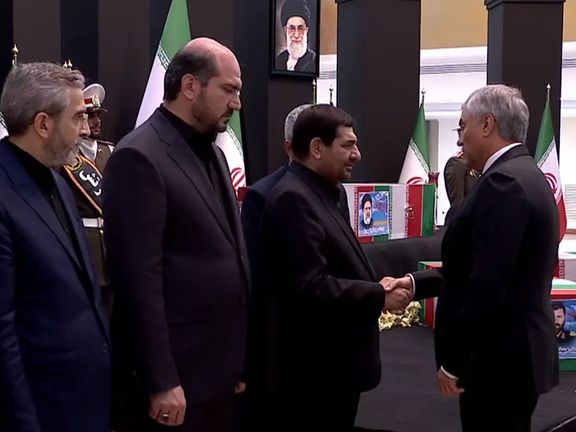
Leaders and officials from Iran’s allies and terror proxies attended the funeral of President Ebrahim Raisi killed in a helicopter crash on Sunday.
Leaders and officials from Iran’s allies and terror proxies attended the funeral of President Ebrahim Raisi killed in a helicopter crash on Sunday.
The high profile attendees included figures such as Saudi foreign minister Faisal bin Farhan and UAE foreign minister Sheikh Abdullah Bin Zayed, with the prime ministers from Iraq and Pakistan also joining, in addition to the Tunisian president.
There was a marked absence of western democratic leaders and dignitaries, reflecting Iran’s isolation on the world stage. Dozens of the world’s democracies have imposed sanctions on Iran due to its military support for Russia in its war on Ukraine, its funding of terror proxies and its nuclear program, in addition to its horrific domestic human rights record.
Meanwhile, the ceremony was attended by controversial Iran-backed terror group figures such as Naim Qassem, deputy secretary general of Lebanese Hezbollah, and Ismail Haniyeh, the political chief of Hamas.
The Wednesday morning funeral, held at Tehran University, saw Iran's supreme leader Ali Khamenei leading prayers over the bodies of Raisi and the delegation he was traveling with, including foreign minister Hossein Amir-Abdollahian.
Iranian media outlets have reported widely differing numbers of foreign delegations attending the ceremony with some claiming as many as 50 high-ranking groups, while others reported significantly lower participation.

Amid funeral ceremonies for President Ebrahim Raisi, Iranian authorities are cracking down on the families of dissidents celebrating his death, issuing threats and making arrests.
This week, following the helicopter crash that killed both Iran's president and foreign minister, Iranians across the country reacted by celebrating the demise of the two men.
In exclusive conversations with Iran International’s English desk, the families of slain protesters and survivors blinded during the 2022 anti-regime protests in Iran, are expressing relief, joy, and what they say is their renewed resolve to continue to fight for justice and freedom in Iran.
The unprecedented nationwide protests, dubbed the "Woman Life Freedom" movement, were sparked by the death of 22-year-old Mahsa Jina Amini at the hands of Iran’s so-called morality police. The months-long demonstrations were said to be the biggest challenge to Iran's clerical leaders in decades.
While Raisi was president, under the directive of Iran’s Supreme Leader Ali Khamenei, the protests were met with severe crackdowns, and the state’s security forces killed at least 500 protesters and imprisoned tens of thousands.
Families of protesters and dissidents have since faced surveillance, threats and intimidation by the authorities to prevent them from speaking out about the fate of their loved ones.
‘Stop celebrating Raisi’s death, or we will kill your other nephews too’
The family of 17-year-old Artin Rahmani Piyani, one of the children killed in the Iranian security forces’ crackdown on protests in 2022, was among those targeted by the authorities this week.
Celebrating the news of Raisi’s death, Foad Choobin, the teenager's uncle, shared videos on X of his nephew Piyani dancing.
Piyani’s mother, Hengameh Choobin similarly posted a video of her son laughing, with the caption “We are feeling better”.
On Tuesday, Foad Choobin revealed that the intelligence ministry contacted him with a warning: they would kill his remaining nephews and nieces if his family, including Piyani’s mother, continued to post content celebrating the President’s death.
“We didn’t have a single day of happiness… Now, with Raisi’s death, we feel a little better... but in my view, a murderer who took the lives of tens of thousands of innocent people had a very easy death,” Foad Choobin said.
Foad Choobin had previously been arbitrarily arrested, tortured, and imprisoned by Iranian authorities in an effort to silence the family for speaking out about his nephew’s killing.
“I will not be silenced and I am determined to continue the path of seeking justice for my nephew Artin, and all those killed by the state and all those silenced,” Choobin said.
Although Choobin said he is rejoicing over Raisi’s death, he knows that the President was “just one of the executioners of the Islamic Republic regime.”
“I want to see the moment of the demise of all of the murderers in the Islamic Republic in front of our own eyes, just as they took our dear ones' lives in front of our eyes. The Islamic Republic regime must be destroyed altogether so that we can feel truly joyful,” he said.
Other family members of protest victims were arrested by security forces.
On Monday, Reza Babrnejad was arrested by security forces in the northeastern city of Quchan, for allegedly posting Instagram stories about Raisi’s death.
Babrnejad’s brother, 22-year-old Mehdi Babrnejad, who was killed by the Iranian state’s security forces amid the September 2022 protests.
Dadban, an organization offering pro-bono legal support to Iranian dissidents, says Babrnejad’s mother confronted the authorities when they detained her son.
"Your president is dead? Weren't our children human? Why did you kill them?" his mother reportedly told the security forces.
The Islamic Revolutionary Guard Corps' (IRGC) intelligence agents also targeted Babrnejad in 2023, around the time that would have marked his brother Mehdi's 23rd birthday.
This arrest, like that of Foad Choobin, was part of a broader crackdown aimed at silencing victims' families, through harassment and intimidation, to prevent them from commemorating their loved ones.
Exiled relatives of protesters rejoice over Raisi’s sudden death
Relatives of protesters outside of Iran similarly rejoiced over the sudden death of President Raisi and Foreign Minister Amir-Abdollahian.
Mahsa Pirayi (Piraei), who fled Iran after her 62-year-old mother Minoo Majidi was killed during the protests, told Iran International that Raisi's death brings her renewed determination.
"All of us—the justice-seeking families of victims—are happy that the murderers of our loved ones and the criminals who restricted the Iranian nation were killed. We are more determined than ever to continue our advocacy and be the voice of our loved ones until we reach absolute victory and freedom!,” she said.
Sharing a video on X, Pirayi and her sister Roya Pirayi toasted to the news of the missing helicopter carrying the President and Foreign Minister.
The sister of slain protestor Shahriar Mohammadi, Asrin Mohammadi, says the news of Raisi’s death brought deep joy to her household.
"We were extremely happy. It felt as if Shahriar had come back to life…I woke up everyone in the house singing ‘Wake up, wake up, it's a party and it smells like barbecue but hold your nose because the barbecue smells like sludge’,” she told Iran International.
According to Mohammadi, a group of mothers whose children were killed in the northwestern city of Bukan during the 2022 protests celebrated the news of the deaths at their children’s graves. She says the mothers placed chocolates on the graves, telling them “we have good news—freedom is near.”
"At the gravesites, they told their buried children that they’re happy. Some of the mothers wanted to dance Kurdish out of joy, but it started raining. They were so happy that they didn’t want to go home," Mohammadi said.
The mother of Abolfazl Amir-Ataei, a 16-year-old Iranian teenager who was shot and later died from his injuries amid protests, also celebrated Raisi’s sudden death.
She says that while she doesn’t wish death upon anyone, her hatred for Raisi and Amir-Abdollahian made her hope that the helicopter crash would end up being fatal.
Dior would share a video on Instagram that begins with an infamous clip of the late Iranian foreign minister denying that anyone was killed during the 2022 uprising.
The video continues to show Dior, speaking about her joy upon hearing the confirmed news of Raisi and Amir-Abdollahian’s death:
“I am very happy. I am very happy that my cries of one year and the pain of nine months were finally answered. I was losing hope in karma and God…but I am very happy now…because those who were the cause of pain and suffering for my son and I…those who destroyed our lives, met their fate and I am waiting for the rest of them to be held accountable,” she said.
‘Raisi should have been tried in criminal court,’ say blinded dissidents
Iranians who survived anti-regime protests with severe injuries, such as blindness, also voiced their reaction to the death of Raisi and Amir-Abdollahian.
Saman, a dissident who widely goes by the pseudonym for security reasons, was blinded amid the 2022 protests.
Like many in the Iranian diaspora, he said he had wished Raisi faced trial for the crimes he committed.
"Humanity always says that the death of any creature is distressing, but with every breath criminals like Ebrahim Raisi and Ali Khamenei and their other mercenaries threaten the world. In a free Iran in the future, all these people should be tried in just public courts,” he told Iran International.
He says he feels happy about Raisi’s death, because a “threat against humanity has been removed.”
“On the other hand, I wish [Iran] would have been freed and that this criminal faced trial before dying, and confessed to his crimes in front of the cameras of the world,” he said.
Yaser Alvandiani, another protester blinded by Iranian security forces during the 2022 uprising, said he had a “strange feeling.”
"The joy in my eyes is accompanied by tears, the tears from my blind eye begin to shed sooner. Tears of joy and happiness, and a heart that longed to see this demon tried in a court of justice for his countless injustices... And yet, the joy of the families of victims seeking justice in their messages to me… families whose hair turned gray within a mere few months… Could this joy be a glimpse of the dawn of freedom for our Iran? Could it? There is this joy that I saw from all of Iran. It is the joy of all the blood-soaked children for the dawn of freedom… Freedom, happiness, and prosperity are the end of our path... Long live Iran.”

Gholam-Hossein Esmaili, the Iranian President’s Chief of Staff, committed to a continuation of the Ebrahim Raisi agenda following the unexpected death of the late President.
It must continue; there is no question," he asserted, urging the electorate to demand that future officials adhere to the same hardline strategies in spite of the fact that under his watch the economy has collapsed and there have been record numbers of executions amid deepened human rights abuses.
"Not only will we not falter in these 45 days, but we will also strive to accomplish the work of 450 days," Esmaili stated on the sidelines of Raisi's funeral.
The administration's heavy-handed approach to dissent, characterized by internet restrictions and violent suppressions of protests, has not only deepened domestic strife but also resulted in further global sanctions.
Unemployment is sky high with at least one third of Iranians now living below the poverty line. Iran has during his presidency also accelerated its nuclear program and escalated its proxy war across the Middle East, in addition to producing drones for Russia in its war on Ukraine.
Under the 1979 Constitution, Vice President Mohammad Mokhber has stepped into the role of acting president with the approval of Supreme Leader Ali Khamenei, serving until the snap elections set for June 28.

Leaders from Iran’s proxy groups joined Iran’s allies in Tehran on Wednesday to attend the memorial services for the late Iranian President Ebrahim Raisi, who was killed in a helicopter crash.
The Wednesday morning funeral ceremony, held at Tehran University, was attended by Ismail Haniyeh of Hamas, Naim Qassem of Hezbollah, and representatives from other groups backed by Iran, while western leaders were notably absent.
Ahmed Hachani, Tunisia's Prime Minister, along with the Prime Ministers of Iraq and Armenia, and Russian State Duma Speaker Vyacheslav Volodin, were also among the figures who arrived to attend the ceremony.
Zhang Guoqing, China’s Vice Prime Minister, and Shehbaz Sharif, Pakistan's Prime Minister, are also expected to arrive, signaling regional support for Tehran amidst its international isolation. Moreover, Egypt’s Foreign Minister, Sameh Shoukry, has traveled to Tehran, marking a rare high-level visit historically strained over ideological differences.

After the sudden death of President Ebrahim Raisi in a helicopter crash, Iran is strategizing ways to increase voter turnout for the impending snap elections amid mass discontent.
Tuesday's meeting of the heads of state branches, led by interim President Mohammad Mokhber and other top officials, focused on strategies to galvanize a disillusioned electorate suffering the country’s worst economic crisis since the beginning of the Islamic Republic.
A possibly record low turnout in the March parliamentary elections are believed to have seen as few as eight to ten percent of Iranians vote. Similar lows were seen in the 2021 elections which brought Raisi to power.
During the meeting, also attended by Parliament Speaker Mohammad Bagher Ghalibaf and Judiciary Chief Gholam Hossein Mohseni Ejei, there was a review of recent amendments aimed at decoupling council elections from presidential elections, purportedly to streamline the electoral process.
The upcoming elections are clouded by uncertainty, with no popular candidates on the horizon and skepticism about whether the Guardian Council will allow any non-hardliner contenders to run.
Statements from the meeting stressed the need to continue the system’s policies and maintain a staunch stance against perceived “enemies”, signaling no shift in Iran's political and social controls both at home and on the global stage.
According to the 1979 Constitution, Vice President Mohammad Mokhber has assumed the role of acting president, following approval from Supreme Leader Ali Khamenei, until the snap elections scheduled for June 28.
The Guardian Council spokesman, Hadi Tahan Nazif, confirmed that the newly elected president will serve a four-year term.

The Biden administration’s Iran policy came under intense scrutiny Tuesday, as Republican senators grilled Secretary of State Antony Blinken over a message of condolence for Ebrahim Raisi’s death, and the failure to enforce existing oil sanction.
Leading the field in a Senate Foreign Relations Committee (SFRC) hearing was Senator Ted Cruz (R-TX) whose simmering and relentless attack seemed to have caught the seasoned diplomat off guard.
“You have presided over the worst foreign policy disaster of modern times,” was Senator Cruz’s opening line. “We now have two simultaneous wars waging: the worst war in Europe since World War Two, and the worst war in the Middle East in 50 years. Both I believe were caused by this administrations’ consistent weakness.”
‘Weakness’, ‘soft’, even ‘appeasement’, are some of the words that have been used more or less regularly by Republicans in Congress when discussing the Biden administration’s foreign policy, especially with regards to Iran.
Joe Biden had made clear before the election in 2020 that he’d scrap Donald Trump’s 'Maximum Pressure' doctrine against Iran, if he won. Many of Biden’s critics believe that that announcement essentially signaled to the Iranian regime that they’d have more breathing space during a Biden presidency. And that’s what many believe has happened, especially with regards to Iran’s oil exports.
Why Iran's oil sales have increased from 300,000 during the Trump administration to 2 million barrels a day today, the Sneator asked Blinken. Because they're determined to try to do that, we're determined to cut them off, Blinken replied. Cruz continued his relentless questions: They weren't determined when Trump was president?
“When you became secretary of state, how much oil Iran was selling a day,” Cruz asked Blinken. He didn’t know. “How much oil are they selling today,” Cruz continued. Blinken didn’t know, or did not want to respond. “It’s gone up from 300,000 [barrels per day] to 2 million,” Cruz put to Blinken, adding that during the same period, Iran’ ghost fleet –which helps the Iranian regime sell sanctioned oil under the radar.
Blinken stated that the Biden administration had in fact added to Iran’s sanctions, explaining the rise in Iran’s oil revenue by its determination to circumvent sanctions. But the answer did not satisfy Cruz, who had a simpler explanation. “This administration desperately wants a new Iran deal,” he wrapped up his remarks addressing Blinken. “You have been showering cash on Iran from day one.”
It is estimated that Iran has sold around $80 billion of oil during Biden’s presidency, far more than what it used to earn during the era of Maximum Pressure. Biden critics say this has happened because existing sanctions have not been enforced, with the hope that a more lenient approach would persuade Iran to cooperate on other issues of interest to the United States, most notably, the nuclear program.
“The administration's policy is fatally flawed,” Senator Jim Risch, Ranking member of SFRC said in the hearing. “Outreach and accommodation have failed… Iran has doubled down on its support for terrorists and flooded Russia with drones and missiles… I’m proud this committee passed the most significant Iran sanctions legislation we’ve seen in years… Is the admin actually going to enforce them? Recent history suggests it won’t.”
Curiously, Blinken did not even mention Iran in his opening statement, perhaps because he anticipated the bumpy road ahead. He also doubled down on his department’s decision to “express official condolences” on Monday for Raisi’s death, stating that it had been done “many times in the past” in various administrations. It was something the US Department of State does as “a normal course of business,” he said, adding that Iranians were “probably better off” without the man known as the Butcher of Tehran.
“It’s shocking that this administration would mourn the death of the Butcher of Tehran,” Senator Barrasso said at the hearing. “He’s responsible for death, rape, torture. [It was] a terrible mistake.”
This is a sentiment that has been echoed by many Iranians who have gradually grown more critical of the Biden administration for what they see as its ‘embrace’ of the regime in Tehran and ‘betrayal’ of ordinary Iranians. Many say the Islamic Republic “responds only to force,” warning the US government that its aversion to confronting the Islamic Republic would blow out in its face –harming others in the region and in the West.