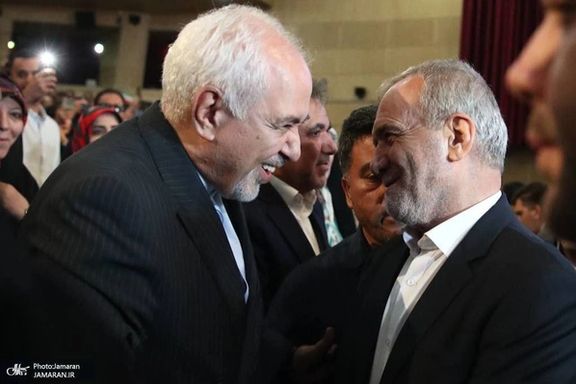
Mohammad-Javad Zarif and Masoud Pezeshkian at campaign meeting in Tehran June 19
The nuclear issue and the crippling impact of sanctions on the Iranian economy, so far largely avoided by the candidates, appear to be turning into an important part of discussions and debates.
The turning point came Monday when former Foreign Minister Mohammad-Javad Javad Zarif made a bold entrance into the election scene alongside the pro-reform candidate Masoud Pezeshkian with a fiery speech at a televised roundtable discussion.
“The whole of Pezeshkian’s candidacy, even if he is not elected, was worth the few minutes that Zarif spoke to the people on TV. These words were anti-spell to the one-sided slanders of the extremists. The reign of lie will not last,” Mohammadreza Javadi Yeganeh, professor of sociology at Tehran University, tweeted after Zarif’s speech Monday.
Zarif who has always insisted that the 2015 JCPOA agreement with world powers was signed with Supreme Leader Ali Khamenei’s full approval, defended the Rouhani administration and his own performance in crafting the deal and its immediate economic outcome.
He also showed a few graphs to prove the deal and the lifting of sanctions had helped Iran's economic growth in 2016 and 2017 and asserted that hardliners’ ability to sell more oil since 2021, in which they take huge pride, was solely due to US President Joe Biden loosening the sanctions.
Ultra-hardliner Saeed Jalili who is one of the top three contenders to the presidency said Tuesday in response to Zarif’s remarks, “Today I heard that [someone] has said it was Trump [who imposed sanctions on Iran] and that [Joe] Biden had a different approach. Why did you not continue [your talks with him] during the nine months of your time when Biden was [president]?”
In fact, The Rouhani administration did participate in in indirect talks with the United States from April to June 2021, but they did not reach an agreement before the end of his term and the election of hardliner Ebrahim Raisi, who took office in August of that year.
“Biden not only did not remove Trump’s sanctions but also imposed tens of other sanctions,” Jalili added.
“Mr. Zarif's statements yesterday were wrong, and he was unfair. I will answer his insult tomorrow [in televised campaign programs],” ultra-hardliner candidate Alireza Zakani, who many believe is playing a supporting act to Jalili, said Tuesday.
Zarif has thrown all his weight behind Pezeshkian, a former lawmaker and health minister previously little known to many ordinary Iranians, particularly the younger generation, who may potentially cast their ballots for Pezeshkian if swayed to vote rather than boycott the elections.
The former foreign minister accompanied Pezeshkian Tuesday morning at a campaign trip to Isfahan, Iran's third-largest city and delivered a short speech at his campaign meeting in Tehran in the evening of the same day when he urged Iranians to vote for Pezeshkian. “Not voting is voting for the [hardliner] minority,” he said.
So far Pezeshkian has made no indication that he intends to propose Zarif as his foreign minister to the newly elected, hardliner-dominated parliament if he is voted president.
In a meeting on Wednesday with his former deputies and ministers, former President Hassan Rouhani also accused Jalili and the three other hardliner candidates, namely Zakani, Mohammad-Bagher Ghalibaf, and Amir-Hossein Ghazizadeh, of only believing in “war and confrontation”.
“They say we have no way other than fighting and confronting the world powers and defeating them and that [Iran] will never win in the United Nations and negotiations with big countries,” Rouhani, who was barred from running in the elections of the Expediency Council in March by the Guardian Council, said.
At an economic roundtable discussion Wednesday, conservative candidate Mostafa Pourmohammadi also touched upon the issue of the nuclear deal and sanctions. He said his government would complete the “unfinished” business of the JCPOA, which he describes as "not perfect" while accusing hardliners of sabotaging the talks.
“Pressures and damages [caused by sanctions] are serious and certain imprudent actions have increased the damages,” the conservative Pourmohammadi who insists he will negotiate even with the "bitterest enemy" said.
A survey conducted by the Iranian Students Polling Agency (ISPA) reveals a significant lack of interest among the electorate, with 73% of respondents indicating they did not watch the first presidential debate on June 17.
This lack of engagement is alarming as Iran prepares to elect a new president following the unexpected death of President Ebrahim Raisi in a helicopter crash last month.
The survey, which involved face-to-face interviews with 4,545 citizens on June 18 and 19, shows just 26.8% of the population watched the televised debate, focusing on the pressing economic issues facing the nation.
Moreover, the ISPA's findings reveal a broader trend of apathy towards election news, with 35% of respondents indicating they do not follow election news at all, and others only minimally engaged.
A group of Iranians watching the first presidential debate on June 17, 2024
The disengagement comes amid calls for an election boycott. Many citizens, as well as various political and civil society groups, have expressed discontent with the Islamic Republic's track record on human rights and democratic governance. The pressure for boycotting the election is compounded by the Iranian government's repressive measures against free speech and the dissemination of independent survey results.
Authorities have previously issued threats against those releasing or publishing survey data that portrays the government negatively, warning of legal repercussions and potentially criminal charges.
Participation in elections plummeted in the 2020 parliamentary race when hundreds of regime insiders deemed too moderate were banned from competing. As a result, hardliners swept the majority of seats amid a voter turnout of less than 50%.
The same scenario repeated itself in the 2021 presidential election and the March 2024 parliamentary election, where many serious candidates were disqualified by the 12-member unelected Guardian Council. In both elections, voter turnout was well below 50%. In the current election also, six hand-picked candidates were allowed to compete.
Meanwhile, the government continued to use lethal force against protesters and harsh measures against dissidents. This suppression reflects deeper systemic issues within the Iranian political landscape, as highlighted by prominent Iranian sociopolitical analyst Abbas Abdi. In a recent critique titled "A Point with the Government," Abdi articulated the consequences of the government's policy of uniformity, which he argues has led to a reduction in political participation.
Political activists and commentator Abbas Abdi
According to Abdi, when participation rates in areas like Tehran drop to around 10% or less, it is a clear sign of a legitimacy crisis within the political system. He noted that while some electoral districts may see higher turnout due to ethnic, tribal, linguistic, or religious factors, the overall low participation is a warning sign and a "trumpet of doom" for Iranian politics under the rule of the current ruling system.
“I'm not saying that participation in Tehran should be 80%, but participation under 50% is a warning sign. When it drops below 10%, it is a siren call and even the trumpet of doom for politics.”
Abdi further argued that the distrust in the government leads to diminished efficiency and a lack of public willingness to engage in the political process. He criticized the current administration for its apparent incompetence in addressing and understanding societal issues, describing it as "idealess, without vision, and disappointing."
An Iranian woman checks the names of candidates during parliamentary elections at a polling station in Tehran, Iran, March 1, 2024.
The implications of such widespread disaffection are profound. As Abdi points out, the distancing of the people from the government has become so significant that bridging such a gap poses not only a logistical challenge but also an emotional and psychological burden on the populace.
As Iran heads towards its contentious election on June 28, the environment is marked by skepticism and a crisis of legitimacy. The last parliamentary elections in March, which saw a low turnout with just about 8% participation in Tehran during the second round, underscore the growing chasm between the government and its citizens.
Canada's official designation of Iran’s Islamic Revolutionary Guard Corps (IRGC) as a terrorist organization has garnered global praise from political figures both inside and outside Iran.
After years of campaigning, Canada's designation follows a series of plots uncovered in Canada where the IRGC is said to have both raised money and recruited agents.
Michael Chong, Conservative Shadow Minister for Foreign Affairs, and Melissa Lantsman, Deputy Leader of the Conservative Party of Canada, said in a joint statement, “Trudeau and his Liberal government took six years to list the IRGC... As a result of that delay, the IRGC has been able to grow stronger as a result of Trudeau’s inaction.”
The US designated the group in 2019 and until now, Canada has imposed multiple rounds of sanctions on several terrorist designated entities that have benefited from the IRGC’s patronage and that have helped advance Iran’s interests and foreign policy, including Hezbollah, Hamas, the Palestinian Islamic Jihad, and the Taliban.
The designation has triggered others to push again for designating the group globally. Senator Claire Chandler, Chair of the Senate Foreign Affairs, Defense, and Trade Committee in Australia, reacted on X by saying, "While Canada acts, in Australia the Albanese Govt is refusing to even consider listing the IRGC."
The Australian Jewish Association also welcomed Canada's decision to declare the IRGC a terrorist organization and called on Australia to do the same. AJA CEO Robert Gregory stated, “The Albanese Government is the weakest link in the West when it comes to standing up to Iranian Regime terrorism and oppression.”
However, designation has been impacted by governments trying to appease the Iranian government amid its ongoing nuclear program. Countries such as France and the UK have seen massive lobbying from parliamentarians only to be pushed back under claims of pursuing a diplomatic solution. However, at the same time it should be noted that UK has issued many sanctions targeting Iran's malign activities and weapons proliferation.
In London, Iranian-born opposition figure and human rights activist Nazanin Boniadi expressed hope that the UK, EU, and Australia would follow suit in listing the IRGC as a terrorist group. The UK's top intelligence chief said last year that Iran was among the biggest foreign threats on UK soil after multiple plots had been foiled, including attacks and threats to Iran International journalists.
Israeli Foreign Minister Yisrael Katz also welcomed Canada's decision, calling the IRGC "the largest terrorist organization in the world."
In the announcement, Canada stated "there are reasonable grounds to believe that the IRGC has knowingly carried out, attempted to carry out, participated in or facilitated a terrorist activity, or has knowingly acted on behalf of, at the direction of, or in association with an entity that has knowingly carried out terrorist activity".
Journalist and activist Masih Alinejad, who has been the target of multiple assassination plots by the IRGC in the UK and US, also welcomed the Canadian government’s decision and called on G7 countries to follow the US and Canada in this regard.
"This is a step that took many years to come together. But better late than never," she said. "I want to strongly urge the rest of the G7 countries to follow the US and Canada’s lead to also designatie the IRGC as a terrorist organization."
Exiled Crown Prince Reza Pahlavi also praised the decision, calling it "an important but overdue step" in holding the "criminal" Islamic Republic regime accountable.
Iran’s Foreign Ministry Spokesman Nasser Kanaani condemned the move as "disgusting." He stated, “This irresponsible and provocative move continues the wrong path that the Canadian government has pursued for over a decade.”
Kazem Gharibabadi, Deputy for International Affairs of the Judiciary, also condemned Canada’s "hostile" decision, stating that the IRGC "is responsible for guarding Iran's national security and confronting terrorism in the region."
Mehdi Hosseini, Iran's former Deputy Minister of Oil, said oil sales have become easier under the Biden administration as Washington tries to keep gas prices low while the US elections approach.
Hosseini said, "The Americans want gas pump prices to be low and therefore allow Iran to increase its supply." However, former foreign minister Javad Zarif said earlier this week that the US government allowed Iran to break sanctions and export oil in the last three years.
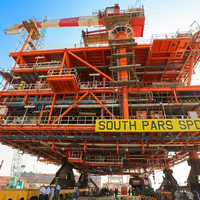
The Iranian hardliners claim credit for the current government's ability to sell more oil despite sanctions, touting their strategies and "energy diplomacy." However, statistics and expert analyses suggest that the increase in oil exports is more attributable to decisions by the White House not to enforce sanctions.
With the US approaching elections, there is a strong need for low gasoline prices to gain votes, providing Iran with an opportunity to boost its oil production, claimed Hosseini.
However, Iran's oil exports, almost all to China, began to increase after a huge drop in 2019-2020, when Joe Biden was elected president in November 2020. Candidate Biden had promised to reverse President Donald Trump's decision to leave the JCPOA nuclear deal and impose sanctions on Iran.
Iran's crude output has risen to approximately 3.6 million barrels per day (b/d), according to the country's oil minister, Javad Owji, the highest production levels since sanctions were reimposed on Tehran's oil sector.
"Our oil production, which was 2.1 million b/d at the beginning of our time in office [in September 2021], has reached 3.6 million b/d," Owji stated during a presentation to the Iranian parliament on Wednesday.
Iran's Acting President Mohammad Mokhber also said Thursday that the country's oil sales capacity had been less than 300,000 b/d when Raisi took office but rose to about 1,800,000 b/d in less than a year and a half.
The additional output and exports to China, which are around 1.3 million barrels a day, generate around $37 billion a year for Iran. Although it is not clear if China pays all cash for the oil or exports good to Iran, the income is the main lifeline for Iran's battered economy.
The reasons for the revival in exports have been debated, with some attributing it to more relaxed enforcement of sanctions by the US, and others to Iran's improved methods of circumvention.
The debate has even become a point of contention among Iranian presidential candidates as they gear up for the country's snap election on June 28.
Conservative candidates and hardliners largely attribute the boost in exports to their own methods of evasion with Raisi administration officials repeatedly pointing to their success in raising exports.
But the 'reformist' camp refutes those claims, with former Foreign Minister Javad Zarif rejecting the conservative narrative on state television on June 18.
"They [hardliners] said 'we taught them how to sell oil.' Not at all," Zarif stated. "When Biden took office, his policy was to loosen the screw. Wait until Trump returns to office, and then we can see what [the hardliners] say."
He also argued that the Biden administration was willing to return to the nuclear deal that former President Donald Trump unilaterally withdrew from in 2018. However, according to Zarif, the opportunity was squandered due to pressure from both Israel and Iranian hardliners, who pushed the government to escalate the nuclear crisis.
The Islamic Revolutionary Guard Corps (IRGC) spokesperson reiterated last week that the Revolutionary Guard would refrain from any involvement in the election process despite the close affiliations of most candidates with the organization.
Ramezan Sharif emphasized that the IRGC would remain neutral and abstain from supporting or opposing any candidate but while the IRGC officially denies fielding candidates in Iran's upcoming presidential snap elections, the majority of contenders appear to maintain close ties with the organization.
Even when the president is not affiliated with the IRGC, its influence remains profound. Former President Hassan Rouhani famously dubbed the IRGC a "shadow government with guns," lamenting its extensive control over political, military, and economic realms.
He once characterized them as “a government wielding both military might and media dominance, possessing an unrivaled grasp on power, leaving little room for challengers.”
This election cycle underscores the IRGC's pervasive influence, as evidenced by the strong connections of most of the six hand-picked presidential candidates to the organization through personal relationships or their staff affiliations.
Mohammad Bagher Ghalibaf
Mohammad Bagher Ghalibaf's association with the IRGC dates back to his youth. He officially joined the IRGC at 19 in 1980 and served until 2005.
He has held various high-ranking positions within the IRGC, including serving as deputy commander of the Basij, leading the Khatam Al-Anbiya Construction Headquarters, and commanding the IRGC Air Force.
During Ghalibaf's tenure leading the IRGC Air Force, clashes emerged with the Army over land seizures. Ghalibaf's forces resorted to violence, resulting in the death of an army soldier.
Hossein Salami, the Commander of the Revolutionary Guard (IRGC) (L), Parliament Speaker Mohammad Bagher Ghalibaf (R)
As Speaker of Parliament, Ghalibaf furthered IRGC's economic interests. In one instance, he reportedly replaced the head of the Central Bank to facilitate IRGC financing during Ebrahim Raisi's presidency in 2023.
In a leaked audio recording from February 2022, conversations among senior Revolutionary Guard generals surfaced, shedding light on a significant corruption scandal. The discussions implicated Ghalibaf during his tenure as Tehran's mayor.
The funds at issue were primarily allocated to the Quds Force, the IRGC's clandestine overseas operations unit, which wields huge economic power in Iran. Still, they became entangled in transactions between the municipality and Yas Holding, an IRGC's Cooperatives Foundation subsidiary engaged in services, dealerships, and subcontracting within the housing sector.
Throughout his term, he oversaw the enactment of the Strategic Action Law to Lift Sanctions and Safeguard Iran's National Interests in the parliament. This law compelled aggressive measures to expedite Iran's nuclear program and limit International Atomic Energy Agency (IAEA) oversight.
Amir-Ali Hajizadeh, the commander of the Aerospace Force of the IRGC (L), Parliament Speaker Mohammad Bagher Ghalibaf (R)
In March, Amir Ali Hajizadeh, the IRGC's Aerospace Division commander, praised Ghalibaf's pivotal role in establishing IRGC missile sites, hailing him as "revolutionary" and "indefatigable." He emphasized the need for "jihadist managers" like Ghalibaf in the country's economy.
Ghalibaf's potential presidency would mark the first time a former senior career commander of the IRGC assumes the position under Khamenei. His presidency would likely safeguard IRGC interests in the event of Khamenei's passing during his tenure at 85 years old.
Alireza Zakani
Although not a military figure like Ghalibaf, Alireza Zakani is well-known for his role in leading the IRGC’s Student Basij Organization (SBO).
Alireza Zakani has held various prominent positions within the Islamic Republic, including leading the SBO, serving as a member of parliament, presiding over the Parliament’s Research Center, and currently holding the position of mayor of Tehran.
Alireza Zakani, the Tehran conservative mayor
Renowned for his conservative ideology and often referred to as the "revolutionary tank," Zakani is re-entering the presidential race after withdrawing his candidacy in 2021 to endorse Ebrahim Raisi, who died in a helicopter crash last month.
He is subject to UK sanctions due to allegations of serious human rights abuses in Iran.
While not donning a military uniform, Zakani, who served as Ghalibaf’s campaign manager during his unsuccessful presidential bid in 2005, aimed to govern Tehran with military-like tactics, evidenced by his establishment of IRGC and Basij-led camps in the city.
He has also received support from figures like General Esmaeil Kosari, a former IRGC commander and current member of parliament, in controversial decisions like building mosques in parks.
Lotfollah Forouzandeh leads Zakani's election campaign. Forouzandeh is currently Tehran’s municipality deputy for financial affairs. His appointment raised concerns about the misuse of municipal resources for personal political gain.
Tehran Mayor Alireza Zakani (R) and his financial deputy Lotfollah Forouzandeh
Forouzandeh held positions such as commander and deputy in the IRGC until 1992; he is also recognized as one of the founders of the Society of Devotees of the Islamic Revolution, a group composed of former Iran-Iraq war commanders who have wielded significant influence in elections since the early 2000s. This group notably contributed to Mahmoud Ahmadinejad's rise to power in the Tehran Municipality and the presidency.
Saeed Jalili
Saeed Jalili earned the moniker "a living martyr" following the loss of one of his legs during the Iran-Iraq War while serving in SBO.
Throughout his career, Jalili has held many significant roles, from the Office of the Supreme Leader to Iran's Foreign Ministry and the Supreme National Security Council (SNSC).
Presidential hopeful Saeed Jalili
These positions include leading Iran’s Foreign Ministry’s Inspection Office, heading the Foreign Ministry’s US Affairs Office, serving as a senior director in Khamenei’s office, deputy foreign minister for European and American Affairs, secretary of the SNSC, and subsequently, the supreme leader’s personal representative on the SNSC.
Jalili, although aligned with the fundamentalist faction, lacks clear organizational ties with the Revolutionary Guards akin to figures like Ghalibaf or Zakani.
A leaked audio revealed that former IRGC Quds Force Commander Qasem Soleimani was discontent with Jalili's management style. However, IRGC-affiliated media outlets, such as Fars, Tasnim, and Javan, as well as Ofoq TV, have maintained a favorable relationship with Jalili.
Mohsen Mansouri, who is leading Jalili's campaign, has strong ties with the IRGC. As the governor of Tehran province and the head of the province's security council, he appointed IRGC commanders to critical positions. Mansouri also directed resources to the IRGC in his capacity within Jalili's campaign, appointing Rahim Aghdam, a Quds Force commander and associate of Qassem Soleimani, to the team.
Mostafa Pourmohammadi
Mostafa Pourmohammadi, the only cleric approved to run for the presidency in 2024, is notorious among Iranians for his role alongside Raisi on the Death Commission, which sanctioned the execution of thousands of political prisoners in 1988.
He has maintained a positive relationship with the IRGC and even appointed an active IRGC commander to governmental positions.
Pourmohammadi served as a cabinet minister in Mahmoud Ahmadinejad's first administration. One of his initial appointments was Mohammad Bagher Zolghadr, then deputy commander of the IRGC, as his deputy.
Pourmohammadi reportedly revealed electoral irregularities to Supreme Leader Ali Khamenei without Ahmadinejad’s knowledge, leading to his dismissal as interior minister in 2008.
Subsequently, he stood in defense of the IRGC against Ahmadinejad's criticisms.
In 2011, when Ahmadinejad referred to the IRGC's illicit activities with the term "Smuggler Brothers" and mentioned illegal docks. Mostafa Pourmohammadi, then head of the General Inspection Organization, asserted that no illegal docks existed in the country.
Amir-Hossein Ghazizadeh Hashemi
Amir-Hossein Ghazizadeh Hashemi, a trained physician and former member of parliament, served on its presidium and as the first deputy speaker. He ran for the presidency in 2021 but was unsuccessful. Subsequently, Ebrahim Raisi appointed him as vice president and head of the Martyrs and Veterans Affairs Foundation. This Iranian parastatal organization is sanctioned for channeling financial resources to terrorist groups, notably Hezbollah.
Amir-Hossein Ghazizadeh Hashemi during presidential debate
As head of the Martyrs and Veterans Affairs Foundation, Ghazizadeh Hashemi naturally maintained business relations with the IRGC’s Quds Force.
Mohammad Reza Mirshamsi, who leads Ghazizadeh Hashemi's election headquarters, is a relatively lesser-known figure with a history of serving as the political deputy at Imam Hossein University, an institution affiliated with the Revolutionary Guards.
Masoud Pezeshkian
Masoud Pezeshkian is the only ‘reformist’ candidate allowed to participate in this election. A heart surgeon by profession, he previously served as the health minister in Mohammad Khatami's administration.
Masoud Pezeshkian in IRGC uniform at parliament
Though he appears to have fewer connections to the Revolutionary Guards than others, he, along with Ghazizadeh Hashemi, wore the IRGC uniform alongside fellow parliamentarians in solidarity with the IRGC a day after then-US President Donald Trump designated the IRGC as a terrorist organization.
In December 2022, during a university lecture, he responded to a student criticizing his choice to wear the IRGC uniform by stating, "Without the IRGC, this country would have been divided, and our work would have ended."
Iran is set to triple or even quadruple its uranium enrichment capacity at Fordow, one of the country's most secretive nuclear facilities, according to reports published by the Institute for Science and International Security (ISIS) and the Washington Post on Wednesday.
The reports said the International Atomic Energy Agency (IAEA) has confirmed new constructions at Fordow.
David Albright, a nuclear weapons expert and president of ISIS, told Iran International his technical report came in response to Iran's announcement that it's going to rapidly deploy 1400 advanced centrifuges.
The advancement, Albright said, came as a surprise
"People didn't know they had that many [centrifuges] ready to go... At the Fordow plant, the centrifuges are called the IR-6s and it's the most advanced centrifuge Iran operates," said Albright.
The 1,400 advanced machines would increase Fordow’s capacity by 360 percent, according to Albright. The plant is a deeply buried facility that is very hard to destroy.
The Washington Post also reported that the major expansion underway inside Fordow could soon triple the site’s production of enriched uranium, according to confidential documents and analysis by weapons experts.
Albright said that within a month, Iran could produce enough weapons-grade uranium for five nuclear weapons at Fordow.
The reports come amid growing concern about Iran’s nuclear program, which has grown rapidly in the last few years, while access has been limited and many UN inspectors have been kept out.
Last week, France, Germany, and Britain, original signatories of the 2015 nuclear deal with Iran, condemned Tehran’s plan to further expand its uranium enrichment.
The United States has also threatened to respond to Iran if it further accelerates its uranium enrichment.
Iran's disclosure of its plans comes after the IAEA member states approved a formal reprimand on June 5 in response to its nuclear defiance.
The IAEA Board of Governors resolution demanded Iran step up cooperation with the watchdog and reverse its recent barring of inspectors.
On June 10, Iran's Acting Foreign Minister Ali Bagheri downplayed the resolution censuring Iran, stating that issuing resolutions has no impact on Iran's "determination" to develop its nuclear projects.
Albright believes Iran's reaction to the resolution was "more aggressive behavior" with regards to "deploying these 1400 centrifuges."
Iran dismisses all concerns as politically motivated. It has officially informed the International Atomic Energy Agency of its expansion and ‘upgrade’ plans at its primary enrichment plant near Natanz.
For two years now, Iran has been enriching uranium to 60% purity. The IAEA chief Rafael Grossi has stated that uranium of this purity has no obvious civilian use. It would be “a matter of weeks,” experts say, if Iran decided to go from 60 to 90 percent that is required for making a nuclear weapon.
Albright said Fordow is now viewed as a plant that could break out and produce several nuclear weapons within weeks, while previously it was never seen as a facility capable of achieving that.
The surprising nature of the plant's capability, and the fact that it's one of the most heavily protected nuclear facilities in Iran, are major concerns, he said.
"We're dealing with a brand new situation," said Albright.