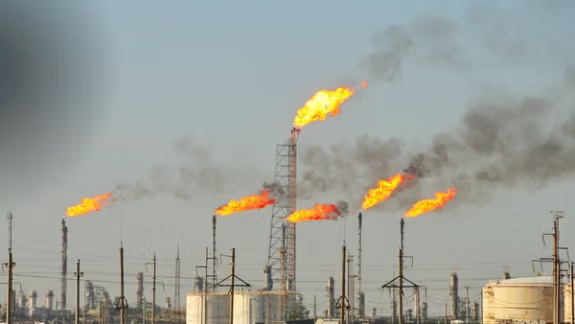
Iran is among the top most gas flaring countries. (file photo)
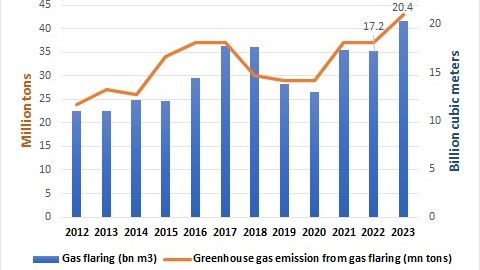
Iran's gas flaring rose by 19% year-on-year to 20.4 billion cubic meters in 2023, marking the highest recorded level for the Islamic Republic since satellite-based flaring estimates began in 2012, as per a World Bank report.
According to the report, the increased intensity of flaring indicates a lack of investment in gas infrastructure and its utilization.
Iran ranked second globally after Russia in gas flaring levels last year and had the highest increase rate worldwide.
The country has failed to develop and install the necessary equipment to collect associated gas from oil fields over the past two decades.
According to the Oil Ministry's estimates, approximately $5 billion is needed to curb gas flaring, which accounts for about 8.5% of the country’s total gas production. The annual value of this flared gas exceeds $5 billion in regional markets. To compare, Iran's flared gas volume equals 42% of Turkey’s total gas consumption in 2023.
At the same time, natural gas consumption is increasing in the country and supplies get tighter leading to industrial disruptions.
British Petroleum (BP) also released its annual statistical review of world energy this week, reporting that greenhouse gas emissions from flaring in Iran increased by 16.3% year-on-year, reaching 43.1 million tons in 2023.
Iran’s total greenhouse gas emissions reached 927 million tons last year, ranking sixth globally.
Why is Iran’s gas flaring rising?
The World Bank attributes Iran’s increase in gas flaring to a rise in oil production.
In 2017, Iran’s gas flaring volume was just over 17 billion cubic meters when it produced up to 3.8 million barrels of crude oil per day, about 800,000 barrels more than in 2023. The reason for this contradiction is Iran's failure to install equipment at new oil fields.
The increase in flaring resulted from Iran's newly developed oil fields, particularly those managed by domestic companies, including Azadegan, Yadavaran, and Azar. However, unlike older old fields that have gas collection technology, there have been no investments in the new fields.
•
•
According to both the Iranian Oil Ministry and the US Energy Information Administration, approximately 80% of Iran’s oil production comes from aging fields that lose 8-12% of their productivity annually.
Iranian domestic companies have developed and partially launched new fields in recent years, resulting in higher gas flaring rates to compensate for declining oil production from aging fields.
In the 2000s, Iran installed associated gas collection equipment on some oil fields, relying on domestic technologies. However, after 2010, investment in oil fields declined significantly, and associated gas collection projects lost priority.
For instance, since 2018, Iran’s total annual investment in upstream oil and gas projects has been around $3 billion, down from over $7 billion in the early 2010s and $18 billion in the 2000s.
Iran suffers not only from high volumes of gas flaring but also significant methane emissions, which increased by 12% to 8.5 billion cubic meters in 2023, according to the International Energy Agency.
A significant portion of Iran's gas leakage is due to its outdated transmission and distribution network.
Iran loses about 29 billion cubic meters of its produced gas (12%) during production, transmission, and distribution stages—equivalent to the country’s total household gas demand.
Due to delays in gas field development and significant gas wastage, Iran faces a substantial gas deficit in winter, leading to increased consumption of polluting mazut and diesel instead of natural gas.
Additionally, Iran's gas exports dropped by a quarter, reaching 14.3 billion cubic meters in 2023, according to BP estimates.
Natalie Sanandaji, a survivor of the October 7 atrocities, stood before a virtual panel this week to show a shared unity between Iranians and Israelis that she believes many either overlook - or are unaware of.
“We are not enemies. We’re allies in the fight against a shared enemy,” said the 28-year-old Natalie Sanandaji.
Hosting a digital rally, Sanandaji declared that the common enemy for both Iranians and Israelis is the Islamic Republic of Iran.
“I survived an Iranian-led attack at the Nova music festival in Israel, which only strengthened my resolve to fight for my fellow Iranians living in fear under the regime,” she said.
She was attending the Re’im music festival on October 7 when Hamas launched attacks. Out of the nearly 1,200 people killed that day, at least 364 were young partygoers at the festival.
Hearing gunfire from all directions, she ran for hours, passing by some who were killed on their way trying to escape the carnage. She ran until an Israeli local came to her rescue, according to reports.
Sanandaji was born to an Iranian father and an Israeli mother. Her background, she said, has often led to misconceptions with people.
Israelis mourn the dead on October 10, 2023
“I'm Iranian and Israeli, their automatic reaction was, what's it like to be from two countries that hate each other? What's it like? To have parents from two cultures who hate each other. And I would always have to explain to people. It's not. It's not the people. They don't hate each other.”
On June 23, she hosted the "Voices Against Violence: The Iranian Diaspora Speaks" Digital Rally, organized by the Combat Antisemitism Movement. The event united voices from the Iranian diaspora to address issues of human rights violations by the Islamic Republic of Iran.
“It started in Iran, and a lot of people seem to not realize that Hamas is just one of the proxies of the Islamic regime. And it's so it's so important to have that unity, because that's what they want more than anything. They want us to not be unified against all of them. They want us to not realize that they are all one and that we have one common enemy,” said Sanandaji.
On October 26, 2023 Congressman Bill Huizenga, the Chairman of the House Financial Services Subcommittee on Oversight and Investigations, held a hearing examining how the Iranian regime moves money to finance terrorism. He stated that Iran funds roughly 93% of Hamas’ budget which is about $350 million dollars per year.
In 2018, the US State Department report stated that Iran funds Hezbollah with around $700 million annual and gives $100 million a year to groups like Hamas and Palestinian Islamic Jihad.
Behnam Ben Taleblu, a senior fellow at the Foundation for Defense of Democracies (FDD), told Iran International, Iran uses its proxies like Hamas to avoid the prospects for a direct and over confrontation.
“Proxy forces function as low cost auxiliaries for the Islamic Republic, allowing the regime in Tehran to conserve resources and personnel by fighting on the cheap and using local actors as shock troops and terrorist forces,” said Taleblu.
Hamas leader Ismail Haniyeh with Iran's Supreme Leader Ali Khamenei
The lineup of the digital rally speakers, including activists, scholars, and community leaders, expressed that at the acts of violence committed in Iran against its own people and through its proxies abroad like in Israel, are the same.
Marjan Keypour, a human rights activist and advocate for women and minorities in Iran, implored the West, specifically feminists to condemn the atrocities of the Iranian regime.
“I'm speaking specifically to the feminists around the world, especially in the Western countries, who have time and again ignored the atrocities that are committed by the Iranian regime and their perpetrators across the world. For them to speak out with the same vehemence and with the same level of condemnation against the violence that is taking place inside Iran and against the violence that took place on October 7th by the Iranian regime proxies. We cannot forgive. We cannot forgive. We cannot ignore,” she said.
Jonathan Harounoff, an Israeli-Iranian expert and journalist, said the "bond between Israelis and Iranians is one of the most misunderstood dynamics in this entire conflict."
Harounoff said the reason there's a strong bond is because they share the same "source" of "suffering" and share a "the same sort of lived experiences."
"Iranian people, they've been suffering for decades and decade from the Islamic Republic. Israelis and Jewish people worldwide have have suffered at the hands of the Islamic Republic, whether directly or, through its, very vast proxy network," he said.
Another featured speaker, Sarah Raviani, a visiting fellow with the National Union for Democracy in Iran (NUFDI), drew parallels between the death of Mahsa Amini, which she said created a “revolution in all of our hearts" and the victims of October 7.
Amini was killed in Sept 2022 after being taken into police custody for allegedly not wearing her hijab properly. Her death sparked the Woman, Life, Freedom protest movement in Iran, and became a rallying cry for change.
Raviani said when the movement broke out, “for all of 2022 and 2023, the Israeli and Jewish community were basically our only allies.”
She said when October 7 took place she felt like all of her advocacy against the Islamic Republic had “fallen on deaf ears.”
“I woke up that morning very, very early. It was around 5 a.m. and for around an hour I sat on social media as I watched videos of Hamas hunting down Israelis, and I remember calling my mom. I was at my parent's house, and I called my mom over to my bedroom, and I just had her lay down with me, and we were crying and just in shock because, you know, we had been advocating for so long and trying to educate lawmakers on the dangers of the Islamic Republic” she said.
Harounoff said the perpetrators behind the attacks in Israel and against Iranian people inside Iran have the same roots - the Islamic Republic.
The FDD’s Behnam Ben Taleblu said Iran is trying to export its revolution and Islamist, authoritarian agenda abroad through its proxies. That agenda, he said, is not supported by a vast majority of Iranians.
“This is an agenda that has no social base or resonance at home and is increasingly contested by the vast majority of Iranian society which has been protesting against the regime in its entirety.”
American-Israeli expert and journalist Emily Schrader, one of the panelists, said it’s her mission to educate people on the solidarity felt by many Iranians and Israelis. It’s a unity that she believes most of the Western world doesn’t understand.
“I think that one of the most important things that we can do is to show the world that there is this solidarity and to show the world that we do have this common goal of fighting against an Islamist terrorist organization, which is the Islamic Republic of Iran, along with all of its proxies, whether it's the IRGC, the Houthis, Hezbollah, or Hamas.”
She organized the Woman-Life-Freedom protests in Israel and helped bring murals supports the people of Iran to the streets of Israel.
Schrader described the bond between Iranians and Israeli’s as historic.
“We always loved each other. I mean, speaking historically, of course, from the time of Cyrus the Great, there's a true allyship between the Jewish people and the Iranian people.”
Israel-Iran expert Jonathan Harounoff agrees. He pointed to the fact that around the world, some Israelis have shown up to anti-regime protests organized by Iranians and that some Iranians have also supported Pro-Israel demonstrations.
"You'll see flags from both present. You'll see people who are, waving flags side by side into it. To an outside observer, that seems like a crazy thing. How is that what is going on? But it's it actually makes a lot of sense that people who are building this bond not just by suffering, but also mutual understanding where Iranians understand where Israelis are coming from, and Israelis also understand where Iranian people are coming from."
Amir-Ali Hajizadeh, the commander of the Aerospace Division of the Islamic Revolutionary Guard Corps (IRGC), claims that Israel conveyed messages through Turkey, asking Iran to keep its attack on April 13 “lite.”
"The Americans wrote a letter, and the Zionist regime relayed a message through Turkey, urging us to keep the retaliatory strike restrained. They pleaded for a measured response," stated the IRGC commander on Thursday.
He also asserted that foreign ministers from "France and several European nations" contacted Iran's foreign ministry, initially expressing concerns but ultimately accepting the operation's legitimacy.
“Their [the Europeans] primary contention afterward was that 'the operation was meant to be punitive; if this is mild, what would a full-scale military operation entail?'" he said.
In addition to diplomatic exchanges with Western nations, Hajizadeh claimed that neighboring Arab countries intervened through their foreign ministers to propose a ceasefire in Gaza to dissuade the Islamic Republic from attacking Israel.
Described as "Operation True Promise" by Tehran, the April 13 massive air strike employing over 350 drones and missiles marked Iran's first direct assault on Israeli territory. According to the Israeli military, 99% of the projectiles were intercepted with the assistance of a coalition led by the US.
The attack was a response to what Iran claimed was an Israeli attack on its consulate in Damascus, which resulted in the death of seven officers of the Islamic Revolutionary Guard Corps, including a senior commander.
This is not the first time the IRGC commander has made such claims, but it is the first time he has mentioned Turkey as an intermediary.
"Following the Supreme Leader's address, the Zionists recognized Iran's resolute stance. Consequently, they appealed through neighboring countries, urging us to respond with restraint," he stated last week.
Last month, Hajizadeh asserted that the aerial assault on Israel employed limited military capabilities, explaining, “We had to use a great number of missiles and drones to get through Israel's Iron Dome; we used 20% of our military capability in the operation.'"
Hajizadeh also alleged that Israel offered concessions in Gaza to preempt Iranian retaliation despite its ongoing offensive against the Gaza Strip.
"Israel conveyed messages through Egypt's foreign minister, indicating readiness to negotiate in the Gaza conflict to avoid Iranian reprisal," claimed Amirali Hajizadeh.
However, these claims, reported by Iran's state media, appear dubious as Israel has continued to escalate operations in Rafah, Hamas's southern stronghold, despite warnings from a host of countries, including the US and European nations. Israel's primary objectives remain the elimination of Hamas and the release of the remaining 120 hostages held in Gaza.
Israeli Foreign Minister Yisrael Katz has responded to Iran's warning against the Jewish state's possible offensive in Lebanon, saying the Islamic Republic deserves to be "destroyed".
"Iran threatens today to destroy Israel if Israel fully responds to Hezbollah attacks from Lebanon," Katz said in a post on his X account on Saturday. “My response to Iran is clear: A regime that threatens destruction deserves to be destroyed."
Katz's comments came in response to Iran's mission to the United Nations which warned that any “full-scale military aggression” by Israel in Lebanon against Hezbollah would trigger an "obliterating war."
The Israeli top diplomat also made it clear that if Hezbollah does not cease its attacks from Lebanon, Israel will retaliate with full force.
"If Hezbollah does not cease its fire and withdraw from southern Lebanon, we will act against it with full force until security is restored and residents can return to their homes,” Katz said.
The situation has been tense along the Lebanese border following a series of attacks by Hezbollah, the Iran-backed militia. The Israel Defense Force (IDF) retaliated by targeting several Hezbollah positions after the group launched attacks on northern Israel.
The confrontation is part of a broader conflict involving Iran’s “Axis of Resistance," which includes not only Hezbollah but also Hamas, Yemen’s Houthis, and other groups in Syria and Iraq.
The axis has actively targeted Israel since October 7, when Hamas-led fighters stormed southern Israel, killing 1,200 people and taking 251 hostages, sparking the ongoing war in Gaza.
Iran itself launched missile and drone strikes on Israel on April 13, following an alleged Israeli airstrike in Damascus that killed several senior officers of the Islamic Revolutionary Guard Corps.
Although Iran’s strike was largely repelled with the help of the United States and other allies, it marked a new level of escalation in the region.
Voter turnout in Iran’s Friday snap presidential election reveals a sharp decline across various provinces, particularly in regions that were centers of protests in 2022 and 2023.
Based on official tallies, significant drops in voter engagement were recorded in Tehran (capital city) and in Kordestan and Kermanshah provinces, all of which were epicenters of recent anti-government protests, as well as in restive Sistan-Baluchestan province, which saw a dramatic 23-percent decrease in turnout.
The nationwide protests, ignited by the death in custody of Kurdish Mahsa Amini, saw Kordestan (Kurdistan) among the first to rise up against the clerical rulers.
In the presidential vote, Kermanshah recorded a mere 19.5 percent participation rate, 28.8 percent less than the 2021 turnout. Greater Tehran and Kordestan also recorded a 23-percent turnout, down from 26 percent and 37.4 percent respectively in 2021.
These regions, at the forefront of protests, reflect citizens’ frustration over systemic corruption, economic hardships, repression and lack of political freedoms.
Voter turnout In Sistan-Baluchestan in southeastern Iran nosedived from 62.8 percent in 2021 to just 40 percent in 2024. This marginalized and underrepresented region faces severe socio-economic challenges and repression.
During Bloody Friday on September 30, 2022, security forces killed around 100 protesters and injured hundreds more. The government has repressed the weekly protests following Friday prayers, leading to the arrest of many Baluch Sunnis.
The northern provinces of Gilan, Mazandaran and Golestan also saw significant decreases of 24.8, 18.5 and 19.4 percent, respectively, while Khuzestan's turnout dropped by 20.4 percent.
The only province that showed a minor increase was Qom, home to Iran's biggest Shia seminary, which saw a three-percent increase in turnout.
The June 28 presidential election marked the lowest voter turnout in the history of the Islamic Republic, with only 39.92 percent participation. This breaks the previous record set during the last election, in which the late President Ebrahim Raisi won with a turnout of 48 percent.
Activists and officials have highlighted that the low turnout is a clear sign of the public's discontent with the ruling autocracy, demonstrated through the widespread boycott of the election.
Mostafa Pourmohammadi, who scored the lowest number of votes in the election, said on X, "Greetings to all of you who came to vote on June 29, and respect to all of you who did not believe us and did not come. Your presence and absence are full of messages that I hope will be heard. Your message is clear and unambiguous.”
IRGC Chief Commander Hossein Salami claims Iran's 'Resistance' ideology has infiltrated universities across the United States and Europe, referring to pro-Palestinian protests in Recent months.
"The resistance is so grand, beautiful, and captivating that its attractions have penetrated even into the universities of the US and into the cities of France, England, Germany, Spain, Australia, and everywhere," Hossein Salami said during a conference on "Resistance" in Mashhad on Saturday.
The "Resistance" generally refers to the Islamic Republic's ideology of fighting Israel and also the US through a coalition of Tehran-backed armed militant groups such as Hezbollah, Hamas, the Palestinian Islamic Jihad, the Houthis in Yemen, and various Iraqi Shiite militias.
Salami's remarks specifically point to the recent campus protests in the US and Europe by thousands of students who established encampments on campuses to decry Israel's military actions against the Iran-supported Hamas in Gaza.
Enraged by the Israeli military campaign in Gaza, students across the US have been organizing pro-Palestinian rallies and sit-ins to pressure their institutions to disclose and divest from funds and corporations that do business with Israel.
Triggered by a Hamas attack on October 7, which resulted in the deaths of 1,200 individuals, mostly civilians, Israel's subsequent military response reportedly led to the deaths of over 35,000 Palestinians, according to Hamas figures.
The protests in Western universities have been praised and politically leveraged by Iranian leaders, including Supreme Leader Ali Khamenei, who has repeatedly lauded the students' efforts as aligning with Iran's resistance against American and Israeli policies.
In a recent speech, Khamenei branded the campus protesters part of Iran's 'resistance front' against the US and Israel.
The campus protests across the US featured on the cover pages of many Iranian dailies, triggering a considerable backlash from ordinary Iranians who view the stunt as ‘glaringly hypocritical’ from a ruling system that suspends, beats and imprisons students for much less than what students have been doing in the US in the past ten days.
The Islamic Republic has always presented itself as the only true champion of Palestinians and their cause. This sentiment has become much stronger and prevalent since October 7 when Hamas, backed by Iran, rampaged border areas inside Israel.
The irony, as ordinary Iranians have been pointing out on social media, is hard to miss. It is a case of 'astounding hypocrisy', many say, of a regime who cheers on American students exercising their freedom of expression, while its prisons are humorously called ‘universities’ for hosting sheer numbers of students, graduates, and educators who have dared to speak their mind.