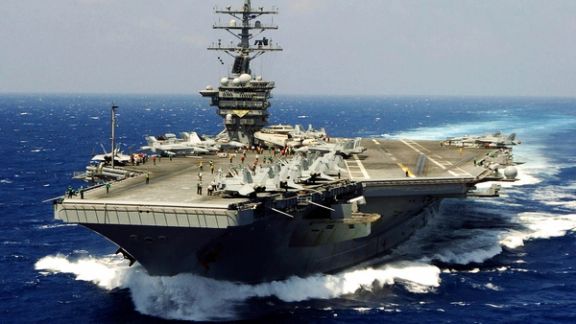
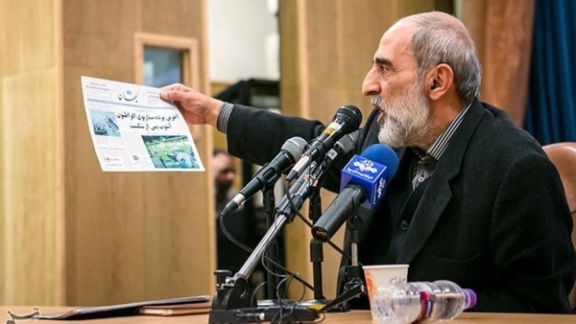
Some Iranian hardliners have warned that US interests could be targeted by Islamic Republic forces if Israel continues its strikes on Iran, asserting that Iran should view "interests, resources, and military personnel" as legitimate targets.
Foad Izadi, a hardline commentator often featured on Iranian state TV as an expert on the United States, stated in an interview with the conservative Nameh News website: “Attacks will not stop unless the United States realizes that strikes on Iran could be costly.”
Izadi added, “It is up to us to decide how we want to confront [Israel and the United States].” He continued, “The Americans, as Iran’s staunch adversaries, operate without ethical limitations. But if they sense that Israel’s attacks on Iran will come at a high cost to the US, these strikes will cease.”
Speaking a day after Israel’s strikes on military targets across Iran—from the capital Tehran to Shiraz in the south, Ahvaz, Mahshahr, and Ilam in the southwest, and Shahroud in the northeast, among other locations—Izadi remarked, “Whatever was done, Israel and the United States did it together, though the United States has declined to take responsibility for the attacks.”
He argued that if the United States did not want an escalation, it could refrain from sending weapons and equipment to Israel. He said, "no one should believe Washington's claims about trying to stop the war in the region."
Meanwhile, Hossein Shariatmadari, editor of the hardline *Kayhan* daily, closely linked to Supreme Leader Ali Khamenei’s office, wrote a pointed commentary after the Israeli strikes, warning, "We saw how you rained [missiles] on us. Now prepare for our flood."
Shariatmadari underscored what he called “undeniable evidence” proving that it is, in fact, the United States standing as Iran’s true adversary. He issued a stark warning to "Israel and its American, European, and regional supporters," promising that Iran’s response would be “far heavier and more severe than they can imagine."
In his commentary, Shariatmadari labeled Israel as “a mere front for the United States” and described it as "the U.S. garrison in the region." Further implicating Washington, he speculated, "Do you really think the fighter jets that launched missile attacks on Iran Saturday morning weren’t American-made? Or that their pilots weren’t American?"
Shariatmadari concluded by asserting that in any response to Israel, Iran would treat U.S. interests, assets, and military personnel as legitimate targets.
In a separate development, Majles Speaker Mohammad Bagher Ghalibaf vowed that "Iran will certainly respond to the Zionist regime’s aggression." Meanwhile, Khamenei’s senior political adviser, Ali Akbar Velayati, dismissed Israel’s attack as “much ado about nothing,” asserting that Iran has never initiated a war, is a recognized international power, and that Israel is too insignificant to challenge it.
However, Iranian journalist Amir Soltanzadeh countered Velayati's claims, noting that it was Iran who first initiated hostilities with Israel and that Iran’s isolation prevents it from claiming true international power status.
However, long-time establishment insider Mohammad Javad Larijani acknowledged, "This is not a small matter. Our country has been invaded. Although it was a cowardly attack, it remains an act of aggression against Iran."
Although military commanders seem to have been restricted from commenting on the incident, the IRGC-affiliated daily Javan downplayed the strikes’ significance, claiming that Iran’s anti-aircraft defenses largely thwarted the attack. Like most other Iranian media, Javan characterized the strike as “weak and limited,” adding that “Iran reserves the right to respond”—a measure that would likely be welcomed by those on both sides seeking to test Israel’s new THAAD air defense system.
In one of the rare comments from Iranian military experts, Amir Mousavi claimed that Iran had foreknowledge of the attack by hacking Israeli military documents, disputing reports that other countries had informed Iran. This contrasts with international media reports and statements from the Dutch Foreign Ministry and Russian officials, who reportedly notified Iran about the attack approximately four hours before it occurred.
The government-owned Iranian Students News Agency (ISNA) labeled the attack as "The big folly of a small regime," warning that Israel and its allies would face repercussions for this "limited" strike.
The United States issued a warning to Iran at the United Nations Monday, saying that any further aggressive actions against Israel or US personnel in the region would result in severe consequences.
The security council meeting, called upon by Iran, was held after Israel’s weekend retaliatory strikes on Iranian soil, which targeted several missile and drone factories as well as Iran’s air defense systems, according to American and Israeli officials.
“Should it [Iran] choose to undertake further aggressive acts towards Israel or US personnel in the region, there will be severe consequences,” said ambassador Linda Thomas-Greenfield.
She said the Iranian envoy called the security council meeting to gaslight and act like the victim.
The US Ambassador told the Security Council meeting on the Middle East situation that the US will not allow the future of the region to be dictated by Iran and its proxies.
“Stop pouring gasoline on the fire of the regional conflict,” the American envoy said, addressing the Islamic Republic.
The US stood by Israel and said the nation was acting in self-defense, whereas the British representative asked Iran not to respond and said both sides need to show restraint.
Amir Saeed Iravani, Iran’s UN envoy, accused the US of being complicit in Israel’s airstrikes and said it would bear the consequences. The US envoy, however, denied any involvement in Israel’s strike against Iran.
"The US government is complicit in Israeli aggression and will bear its consequences,” Iravani said.
He added that Israel breached international law and took aim at the US, noting that Washington had double standards when it came to Israel.
Israel’s UN envoy, Danny Danon, said he was giving Iran a last warning.
"Israel has shown restraint, but from now on you will only see strength. Any further aggression will be met with powerful and swift action."
Ambassador Danon demanded from the Security Council accountability and action.
Israel Ambassador at UN Security Council meeting on Mideast.
"We demand immediate and paralyzing sanctions against Iran's military and economic infrastructure, designate the Islamic Revolutionary Guard Corps as the terrorist organization it is and take all necessary measures to prevent Iran from becoming a nuclear state."
Danon referred to Iran’s government as the puppet master behind attacks against Israel and promised that any response by Iran would be met with strength.
A Pentagon aide previously linked by an Iran International investigation to a Tehran-led influence network has taken on a new role in the defense department which gives her reduced access to intelligence, according to a former Pentagon official.
The Iranian-American academic will now oversee force education and training within Defense Secretary Lloyd Austin's office. In her new position, she will have "significantly less access to intelligence and covert military programs," according to former Defense Department officials interviewed by The Free Press.
The change in her access to intelligence comes more than a year after an extensive investigation by Iran International last September, based on a large cache of Iranian diplomatic emails, identified Tabatabai as a core member of the Iran Experts Initiative (IEI) -- a network established by Iran’s foreign ministry in 2014 to promote Tehran’s interests within Western policy circles.
After the revelations linking her to the IEI, Tabatabai retained her role and security clearance as the Pentagon Chief of Staff for the Assistant Secretary of Defense for Special Operations and Low-Intensity Conflict.
The report prompted multiple congressional investigations, with Republicans raising concerns about her ability to obtain a top-secret security clearance.
The Pentagon and State Department have said there was nothing in Tabatabai’s background that would have disqualified her from accessing classified information.
She previously served as a key aide to the since-suspended US Special Envoy for Iran Robert Malley, whose own connections to Tehran were detailed in a subsequent investigation by Iran International in February.
New Position
In her new position, Tabatabai takes on expanded responsibilities overseeing force education and training—a shift from her previous role which generally entails more direct access to classified operational details.
While the Pentagon did not specify the exact date when she left her last post, a report by Politico said she was offered the new position last month.
The Pentagon, however, notified Congress about her transition to the new office on Friday, October 25, one week after the leak of US documents on Israel's plans to attack Iran, according to the Free Press.
Sky News Arabia named Tabatabai as the one being investigated in the case, citing a Pentagon official. However, the Defense Department officially denied that she was a subject of interest in the investigation.
The emails reviewed in the 2023 Iran International investigationindicate Tabatabai consulted Iranian officials on professional matters, shared article drafts for review, and promoted Iran-aligned narratives on its nuclear policy.
Prior to Tabatabai’s elevation to Deputy Assistant Secretary of Defense, the Free Beacon reportedthat the Biden White House hosted Tabatabai on eight occasions – after it was revealed that she had been at the heart of the Iranian influence network.
Those meetings sparked further concerns by senior Republican lawmakers about Tabatabai's access to classified information long after US lawmakers called for a suspension of her security clearance and an investigation into her role and her recruitment process.
A reporter blasted Russia at a usually staid Iranian foreign ministry press conference on Monday for failing to provide Iran with means to defend itself against an Israeli attack, discomfiting a government spokesman who urged civility.
Russia's failure to provide promised S-400 anti-aircraft systems or Su-35 fighters left Iran vulnerable, Ali-Akbar Saadati of the Kar va Kargar daily said, even after Tehran had provided Moscow hundreds of drones for its invasion of Ukraine.
"Whenever they faced difficulties in Ukraine, suffered misfortune, or got stuck in the quagmire of the Ukraine war, they came running to us, asking for drones, missiles, everything," Saadati said. "On the night Israel attacked us, our military’s defense system stood alone, completely alone."
"What is the position of the Pezeshkian admin's foreign ministry regarding this blatant dishonorable behavior by Vladimir Putin, the invading president of Russia?" demanded Saadati, who was dressed in Western attire rare in official Iranian circles.
The line of questioning sparked visible shock from foreign ministry spokesperson Esmail Baghaei, who asked the reporter to show decorum.
“I ask friends to raise questions here and leave the task of issuing political statements to the foreign ministry,” Baghaei replied. “Secondly, I must mention that here is a gathering of educated people, so please follow the usual code of conduct,” he added.
Iran's Foreign Ministry Spokesman Esmail Baghaei
Baghaei said Iran is self-reliant in defense, adding, “One of the proud achievements of the Islamic Republic of Iran is its reliance on its own strength, a result of the sacrifices of thousands."
"For the past 45 years, we have been under the most severe economic and arms sanctions, and everything we have accomplished has depended on our own steadfast air defense and armed forces,” he added.
In April, the former head of Iran’s parliamentary National Security Committee, Heshmatollah Falahatpisheh, criticized Russian inaction. After an Iranian attack on Israel, Falahatpisheh said that Western powers quickly mobilized to intercept Iran’s more than 350 projectiles, but no support arrived from Russia despite Iran’s provision of drones for Russia’s war in Ukraine.
“The developments showed that Iran is alone in the region … other powers did not come to Iran’s aid even in wartime conditions. Russia was not willing to provide Iran with the necessary equipment,” he added.
The words were consistent with Falahatpisheh’s previous criticisms of Russian policies. In January, he accused Moscow of seeking a “partner in crime” for its actions in Ukraine, highlighting that Iran’s provision of drones has not been reciprocated.
Since October 2022, Iran has supplied drones to Russia for use in Ukraine to target infrastructure and civilian areas. After initial denials, Iran eventually acknowledged sending a limited number before the conflict escalated.
Iranian requests for advanced Russian defense systems, such as the S-400, were met with no public response from Moscow.
Despite Russia’s inconsistent support, Iran’s Supreme Leader Ali Khamenei has maintained a firm pro-Moscow stance, emphasizing close ties with both Russia and China while warning against any reconciliation with the West.
Iran executed Jamshid Sharmahd, a 68-year-old software developer and California resident who also held German citizenship, the Judiciary's news agency said on Monday, two days after the biggest Israeli attack on the Islamic Republic in its history.
Sharmahd was abducted by Iranian agents during a visit to the United Arab Emirates in 2020 and forcibly taken to Iran. In February 2023, the Iranian judiciary sentenced him to death on charges of endangering national security.
Sharmahd was convicted of heading a pro-monarchist group named Tondar accused of a deadly bombing incident that occurred in 2008 at a religious center in Shiraz, killing 14 and injuring 215 more. The accusation, repeatedly denied by the political prisoner, was never substantiated by documented evidence.
The US green card holder's execution comes two days after the Israeli airstrikes on Iranian military sites. Iranian officials have accused the US of allowing Israel to use Iraq's airspace to carry out the attack, calling for Washington's accountability as "Israel's accomplice".
Jamshid Sharmahd and his daughter Gazelle
Reactions
Germany's foreign minister Annalena Baerbock issued a statement calling the execution a murder.
"I condemn in the strongest terms the murder of Jamshid Sharmahd by the Iranian regime... We made it unequivocally clear to Tehran that the execution of a German citizen would have severe consequences," she posted on X.
Abram Paley, US deputy special envoy for Iran called the execution abhorrent and condemned the country's rising rate of executions.
"Sharmahd should never have been imprisoned in the first place," Paley wrote on X. "His kidnapping and rendition, as well as sham trial and reports of torture, were reprehensible. We...stand with the international community in holding the regime accountable for its horrific abuses."
Iran conducted the most executions of any country in the world after China last year, Amnesty said in a report in May, adding that nearly 75% of all executions worldwide in 2023 outside China were in Iran.
The recent wave of executions brings the total number of hangings in Iran this year to more than 567, including 20 women, according to rights groups.
Earlier this month, HRNA reported that at least 811 people had been executed in Iran between 10 October 2023 and 8 October 2024, coinciding with the annual World Day Against the Death Penalty.
Call for international response
Kambiz Ghafouri, a Finland-based political analyst, believes the international community must take serious action against Tehran to prevent such cases from happening again.
"The Islamic Republic acts like an abusive, alcoholic, and addicted father who, whenever goes out and gets beaten up by someone stronger, returns home to beat up his stepchildren so they don’t become too bold. The Islamic Republic has acted exactly in this way," Ghafouri told Iran International.
"Experience has shown that dealing with a violent, criminal, alcoholic man requires a superior force from outside the family. The international community must severely punish the Islamic Republic; otherwise, we will face more instances like this," he added.
Iran’s Supreme Leader, Ali Khamenei, often deflects responsibility on difficult decisions, issuing vague statements that allows him to avoid blame if and when things go wrong.
Following Israel's air strike on Iran, many asked if the leadership in Tehran will respond, and if so how?
In the initial hours after Israel’s Saturday attack, supporters of the Islamic establishment attempted to downplay it, presenting it as if there was no need for retaliation. Silence from IRGC commanders and officials only reinforced the perception that no response was planned.
However, Khamenei’s statements on Sunday introduced doubt among supporters. He refrained from clearly stating whether the Islamic Republic would respond, instead passing the decision to the Supreme National Security Council and the government.
This move suggests Khamenei wants to avoid the responsibility of decision-making on this matter, so that any outcome can be attributed to other institutions.
If the Supreme National Security Council decides on a military response, leading to a conflict with Israel and possibly the US, Khamenei can claim it wasn’t his decision. Alternatively, if no response is chosen, he can tell hardliners that he was prepared for conflict, but other officials opposed it.
Despite his usual direct involvement in state matters, this time—though the constitution grants him responsibility for war and peace, Khamenei is acting cautiously, keeping options open for both scenarios. However, the public, familiar with this behavior over the years, recognizes his attempt to avoid accountability.
This is not the first time Khamenei has taken this approach. During the anti-government protests of November 2019, when a fuel price hike sparked widespread unrest, he distanced himself, claiming he had no role in the decision, which he attributed to other leaders.
A similar pattern occurred in 2018, when Donald Trump announced plans to exit the JCPOA. Khamenei stated he had always opposed the agreement as it stood, suggesting officials had disregarded his advice. Yet it’s well-known that the JCPOA would not have been possible without his approval; Hassan Rouhani and Mohammad Javad Zarif negotiated with US officials under his directive, and all stages of the negotiation were reported to him. Former Foreign Minister Ali Akbar Salehi even revealed that before Rouhani's administration, Khamenei had tasked him with initiating secret talks with the US in Oman.
These examples illustrate Khamenei’s tendency to deflect responsibility during critical moments, delegating difficult decisions to others. Now, confronted with Israel’s recent attacks on Iran’s missile, drone, and air defense facilities—and with the potential for US involvement if reciprocal strikes persist—he is once again refraining from taking a clear stance.
What’s more, he has delegated decision-making to the Supreme National Security Council, all of whose members are his appointees. Thus, the ultimate decision on whether to attack Israel still rests with Khamenei, though he seeks to sidestep direct accountability for potential consequences.
Meanwhile, Mohammad Bagher Ghalibaf, Speaker of the Islamic Consultative Assembly or parliament and one of Khamenei’s close appointees, has stated that Tehran must respond to Israel. This indicates that if a decision to attack is made, it will likely come from Khamenei and IRGC leaders, and other top insiders, including Ghalibaf.
In this situation, the role of institutions like the government will likely be limited to providing funding and carrying out orders.
This presents a significant challenge, as with an empty treasury, the Islamic Republic faces serious obstacles in funding a potential conflict.