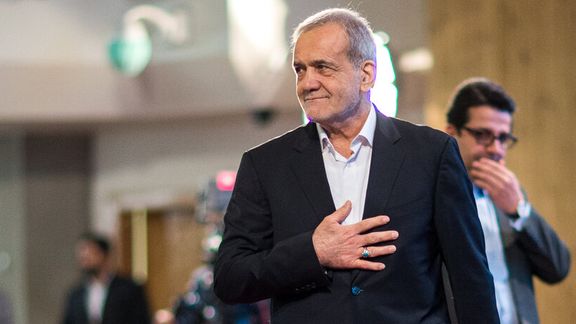
President Masoud Pezeshkian attending a "national reconciliation" gathering on Jan. 9, 2025
As Iran's relative moderate president Masoud Pezeshkian struggles to fend off an economic slump and a bid by hardline politicians to impeach senior ministers, media commentators have pulled no punches about his job performance.
In an unprecedented report on Thursday, Tehran’s Reformist daily Etemad questioned Pezeshkian and his team's effectiveness, telling him, "Iranian and foreign politicians have not taken you seriously."
As hardliners in the Iranian parliament push to impeach four ministers, Tehran’s press has also highlighted that some opposition to Pezeshkian also stems from within his own government and support base.
Iran's economic conditions have significantly worsened in the five months since the new president took office, driven largely by major regional setbacks that triggered a 33% decline in the national currency's value.
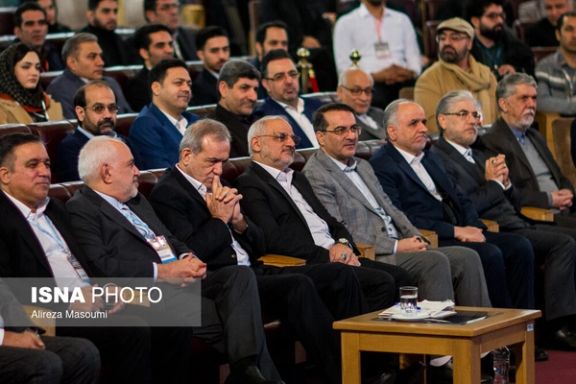
Despite ongoing criticism of the government’s efficiency, the President and his aides participated in a “national reconciliation” conference on Thursday morning. However all 44 photos published by the state-owned news agency ISNA exclusively feature Reformist participants, with no representation from other factions within the Islamic Republic’s political spectrum.
President Pezeshkian has promoted the concept of Vefaq-e Melli (national reconciliation) as an olive branch to hardliners who dominate the parliament and many state-backed organizations. Yet, these same hardliners have recently intensified their campaign against him, even though he has already appointed several of them to key positions.
Pezeshkian with former FM Javad Zarif during the Jan 9 "national reconcillitation" gathering in Tehran.
According to multiple media reports, including those from the moderate Khabar Online website, critics across the Iranian media spectrum argue that "The concept of national reconciliation has achieved little beyond awarding most key government positions to the President's political rivals, without securing their commitment to follow his policies or refrain from advancing ultraconservative agendas."
In another report on the same website, columnist Nilufar Molaei highlighted the growing criticism from various circles, noting, "Those who previously supported former President Ebrahim Raisi have now joined the ranks of Pezeshkian's critics." Molaei was referring to members of the ultraconservative Paydari Party, which formed the backbone of the Raisi administration.
She explained that hardliners are frustrated with the president's efforts to improve Iranians' access to social media, his decision to halt the enforcement of legislation targeting women who defy the compulsory hijab, and the possibility of negotiations between Iran and the United States.
Highlighting the opposition from hardliner Friday Prayer leaders in cities such as Mashhad, Karaj, Qazvin, Isfahan and others, Molaei also noted that some criticism of the Pezeshkian administration originates from within his own government.
This observation was echoed by ultraconservative lawmaker and a member of the Paydari Party, who remarked that even some individuals pushing for the impeachment of four of Pezeshkian's ministers are staunch supporters of the president and affiliated with reformist parties.
Meanwhile, the reformist daily Etemad, in a commentary directed at the President, urged, "Being a good President is not enough; you must also stand firm on your positions." The publication warned that "both Iranian and foreign politicians do not take you seriously."
Etemad further observed, "Whether Pezeshkian realizes it or not, he now occupies a pivotal position in history, and his performance could play a decisive role in shaping the future of the Iranian people."
The commentary also pointed out that "The country's current situation calls for someone who can do something more than simply running meetings, visiting other countries and meeting with their politicians, and making ad hoc decisions. Iran is facing complicated threats and major challenges."
Etemad wrote that Pezeshkian has repeatedly acknowledged he never expected to become Iran's president or to face such significant challenges. The publication emphasized that the entire nation is watching him, expecting decisive and bold action to address the crises. It urged Pezeshkian to rise to the occasion, overcome obstacles, and pave the way for progress as the nation waits in anticipation.
Etemad warned Pezeshkian that relying solely on optimistic declarations is not enough, writing, “Give the people the feeling that someone is in charge and capable of stopping the violation of their rights and plundering of their wealth. It is a difficult job, but you need to stand firm and shake up the country's [system] and instill hope among the nation.”
Iran has more missiles than it can store, the Revolutionary Guards commander said, dismissing what he called enemy propaganda about the weakening of Iran's armed forces following consecutive attacks by Israel on Iran and its allies.
Providing no details about what he meant by the term, Hossein Salami stressed that Iran faces no shortages of missiles, drones or naval vessels, calling them key elements of the country’s deterrence strategy.
He also announced that the country will unveil new underground missile and drone cities, highlighting them as symbols of military strength and self-reliance, independent of foreign territories like Syria.
Iranian military commanders have been announcing the procurement of new offensive weapons since their proxies and allies in the region suffered consecutive defeats last year.
Tehran was pushed out of Syria in December after the ouster of its ally Bashar al-Assad from power at the hands of opposition insurgents.
Salami added that Iran does not rely on Syria for its deterrent power, stating, "Syria fell, but we did not rely on military advantages from Syria to an extent that would impact our deterrence."
"Our deterrence is not based on operations from any other land. It is fully rooted in Iranian soil, will, decisions, and actions," he added.
However, since establishing its military presence in Syria in 2011, Tehran has frequently emphasized Syria’s importance to its Axis of Resistance, referring to it as its strategic depth.
This comes as two senior IRGC commanders said this week that financial constraints and the loss of Syria, a key regional ally, have left the Islamic Republic unable to retaliate against Israel's October airstrikes.
The loss marks one of the most significant setbacks for Iran’s so-called Axis of Resistance in 15 months of conflict with Israel. Tehran, which frames the Axis as legitimate resistance against Israel, has been cautious to avoid full-scale conflict with its better-armed foe.
Former Iranian Foreign Minister Mohammad Javad Zarif on Friday tweeted that the widespread destruction caused by the ongoing California wildfires are reminiscent of the conditions in Gaza.
"Grim footage out of California is reminiscent of ravaged homes, schools and hospitals in Gaza," Zarif wrote. "It's only human to sympathize with Californians who've lost everything to wrath of nature—particularly as many there have stood with Gazans who lost everything to savagery of Israel."
The wildfires, which have ravaged Los Angeles and adjacent areas, have claimed at least 10 lives and destroyed nearly 10,000 structures. Five separate fires continued to rage into a third night on Thursday, with dry desert winds fanning the flames.
A French mayor has cancelled an advertising campaign on sorting garbage which lampooned Supreme Leader Ali Khamenei, citing safety concerns after Iran decried it as an insult.
The campaign on the back of municipal buses features Khamenei alongside North Korean leader Kim Jong Un and Russian President Vladimir Putin under the slogan "Don’t forget to sort your waste".
Far-right Mayor Robert Ménard of the southern French city of Béziers had spearheaded the initiative but announced the removal of the adverts on Thursday.
Describing the move as a precautionary measure, Ménard told AFP: "We take this very seriously. I don't want there to be the slightest problem, for example, for our bus drivers."
"We've run lots of campaigns, but they never achieve anything. Nobody even notices them. This one, at least, everyone noticed," he added.
Majid Nili, an aide to Iran’s Foreign Minister, announced Thursday that the Iranian Embassy in Paris has lodged an official complaint against the campaign, which he described as an insult to the Islamic Republic, hate speech and disrespect for Iran's cultural values.
Nili further said that the embassy had demanded what he called an appropriate response from the French government, calling for measures to prevent provocations in the future.
The campaign was launched on January 4, 2025, as part of an initiative to encourage residents to participate in waste sorting.
Since then, images of the municipal buses have been shared widely on social media platforms, including the city’s official Facebook page with the caption: "To start the year off right, think about sorting your rubbish."
French media earlier quoted Ménard saying, "These are scoundrels, non-recyclable waste. One wages an unjust war on his neighbors and sends his army to die, another imprisons his population and the last treats women worse than doormats while eliminating his opponents."
In his New Year’s statement, he also expressed solidarity with the women of Iran, saying: "I am also thinking of those women who, in Iran and elsewhere, refuse to be confined behind a veil, a prison of fabric."
A senior official in Iran’s Revolutionary Guard appears to have acknowledged that a series of direct attacks on Israel did not achieve their intended strategic goals.
Hossein Taeb, an advisor to the IRGC Commander-in-Chief, made the comments on Wednesday during a speech discussing Iran's so-called operation True Promise 3, an attack promised by Iranian officials on Israel.
"The operations of True Promise (1), 2, and 3 should be executed when they are strategically effective," Taeb said in comments carried by state media, referring to earlier Iranian attacks against its regional arch-enemy.
Operation True Promise 1 was Iran's first ever direct military strike against Israel, conducted on April 13, 2024.
In retaliation for an Israeli air strike on the Iranian consulate in Damascus two weeks earlier, which resulted in the deaths of two Iranian generals, the Islamic Revolutionary Guard Corps (IRGC) launched a coordinated assault involving over 300 ballistic missiles, cruise missiles and drones targeting Israeli military installations.
Operation True Promise 2, conducted on October 1, 2024 saw the IRGC launched approximately 200 ballistic missiles targeting Israeli military facilities in response to the assassinations of high-ranking Iran-aligned militant leaders.
"Speeding up a war does not mean achieving success," Taeb added. "Strategic weapons must be used at the right time and in a timely manner."
The unprecedented attacks marked a significant escalation in Iran-Israel tensions, transitioning from proxy engagements to direct confrontation. But Israel's advanced air defense systems, with support from US and allied forces, intercepted the majority of the incoming projectiles, minimizing casualties and damage.
Hossein Taeb, an advisor to the IRGC Commander-in-Chief and former IRGC Intelligence Chief (File Photo)
Two senior IRGC generals said earlier that Iran's loss of its ally in Syria and lack of sufficient funding meant the time was not right to hit Israel anew.
Around 30,000 general practitioners in Iran are unwilling to practice due to low doctor's fees, according to Mohammad Raiszadeh, head of the Medical Council.
"The problem we are facing is that general practitioners are not interested in pursuing specialization or working in the medical field. This issue cannot be resolved with such extremely low fees," Raiszadeh, who leads the non-governmental licensing and regulatory body for the medical profession, said Thursday.
The same official noted in November that, compared to the salaries of civil servants and the wages of workers, doctors' incomes have experienced minimal growth in recent years. Moreover, due to a persistent inflation rate exceeding 40%, nominal incomes have lost much of their purchasing power since 2019.
The Iranian government strictly regulates medical fees and annually announces chargeable rates for private general practitioners, specialists, and dentists.
In early April, for instance, doctor's fees for general practitioners and specialists were set at 1.26 million rials ($20) and 1.89 million rials ($30), respectively, for the next twelve months. The medical community argues that these tariffs for medical services do not align with inflation and has strongly objected to them.