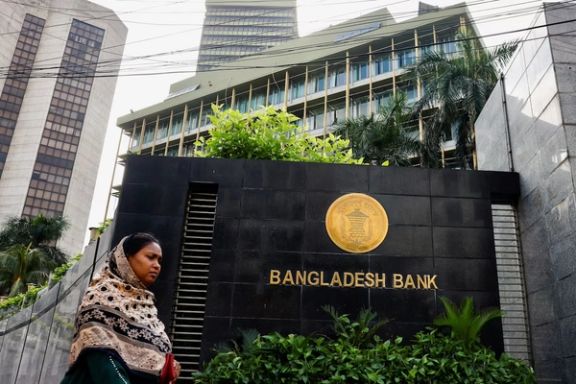
A woman passes by Bangladesh's central bank in Dhaka, Bangladesh, July 19, 2023.
Following reports on surging rebranded Iranian liquefied petroleum gas (LPG) exports to Bangladesh, its Central Bank warned all domestic banks to stay alert regarding the import of products from countries that are subject to global sanctions.
Similar instructions have been incorporated into Bangladesh Bank's anti-money laundering and terrorist financing policy, a source told local Business Standard newspaper.
LPG, a mixture of heavier gases such as propane, butane, and pentane (rather than methane or natural gas), is a petroleum product and ranks among Iran's top non-oil exports.
According to Iran’s customs statistics, the country exported $2.2 billion worth of LPG, along with $1.7 billion of pure propane, $1.1 billion of pure butane, and $1 billion of other heavy gases during the first half of the Iranian fiscal year, which began on March 21. Iran classifies these raw petroleum products as non-oil exports. Collectively, petroleum gases account for 24% of the country’s non-oil exports.
Iran exports 11-12 million tons of LPG annually, mostly to China, earning approximately $8 billion.
A day after the Central Bank’s warning, Lloyd's List reported on January 18 that, amid concerns over Chinese buyers hesitating to risk violating US sanctions, a very large crude carrier suspected of transporting Iran-origin LPG to China made an unusual U-turn in December. After spending two weeks at anchor, the vessel discharged its cargo in Bangladesh.
In October 2024, The Business Standard, a Bangladeshi publication, reported that the LPG Operators Association of Bangladesh (LOAB) had raised concerns about the growing imports of Iranian LPG. According to the report, Iran has been offering Bangladeshi buyers prices $40–$50 per ton below market rates, with monthly LPG exports to Bangladesh recently reaching 150,000 tons. This surge has enabled Iran to capture a quarter of Bangladesh's LPG market.
The newspaper published a letter from LOAB to port authorities and the central bank, listing several tankers suspected of carrying Iranian LPG in Bangladeshi waters. The letter warned that, aside from the potential sanctions-related consequences, Iran's underpricing disrupts the competitive energy market in the country.
Mahammed Jamal Hosen, representing the Bangladesh LPG Distributors and Dealers Welfare Association, said in the letter that "Many banks will face direct consequences of potential US sanctions, and in the long term, Bangladesh's reputation as a destination for foreign direct investment will be at risk."
The letter identified a dozen companies that allegedly forged Iranian LPG documents through intermediaries in the UAE, particularly Dubai, and rebranded the shipments as LPG from Iraq's Basra Gas Company before routing them to Bangladesh.
The Business Standard says “for instance, in August 2024, two local LPG companies imported over 10,000 tons of LPG on a vessel named G YMM. The documents submitted to customs and port authorities showed the liquid gas came from Basrah Gas Company in Iraq. However, The Business Standard on 6 September obtained a response from Andrew Wiper, managing director of Basrah Gas, confirming that the vessel G YMM has never loaded LPG from his company”.
Iran and Russia have implemented a bilateral currency agreement to settle trade using their national currencies, according to the governor of Iran's Central Bank.
“The currencies of the two countries have been settled based on the agreed market exchange rate for trade,” Iran’s state media quoted Mohammad-Reza Farzin as saying in Moscow on Friday.
Farzin also highlighted progress in integrating the Russian Mir and Iranian Shetab card payment networks, saying that the first phase of the project has been launched.
The joint action plan between the central banks of Iran and Russia, Farzin added, has been implemented under three main areas: the use of national currencies in trade, connecting the banking and local messaging systems of the two countries and linking their card payment networks.
It was unclear if the development was related to an Iranian-Russian comprehensive strategic partnership agreement signed on Friday by Russian President Vladimir Putin and his Iranian counterpart Masoud Pezeshkian.
US Congressman Joe Wilson called for action to counter Russia and Iran after they signed a strategic pact on Friday, saying US President-elect Donald Trump will solve the issue.
“To defeat Iran, stop Russia. @realDonaldTrump will fix it,” the South Carolina Republican representative wrote on X Friday after the presidents of Russia and Iran signed a 20-year pact at the Kremlin just three days before Trump’s inauguration.
In a separate post, Wilson praised Scott Bessent, Trump’s treasury secretary-designee, for his economic ambition and stance on Iran and Russia.
“I am so grateful for Scott Bessent, who will impose maximum pressure sanctions on Iran and Russia ... He will help create the Trump economic boom. He is a South Carolinian, and we could not be prouder,” Wilson wrote on X.
Analysts say the Moscow-Tehran pact signals a united front Moscow in the face of Trump’s return, as his advisors have reportedly drafted sanctions to push a Russia-Ukraine accord while pressuring Iran.
Iranian officials find themselves in a Shakespearian dilemma over whether to negotiate with the incoming Trump administration. Engaging would mean justifying or apologizing for past intransigence, while refusal risks confronting a deeper existential threat.
A fierce battle is unfolding between centrist politicians, such as President Masoud Pezeshkian, who favors dialogue with Trump in an effort to solve the country's economic problems as he told the NBC News channel, and hardliners who accuse the proponents of negotiations with the Trump Administration of selling out the country to the United States. Meanwhile, Foreign Minister Abbas Araghchi attempted to take a neutral stance, stating that the Ministry simply implements decisions made by the political system. "Decisions will be made by the authority that has to decide," Entekhab News quoted him as saying.
These conflicting views among Islamic Republic officials and politicians regarding negotiations take place against the backdrop of Supreme Leader Ali Khamenei's firm opposition to talks with Donald Trump, primarily due to Trump's role in the assassination of former IRGC Quds Force Commander Qasem Soleimani.
The positions of both men are well-documented and publicly accessible. Khamenei's opposition to negotiations with Trump is explicitly stated on his official website, while clips of Trump’s televised statement admitting to ordering Soleimani’s killing are widely circulated on social media. Neither can deny their past remarks.
A senior member of Khamenei's office, Mehdi Fazaeli, told the press in Tehran on Wednesday: "I say loud and clear, and with the highest degree of certainty that negotiations with the United States will not serve our national interests."
Mehdi Fazaeli, a senior official in Ali Khamenei's office
At the same time, Foreign Minister Araghchi has stated that "Iran might start negotiations if Washington returns to the 2015 nuclear deal." However, this scenario seems unlikely, given that it was Trump who unilaterally withdrew from the agreement, known as the Joint Comprehensive Plan of Action (JCPOA), in 2018.
Furthermore, it seems highly unlikely that Iran's nuclear program would be the sole focus of negotiations between Khamenei's Islamic Republic and Trump's America. The West has repeatedly emphasized its demand for Iran to cease harboring and supporting “terrorism” and armed proxy groups.
Although Israel’s attacks against Iran’s regional proxy groups have diminished their prominence on the negotiation agenda, the United States, Europe, and even China remain concerned about the Yemeni Houthis’ attacks on Israel and international navigation in the Red Sea.
The Didban Iran website quoted Fazaeli as saying: "Supporters of negotiations believe they can resolve Iran's economic problems, while opponents argue that not only will negotiations fail to address these issues, but they may also lead to new challenges."
Fazaeli, regarded as a voice reflecting Khamenei’s views, stated that "the Islamic Republic, rooted in its ideology, cannot engage in talks with oppressors and imperialists." He further argued that "America's positions on the Panama Canal and Greenland are clear evidence of its imperialist nature."
"Meanwhile, our experiences negotiating with the United States, whether over the release of US hostages in 1981 or the nuclear deal in 2015, have reinforced our distrust of America," he said, notably without expressing any regret over the 1979 hostage-taking of US diplomats.
Hardline daily Kayhan, close to Khamenei's office, characterized Pezeshkian's remarks in his NBC interview about the possibility of talks with the Trump Administration as "Begging America for negotiations," and added: "That is madness."
While Iranian hardliners are well-known for their staunch opposition to rapprochement with Washington, other Iranian politicians also frequently resort to anti-US rhetoric. Earlier this week, in an ironic twist, Speaker Mohammad Bagher Ghalibaf repeatedly chanted "Death to America!" in an effort to pacify an outraged hardliner MP who was railing against the US in parliament.
The apparent divide among Iranian politicians over negotiations could be a calculated strategy to present a united front in disagreement, aimed at convincing US negotiators that significant concessions are needed from Washington to overcome internal opposition. At the same time, they may seek to reassure Russia during an upcoming meeting between President Pezeshkian and Vladimir Putin in Moscow on Friday that the prospects for Tehran-Washington relations remain uncertain.
Advisers to US president-elect Donald Trump are crafting a wide-ranging sanctions strategy to squeeze Iran, Bloomberg reported citing people familiar with the matter.
Trump’s key advisers plan to return to a maximum pressure strategy targeting Tehran, the sources said, starting with a sanctions package targeting major players in the oil industry due as soon as February.
The International Energy Agency (IEA) on Wednesday said the latest US sanctions targeting Russian and Iranian oil could eventually dent their export volumes.
New US sanctions on Iran and Russia announced last Friday target entities responsible for over one-third of Russian and Iranian crude exports in 2024.
A report by Iran's Central Bank has inadvertently highlighted the pervasiveness of insider dealings and corruption that threaten the integrity of Iran’s entire banking system.
The report published by Tehran-based Aftab News website details a list of significant overdue, non-performing loans owed by bank customers and, in turn, the debts these banks owe to the central bank.
27 major institutional debtors who have borrowed from public and private banks collectively hold approximately 790 trillion rials (about $10 billion at the current free market exchange rate) in non-performing loans.
The loans were issued over several years when the Iranian rial held significantly more value, and with the tanking currency their actual value in today's terms is likely far greater than $10 billion.
A non-performing loan (NPL) is a bank loan that is subject to late repayment or is unlikely to be repaid by the borrower in full.
For instance, over a quarter of the total amount is owed by the Bank of Industry and Mines.
The bank's current CEO, Mahmoud Shayan, started his career as a junior employee at a branch of the National Bank serving religious seminary students in the Shiite holy city of Mashhad and rapidly climbed the ranks to serve as a board member of the National Bank and CEO of Bank Maskan, a real estate bank.
Iran's Bank Melli or National Bank main branch in Tehran
Even Iran's state-controlled media and officials have for years alluded to political insiders leveraging their influence to secure substantial bank loans through companies they or their associates control, often evading repayment obligations.
The largest entity indebted to the country’s banking system is the Middle East Mines and Mineral Industries Development Holding Company (MIDHCO), which has been under US sanctions since 2019.
MIDHCO’s chairman Majid Ghasemi is also the Deputy for Economic Research at the research center of Expediency Council, an official body staunchly opposed to Iran’s adherence to international anti-money laundering standards demanded by the global watchdog, the Financial Action Task Force (FATF).
The second largest banking debtor is Debsh Sabz Gostar, a tea trading company around which a $3.5 billion embezzlement scandal has swirled since 2023.
The third-largest debtor is state-backed automaker SAIPA, which was also active in Syria until 2023.
Following these are steel companies, including Esfahan Steel Company, which bears Iran’s second largest ever embezzlement case after Debsh Sabz Gostar.
Iran's oldest steel plant in Mobarakeh
The Islamic Revolutionary Guard Corps (IRGC) holds a nearly 50% stake in Khuzestan Steel Company, which is also implicated in the broader embezzlement cases of steel companies.
The companies are Iran’s largest steel producers.
The MAPNA Group, the largest electric power plant construction company in Iran, with close ties to IRGC is also the largest debtor to Pasargad Bank, Parsian Bank, and Bank Saderat.
Abbas Aliabadi, a former IRGC commander, served as MAPNA CEO until 2023, is currently the Minister of Industry.
Additionally, Ghadir Investment Company, under direct control of Iran’s Supreme Leader Ali Khamenei, whose largest shareholders are entities affiliated with the armed forces, is listed among the 27 largest non-performing debtors in the banking sector, both directly and through its sanctioned subsidiaries.
This massive accumulation of non-performing loans by entities linked to the IRGC comes at a time when the banks themselves are facing significant financial losses.
According to the central bank, the accumulated losses of seven banks reached 540 trillion rials ($6.8 billion) in October 2024.
Notably, Pasargad Bank and Parsian Bank top the list, while they also rank the second and third in term of granting non-performing loans to the 27 major banking debtors.
Profiting from exchange rate volatility
Over the past year, the value of the US dollar has risen by more than half against the Iranian rial, and over the past three years, it has almost tripled.
Real estate prices in Iran have increased even beyond the dollar exchange rate, creating an attractive opportunity for insiders to secure loans from banks and invest in real estate and other sectors.
MIDHCO, the largest banking debtor, saw a 25% jump in investments during the past Persian calendar year ending in March compared to the preceding year, despite an economic crisis gripping the country.
The government itself, the largest debtor, has also intensified borrowing from domestic banks which in turn borrow from the central bank.
The latest central bank statistics reveal that government and state-owned enterprise debt to the central bank jumped by 65% in October compared to the same month in 2023.
Government and state-owned enterprise debts to the overall banking system saw an increase by more than half.
To offset budget deficits caused by reduced oil export revenues due to sanctions, the Iranian government borrows from domestic banks.
These banks, in turn, borrow from the central bank, which has caused their debt to the central bank to double over the past two years.
To cover loans to banks and the government, the central bank has resorted to extensive money printing, resulting in liquidity surges and runaway inflation which are set to only deepen the country’s economic woes.