Senior Iranian official reveals internal criticism of IRGC for regional blows
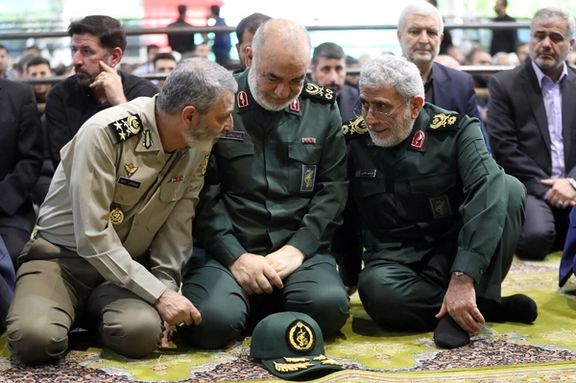
IRGC Commander in chief Hossein Salami with Iran's Army chief Abdolrahim Mousavi to his right and Quds Force commander Esmaeil Qaani to his left
A former representative of Supreme Leader Ali Khamenei revealed on Thursday that regional setbacks have stoked high-level criticism of Iran's Islamic Revolutionary Guards Corps and the leader of its foreign operations Esmail Qaani.
"Now that Syria has fallen, some say, ‘What kind of Quds Force is this, and Qaani is incapable," Ali Shirazi told news website Khabar online, which described the discussions as having occurred in so-called revolutionary circles.
Citing the fall of the Assad dynasty in Syria to hardline Sunni Islamist rebels, Shirazi related that criticism centers around comparing Qaani to his fearsome predecessor.
"Where is Haj Qasem? What would have happened if he had been [alive]?" he said, referring to the former IRGC Quds force commander Qasem Soleimani who was killed in a US drone strike in 2020.
Shirazi, a senior cleric, was Khamenei's representative at the Quds Force when Soleimani led it. He now serves as an enforcer of Islamic revolutionary ideology in the defense ministry.
"If tomorrow a movement emerges in Syria and it recovers, they will say, 'See? We told you Qaani is better than Haj Qasem!'" Shirazi added. "So let’s not rush to conclusions and think carefully."
Following Assad's ouster in December, some Iranian ultra-hardliners online blamed the fall of Tehran's longtime ally on Qaani and the Revolutionary Guards.
Israel appeared to gain the initiative in a 15-month region-wide fight with Iran and its proxies when it hit out at the leadership of Lebanon's Hezbollah late last year and launched air strikes on Iran which knocked out much of its air defenses.
Following the assassination by Israel of Hezbollah chief Hassan Nasrallah, Qaani was not immediately seen in public and some commentators assessed that he had fallen from official favor. His appearances have been few in the following months.
"When the Imam (Khomeini) passed away, some people in this very country said, 'It's over,'" Shirazi continued. "But now, all political groups in the country say, 'We have no one better than the Master (Khamenei).'"
"It’s true that (Qaani) was in the Quds Force and should have been further along," Shirazi added, saying that he counseled critics not to be patient and not too harsh.
Public participation in the ancient Zoroastrian Sadeh festival, once nearly forgotten but now surging in popularity among Iranians, is being banned anew by authorities in the Islamic Republic.
Interest in the Sadeh celebrations, along with other pre-Islamic festivals like the fall Mehregan celebration, has become a growing trend among Iranians.
Recognized by UNESCO in 2023 as a joint Iranian, Tajikistani Intangible Cultural Heritage of Humanity, Sadeh is an agricultural festival celebrated since ancient times. Though highly revered by Zoroastrians, this holiday is not exclusive to their faith and was historically celebrated by agricultural communities across the Persian Empire.
This year, travel agencies promoted package holidays to cities like Kerman, Yazd, Shiraz, and other smaller towns, offering tourists the chance to observe or participate in the Sadeh rituals led by Zoroastrian clergy, known as fire priests.
Plans were, however, canceled at the last minute after media reports on Tuesday revealed that, as in previous years, participation in the Sadeh celebrations in Kerman, Yazd, and Tehran on Wednesday would be strictly limited to Zoroastrians, despite many members of the general public hoping to take part.
Old footage from 1966 shows Zoroastrian fire priests preparing to light the Sadeh fire with embers from the holy fire
The festival takes place roughly midway between the Winter Solstice (Yalda) and the Spring Equinox, which marks the celebration of the Iranian New Year (Norouz). Ancient texts, including classical Persian historical chronicles, suggest that Sadeh commemorates the mythical King Houshang’s discovery of fire. In the Zoroastrian holy book, the Avesta, he is referred to as Haošyangha.
Sadeh is typically celebrated in open spaces, such as fields, with large bonfires. During Zoroastrian ceremonies, fire priests dressed in white robes light a massive bonfire, while participants gather to enjoy festive food and celebrate together.
Zoroastrianism, the world's oldest monotheistic religion, predates Islam by over a thousand years. Today, some estimates suggest there are about 30,000 Zoroastrians remaining in Iran.
In ancient Persia, the Sadeh bonfire symbolized the Sun, believed to grow stronger after the festival, warming the earth and preparing it for the spring planting season.
Some Iranian media outlets criticized the decision and some reports suggested that the decision to exclude the public may have been dictated by state authorities.
“Despite the inclusion of the Sadeh festival on UNESCO’s list of Intangible Cultural Heritage, restrictions on its celebration in Iran persist,” reported Kojaro, Iran’s leading tourism platform, on Wednesday.
Footage of Sadeh celebrations in Kerman Wednesday
Officials from the Zoroastrian community have not directly mentioned pressure from security forces or state agencies, instead citing "limited space" and "health considerations" as reasons for the decision.
Sirus Nikbakht, chairman of the Kerman Zoroastrian Association, told the media that non-Zoroastrians were not allowed to even watch the ritual lighting of the bonfire in the field where the ceremony was to take place. However, he mentioned that some government officials were invited to the ceremony.
A video of the celebration in Kerman shared on social media Wednesday showed Zoroastrian celebrants carrying large images of Supreme Leader Ayatollah Ali Khamenei, his predecessor Ayatollah Ruhollah Khomeini, and Prophet Zardosht during the procession—presumably as a sign of respect for the government officials who attended the "private" ceremony.
“Cultural heritage experts still believe that due to its historical and cultural background, this festival should be celebrated as a national event with the presence of the public. Nevertheless, the [government's] policies regarding its celebration have not [yet] changed,” a commentary titled “Why Has the Ancient Sadeh Been Limited to Zoroastrians?” published by Jahan-e Sanat News on Tuesday stated.
Zoroastrian fire priests carrying embers to light the Sadeh fire in Kerman
“The celebration of Sadeh festival is not only a [Zoroastrian] religious ritual, but also a several thousand years old national celebration which all Iranians should participate in, not just Zoroastrians ... The ban on the presence of tourists in the celebration of Sadeh is a great disappointment and one cannot understand the logic behind it,” Afshin Amirshahi, chief editor of Payam-e Ma newspaper, protested in a Wednesday editorial.
While Zoroastrians, along with Armenians, Assyrians, Chaldean Christians, and Jews, are allowed to practice their faith, they must be cautious to keep Muslims away from their places of worship, particularly during prayers and ceremonies.
The Shia establishment closely associates Sadeh—and other ancient festivals like Norouz, Yalda, Charshanbeh Souri and Mehregan—with pre-Islamic Persia and Zoroastrianism, which they often link to "fire worship" and paganism.
Iranian authorities are also likely concerned that public participation in the festival could lead to uncontrollable crowds, reflecting their ongoing effort to restrict gatherings, especially after previous anti-state protests.
On January 30, 2023, at the height of the nationwide anti-state Woman, Life, Freedom protests, demonstrators lit Sadeh bonfires in several Iranian cities, including Tehran, Ahvaz, and Shiraz, while chanting slogans against Supreme Leader Ali Khamenei.
Iran is in a state of limbo as no one can know whether the country is moving toward negotiations or war - a choice which rests with Supreme Leader Ali Khamenei.
This unpredictability has stalled or significantly slowed many economic, political, and social developments. The only process that continues unabated is repression, restrictions, and the violation of citizens’ rights.
Meanwhile, President Masoud Pezeshkian, who remains loyal to Khamenei, has effectively become an even weaker version of his predecessors, Mohammad Khatami and Hassan Rouhani—a trajectory that is fueling growing public anger. Iranians are no longer merely dissatisfied; they are outraged, and this anger is evident in daily conversations.
Six months into Pezeshkian’s administration, no positive changes have taken place in the country, and all eyes are on the standoff between Khamenei and Donald Trump.
Khamenei’s recent remarks have done little to clarify the Islamic Republic’s path. Some analysts interpret his statements as a sign of readiness for negotiations, while others see them as a continuation of the regime’s anti-US policies.
This uncertainty has deepened the country’s economic stagnation, with repression being the only policy consistently pursued. Iran’s currency has lost more than 30% of its value since early September, and inflation of consumer good has spiked to 50%, based on media reports from Tehran.
At the same time, Trump’s stance on negotiations remains unclear. He may set conditions that the Islamic Republic finds difficult to accept. His broader Iran policy also remains ambiguous, with his only clear position being opposition to Iran acquiring nuclear weapons.
This prolonged state of anticipation and suspension has not only paralyzed key affairs but has also worsened the country’s economic crisis and living conditions.
Iran’s oil exports, already under heavy sanctions, continue covertly, but they are expected to decline with Trump’s return.
Meanwhile, much of the oil revenue is squandered by IRGC commanders and the ruling system's insiders.
The stock market, investments, and production remain in complete uncertainty, while prices for essential goods continue to rise. The dollar and gold coin exchange rates have reached record highs, while people struggle to afford basic necessities, including even potatoes and onions.
In this situation, many Iranians have concluded that whether negotiations take place or not, the Islamic Republic remains unbearable for them.
Years of negotiations, agreements, and repeated failures have left people exhausted and without hope for improvement. The past two decades have shown that regardless of the outcome of talks, their daily lives remain in crisis.
People now understand that a deal or no deal will make little difference in their fate. Even if sanctions ease and Iran resumes oil sales, the revenues will not benefit them. Instead, the money will either fund regional proxies like Hezbollah and Hamas or be used by officials to buy loyalty from security forces or be lost to corruption.
For this reason, many believe that reform is no longer possible and that the only solution is the end of the Islamic Republic. This sentiment is increasingly visible both in public discourse and online spaces.
For many, it no longer matters whether Iran-US negotiations succeed because past experience has proven that the Islamic Republic will not change. When weakened, it negotiates and compromises to ease international pressure; when strengthened, it resumes its aggressive policies.
This widespread distrust is the result of years of unfulfilled promises and the system’s exploitation of domestic and international crises.
Now, more than ever, people are both furious and disillusioned. This sentiment is resonating across society and is increasingly reflected in the sharper and more direct language used against Khamenei himself.
Iran plans to use artificial intelligence to develop smart governance to secure a place among the world's top ten nations in the field, according to an IRGC commander.
Speaking at a conference in Tehran titled Artificial Intelligence and the Future Civilization on Wednesday, Mohammadreza Ahanger, the head of the Revolutionary Guard’s Imam Hossein University, also called for unified government control and strategic investment to achieve its goal.
He added that unified command is the most crucial factor for successful AI governance in Iran, requiring centralized responsibility within the government.
Iran has made limited practical advancements in artificial intelligence but has hosted several events focused on the technology's applications.
In July 2024, Iran established the National Artificial Intelligence Organization as an independent body under the president’s supervision. While its official charter is yet to be finalized, an initial document outlines Iran’s ambition to rank among the world’s top 10 AI leaders within the next decade.
Despite these aspirations, Iran ranked 94th out of 193 countries in the 2024 AI Readiness Index by Oxford Insights, which assesses governments' preparedness to implement AI in public services.
Meanwhile, the country's first artificial intelligence park is set to be established in Tehran within the next two years, according to an official from the Vice Presidency for Science, Technology, and Knowledge-Based Economy.
Iran's Vice-President for Strategic Affairs Javad Zarif criticized US influence on the country's foreign policy, calling it an obstacle that must be removed.
Speaking at a conference titled Prospects of Regional and Global Developments in the Trump Era in Tehran, Zarif said, "I do not view the United States as an opportunity for Iran's foreign policy; I see it as an obstacle."
The event, hosted by the Institute for Iran-Eurasia Studies (IRAS), brought together diplomats and analysts to examine the challenges posed by Trump-era policies.
Zarif argued that US President Donald Trump's focus on reviving hard power through economic pressure—such as tariffs and visa restrictions—was emblematic of his administration's approach to global dominance.
He added that Trump divided countries into "smaller nations that must show loyalty and peer nations that do not." This dynamic, he suggested, “weakened the notion of stable alliances, replacing them with temporary, issue-based coalitions."
For decades, Iran has labeled the US its enemy, citing a history of sanctions, intervention, and regime-change attempts. The two nations broke diplomatic ties in 1980.
Trump’s maximum pressure campaign marked a peak in hostility, with severe sanctions targeting Iran's economy. Yet Tehran claims to have withstood these efforts, portraying its survival as a defeat of Washington's regional ambitions.
Zarif also addressed perceptions of Iran’s weakened state, refuting that it posed a greater nuclear threat. "They argue that military action is the only way to stop Iran," he said, but added that Trump’s flexibility might leave room for negotiations.
He said that based on Trump's recent statements, the new US president's mind is subject to change.
"Trump does not have a solidified perspective in this area, and depending on the circumstances he finds himself in at any given moment, he is willing to adjust some of his paradigms," he added.
US President Donald Trump's latest remarks on Iran, which downplayed the likelihood of military conflict and suggested possible dialogue, have prompted some Tehran insiders to favor direct talks and a potential agreement with his administration.
“This time Trump is completely different from before. There were [people like] John Bolton and [Mike] Pompeo before and he had radicals [around him],” Ahmad Bakhshayesh-Ardestani, a member of the Parliament’s National Security and Foreign Policy Committee told the Iranian Labour News Agency (ILNA) Tuesday.
Last week, President Trump expressed hope that a deal on Iran's nuclear program would eliminate the need for the US to support an Israeli attack on Iran.
"It would really be nice if that could be worked out without having to go that further step ... Iran hopefully will make a deal, and if they don't make a deal, I guess that's okay too," Trump said.
Last week, Trump terminated Secret Service protection for former national security advisor John Bolton, former secretary of state Mike Pompeo, and former special envoy for Iran Brian Hook, despite alleged threats from Iran against their lives. This decision has drawn criticism from some Republicans.
Bakhshayesh-Ardestani also argued that Trump’s approach and way of thinking about conflicts in the world have changed because he wants to tell the world that he has the power to go to war but wants to solve the problems without resorting to force.
He also argued that Trump has adopted a new approach to the Islamic Republic because he has realized that Iran does not seek a nuclear bomb. “Trump’s focus is on Iran for not having nuclear weapons. Iran considers nuclear weapons to be religiously forbidden,” he said, adding that this means an agreement between the two sides is possible.
He was apparently referring to an alleged fatwa by Supreme Leader Ali kHamenei many years ago. However, analysts argue that the so-called fatwa is merely an advisory opinion rather than a binding legal decree. They argue it was intended to mislead the international community about the true intentions of a nuclear program that Tehran insists is peaceful.
In late December, Bakhshayesh-Ardestani had said that an Israeli strike against Iran's nuclear facilities would effectively allow the Islamic Republic to move toward developing nuclear weapons.
Speaking to the moderate conservative Entekhab news website in Tehran on Monday, a former Iranian diplomat at the UN, Kourosh Ahmadi, described “the tone and content of the words that Trump has spoken about Iran after taking office” as “more diplomatic than hostile.”
“Firstly, he has only talked about negotiation and agreement [with Iran], and secondly, his tone is mostly calm and there is no threatening rhetoric,” he said.
Ahmadi suggested that Trump's stance has increased the likelihood that he plans to "officially propose negotiations as the first step in relations with Iran, rather than focusing on threats or pressure."
The former diplomat also advised Iranian authorities to view Trump’s statements as an indication of his openness to negotiating with Tehran before exploring other options.
President Masoud Pezeshkian and officials of his administration including Foreign Minister Abbas Araghchi say Tehran is open to and prepared for talks with the Trump administration, but it is unclear to what extent they are willing to be flexible. Trump also has not officially reveal his next steps toward Tehran.
Other Iranian officials, including Pezeshkian’s Special Envoy in Maritime Economy, Ali Abdolalizadeh, have in recent weeks indicated that the “governance” has concluded that there must be direct talks between the US and Iran.
In the parlance of the Islamic Republic, terms like "governance" or "system" are frequently used to refer to Supreme Leader Ali Khamenei. In 2018, Khamenei stated that the Islamic Republic would never engage in negotiations with the US, specifically not with the Trump administration.
In mid-January, a senior figure in Khamenei’s office claimed that the Supreme Leader’s anti-American remarks in a speech were not meant to rule out negotiationsif the positions of the two sides of a dispute align.