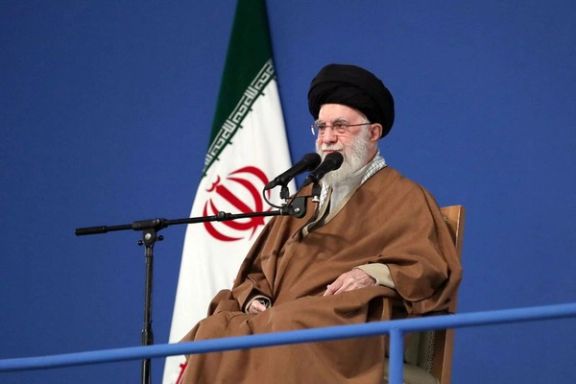
In his Nowruz speech, Supreme Leader Ali Khamenei denied involvement in economic decision-making, claiming it falls under the responsibility of the president. In reality, however, his influence over the economy is both profound and far-reaching.
Khamenei’s formal role in economic planning
While Khamenei does not directly manage economic ministries or oversee the national budget—duties formally assigned to the presidential administration and parliament—he exerts control through other channels. This influence, rooted in both constitutional authority and informal networks, is complex and multifaceted.
According to Article 110 of Iran’s Constitution, Khamenei has the authority to determine the general policies of the Islamic Republic. In collaboration with the Expediency Council, whose members he appoints, Khamenei issues "General Policies of the System," which shape the country’s economic direction.
The Planning and Budget Organization, an administrative body, must ensure that Iran’s development plans—such as macro policies in the oil sector—align with the overarching guidelines drawn in the General Policies of the System documents.
Political
He also holds sway over the expenditure of oil revenues. Any withdrawal from the National Development Fund of Iran (NDFI) requires his approval, for instance. At least 20 percent of all oil revenues are allocated to the NDFI, and successive administrations, including Masoud Pezeshkian’s, have sought his permission to borrow billions of dollars from the fund over the years to cover budget deficits.
Directing the economy through political engineering
Khamenei appoints the head of the judiciary and the members of the constitutional Guardian Council, which has the power to veto legislation, including economic policies and budget plans if they conflict with his prescribed policies. As Iran's election watchdog, the Council also engineers all elections and ensures that candidates whose platforms are not aligned with Khamenei’s political and economic vision are not elected as president or make it to the parliament.
Economic entities under Khamenei’s direct control
Khamenei wields significant economic power through a network of quasi-charitable foundations, known as bonyads, and religious endowments.
Among the largest bonyads are:
Mostazafan Foundation
Execution of Imam Khomeini's Order Headquarters
Martyrs Foundation
Originally established to redistribute wealth and support social welfare following the 1979 Islamic Revolution, these institutions have evolved into major economic conglomerates operating in diverse sectors, including agriculture, construction, mining, energy, manufacturing, telecommunications, financial services, and real estate.
Their financial activities remain opaque, despite assets worth hundreds of billions of dollars.
These entities function as strategic instruments for maintaining Khamenei’s political and economic dominance. By appointing their leadership, he ensures loyalty and strengthens his control. They also help finance Iran’s regional allies and domestic political factions aligned with him through a complex system of privilege distribution—commonly referred to as rent in Iranian economic and political jargon.
The IRGC’s economic influence
The Revolutionary Guards (IRGC), which operate directly under Khamenei’s authority as commander-in-chief, also control vast segments of Iran’s economy. They are allocated a portion of the country’s oil exports, which they reportedly sell through front companies and intermediaries to evade US sanctions—generating funds for their military operations and regional activities.
The IRGC dominates industries such as construction, energy, and telecommunications. Additionally, it is granted a direct share of Iran’s oil revenues, allegedly selling oil through front companies and third-party intermediaries to bypass US sanctions and finance military and regional operations.
The extent of Khamenei’s economic control
Quantifying the economic footprint of bonyads, religious endowments, and the IRGC is difficult due to their opaque financial practices. Nonetheless, estimates suggest these entities collectively control at least half of Iran’s GDP.
Though they are technically subject to taxation and audits, they use complex methods to conceal financial data, making meaningful oversight nearly impossible.
Khamenei’s firm grip over these institutions reinforces his dominance over the Iranian economy, limiting transparency and blocking major reforms. This control expanded significantly after a 2005 privatization initiative that channeled state assets not to a genuine private sector, but to IRGC-linked entities, bonyads, and companies benefiting from monopolistic privileges.
Iran began its new fiscal year on March 21 amid deepening economic and energy crises, with even officials of the Islamic Republic acknowledging that conditions are likely to worsen in the year ahead.
Meanwhile, the return of Donald Trump to the White House and the revival of the US administration’s maximum pressure policy have further tightened the noose on Iran’s economy.
While the Central Bank reported a year-on-year inflation rate of 45% last month, local media suggest that actual price increases are far higher. In reality, the cost of food, medicine, and other essential goods has nearly doubled.
Moreover, the fiscal year is ended with the US dollar surging to nearly 1 million Iranian rials, marking a 65% increase since the beginning of the past fiscal year. The depreciation of the rial has accelerated sharply in recent days.
At the same time, Central Bank data reveals that Iran’s foreign reserves have been rapidly depleting, plunging to just one-fourth of their level in March 2024 and a mere tenth of their March 2023 levels.
Iran’s foreign trade situation:
The latest figures from the Central Bank show that Iran's foreign exchange revenue crisis persisted in the first half of the current fiscal year, which began on March 20, 2024. No data has yet been released for the second half of the year.
During this period, Iran recorded a positive overall trade balance of $11.5 billion, including oil, goods, and services. However, the country also experienced capital flight totaling $12.5 billion.
As a result, the net balance of foreign currency inflows and outflows—including gold bullion—turned negative.
Given the sharp decline in Iran’s oil exports to China since September, the situation is expected to worsen—particularly as oil, petroleum products, and natural gas account for more than half of the country’s total exports.
Over the first 11 months, Iran has imported approximately 93 tons of gold bullion worth $7.3 billion in exchange for its oil and goods exports—three times the amount imported in the previous year. More than 55% of this gold was purchased from Turkey.
Indeed, around 13% of Iran’s total oil and non-oil exports have been bartered for gold instead of foreign currency. This highlights the government’s inability to collect payments for exported goods and oil and transfer foreign currency into the country, due to US banking sanctions. As a result, Iran is facing a severe shortage of foreign exchange reserves.
Government debt crisis
Recent data from the Central Bank shows that the Iranian government’s debt to the banking system has surged by 41% during the current fiscal year. To cover its widening budget deficit, the government has relied heavily on borrowing from domestic banks, tapping into the National Development Fund, and issuing bonds.
According to the International Monetary Fund (IMF), Iran’s total government debt now exceeds $120 billion—roughly one-third of the country’s economy. In contrast, Iran’s total external debt, including both governmental and non-governmental liabilities, stands at less than $10 billion—just 2% of GDP—underscoring the country’s extreme financial isolation and the reluctance of international institutions to fund Iranian projects.
Two decades ago, before the imposition of heavy sanctions, Iran’s external debt was more than 12% of GDP, largely driven by foreign investment in oil and gas projects. Today, the government’s increasing dependence on domestic borrowing has sharply boosted liquidity, further fueling inflation. Over the past year alone, liquidity in Iran has risen by 28%.
The economic crisis has pushed more Iranians into poverty. Official reports suggest that one-third of the population lives in extreme poverty. However, based on the World Bank’s global poverty standards, around 80% of Iranian households earn less than $600 per month and fall below the poverty line.
Energy and Water Crisis
For the first time, Iran has experienced electricity and gas shortages across all seasons. During peak summer demand in 2024, electricity shortages reached 20%, while winter gas shortfalls surged to 25%. Officials warn that energy shortages could worsen by at least 5% in the next fiscal year.
Industrial reports show that since summer 2024, energy disruptions have forced 30–40% of Iran’s industrial capacity to shut down. At the same time, the country has been grappling with growing gasoline and diesel shortages since 2023. Without new refinery projects, these fuel deficits are expected to escalate rapidly.
Meanwhile, Iran’s water crisis has reached a critical stage. Tehran’s main reservoirs are reportedly at just 7% capacity, and officials warn of severe water shortages by summer 2025.
The Iranian year 1403, which ended on March 20, saw the further weakening of major state institutions as Supreme Leader Ali Khamenei tightened his grip over a network of overlapping bodies, some of which he created himself.
Nonetheless, while the weakening of state institutions, including the parliament and the presidency, has largely succeeded, it does not mean Khamenei rules unchallenged.
As the country’s economy sinks deeper into crisis, many challenges come from within his own conservative camp, where critics—often quietly—hold him responsible for the system’s failures, referring to him indirectly as the "political system."
Throughout the year, Iran struggled with a broken economy and the looming threat of political unrest. Gas and electricity shortages have plagued both industries and households for months, while officials warn of an impending water crisis. Meanwhile, the US dollar has doubled in value against the rial. Most Iranians now see Khamenei as the primary figure responsible for these crises.
With the death of former President Ebrahim Raisi in a helicopter crash in May 2024—widely seen as appointed rather than elected—the Islamic Republic’s leader had to find another obedient aide to serve as a silent partner in governing. But the new president proved to be even more obedient than Khamenei expected.
Rescued from disqualification by the Guardian Council at Khamenei’s behest, he has repeatedly acknowledged that he would not be president without the Supreme Leader’s favor. He has gone even further, openly stating that he has no independent plans or platform and will simply implement Khamenei’s vision for the country.
In a recent example, he told parliament that while he initially supported negotiations with the United States over Tehran’s nuclear program, he opposed them as soon as Khamenei dismissed the idea. “It is as simple as that,” he explained.
The Iranian parliament (Majles), shaped by Khamenei and the Guardian Council in its two most recent elections, was engineered to ensure an overwhelming majority of hardline conservatives. The Guardian Council disqualified nearly all moderate and pro-reform candidates as part of what former Majles Speaker Ali Larijani described as "political purification."
Under both Raisi and Pezeshkian, key decisions on critical issues, including the annual budget and contentious matters like the compulsory hijab bill, were made by the heads of the three branches of government or the Supreme Council of National Security, rather than the Majles. Government insiders often criticize the parliament as "illiterate and inefficient."
The Assembly of Experts, tasked with selecting the next Supreme Leader, has been effectively sidelined, as a three-member committee reporting exclusively to Khamenei now secretly vets candidates for his consideration alone.
Meanwhile, the council’s deputy chief, Ahmad Khatami, was stripped of his privileges for violating unwritten rules set by Khamenei.
The Guardian Council's decisions have also been occasionally overturned by Khamenei himself, allowing disqualified candidates such as Mostafa Moein, Mohsen Mehr Alizadeh, and Massoud Pezeshkian to run for president.
The Expediency Council has become so ineffective and paralyzed by intimidation that it has failed to issue a verdict on approving laws meant to improve Iran’s compliance with international regulation against money laundering.
For years, Khamenei has not publicly assigned it any new responsibilities, instead making all key decisions himself.
Until five years ago, when these institutions functioned with a degree of quasi-efficiency, some Western observers described Iran’s system as resembling a democracy. Today, such a characterization is no longer plausible. Iran’s political landscape is now "unique" for all the wrong reasons.
Millions of Iranians across the world are welcoming Nowruz, an ancient tradition deeply rooted in Iran's heritage, marking the beginning of 1404 in the Persian solar calendar.
Nowruz is more than just a celebration of renewal, prosperity, and the arrival of spring; it is a cultural cornerstone that has survived centuries of change. Its enduring spirit reflects the resilience of Persian heritage, bridging the past and present while continuing to bring families and communities together.
Nowruz begins at a precise astronomical moment—the Spring Equinox, usually on March 21—when families gather around the traditional haft-seen table, exchanging greetings and gifts to welcome the new year. If the Equinox falls in the second half of March 20, celebrations begin earlier, though the new calendar year officially starts the next day.
Nowruz and the Iranian Calendar
Unlike the lunar-based Islamic calendar, where the year is 1446, the Iranian calendar follows the solar-based Jalali system, introduced in 1079 AD. The first year of the Jalali calendar aligns with Prophet Muhammad’s migration (Hijra), yet its months are named after ancient Persian deities, reflecting Iran’s fusion of Islamic and pre-Islamic traditions.
The lunar-based calendar is around ten days shorter each year than the Iranian calendar year. This sometimes causes an overlap between Nowruz and Shia mourning days or Ramadan. Like last year, Nowruz coincides with Ramadan this month, and the second day of the New Year will be a mourning day for the first Shia saint, Imam Ali. Such coincidences complicate the celebrations for observant Muslims and others in Iran who must be careful not to offend the former by making a show of the festive Nowruz spirit.
Thousands of Iranians flocked to Pasargadae, the cite of the mausoleum of Cyrus the Great, to celebrate Nowrouz in 2023 2023
Endurance of a pre-Islamic festival
Despite Iran’s Islamification 1,400 years ago and the 1979 Islamic Revolution, Nowruz remains a cherished festival, celebrated not only in Iran but also in neighboring countries including Afghanistan, Turkmenistan, Azerbaijan, and by Kurds in Turkey and Iraq.
Some Iranian clerics and their followers oppose or are lukewarm toward Nowruz due to its pre-Islamic origins and perceived ties to Zoroastrianism. However, the Islamic Republic has never sought to ban the widely celebrated holiday. Instead, it has used state media, mosques, and propaganda organizations to elevate Islamic holidays—including the birthday of Prophet Mohammed, Eid al-Fitr, and Eid al-Adha—seeking to enhance their festive significance.
Folk music group performing at Pasargadae on Nowruz day, March 21, 2023
Ancient Origins: From Persepolis to Today
Nowruz dates back to the Achaemenid Empire (550–330 BC) and likely has roots in ancient agricultural festivals that celebrated the cycle of nature. Some scholars believe it was influenced by the Babylonian spring festival of Akitu, which inspired Persians to establish their own New Year tradition.
Historical evidence suggests that parts of the Persepolis complex, such as the Apadana Palace and the Hall of a Hundred Columns, were constructed for grand Nowruz ceremonies. The famous bas-reliefs of Apadana Palace, depicting people from various regions bringing gifts to the Persian king, may represent Nowruz celebrations at the heart of the empire.
The Haft-Seen: A Table of Symbols
At the heart of Nowruz celebrations in Iran is the haft-seen, a carefully arranged spread on the floor or a table that symbolically embodies light, life, fertility, nature, and prosperity.
The names of at least seven items on the spread must start with the Persian letter “sin”, possibly derived from “sini” (meaning tray), as it was once customary to display them on seven trays. These items include sprouted greens (sabzeh), Coins (sekkeh), Apples (sib), a pudding made from freshly sprouted wheat germ (samanu), sumac (somagh), garlic (sir), hyacinths (sonbol) and vinegar (serkeh).
A mirror and candles (symbols of light), painted eggs (symbol of fertility), goldfish (symbol of life), as well as various sweets and nuts, and a holy book (such as the Quran) are often also placed on the spread.
The family gathers around the spread, and when the Equinox is announced on radio or television, they embrace and exchange well wishes. The head of the family distributes gifts, often crisp new banknotes placed inside the Quran for blessing, while sweets are shared to usher in a sweet and prosperous new year.
Traditionally, people visit the eldest members of their extended families as soon as possible after the new year begins. During the holiday season, they continue visiting other relatives and acquaintances, with each visit expected to be reciprocated.
Traditional Nowruz cuisine
Food is central to Nowruz celebrations, with special dishes symbolizing renewal and abundance. While traditional Nowruz meals once varied widely across regions, they were shaped by local ingredients and culinary traditions.
Since the mid-20th century, however, a fragrant rice dish with fresh herbs (sabzi polo), served with pan-fried fish and a rich green herb omelet (kuku sabzi), has become the most common Nowruz meal. Previously, this combination was mostly popular in the northern Caspian Sea region.
Rice mixed with noodles, served with various meat or chicken-based stews, and ash-e reshteh—a hearty soup made with legumes, herbs, and noodles—are also popular Nowruz dishes. The noodles in these meals are believed to symbolize the unraveling of life’s complexities and a clear path for the year ahead.
Iraqi naval forces seized an unidentified vessel in the Persian Gulf suspected of fuel smuggling, detaining the Iranian captain and ten Indian and Iraqi crew, the navy said Tuesday.
The vessel, intercepted in Iraqi territorial waters, was towed to Umm Qasr naval base for investigation and the crew was handed over to local police. Its name was not visible in a picture released by the navy.
Fuel smuggling is common in the Persian Gulf, where heavily subsidized fuel is sold on the black market to buyers across the region, but Iraqi seizures are relatively rare.
In December, Iran's President Masoud Pezeshkian said that 20 to 30 million liters of fuel are smuggled out of the country daily, calling it a catastrophe amid the country's energy crisis.
Pezeshkian did not specify the destinations but fuel smuggling in Iran often involves routes to neighboring countries where fuel prices are significantly higher.
In December, Reuters reported that a sophisticated oil smuggling network generating at least $1 billion a year for Iran and its proxies has flourished in Iraq since Prime Minister Mohammed Shia al-Sudani took office in 2022.
Earlier this month Iranian authorities discovered and sealed four illegal taps on a major oil pipeline near the southern city of Bandar Abbas.
Last month, Iran said it dismantled 130 fuel smuggling depots and arrested 41 key suspects in Tehran province.
The Iranian year 1403 ending on March 20 marked one of the most challenging yet for the country’s ruling elite, which has been beset by economic malaise at home and historic setbacks abroad.
At the start of the year in March 2024, Iran was already grappling with a broken economy and the looming threat of political unrest. Regionally, however, it still appeared strong and could plausibly project itself as a serious challenge to US and Israeli interests.
Conflict with Israel
As the year began, Israel was deeply engaged in its war with Iran-backed Hamas in Gaza. Tehran confidently claimed that its regional adversary was stuck in an unwinnable conflict, boasting about its so-called Resistance Front and threatening to escalate against both Israel and US interests. Yemen's Houthis were already disrupting shipping in the Red Sea and launching missiles at Israel.
Houthi attacks on maritime trade which began in November 2023 following a declaration by Iran’s Supreme Leader Ali Khamenei inflicted an estimated $200 billion in losses on the global economy.
Israeli tanks in Gaza still confronting remnants of Hamas
Less than a month into the Iranian year, Tehran launched a large-scale missile and drone strike on Israel In April 2024 in response to Israeli attacks on Iranian targets in Syria.
While most projectiles were intercepted with minimal damage, the Islamic Republic framed it as a significant blow against the "Zionist entity." At the time, Tehran appeared strong, seemingly capable of deterring its most determined adversary.
However, the tide began to turn in late July when Hamas leader Ismail Haniyeh was killed in an explosion while staying at a government guesthouse in Tehran.
It remains unclear whether the incident was caused by a planted explosive or an Israeli missile strike, but the ability of Tehran's arch-foe to strike seemingly anywhere was lost on no one.
The assassination would be just one of many, crescendoing with the killing of Hezbollah leaders via their bomb-laden communication devices and culminating in the assassination of its storied leader Hassan Nasrallah.
Political crisis
Before these epochal blow, Iran suffered another major shock in May when hardline President Ebrahim Raisi and his foreign minister died in a mysterious helicopter crash in northwestern Iran.
Raisi had been widely regarded as ineffective, presiding over a rapidly deteriorating economy since taking office in 2021.
Rescuers at the remote region where Raisi's helicopter crashed in May 2024
In June, Iran held presidential elections, with several key candidates disqualified through a vetting process controlled by Khamenei. Ultimately, Masoud Pezeshkian, a politician with no executive experience, faced hardliner Saeed Jalili in a low-turnout runoff and won.
Some Iranians still hoped for limited reforms and a diplomatic breakthrough to ease US sanctions. However, when Khamenei formally banned negotiations in early February 2025, Pezeshkian pledged loyalty to his decision, disappointing even his Reformist supporters.
Economic crisis
By mid-2024, with Hezbollah and Hamas weakened and Israel growing more confident in striking Iranian military targets, Iran’s economic woes deepened. The rial, which had been around 550,000 per dollar in September, plunged to 900,000 by February and even hit one million by March 18.
The worsening economic picture underscored a government unable to halt a downward spiral. Severe energy shortages crippled both households and industries throughout fall and winter, with the government regularly announcing power shutdowns across the country due to heating and electricity failures.
Blackouts hit Iran in the fall and winter of 2024-2025
Iran’s oil exports to China continued through intermediaries and at deep discounts, but the Trump administration escalated sanctions on oil tankers and trading entities following Biden’s late-term crackdown on exports.
Revenues from these limited exports fell far short of meeting the government’s foreign currency needs, especially given Tehran’s ongoing financial commitments to regional proxy groups.
Bleak outlook
Many political insiders in Tehran now say Pezeshkian’s administration may be incapable of addressing the worsening economic crisis. The only potential relief would come from easing US sanctions, but Khamenei has so far resisted Trump’s pressure to make concessions.
It remains unclear whether Washington seeks only a binding agreement to prevent Iran from enriching uranium to weapons-grade levels or whether it also aims to curb Tehran’s ballistic missile program and regional activities.
Khamenei appears to be employing delaying tactics, hoping circumstances shift in his favor or that he can stall until the next US elections. Meanwhile, Trump continues to tighten sanctions and increase military threats, either directly or through Israel.
Another critical challenge is the risk of public unrest due to soaring prices and a growing sense of political instability.
While the Islamic Republic has repeatedly demonstrated its willingness to use deadly force against protesters, its ability to quash mass uprisings is not guaranteed.
If essential goods approach hyperinflation levels, even the security forces and loyalist cadres—who rely on fixed incomes—could begin to waver.