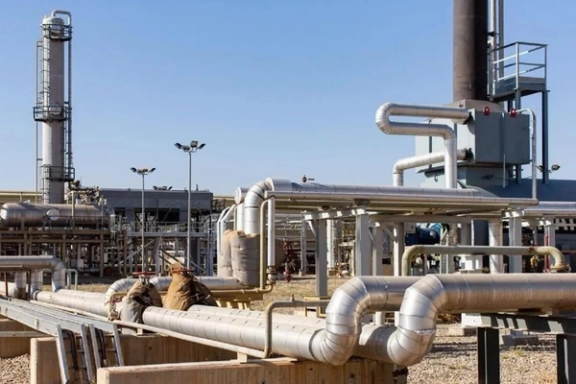
Khor Mor gas field in Sulaymaniyah province in Iraqi Kurdistan
Two major energy agreements signed between US companies and the Kurdistan Regional Government (KRG) have sparked swift backlash from Baghdad and could undercut Iran’s long-standing economic and political grip on Iraq.
During a high-profile visit to Washington in May, KRG Prime Minister Masrour Barzani announced the deals with HKN Energy and WesternZagros, targeting development of the Miran and Topkhana-Kurdamir gas fields in the western part of the region near the Syrian border. Together, the projects are valued at $110 billion over their lifetime.
The US-KRG energy deals have sent a powerful message—both to Baghdad and to Tehran. If realized, they could shift Iraq’s energy independence and diminish Iran’s regional clout.
US Energy Secretary Chris Wright praised the deals at the Al-Monitor Global Institute in Washington on May 22, calling them “very aligned with President Trump’s agenda.”
He added, “We need Iraq and others off Iranian dependence.”
Secretary of State Marco Rubio met with Prime Minister Barzani in Washington on May 23. According to the State Department, the Secretary praised the energy agreements and reaffirmed US support for a strong and resilient Kurdistan Region within a sovereign and prosperous federal Iraq.
But analysts believe without a breakthrough in Baghdad-Erbil relations and tangible infrastructure investment, the deals remain aspirational—more of a political statement than a pipeline to regional transformation.
Iran’s gas grip at risk
Iran currently supplies around 25% of Iraq’s electricity needs through natural gas exports. Should the Kurdish projects proceed, that influence could be seriously eroded.
According to Iman Nasseri, Managing Director for the Middle East at FGE, Iran has little to gain financially from its gas exports to Iraq, and growing domestic shortages are shifting Tehran’s calculus.
He told Iran International, “They’re (Iraq) receiving gas for free because they have the excuse of not being able to pay due to US sanctions....Iran would welcome any scenario that could get Iraqis off the contract that they have signed with the Iranians [...] because they are short in natural gas at the moment."
•
•
Nasseri said that while the gas fields targeted by the US-KRG deals—estimated to hold 13 trillion cubic feet collectively—are indeed substantial, the main obstacles to their development have always been political and economic, not technical.
Strategic implications for Iran
Meanwhile, Baghdad swiftly denounced the agreements. Iraq’s Oil Ministry declared them “null and void." A senior Iraqi official told Reuters the central government had not been informed in advance.
KRG’s Ministry of Natural Resources defended the move, citing existing legal frameworks and long-standing contracts validated by Iraqi courts.
Energy analyst Dalga Khatinoglu told Iran International that the gas reserves in Iraqi Kurdistan—estimated at over 211.9 trillion cubic feet —are large enough to position the region as a major exporter to Turkey and Europe.
While Iran holds five times more gas, he warned, Tehran risks losing its most critical energy customers if the Kurdish fields come online.
“Iran earns $5 billion a year from gas exports to Iraq and Turkey,” Khatinoglu said, underscoring the threat to both revenue and regional influence. If Kurdish gas starts reaching Turkey and Europe, Iran not only loses market share—it loses geopolitical leverage.
US policy or political signal?
Ambassador John Craig, a former senior US diplomat, told Iran International the announcement may signal more of a “test” than a decisive turning point.
“The KRG is testing the water—to see how the Iranians react to it and how the US reacts to it,” he said, emphasizing that Iran “no longer has the punch” it once did following Israeli strikes that “took out all their munitions factories” and weakened Tehran’s regional leverage.
Craig is a former US ambassador to Oman under President Clinton and later served as director for the Middle East at the National Security Council under President George W. Bush.
He said that while the Kurdish leadership may see an opening to act more independently, the projects are far from being realized. “This is not going to happen in the next 10 months, no. It’s long term,” he said. “Exploration, production, development—it could take three to five years.”
Nasseri also described the deals as more symbolic than real, likening them to ‘wishful thinking’ without the conditions needed for execution. He emphasized that Kurdistan currently lacks a viable off-taker, adding, "you can’t develop gas without finding a place and an off-taker that can consume that gas.”
While suffering from severe gas shortages, Iran wastes a staggering volume of natural gas during production and transmission—equal to Spain’s annual consumption or about half of what Turkey or Italy use each year.
In regional markets, the wasted gas would be worth over $10 billion per year. It amounts to 40% of the gas used annually by Iranian households.
This massive loss stems from underinvestment in gas recovery infrastructure at oil fields and an aging transmission network.
Most recent data from the International Energy Agency (IEA) shows methane leaks from Iran’s oil and gas facilities exceeded 8 billion cubic meters in 2023.
Iran also flares over 20 billion cubic meters annually due to the lack of gas-capturing systems at oil production sites, according to the World Bank estimates.
Leaks and flaring
Iran ranks fourth globally in methane emissions from fossil fuel operations. Despite this, Iran has made little progress in cutting emissions.
IEA data shows most methane leaks originate from production facilities, with the rest linked to transmission infrastructure.
When it comes to gas flaring, Iran ranks second worldwide. For two decades, the government has done virtually nothing to capture associated gas—the byproduct of oil extraction—opting instead to burn it off at the wellhead.
This alone releases 38 million tons of greenhouse gases annually, nearly matching the total yearly emissions of Sweden or Norway.
Iran’s Oil Ministry estimates it would cost $5 billion to capture the flared gas. Yet investment in oil and gas fields has fallen sixfold in two decades and now stands at just $3 billion, according to the parliament’s Research Center.
As a result, flaring continues unabated, and gas production growth has slowed to a third of its pace a decade ago. Iran now faces gas shortages in all seasons.
Authorities often blame consumers for excessive use, overlooking the fact that losses during production and transmission account for 40% of the gas consumed by households.
Turning to imports
With domestic solutions stalled, Iran has increasingly looked abroad to cover its shortfall. But solving the crisis will take more than money—it also requires advanced technology and cooperation with international energy firms.
Recent efforts have focused on non-binding memoranda of understanding with Russian companies, none of which have led to concrete outcomes. Ironically, Russia itself suffers from even greater gas losses and lacks the technological capability to fix the problem at home or in Iran.
Iran has also tried to import gas from Turkmenistan and Russia. Turkmenistan, however, halted exports years ago over debt dispute. Russia recently agreed to supply small volumes via Azerbaijan, but pipeline capacity on that route is a fraction of peak deficit in winter.
Despite these shortages, Iran continues to export gas to Turkey and Iraq, often at the expense of domestic industries and power plants.
The reason? Price disparities. Exporting just 7% of its gas earns more revenue than selling the remaining 93% at heavily subsidized domestic rates, offering critical budgetary relief.
In its current budget, Iran projects gas exports of 16 billion cubic meters worth $5 billion—a 14% increase over last year.
But the future is uncertain. The 25-year gas deal with Turkey expires in 2026, and Iraq has announced plans to phase out Iranian gas imports within three years.
Without urgent investment, technological cooperation, and sweeping infrastructure reforms, Iran’s energy sector risks permanent decline—trapped in a cycle of waste, environmental damage, and economic self-sabotage.
Iran is open to compromise in nuclear talks with the United States, but uranium enrichment remains non-negotiable, CNN reported citing an interview with foreign ministry spokesperson Esmail Baghaei on Monday.
“If the intention is to make sure that Iran’s nuclear program would not be weaponized, I think that’s something that we could simply do,” Baghaei said.
“If the (US) intention is to deprive Iranians of their right to peaceful nuclear energy, I think that would be very problematic to the extent that I think it would really challenge the whole process,” he added.
Asked how a compromise could be reached, he replied, “So many ways,” without elaborating.
Following Tehran and Washington's fifth round of nuclear talks, US President Donald Trump on Sunday said that “real progress” had been made in recent talks with Iran and suggested there could be “some good news” in the coming days.
However, in spite of the contentiousness of the issue, Baghaei suggested there is room for maneuver.
“The fact that so far we have continued our talks means that we understand there is a certain level of understanding that Iran cannot under any circumstances give up its right to peaceful nuclear energy,” he said.
Last week, Iran's Supreme Leader, Ali Khamenei, ruled out the option of ceasing enrichment.
"Saying things like 'we won’t allow Iran to enrich uranium' is way out of line. No one is waiting for anyone’s permission. The Islamic Republic has its own policy, its own approach, and it will continue to pursue it," he said, going as far as to say he felt it would be the issue to break the talks.
"Indirect negotiations took place (under Raisi) as well—just like now—but without results,” Khamenei said during a memorial ceremony for the late president and others killed in a helicopter crash last May.
“We do not think it would yield results now either. We do not know what will happen.”
Iran is increasingly blending hazardous petrochemicals into its gasoline supply to address a growing shortfall in domestic fuel production, risking environmental damage and endangering public health, according to confidential documents reviewed by Iran Open Data (IOD).
Among the additives is methyl tert-butyl ether (MTBE), a chemical known for its role in groundwater contamination and listed as a potential carcinogen.
Though banned or heavily restricted in numerous countries such as the US, MTBE is reportedly being used in substantial volumes—even in gasoline marketed under European emissions standards, such as Euro 4 and Euro 5.
Unacknowledged chemicals in ‘euro-standard’ fuel
The documents reviewed by IOD detail a system-wide reliance on off-site chemical additives to raise the octane rating of base gasoline. These include MTBE and aromatic octane boosters, which are not derived from conventional refining processes.
Iran’s Shazand refinery, the country’s largest producer of Euro-grade gasoline, blends approximately 350,000 liters of MTBE daily, while the Esfahan refinery adds 325,000 liters per day, according to the data. Both refineries label their fuel as Euro 4 or Euro 5 compliant.
The use of restricted additives contradicts environmental standards associated with the Euro classification, which are designed to reduce emissions and limit pollutants.
Production gap and fuel demand
Iran produced an average of 101 million liters of base gasoline per day in 2024, rising to 121 million liters per day after incorporating roughly 20 million liters of off-site additives. However, daily domestic demand stands at 123.5 million liters, leaving a shortfall of 2.5 million liters.
The shortfall, coupled with economic constraints and sanctions limiting imports and refinery upgrades, has prompted a quiet return to petrochemical-derived gasoline—first adopted during international sanctions in 2010.
Refining limitations and aging infrastructure
In spite of owning the world's second largest natural gas reserves, Iran’s refining infrastructure remains massively underdeveloped resulting from both sanctions and macroeconomic policies in Iran. No new refinery has been commissioned since 2017, and six of the ten major facilities predate the 1979 Islamic Revolution.
The Persian Gulf Star refinery, Iran’s largest by volume, produces 39 million liters/day, but none of its output qualifies for Euro-grade certification.
According to IOD, one-third of Iran’s gasoline is officially labeled Euro 4 or Euro 5, but internal documents indicate that even these fuels often contain high-risk chemical additives.
Health and environmental risks
MTBE is widely banned in Europe, the US, and other countries due to its high solubility in water and persistence in the environment. Even trace contamination of groundwater can lead to environmental damage and health risks for the population, making its use in consumer fuels controversial.
In 2014, a Tehran city health official warned that non-standard fuels could increase airborne benzene levels up to 35 times the safe limit.
A 2023 environmental review by Iranian authorities said that just 38% of gasoline met domestic quality standards. The IOD report suggests the problem has since worsened.
Iran maintains one of the world’s lowest gasoline prices—second only to Libya—due to heavy state subsidies, currency depreciation, and the impact of international sanctions.
Officials frequently cite low fuel prices as a driver of excessive consumption and cross-border smuggling, but attempts to increase prices have been shelved amid fears of social unrest.
The government has not publicly addressed the use of MTBE or other additives, and internal reports avoid naming specific chemicals, instead using general terms such as “aromatic octane boosters” or “off-site petrochemical inputs.”
Iran Open Data warns that Iran’s increasing dependence on petrochemical additives, without parallel investment in refining capacity, poses significant long-term risks to public health, environmental safety, and economic sustainability.
“The growing reliance on high-risk additives has become a cornerstone of fuel supply, in the absence of refinery upgrades,” the report said. “This strategy could carry severe health, environmental, and economic consequences.”
Officials from Iran’s Ministry of Petroleum and the Department of Environment did not immediately respond to requests for comment.
A senior Iranian cleric affiliated with the office of Supreme Leader Ali Khamenei was arrested in Saudi Arabia during the annual Hajj pilgrimage after publishing a video critical of the kingdom’s religious and cultural policies, Iranian state media reported on Monday.
Gholamreza Ghasemian, a conservative religious scholar and a former head of Iran’s parliamentary library and documentation center, was detained in the city of Medina while performing Hajj rituals, the reports said.
On Tuesday, Iran’s judiciary spokesman said the arrest of Gholamreza Ghasemian in Saudi Arabia was “unjustified and unlawful,” adding that the Foreign Ministry would follow up on the case.
Saudi authorities have not commented publicly on the matter.
In a video posted before his arrest, Ghasemian criticized Saudi Arabia, accusing it of transforming the Islamic holy cities of Mecca and Medina into destinations for entertainment and commercialization.
He also described conditions for pilgrims as highly restrictive, alleging that Saudi authorities prevent worshippers from engaging deeply with Islamic teachings during Hajj.
Cleric linked to 2016 Saudi embassy attack
Ghasemian has been linked by an Iranian documentary filmmaker to the 2016 attack on Saudi diplomatic missions in Iran, which triggered a major rupture in relations between Tehran and Riyadh.
According to the filmmaker, Javad Mogouei, Ghasemian gave a fiery speech at a religious gathering shortly before some attendees went on to storm the Saudi embassy in Tehran.
The assault on the embassy and the consulate in Mashhad came after Saudi Arabia’s execution of prominent Shia cleric Nimr al-Nimr. The incident led Riyadh to sever diplomatic ties, accusing Iran of failing to protect foreign missions. Iranian security forces were widely criticized for allowing demonstrators to set fire to the embassy and destroy diplomatic property.
Saudi and Iran continue to rebuild relations
The arrest comes at a time of cautious rapprochement between Tehran and Riyadh, who resumed diplomatic relations in 2023 after a seven-year break.
In April, Saudi Defense Minister Prince Khalid bin Salman made a rare visit to Tehran, marking only the second such trip since Iran’s 1979 revolution.
Ties have also improved in practical terms. Earlier this month, a direct flight by Saudi carrier Flynas landed in Iran for the first time in nearly a decade, marking the start of Hajj operations under a bilateral agreement that will see around 37,000 Iranian pilgrims flown to Saudi Arabia by July 1. Flynas and Iran Air are jointly operating the routes.
A judge was assassinated in a stabbing attack on Tuesday in Shiraz, the capital of Fars province in southwestern Iran, according to the local judiciary.
"This morning, two individuals attacked and assassinated Judge Ehsan Bagheri, head of Branch 102 of Shiraz Criminal Court 2, on his way to work. Unfortunately, he was martyred in this terrorist act," local judiciary chief Sadrollah Rajaei told Iran’s official IRNA news agency.
"This assassination was carried out with a cold weapon," he added.
Iran’s judiciary chief Mohseni Ejei condemned the assassination, calling it "cowardly," according to a statement published on Mizan.
The statement said that Ejei also ordered an urgent investigation into the incident and called for the perpetrators to be identified and prosecuted swiftly.
No details about the motive behind the assassination or the identities of the attackers have been released by Iranian authorities.
IRNA’s report said that Bagheri was 38 years old and had 12 years of judicial experience.
Iran's judiciary-affiliated news agency Mizan said that before becoming a criminal court judge, Bagheri spent over a decade at the Public and Revolutionary Prosecutor’s Office. The Revolutionary Court system in Iran, where he served, is responsible for handling cases related to national security, political and ideological offenses.
Earlier this year, two Revolutionary Court judges, Mohammad Moghiseh and Ali Razini, were assassinated in Tehran on January 18. Both had decades-long records of issuing death sentences and lengthy prison terms to dissidents in numerous cases.
The source said Asadi originally intended to also target former Revolutionary Court judge Mahmoud Toliyat but changed his mind for unknown reasons before fatally shooting himself.