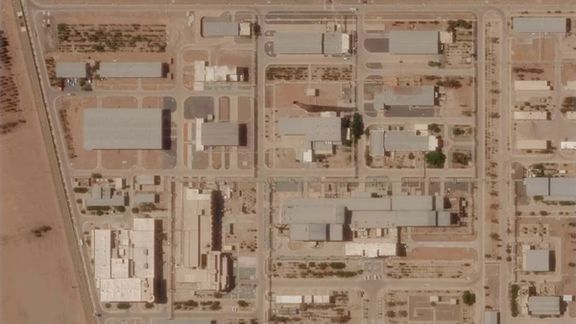
Satellite image provided by Planet Labs PBC shows buildings at Isfahan Nuclear Technology Center in Isfahan, Iran May 17, 2025. Reuters
A nuclear Iran is still possible despite US and Israeli strikes on key nuclear sites, a former top UN nuclear official told Eye for Iran, noting that the whereabouts of Tehran's near-weapons grade uranium was unknown.
Around 400 kilograms—more than 900 pounds—of uranium enriched to 60% purity is unaccounted for.
Until the International Atomic Energy Agency (IAEA) confirms its location, the risk remains high, former Deputy Director General of the IAEA Olli Heinonen warned.
“One should not relax because this material as such is enough for 10 nuclear weapons if it is enriched further to 90%,” Heinonen toldEye for Iran.“So in a big picture, yes, Mr. Trump was correct, but it should have had this caveat telling that it's not yet over.”
Trump gave the green light to launch 75 precision-guided munitions—including bunker-buster bombs—and more than two dozen Tomahawk missiles against Fordow and two other Iranian nuclear sites in the early hours last Sunday, Tehran time.
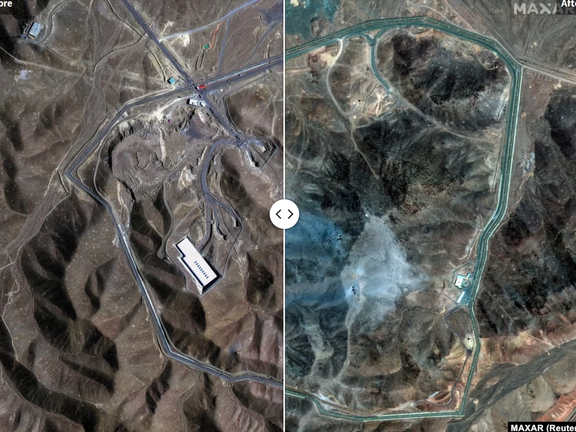
Satellite imagery appeared to show that the strikes had severely damaged or destroyed the Fordow plant and possibly the uranium-enriching centrifuges it housed.
Trucks had reportedly been seen lining up at the Fordow facility in the days before the attack, prompting speculation Tehran may have relocated its uranium stockpiles in advance.
US and Israeli intelligence officials were aware of the movement at the time but opted not to act in order to track the trucks and await Trump’s final order to strike.
A combative Defense Secretary Pete Hegseth forcefully defended the US strikes on Iran’s nuclear program, calling them a “resounding success” and accusing the media of rooting for failure.
“Because you cheer against Trump so hard — in your DNA and in your blood, cheer against Trump — because you want him not to be successful so bad, you have to cheer against the efficacy of these strikes,” Hegseth told reporters at a Pentagon briefing. “You have to hope maybe they weren’t effective.”
A satellite view of the Fordow underground complex before and after the US struck the nuclear facility near Qom on June 22.
What can you do with enriched uranium and obliterated nuclear sites?
Heinonen explained that even with Iran’s main enrichment facilities damaged, the risk remains. A small, easily concealed facility, could turn the missing uranium into weapons-grade material within days.
“Then someone may ask, but they were just wiped away these enrichment plants, so why one has to worry, because such kind of installation, which can convert this material in a matter of days for the first weapon, needs about 1,000 centrifuges only."
"It's just a normal workshop,” he added, “not a big building. And it would be very difficult to find, because it can be concealed among others. Technical buildings in any industrial site or warehouse complex.”
Heinonen joined the IAEA in 1983 and served as Deputy Director-General and Head of the Department of Safeguards from 2005 to 2010. He was among the top officials overseeing Iran’s nuclear file during the pivotal period from 2002 to 2010.
“There is this history of concealment and I think that one has to be careful in accepting explanations,” Heinonen warned. “Iran started to work with uranium metal in early 1990s in secrecy ...to the IAEA… Never disclosed it… until we found it at a later date.”
Heinonen said even after the Fordow, Natanz, and Isfahan strikes, “the question is what about the rest of the weapon?” Iran would still need to machine uranium metal into a weapon-ready shape, using small, controlled batches of critical material.
“It will take all this one about one month. That’s it,” he said. “From start to have the weapon components on your hand.”
But the presence and availability of trained engineers and technicians is also a factor. “They are technicians, they are engineers, they are people who get their hands dirty with this material. Are they still available?” he asked.
“If they are available, then this scenario… in principle [is] possible.”
A race to verify
Heinonen said the IAEA must now be given full access and cooperation by Iran to verify the location and condition of the uranium. If Iran is unwilling, there’s no magic tool to find it.
“Only intelligence. There is no magic detector which you fly around and say, okay, it's there,” he said. “If Iran wants to prove that they have the material, why to hide it? If they have no intention to use it, why to [not] find it?”
The missing material is a red flag that should expand the scope of inspections and investigations.
Iran recently informed the IAEA about a new underground enrichment facility, described as “heavily secured,” but Heinonen said its nature remains unclear.
“Let's find facts first. What was the new site? Can anyone tell? Was it enrichment? Was it the storage? Was the storage of centrifuges? Was it assembling of centrifuges?” he asked.
Iran’s Foreign Minister, Araghchi, posted on X Friday: “The Parliament of Iran has voted for a halt to collaboration with the IAEA until the safety and security of our nuclear activities can be guaranteed.”
Araghchi’s statement signals a hardening stance in Tehran just as international inspectors are racing to verify the fate of Iran’s enriched uranium.
For Heinonen, the message is clear: transparency is now the only path to de-escalation.
“This is the truth-telling test,” he warned. “Because there's no reason to resist. If this is a civilian program, why restrict the IAEA's work?”
Until Iran proves otherwise, the world must treat the threat as far from over.
You can watch the full episode of Eye for Iran on YouTube or listen on any major podcast platform like Spotify, Apple, Amazon Music and Castbox.
President Donald Trump on Friday lashed out at Iran’s Supreme Leader Ali Khamenei for claiming victory following a US-brokered ceasefire between Israel and Iran.
Trump said he personally stopped a final, massive Israeli airstrike on Tehran and refused to target Khamenei, despite knowing his exact location.
“I knew EXACTLY where he was sheltered, and would not let Israel, or the U.S. Armed Forces—by far the Greatest and Most Powerful in the World—terminate his life,” Trump posted on social media.
Khamenei, in a televised speech Thursday—his first since the ceasefire took effect on Tuesday—declared Iran had dealt a blow to both Israel and the United States.
‘Tell the truth’
Trump responded Friday in a press briefing and again on Truth Social, mocking Khamenei’s remarks and appearance.
“I’m going to respond to the Ayatollah’s statement yesterday that they won the war,” he told reporters. “Oh, God… You have to tell the truth. You got beat to hell.”
In a follow-up post, Trump questioned Khamenei’s credibility and doubled down on the damage inflicted.
“Why would the so-called ‘Supreme Leader,’ Ayatollah Ali Khamenei, of the war-torn country of Iran, say so blatantly and foolishly that he won the war with Israel, when he knows his statement is a lie?” Trump wrote.
“His country was decimated. His three evil Nuclear Sites were OBLITERATED.”
Sanctions relief scrapped
Trump said he had been considering easing US sanctions on Iran, but abandoned the effort in response to Khamenei’s remarks.
“I was working on the possible removal of sanctions, and other things, which would have given a much better chance to Iran at a full, fast, and complete recovery,” he wrote. “Instead, I get hit with a statement of anger, hatred, and disgust—and immediately dropped all work on sanction relief.”
It remains unclear whether any formal sanction relief efforts had begun within the White House or relevant agencies.
Future with ‘honey, not vinegar’
Trump has said many times that he only opposes Iran developing nuclear weapons and otherwise wants the country to "do well."
“Iran has to get back into the World Order flow, or things will only get worse for them,” he warned in his Friday post.
“They are always so angry, hostile, and unhappy—and look at what it has gotten them: a burned-out, blown-up country, with no future, a decimated military, a horrible economy, and DEATH all around them.”
And he closed with a familiar flourish:
“I wish the leadership of Iran would realize that you often get more with HONEY than you do with VINEGAR. PEACE!!!”
Iran has launched a sweeping crackdown on Afghan migrants in the wake of a temporary ceasefire with Israel, targeting them for deportation and alleged security threats, according to officials and media reports.
“All unauthorized foreigners must exit the country,” the national police command was instructed, according to Iranian state media.
“Any home or property rented to Afghans will have its lease annulled and the property sealed and confiscated,” Border police chief Brigadier General Ahmad-Ali Goudarzi warned.
Afghans targeted in phone seizures after ceasefire
The directive follows a wider security sweep across Iran, with Afghan migrants increasingly targeted for alleged ties to Israel.
According to Afghanistan International, Iranian police in multiple cities have been confiscating Afghan migrants’ mobile phones, claiming suspicion of “communication with Israel.”
Eyewitnesses told Afghanistan International that plainclothes and uniformed officers have raided workplaces and migrant housing, issuing receipts for seized phones and telling migrants they could retrieve them after weeks.
Migrants, even those with valid residency, reported being stopped at checkpoints or unable to travel to work out of fear of arrest.
Hundreds detained, mass deportations underway
Iran has arrested around 700 people on suspicion of collaborating with Israel in recent weeks. State media has broadcast forced confessions, including from two individuals identified as Afghan nationals from Badakhshan. The circumstances of the confessions remain unclear.
Tehran’s provincial governor, Mohammad Sadegh Motamedian, said arrests and deportations of Afghan migrants have increased three to fourfold. Taliban officials in Herat said over 30,000 Afghans were deported or returned voluntarily on a single day this week.
Taliban authorities have warned of a looming humanitarian crisis in western Afghanistan due to the rapid influx.
Iranian oil exports to China surged in June, reaching record highs as shipments accelerated and independent Chinese refineries stepped up purchases, Reuters reported on Friday.
From June 1 to 20, China imported over 1.8 million barrels per day (bpd) of Iranian crude — the highest level recorded by ship-tracking firm Vortexa. Kpler, another data firm, estimated Iran’s June oil and condensate exports to China at 1.46 million bpd as of June 27, up from around one million in May.
The rise reflects a surge in Iranian oil shipments in May, when loadings reached a multi-year high of 1.83 million bpd, according to Kpler. Since Iranian crude typically takes several weeks to reach China, much of that volume arrived in June.
“Iranian shipments rose sharply before the recent conflict in the region, and China’s independent refineries increased demand for discounted barrels,” said Xu Muyu, senior analyst at Kpler.
Analysts said the June surge may reflect improved demand and shipping trends, while a possible easing of US sanctions enforcement could support future Chinese buying, according to Reuters. Trump said this week that Washington’s “maximum pressure” campaign remains official policy, but signaled a potential shift, saying China “can now buy Iranian oil.”
Despite the remark, all US sanctions on Iranian oil remain legally in place, and no formal change has been announced. Industry analysts say the market impact may be limited by Iran’s constrained production and export capacity.
Prices for Iranian Light crude have also narrowed relative to benchmark Brent, with discounts tightening to around $2 per barrel, down from earlier levels of $3.30 to $3.50, traders said. The shift came amid concerns over shipping risks in the Strait of Hormuz following US strikes on Iranian nuclear sites. ICE Brent crude was trading at $68 per barrel on Friday.
Constraints on future growth remain
While shipments have increased, Iran’s ability to sustain higher export levels is in doubt. A confidential Oil Ministry report, seen by Iran International, suggests Iran cannot significantly boost exports even if sanctions were fully lifted.
The report, citing Kpler data, said Iran averaged 1.4 million bpd in oil and condensate exports to China in the first half of 2025 — a 12 percent drop from last year. Structural issues, including aging oil fields, rising domestic consumption, and low investment, are limiting capacity.
“Even if all US sanctions were lifted, Iran’s daily oil exports probably couldn’t exceed 1.7 million bpd,” said Homayoun Falakshahi, a senior energy analyst.
Iran’s floating storage — unsold oil held at sea — has reportedly risen to 40 million barrels, reflecting difficulties in clearing inventory. Meanwhile, small Chinese “teapot” refineries remain Iran’s main buyers, but rely on deep discounts and face growing financial pressure.
More than 130 Iranian nationals have been arrested across the United States in the past week in a nationwide enforcement operation, Fox News reported on Thursday, citing multiple federal sources.
The arrests come as President Donald Trump’s administration increases enforcement targeting Iranian nationals, while officials warn of possible retaliation following recent US strikes on Iran’s nuclear facilities, Fox News reported.
Suspected ties to IRGC, Hezbollah among cases
“The presence in this country of undocumented migrants or Iranian nationals who have links to Hezbollah, IRGC, is, in my judgment, a domestic law enforcement concern of the highest magnitude,” former Homeland Security Secretary Jeh Johnson said on Fox & Friends.
Federal officials told Fox News that some of those arrested had criminal convictions for drugs, weapons, and domestic violence. “We don’t know who they are, where they came from, why they’re here,” former border czar Tom Homan said. “This is the biggest national security vulnerability we’ve ever seen.”
Former acting ICE Director Jonathan Fahey said the situation worsened under the previous administration’s policies. “We have probably 2 million known gotaways come through the last administration… we have no idea who went through,” he said.
Fox News also reported that one of the individuals arrested “had served as a sniper in the Iranian military within the last four years,” and that “some of those arrested have criminal histories, including charges related to drugs, weapons and domestic violence.”
The report said that roughly half of the 1,500 Iranian nationals released into the US during the Biden administration were released into the interior.
A Supreme Court ruling that permits deportation to third-party countries may apply to some of those currently in custody, though legal proceedings are ongoing, Fox News added.
Homeland Security identifies key suspects in earlier announcement
Earlier this week, the Department of Homeland Security released specific details about a subset of the same group of arrests. Eleven Iranian nationals were taken into custody in multiple states, including individuals with past deportation orders, terrorism concerns, and criminal records.
Among them was Ribvar Karimi, a former Iranian army sniper arrested in Alabama, who entered the US in 2024 on a fiancé visa and never adjusted his immigration status. Agents found him with an Iranian military ID. In Minnesota, DHS said agents arrested Mehran Makari Saheli, a former IRGC member who admitted ties to Hezbollah and had a prior felony conviction.
Other arrests occurred in Texas, Arizona, California, Colorado, Mississippi, and New York. Some individuals had been ordered removed years ago but remained in the country. One man was carrying a loaded pistol; others had histories involving domestic violence, drug trafficking, or immigration fraud.
All remain in federal custody pending removal, DHS said.
Israel’s twelve days of air attacks on Iran killed hundreds of civilians—among them an eight-year-old gymnast in a red dress whose last joyful dance has become a symbol of the war’s human cost.
A video posted on Instagram by a relative appears to show Tara Hajmiri dancing in a dentist’s office. Her black ponytail sways behind her as she beams with joy and glides toward the treatment chair. Hours later, her short life was over.
Tara died alongside her parents when Israeli missiles struck three six-story residential buildings on Patrice Lumumba Street in central Tehran in the early hours of June 13.
Her father, an estate agent, and her mother were found in the rubble. Israel's military later said the buildings were targeted to eliminate an unnamed nuclear scientist.
Tara's name spread quickly across Iranian social media, where she came to represent innocence lost in war.
Asian Gymnastics Union's tribute to Tara Hajmiri
The war's youngest victim appeared to be Rayan Ghasemi, a two-month-old infant, who succumbed to burn injuries after an Israeli strike on June 19.
His parents, Behnam Ghasemian, an engineer, and Dr. Zohreh Rasouli, a gynecologist, were also killed. His older brother, Kian, remains hospitalized with serious injuries.
A poet’s last verse
Another victim whose story and face became an instant icon was 23-year-old Parnia Abbasi—a poet and English teacher who loved Coldplay, Italian food and mountain climbing.
She was one of the very few to grab attentions outside Iran, her smile and her verses touching hearts.
Young poet Parnia Abbasi and her family
Her family said she often wrote about love and longing. One poem, Returning to You, was widely shared after her death:
You crash upon my shore
the rhythmic pearl of your body bursts across the sand
I row toward your embrace
cast your smile like a hook
The fish are caught and I fall in love
all over again.
Parnia was killed with her entire family—father Parviz, a retired teacher, mother Masoumeh, a retired bank clerk and 14-year-old brother Parham—when their building was leveled.
Israeli authorities later said the intended target was Abdolhamid Minouchehr, head of nuclear engineering at Shahid Beheshti University.
Sarvnaz Vaezzadeh, young business development expert killed in Tehran
Hundreds More
Another victim, graphic artist Saleh Bayrami, was killed while waiting in his car at a traffic light on June 15, en route to a job interview. The strike near Tehran’s Tajrish Square killed several others.
Iran’s Health Minister Mohammad Reza Zafarghandi said on June 23 that 606 people had been killed, without specifying how many were civilians.
Independent tallies put the toll higher—1,190 according to the US-based human rights group HRANA, which reported military deaths just above 400, with the rest either civilian or yet to be determined.
The Israeli government has defended its actions as pre-emptive strikes on Iran’s nuclear infrastructure. But the deaths of Tara, Rayan, Parnia, and Saleh have sparked grief—and questions.
Their names stand for the civilians caught in the crossfire of a conflict paused for now, but which could return with a vengeance at any moment.
Their faces—once full of promise—have become symbols of loss, of questions unanswered, of the cost of ideology and war.