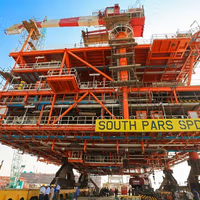
Tanker tracking data obtained by Iran International shows sharp fluctuations in Iranian oil discharges at Chinese ports this year, alongside a steep rise in floating oil stocks.
The United States intensified enforcement of sanctions on Iranian oil exports in October 2024 after Iran’s second missile strike on Israel, though broader measures have been in place since the Trump administration.
Despite these efforts, exports remain substantial, but a growing gap between crude loaded in Iran and volumes discharged in China suggests mounting logistical challenges.
According to energy consultancy Vortexa, Iran’s crude exports fell by 480,000 barrels per day (bpd) in July from June, to 1.5 million bpd.
Data from Kpler, which separately tracks loadings from Iranian terminals and discharges at Chinese ports, confirms the volatility.
Since January, Iran has on average loaded 200,000 bpd more than has been offloaded in China, swelling floating storage from 5 million barrels in early January to 33 million barrels by late July.
China remains the only major buyer of Iranian crude.
Crackdown: limited impact
The United States has in recent months targeted dozens of tankers from the so-called “ghost fleet” and blacklisted front companies.
The US Treasury also sanctioned a major sales network run by the son of former national security chief and supreme leader adviser Ali Shamkhani.
Claire Jungman, Director of Maritime Risk & Intelligence, said that despite expanded enforcement, Vortexa data shows little immediate impact on July volumes.
“Iran’s crude continues to flow via shadow fleet operations involving disabled AIS tracking systems, falsified vessel identities, and ship-to-ship (STS) transfers,” Jungman explained.
“On August 1, Malaysian authorities announced a crackdown,” she added. “While this may complicate Iran’s logistics and raise operational costs, similar measures by Malaysia and Indonesia in the past have had only limited and temporary effects.”
Vortexa expects exports to remain resilient in the short term, supported by Chinese demand and adaptable logistics.
•
•
Opaque trade, sanctions costs
Still, sanctions are costly: central bank, customs, and tanker-tracking data suggest roughly one-fifth of oil income is lost to evasion costs, including discounts.
In mid-July, delivered Iranian crude to China traded at $4/b below Brent, compared with $2/b in May.
Official trade figures remain murky.
Iran’s customs agency counts gas condensate as a “non-oil” export, reporting $3.5 billion in such exports to China in spring 2025—nearly equal to imports from China in that period. But Chinese customs data for the first half of 2025 lists only half that figure from Iran—with oil imports officially at zero.
The discrepancy likely reflects China omitting sanctioned goods such as petrochemicals and metals from official tallies, while Iranian authorities include them.
The Financial Action Task Force has invited Islamic Republic representatives to attend talks in Spain aimed at ending a seven-year impasse over the country’s blacklisting, Iran’s economy minister said.
“After the approval of Iran’s accession to the Palermo Convention, the FATF deadlock has been resolved after seven years, and Iran has now been invited for talks,” Ali Madanizadeh said in a Friday interview on state television.
The Financial Information Center, part of Iran’s Supreme Council for Combating Money Laundering and Terrorist Financing, confirmed the news on its website, saying that Hadi Khani, secretary of the council, had been invited to take part in the negotiations.
The direct talks in Madrid will address the process of normalizing Iran’s case, suspending countermeasures, and removing the country from the FATF blacklist, according to Tehran’s official statement.
Iran’s UN ambassador Saeed Iravani wrote to Secretary-General António Guterres on August 5 announcing that, on government orders, the ratification document for the UN Convention against Transnational Organized Crime—signed by Foreign Minister Abbas Araghchi—was being submitted.
Iran’s parliament passed the bill to adopt the convention in 2017, but the Guardian Council blocked it until the Expediency Council approved it in May this year. The years-long failure to ratify it left Iran unable to establish normal financial links abroad, even after the 2015 nuclear deal offered partial economic relief.
On May 21, Parliament Speaker Mohammad Bagher Ghalibaf formally notified President Pezeshkian of the law’s enactment, enabling Iran’s accession to the Palermo Convention, one of the FATF’s four core treaties.
Tehran has already joined two others: the Vienna Convention against Illicit Traffic in Narcotic Drugs and Psychotropic Substances and the UN Convention against Corruption.
The only outstanding FATF instrument is the 1999 International Convention for the Suppression of the Financing of Terrorism (CFT), designed to curb funding for armed groups and improve cross-border cooperation in tracking and cutting such flows.
The Islamic Republic has for years provided financial support to groups such as Hamas and Hezbollah, which are designated as terrorist organizations by much of the international community.
In May, Expediency Council spokesman Mohsen Dehnavi said the CFT would be addressed in upcoming sessions.
Even if Iran secures removal from the FATF blacklist, the looming prospect of UN sanctions snapback could render the move moot.
The snapback mechanism, which European parties to the 2015 nuclear deal have threatened to trigger if no deal is reached with Iran by the end of this month, would restore UN sanctions lifted under the Joint Comprehensive Plan of Action (JCPOA), from which the US unilaterally withdrew in 2018.
International banking tools may be available, but renewed sanctions could block trade even with long-standing partners such as China and Russia.
Iran’s revamp of a top national security body signals a ruling system in decline, former US State Department official Len Khodorkovsky told Eye for Iran, calling it “pure theater” and likening it to “rearranging deck chairs on the Titanic.”
“We’re seeing the leadership desperate and flailing away in various ways to try and preserve its control and its hold on power,” he said. “Whether you stand up the defense council, whether you change the name of the currency ... the ship is still sinking.”
Khodorkovsky served as Deputy Assistant Secretary of State during the first Trump administration, working closely with the Special Representative for Iran on the administration’s “maximum pressure” campaign.
Born in the Soviet Union, he emigrated to the United States as a child after experiencing life under the communist system. From abroad, he watched the country of his birth unravel — a collapse that, he says, offers lessons for Iran today.
His prediction rests on a convergence of forces the leadership cannot reverse: an economy in freefall, a public that has lost faith in the system, and leaders resorting to cosmetic moves to mask deep structural decay.
Drawing on the lessons of the Soviet collapse, he argued that once cracks appear in an authoritarian system, its fall can come faster than expected.
Chaired by the president, it includes the heads of the judiciary and parliament, senior military commanders, key ministers, and two representatives of Supreme Leader Ali Khamenei.
Veteran lawmaker Alaeddin Boroujerdi called it “necessary given the current wartime situation,” saying it would allow military and defense decisions to be made “in a concentrated manner” during critical moments. Esmaeil Kowsari, a former Revolutionary Guards commander, said it would speed the chain of command and “with timely strikes, suppress threats.”
The revival of such a body — last active during the 1980–88 Iran–Iraq War — follows a 12-day war with Israel in June, during which Iranian military and nuclear facilities were hit by Israeli and US strikes.
Larijani’s return: rebrand, not reboot
Two days after the council’s creation, President Masoud Pezeshkian appointed Ali Larijani as SNSC secretary.
Khamenei quickly followed, naming Larijani his personal representative to the body. A political veteran, Larijani previously served as SNSC secretary from 2005 to 2007, was speaker of parliament for over a decade, and has long been an adviser to the Supreme Leader.
Khodorkovsky said Larijani’s appointment will not change the system’s trajectory. “They’re trying to look strong externally, but internally the system is rotting,” he said. “The personnel changes are cosmetic — the fundamentals are the same.”
Mounting internal strain
Iran’s ruling system is buckling under severe economic pressure. The rial has collapsed—dropping from around 300,000 per USD in 2020 to over 1 million in early 2025—losing more than 80 percent of its value. Inflation remains among the highest in the world.
For Khodorkovsky, these are the real forces eroding the state’s foundations — and they cannot be reversed by councils or reshuffles.
“You can change the faces, you can change the names, you can create new institutions,” he said, “but when the people have turned away and the economy has collapsed, the end is only a matter of time.”
US President Donald Trump will host Armenian Prime Minister Nikol Pashinyan and Azerbaijani President Ilham Aliyev at the White House on Friday to sign a US-brokered peace agreement creating a transit corridor at Iran’s doorstep, Axios reported.
The deal seeks to end decades of conflict between the two countries and includes a 43.5-kilometer corridor across Armenian territory, Axios reported. The route, to be developed by the United States and called the Trump Route for International Peace and Prosperity, will connect Azerbaijan’s mainland with its Nakhchivan exclave, which borders Iran and Turkey.
Armenia and Azerbaijan have fought over Nagorno-Karabakh since the late 1980s, most recently in 2023 when Azerbaijan seized the territory. The corridor would enable travel and trade between Turkey, Azerbaijan and Central Asia without crossing Iran or Russia. Iran has opposed the project, saying it would cut off its only direct land route to Armenia and reduce its influence in the South Caucasus. Russia has also criticized it, while Turkey supports it.
Washington’s quiet diplomacy
Axios said the Trump administration’s work began in March when White House special envoy Steve Witkoff visited Baku after a trip to Moscow at Qatar’s request. According to a US official who spoke to Axios, Witkoff then asked Aryeh Lightstone, a former aide to US Ambassador to Israel David Friedman and close to Trump’s son-in-law Jared Kushner, to lead the talks. Lightstone made five trips to the region to negotiate with both sides.
The same US official told Axios that negotiators pitched Pashinyan on the idea that by allowing a US-developed route, Armenia would gain a strong partner in Washington and a safeguard against future pressure from Baku. Armenia dropped its long-standing objection to the corridor during these talks.
Geopolitical and economic stakes
The route is expected to boost regional trade by billions of dollars a year, US officials told Axios. It would also limit the role of Russia and Iran, whose influence in the South Caucasus has been challenged since the Ukraine war.
The US official said Tehran fears the corridor will leave it more dependent on Azerbaijan for access to Russia and Europe.
The same official described the plan as “very Trumpian,” focusing on trade and economic growth rather than framing it purely as a security issue, and said the deal opens Armenia to the world and gives it the United States as a key partner instead of Iran.
From quiet talks to public signing
Trump called the upcoming gathering a Historic Peace Summit and praised both leaders for “doing the right thing” for their people in a post on Truth Social.
“Peace is not finalized there is still more work to do, but the accord sets out the main issues and steps to resolve them,” the US official told Axios. The agreement will begin with government-to-government cooperation, with hopes it will grow into warmer relations between citizens over time.
The United States on Thursday sanctioned seven people and 11 entities allegedly tied to Iran’s financial and technology networks in what the Treasury Department described as a crackdown on sanctions evasion, repression and hijab law enforcement.
“As a result of President Trump’s maximum pressure campaign and increasing isolation from the global financial system, the Iranian regime is running out of places to hide,” said Treasury Secretary Scott Bessent.
“Treasury will continue to disrupt Iran’s schemes aimed at evading our sanctions, block its access to revenue, and starve its weapons programs of capital in order to protect the American people.”
The designations target Iran’s banking systems, offshore finance networks and technology firms providing surveillance tools to the state.
Among the entities sanctioned is the RUNC Exchange System Company, which developed Iran’s Cross-Border Interbank Messaging System (CIMS), designed to bypass conventional banking controls and facilitate cooperation with sanctioned banks like China’s Bank of Kunlun.
The Treasury also designated Cyrus Offshore Bank, which it said operates from Iran’s Kish Free Zone and is secretly controlled by the already-sanctioned Parsian Bank.
According to the press release, Cyrus Bank has helped route oil proceeds to the Islamic Revolutionary Guard Corps (IRGC).
Other sanctions focused on Pasargad Arian Information and Communication Technology Company (FANAP), a tech firm linked to Iran’s Ministry of Intelligence and the IRGC.
The Treasury said FANAP and its subsidiaries have developed tools used to surveil citizens, enforce internet restrictions, and identify women who defy mandatory hijab laws.
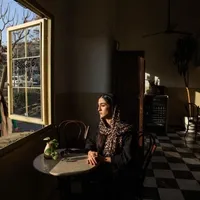
A young woman in a loosely draped hijab, strands of hair framing her face, flashes a peace sign while holding a photo of a slain Revolutionary Guard commander.
The improbable image fills the front page of hardline daily Vatan-e Emrooz, presented as part of the Islamic Republic’s “new generation of resistance.”
But analysts told Iran International it is less a reflection of reality than a carefully crafted narrative aimed at shoring up support for Tehran after its 12-day war with Israel — the worst direct military confrontation in their fraught history.
The war left hundreds of civilians dead, damaged infrastructure and deepened economic strain. In its aftermath, the Iranian establishment has worked to project resilience and unity, even among citizens who defy its strict social codes.
The Vatan-e Emrooz cover accompanied a story built around a Foreign Policy article by an Iranian-American academic which argued that some young Iranians are rallying behind Tehran’s anti-West, anti-Israel stance in the war’s aftermath.
Following the bruising conflict, Tehran embraced nationalist symbols it long suppressed, with mythological tales and ancient monarchs adorning public billboards.
For author Arash Azizi, whose book What Iranians Want: Woman, Life, Freedom examines political and social change, this type of imagery is part of a familiar playbook.
Referring to a domestic militia and Iran's Islamic Revolutionary Guard Corps, he described Vatan-e Emrooz as “a hardliner outlet, traditionally close to the Basij, which is a section of the IRGC … known for a very sensational sort of tabloid-style headlines.”
The paper, he added, has long featured stylish young who appear supportive of the establishment to imply that “even sections of the population that flout the hijab rules … nevertheless supports its foreign and military policies.”
Holly Dagres, a senior fellow at the Washington Institute for Near East Policy, studies Iran’s younger generations and regularly tracks Gen Z and Gen Alpha trends.
She said that while this visual contrast between appearance and ideology is not new—women without hijab have backed hardliners, and chador-wearing women have voted reformist—the cover is nonetheless a strategic push.
“It’s for the regime to make a point, especially at a time when it has historically high anti‑regime sentiment, that ... we have the support of these individuals too that don’t usually fit the stereotypical box of what a good Islamic citizen in our view is," Dagres told Iran International.
Visual communication expert Siavash Rokni, who holds a PhD in communication and researcher in popular music at McGill University, sees deliberate messaging in the picture’s design: the woman’s ear “out of her scarf,” the bright blue clothes “evoking kind of happiness and rejuvenation and the future,” and her phone with a peace sign “as kind of the representation of Gen Z.”
Rokni also points to the way she holds her phone — not in a natural texting or scrolling posture, but almost like a prop, gripped sideways with fingers loosely wrapped around it. The position, he suggests, looks staged.
It’s an example of what Rokni calls the Islamic Republic’s turn to “soft war”—countering Western “soft power” via curated cultural imagery. The same effect is visible, he added, in rap lyrics and music videos where some artists are either funded or influenced by the IRGC to echo establishment talking points, while others openly align themselves with them.
Gen Z beyond reach?
Activist Tara Dachek, part of Iran’s Gen Z and now living abroad, sees the image as a sign of weakness, not strength. “The Islamic Republic is drowning — these are its last desperate gasps,” she told Iran International. Such visuals, she says, reflect “fear, repetition and desperation” rather than genuine engagement.
Having left Iran six years ago, Dachek believes the cover only affirms that her “generation is on the right path — the regime has already lost us.”
"Even back then, I didn’t trust state media. I never followed their news because I knew it wasn’t truth — it was survival wrapped in a lie," said Dachek.
Among younger Iranians, the dissatisfaction runs deep.
Surveys show that nearly 75% of Iranians—including many Gen Z individuals—opposed mandatory hijab, with 84% favoring a secular state over the Islamic Republic, according to GAMAAN — a Netherlands-based research organization that conducts large-scale online surveys of Iranians.
Gen Z, who wasn't yet born at the time of the 1979 revolution, frequently expresses opposition to both political Islam and compulsory dress codes while embracing global cultural values.
Despite Tehran’s efforts to project unity, young Iranians may not be as passive or easily swayed as officialdom believes. Shaped by years of protest and repression, they remain among the most vocal critics of the Islamic Republic.