Australia moves to label Iran’s Guards a terrorist organization under new bill
Forces of Iran’s Revolutionary Guards during military drills in western Iran, January 2025
Australia has introduced legislation that would, for the first time, allow its government to designate foreign state entities -- including Iran’s Islamic Revolutionary Guard Corps (IRGC) -- as terrorist organizations.
Attorney-General Michelle Rowland presented the bill to Parliament, saying it aims to close a major legal gap in Australia’s counterterrorism framework by permitting the listing of state-backed organizations accused of supporting or conducting terrorist acts.
The move follows findings by the Australian Security Intelligence Organization (ASIO) that the IRGC was involved in two anti-Semitic attacks in Sydney and Melbourne in 2024.
Rowland said the new Criminal Code Amendment (State Sponsors of Terrorism) Bill 2025 would strengthen Australia’s ability to respond to “malicious foreign actors” and serve as a warning to any state seeking to threaten the country through violence or coercion.
“This bill strengthens Australia’s counterterrorism framework, creating an environment in which it is more difficult, more risky, and more costly for foreign actors to cause harm,” she told Parliament.
Under the proposed law, the government would gain the power to list foreign state agencies or entities as state sponsors of terrorism if they are found to have directly or indirectly planned, supported, or financed acts of terrorism against Australia.
Once listed, it would become a criminal offence to collaborate with, fund, or provide material assistance to those entities. Limited exemptions would apply for diplomatic or legal obligations.
The legislation introduces new criminal offences, including preparing or participating in state-sponsored terrorist acts and offering material support to listed state actors. Intelligence and law enforcement agencies would also receive expanded powers to investigate and disrupt suspected state-linked terrorism.
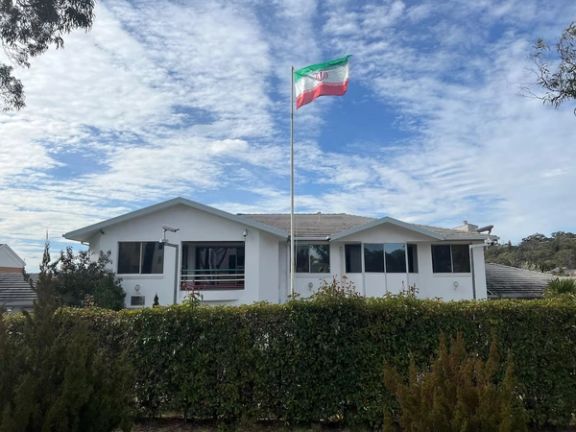
A flag flutters above the Embassy of the Islamic Republic of Iran in Canberra, Australia, August 26, 2025.
ASIO findings link IRGC to attacks in Australia
The bill comes after a series of actions by Canberra against Tehran. In August, Prime Minister Anthony Albanese expelled Iranian Ambassador Ahmad Sadeghi following ASIO’s conclusion that the IRGC directed two arson attacks on Jewish sites -- one at a kosher restaurant in Sydney and another at a synagogue in Melbourne.
“ASIO has now gathered enough credible intelligence to reach a deeply disturbing conclusion that the Iranian government directed at least two of these attacks. Iran has sought to disguise its involvement,” Albanese said.
He described the incidents as “extraordinary acts of aggression orchestrated by a foreign nation on Australian soil.”
The proposed law would align Australia more closely with allies such as the United States, which designated the IRGC as a terrorist organization in 2019.
The group, established in 1979 after Iran’s Islamic Revolution, reports directly to Supreme Leader Ali Khamenei and wields significant military, political, and economic influence at home and abroad. Its Quds Force oversees operations that have supported armed groups in Lebanon, Gaza, Yemen, and Syria.
Australia’s move follows its decision last week, along with New Zealand, to implement revived United Nations sanctions on Iran after European powers triggered the snapback mechanism over Tehran’s nuclear program. The sanctions reimposed restrictions on arms, finance, and missile activities.
Canberra has also joined G7 nations in condemning Iran’s repression of dissidents abroad and intimidation of diaspora communities. In September, Australia warned of “transnational repression” targeting journalists and Jewish groups.
Rowland said the latest legislative step reflects Australia’s evolving security environment. “The threats we face are changing,” she said. “This bill ensures that our national security laws remain fit for purpose -- robust, balanced, and capable of protecting all Australians.”
Turkey’s accelerating move to replace Russian and Iranian pipeline gas with domestic production and US liquefied natural gas (LNG) could shrink Tehran’s last major European export market, Reuters reported on Wednesday.
According to the analysis, written by Can Sezer, Ankara could meet more than half of its gas demand by 2028 through expanded production and LNG imports, sharply reducing the need for pipeline supplies from Iran and Russia.
US President Donald Trump has urged NATO ally Turkey to scale back energy ties with both countries, and the shift aligns with Washington’s push to isolate Moscow and Tehran from global energy markets.
Iran currently supplies Turkey with around 10 billion cubic meters (bcm) of gas annually under a contract due to expire in mid-2026.
The analysis said Ankara is unlikely to renew it under the same terms as it seeks greater flexibility and diversification.
The move comes as Turkey’s energy ministry boosts domestic gas output and signs multibillion-dollar deals to import LNG from the United States and Algeria.
Reuters calculations suggest Turkey’s domestic production and contracted LNG imports will exceed 26 bcm a year by 2028 -- compared with 15 bcm in 2025 -- enough to cover more than half of its estimated 53 bcm annual gas demand.
The remaining import gap of 26 bcm would be far below the 41 bcm currently contracted from Russia, Iran, and Azerbaijan combined.
Iran, already facing renewed UN and Western sanctions over its nuclear program and military activities, could see one of its most reliable export markets eroded as Turkey repositions itself as a regional gas hub, according to Sezer.
Ankara has also expanded its re-export capacity, recently signing supply deals with Hungary and Romania through its state-owned energy company BOTAS.
While Turkey has maintained that it will continue sourcing gas from all available suppliers, including Iran and Russia, its long-term strategy increasingly favors flexible LNG purchases over fixed pipeline contracts.
Two years after Hamas-led October 7 attack on Israel, Daniel Lifshitz believes the tragedy that shattered his family was aided by Iran but insists peace, not vengeance, must define the future.
“The wound is very open,” he told Iran International.
“Forty-eight people are still in Gaza, nine from my community. Every time we mark this date, it feels like a funeral all over again.”
Daniel’s grandparents, Oded and Yocheved Lifshitz, were abducted from Kibbutz Nir Oz, a community near the Gaza border that lost more than a quarter of its residents that day, killed and captured.
They were lifelong peace activists who ferried Gazan patients to Israeli hospitals and spent decades advocating coexistence.
Daniel Lifshitz holding a photo of his grandfather Oded Lifshitz.
Yocheved, then 85, was released after 16 days — frail and traumatized. Oded, 83, was shot and dragged unconscious into Gaza, where he later died in captivity.
“He was a journalist, the first (Israeli) to interview Yasser Arafat,” Daniel said. “He warned everyone about Hamas.”
During captivity, Yocheved came face-to-face with Hamas leader Yahya Sinwar, who assured her in Hebrew she would soon be freed.
“She was only released because she was hours from dying,” Daniel said. Even now, he added, “she wakes every morning saying she still feels like she’s in a tunnel.”
Photo of Oded and Yocheved Lifshitz.
Daniel was in Paris when the attack began; his mother and daughter had left the kibbutz just hours earlier. His best friend, Dolev Yahud, was murdered, while Dolev’s sister, Arbel, spent 482 days in captivity before her release.
Although Daniel blames Iran’s longtime backing of Hamas for making the massacre possible, his message this year is clear: no more war.
Earlier this year, Daniel spoke at a two-state solution conference in Paris, where he called for renewed education and engagement between Israelis and Palestinians. “Everything begins with education,” he said.
“We don’t want any war between Israel and Iran,” Daniel said. “Change in Iran must come from the Iranian people.”
But Daniel also directed anger toward Israel’s own leadership, saying years of complacency and misjudgment left the country vulnerable.
“I do blame 100 percent our Prime Minister,” he said. “He’s been the Prime Minister for the last 20 years, and it’s his decision to neglect the diplomatic arena.”
Reflecting on Israel’s past strategy toward Hamas, Daniel said leaders wrongly believed the group could be managed or pacified through financial incentives.
He praised the Iranian diaspora for their empathy and courage. “The only people outside Israel who truly understood our pain were Iranians abroad,” he said. “They know what it’s like to live under terror.”
Standing on Tel Aviv’s Pinsker Street — one of those struck by Iranian missile fire earlier this year — Daniel reflected on resilience. “If we lose compassion, we lose who we are.”
Israel says the attack by Palestinian militants two years ago killed 1,200 people, most of them civilians, and took 251 people captive in Gaza, of whom some 20 are believed to be still alive there.
Palestinian health authorities say Israel's subsequent ground incursion and air attacks have killed more than 67,000 Palestinians.
In Washington, US President Donald Trump said this week that Iran had sent “a very strong signal” it wanted progress toward a Gaza agreement, describing “tremendous progress” in talks.
Iranian spokeswoman Fatemeh Mohajerani responded that Tehran would support any “lasting peace that benefits the people of Palestine and helps stop genocide.”
For Daniel, those diplomatic signals matter most if they lead to the end of the war and the return of the hostages.
“I hope the mark of two years will bring us to a year of healing,” he said. “Not another year of trauma.”
Daniel says he now carries his grandfather’s mission with him — the conviction that peace, empathy, and education are the only weapons strong enough to outlast war.
Iran's foreign minister faced criticism this week for accusing Israel of paying social media users to advance its agenda, after his intervention into an online spat on Mideast influence operations led to scrutiny of Iran's own social media maneuvers.
At the heart of the spat were comments by CNN commentator Van Jones on the Real Time with Bill Maher show in which he said public outrage over images of dead children in Gaza had been fueled by Iranian and Qatari disinformation campaigns.
Criticized online, he swiftly apologized for his “flat-out insensitive” remarks.
His detractors accused him of echoing Israeli narratives that deflect from the civilian toll of Israel’s war in Gaza, where tens of thousands of children have been killed, according to Gaza health authorities and UN estimates.
Iran’s deputy foreign minister Abbas Araghchi then weighed in on X, citing Jones's apology and asserting that Israel, unlike Iran, pays people to spread lies online.
His comments reignited scrutiny of a government long accused of censorship, manipulation, and repression.
Araghchi’s response — portraying Iran as a truth-teller — drew swift criticism from dissidents. Iran routinely shuts down the internet during protests, censors independent media, and runs cyber units that promote state messaging and harass dissidents.
“Iran’s first target is its own citizens,” said Siamak Aram, president of the National Solidarity Group for Iran (NSGIran), in an interview with Iran International. “It doesn’t stop at propaganda or misinformation; it doesn’t just pay its cyber army — it coerces, threatens, and even kills those who refuse to echo its narrative.”
One of the most high-profile examples of this repression is rapper Toomaj Salehi, who was imprisoned and reportedly tortured after using his music and social media to denounce government violence and support the “Woman, Life, Freedom” movement.
A report by the Israel Internet Association (IIA) last week found that the majority of disinformation circulated across global digital platforms during the Israel-Iran war in June served Iran's narrative. It was not clear how much was directed by Tehran.
Political activist Iman Vaez told Iran International: “It’s always ironic when those who scream the loudest about ‘paid lies’ are the same ones running massive online propaganda networks pretending it’s all just patriotism, not payroll.”
Laurence Norman, Brussels correspondent for The Wall Street Journal, pilloried Araghchi's on X.
Sharing a New York Post report based on an Israeli government–commissioned study that alleged Iranian bots posted more than 240,000 times to block US strikes on nuclear sites, he wrote: “No never,” before adding, “How about allowing Iranians free access to social media, whilst we’re on it” — a pointed jab at Iran’s tight control over domestic access to information online.
While Tehran denies such operations, Western governments have repeatedly accused it of malign cyber activity.
In September, the G7 Rapid Response Mechanism condemned Iran’s transnational repression and cyberattacks targeting journalists and diaspora activists.
Israel's role in digital manipulation is also well documented. In 2024, Global Affairs Canada said it had corroborated “elements” of an Israeli-linked misinformation campaign targeting Canadian politicians and citizens over Gaza.
The department confirmed it raised concerns directly with the Israeli government after its Rapid Response Mechanism detected a coordinated network of inauthentic accounts spreading divisive and Islamophobic content.
Reporting by Haaretz and The New York Times went further, revealing that Israel’s Ministry of Diaspora Affairs had funded a $2 million social-media operation to influence North American lawmakers and shape public opinion in favor of its war in Gaza.
Analyst Marcus Kolga, founder and director of DisinfoWatch and a senior fellow at the Macdonald-Laurier Institute, told Iran International that covert influence networks have become a central weapon for authoritarian governments.
“Iran has a long and well-established record of conducting influence operations in Western countries,” he said. “Like Russia and China, Tehran exploits sympathetic or opportunistic foreign influencers to legitimize its narratives and shape public opinion," said Kolga.
Kolga emphasized that legitimate public diplomacy differs sharply from covert propaganda. “Registered influence campaigns are lawful when they comply with disclosure rules,” he said. “Covert operations using fake personas and hidden funding should be regarded as malign — regardless of who is behind them.”
From Tehran to Tel Aviv to Doha, governments are waging an information war that extends far beyond the battlefield.
Iranian traders, economists and digital market participants are alarmed by new state curbs on stablecoin holdings, telling Iran International the Central Bank’s decision will choke savings and drive capital offshore amid the historic devaluation of rial.
“Iran’s stablecoin limits will not stop dollar demand — they will only drive it deeper underground,” a Tehran-based economist who did not want to reveal his identity told Iran International.
The Central Bank’s High Council late last month approved a $5,000 annual purchase limit per person and a $10,000 ceiling on total stablecoin holdings.
The rule, announced as the rial plunged to a record low of 1,170,000 per US dollar earlier this month, drew sharp criticism from Iranians using Tether and other digital currencies to protect their assets from geopolitical headwinds.
The slump was triggered by the UN sanctions which resumed late last month after European countries suspicious about Iran's nuclear activities activated the so-called snapback mechanism.
The rial stood slightly below 1,140,000 at the time this report was published.
Even a prominent government official criticized the move.
“A disaster is when policymakers with good intentions, but based on wrong reasons and ignoring evidence, make a decision. The result will be weakening governance, erosion of public trust, a threat to people’s assets and discrediting institutions,” Deputy Minister of Communications Ehsan Chitsaz wrote on X.
Crypto market endangered
Traders contacted by Iran International described the new ceilings as both impractical and punitive. “The government keeps tightening controls because it has no real answer for the collapsing rial,” said Farzad, a 29-year-old trader in Tehran.
“They call it regulation, but it’s just another way to shift the burden onto ordinary people. When markets tumble, traders like us will be trapped — unable to cash out or protect our savings.”
“They’ve also started deciding how much people can spend based on their job status — fifty billion rials if you’re unemployed, 200 billion if you earn a salary,” Parham, a 25-year-old in Tehran, said.
“These limits kill initiative and push everyone toward informal channels.”
Parham referred to another Central Bank directive last week that set tiered limits on rial transactions — 200 billion rials for wage earners, 50 billion for the unemployed, and five billion for inactive entities.
Manipulation risk
The new regulation and a concurrent media campaign were meant to manipulate prices, the economist said.
“The $5,000 Tether cap is not about stability; it’s a cover for manipulation,” he said. “They’re draining liquidity under the guise of regulation and trying to buy time while the rial keeps falling. Fear about frozen assets fuels panic, making people sell at a loss.”
Tasnim, a media outlet linked to Iran's Revolutionary Guards, reported that “thousands of addresses on the Tether network have so far been frozen and their assets effectively made inaccessible,” calling for tighter oversight of exchanges such as Nobitex.
Black-market growth likely
Other commentators say the measure will only feed a shadow economy. Saeed Reza Moradian of OTC Crypto Exchange warned that such limits “will lead to the spread of rented accounts.”
“A $5,000 annual Tether limit destroys the digital economy. People’s needs won’t disappear — they will just move to opaque and foreign platforms,” wrote a user called Sepideh on X.
Iran International has observed advertisements offering cash for renting national ID numbers, allowing others to exploit the $5,000 per person stablecoin quotas.
Central Bank officials insist the measure is needed to prevent capital flight. Asghar Abolhasani, Secretary of the bank's High Council said users have one month to comply. But crypto traders told Iran International the rule is unenforceable.
“You can’t police digital assets with outdated banking tools,” said Farrokh, a Tehran-based trader. “Once trust is gone, people won’t wait — they’ll take their money abroad in whatever form they can.”
Failing controls
The comments by people depict a widening gap between official policy and public behavior. Small traders and households that once relied on Tether as a hedge against inflation now face the choice of breaking the rules or watching their savings erode.
For many Iranians confronting another devaluation and the return of UN sanctions, the Central Bank’s rule represents yet another blow to financial autonomy.
Those who spoke to Iran International said the cap will narrow legal channels, amplify underground trade and further alienate citizens from a banking system which is already widely distrusted.
Iran’s foreign minister on Tuesday said Israeli Prime Minister Benjamin Netanyahu had lied about Tehran's ambitions to put the United States in range of its missiles to dupe Washington into a new attack.
Netanyahu said in an interview with right-wing podcaster Ben Shapiro on Monday that Iran is developing intercontinental ballistic missiles with a range of about 8,000 kilometers, warning that Tehran’s expanding weapons program could threaten major American cities.
The Iranian missiles could “put New York City, Boston, Washington or Miami under their atomic guns," the Israeli prime minister said.
“Israel ... finally managed to deceive the US into attacking the Iranian People," Araghchi said in response on X, referring to Israeli and US attacks on Iran in June. "With the failure of that action, Israel is now trying to make an imaginary threat out of our defense capabilities.”
"By now, Americans have had enough of fighting Israel's Forever Wars," he added.
Referring to ultimately incorrect US intelligence assessments about Iraqi weapons of mass destruction (WMD), Araghchi said the consequences were disastrous.
“There was never any ‘intelligence’ that Iraq was hiding WMDs. There was only unfathomable destruction, thousands of dead American soldiers, and seven trillion American taxpayer dollars down the drain,” Araghchi wrote on X.
Araghchi said that after several rounds of indirect talks with US special envoy Steve Witkoff, a deal with Iran was within reach in late May, as long as Tehran's demand that it be allowed to enrich uranium was heeded.
The Trump administration had set a 60-day deadline for reaching a new agreement with Iran. On day 61, June 13, Israel launched a surprise military campaign targeting Iran’s senior military and nuclear officials and facilities. The attacks also killed hundreds of civilians.
The United States joined the campaign on June 22 with strikes on nuclear sites in Isfahan, Natanz and Fordow.
US President Donald Trump said Iran's nuclear program had been "obliterated", a view Araghchi contested.
“Buildings and machines can be destroyed, but our determination will never be shaken. Doubling down on that miscalculation does not resolve anything,” he said.
Araghchi urged Washington to return to diplomacy, saying, “Iran is a great country and Iranians are a great nation — the heirs of a great and ancient civilization ... There is NO solution but a negotiated outcome.”