Biden, Blinken Extend Nowruz Wishes
President Joe Biden and his wife Jill, have extended greetings for Nowruz, emphasizing its growing significance within American culture.
President Joe Biden and his wife Jill, have extended greetings for Nowruz, emphasizing its growing significance within American culture.
The President noted the significance of the festival for expat Iranian communities across the United States who have turned the celebration into “a joyful part of American culture”. Around half a million to a million expats now live in the US, the largest in the world outside Iran.
Addressing the challenges faced by many this year, President Biden emphasized the importance of hope, stating, “the United States will continue to stand with the courageous women of Iran, who are fighting for their freedoms. And together with our partners, we will hold Iranian officials to account for denying fundamental human rights.”
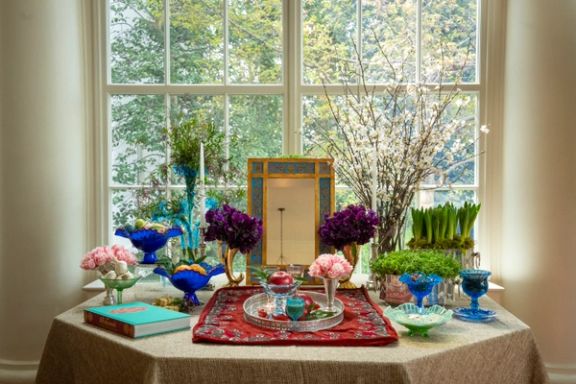
Secretary of State Antony Blinken also joined in the Nowruz festivities, posting a picture of the Haft-Seen spread and expressing his wishes, saying, “Happy Nowruz to all celebrating the arrival of spring and new beginnings. May we cherish the bonds of family and the promise of a brighter tomorrow.”
Nowruz, celebrated across Iran, Afghanistan, Central Asia, and parts of South Asia, holds deep cultural significance as it welcomes the spring season and the New Year in the Persian calendar.
Nowruz is a cultural event marked by age-old rituals like the Haft-Seen table arrangement and joyful gatherings.
Reports affirm that Nowruz transcends regional boundaries, uniting people in celebration irrespective of their religious or ethnic backgrounds.
The festivity has been recognized as a UNESCO Intangible Cultural Heritage.

Their defiant statements and widespread criticism of the clerical government stand in contrast to far-fetched claims by Supreme Leader Ali Khamenei and other officials of having been able to control inflation and make progress on various fronts.
Families of victims commemorated Norouz (Nowruz) by honoring the memory of those killed by security forces, gathering at the graves of their loved ones and issuing messages calling for resistance and perseverance for freedom and justice in Iran.
The mother of Reza Moazami Goudarzi, one of the victims of the November 2019 protests, wrote on Instagram that she is celebrating Norouz in memory of all the heroes who have sacrificed their lives for freedom during 45 years of Islamic rule. Goudarzi was shot in the back by security forces in November 2019 in Andisheh city, near the capital Tehran, and died at the age of 19 because hospital staff refused to treat him in fear of government reprisal.
Regime’s security forces and vigilante gunmen killed at least 1,500 citizens during a week of anti-government protests in 2019.
The father of Mehrshad Shahidi, another victim of the 2022 protests, released a video saying that he will be at his son's grave on Wednesday with other family members to celebrate Norouz.
The parents of Mahsa Zhina Amini, also took to Instagram to welcome the new year by honoring the memory of their daughter. Her death in the custody of morality police in 2022 sparked the "Woman, Life, Freedom" movement and widespread protests in Iran that continue to this day. Taking a metaphorical tone, her parents described spring as "liberation from the tyranny of winter."
Quashing the protests, government forces killed more than 550 people, including 68 children. The mother of Hananeh Kia, one of the victims, wrote in a message how she is longing for her child and expressed hope for "bright days" ahead. Hananeh Kia, 23, was shot and killed by government forces in September 2022, during the first week of the uprising.
Meysam Pirfalak, the father of Kian, a 9-year-old boy who became one of the icons of the anti-regime revolt, also released a video message for Norouz. Kian was shot and killed by government forces in November 2022, while he was in the family car with his parents and younger brother on their way back home in Izeh, in southwestern Iran.
In addition to people in Iran, several opposition figures issued Norouz messages almost with a similar theme, wishing an end to the Islamic Republic and the freedom of the country.
Iran’s exiled prince Reza Pahlavi and his mother, the last queen of Iran Farah Pahlavi, in separate messages, emphasized the importance of Iranian unity and solidarity “to overcome darkness.”
Reza Pahlavi described the new year as a year of pragmatism, “a year of rolling up sleeves of determination and putting on boots of resilience; a year of overcoming obstacles and uniting for solutions; a year of advancing from hope to belief; a year of launching a new plan."
He expressed hope that light will prevail over darkness and Iran will regain its past freedom and glory, saying, “For forty-five years, we have been in our long winter night, but today even the guards of Zahhak (a tyrannical king in Iranian mythology and a metaphor for Ali Khamenei) smell the scent of spring. The echo of Iran's footsteps towards liberation has terrified their dark hearts."

Iran’s Supreme Leader Ali Khamenei referred to the plight of recent flood victims in his New Year address but emphasized that "the most tragic of all was the tragedy that occurred in Gaza – an event that holds great importance in our international affairs. We did not experience anything more tragic than that this year.”
Iran-backed Islamist group Hamas invaded Israel on October 7 and killed 1,200 mostly civilians, taking 240 hostages. Israel's ongoing offensive to dismantle Hamas has resulted in thousands of civilian casualties in Gaza.
Many Iranians, however, oppose the regime’s support for Palestinians and other extraterritorial causes, while Iran is becoming poorer and tens of millions suffer as a result.
Despite the dire economic situation, with inflation hovering at 50 percent and the national currency in freefall, Khamenei claimed there was progress in the country. "If growth in domestic production is pursued in a suitable manner, many of the country’s key economic issues, such as inflation, employment, and the value of our national currency, will be solved in a desirable manner," he said.
Khamenei also designated the new Iranian calendar year as the year of "Surge in production through people's participation." He has been designating slogans for each year in the past 35 years, with most of the slogans focusing on economic growth which has hardly materialized. Iranian officials and organizations try to portray their activities as if they are in line with the Khamenei-designated motto. President Ebrahim Raisi delivered a New Year address, boasting that despite projections, the country's inflation rate did not surpass 100 percent.


Reacting to a UN Security Council briefing on the Yemen crisis, Amir Saeid Iravani dismissed statements made by the US and UK as "baseless allegations”.
Since November, the Iran-backed Houthi rebels have been targeting vessels in the Red Sea and the Gulf of Aden. They proclaim that these attacks will persist until Israel halts its operations in Gaza. The attacks began after Iran's Supreme Leader Ali Khamenei called on Muslims to blockade Israel.
In response, the US and UK have carried out several rounds of strikes against an array of Houthi targets in Yemen.
“The Islamic Republic of Iran categorically rejects these baseless allegations, considering them as a pretext utilized by the United States and the United Kingdom to advance their short-sighted political agenda as well as to justify and validate their ongoing unlawful actions and military aggression against Yemen,” the Iranian envoy said in a letter to the president of the UN security council.
While Iran’s military support for the Houthi rebels goes back to at least 2009, Tehran often claims it merely offers political support to the group.
As experts note, the growing Houthi-Iran “integration” has allowed the Houthis to turn from a local guerrilla group to a more sophisticated armed force able to strike ground and maritime targets throughout the region.
Early this year, American forces intercepted an Iranian shipment, carrying military aid to the Houthis – including drone parts, missile warheads, and anti-tank missile units.

UK, US call for UN action on Iran's Yemen missiles
During the security council meeting, the US and UK urged UN intervention through its maritime inspectorate to prevent more Iranian missiles from reaching Houthi-controlled ports in western Yemen.
Reports of Iranian ships circumventing these inspections are therefore extremely concerning. The UK calls on Iran to cease its unlawful support for the Houthis. All ships entering Hudaydah must comply and report to UNVIM for inspection,” James Kariuki, the UK ambassador to the UN said.
Originally established in 2016, the UN Verification and Inspection Mechanism (UNVIM) is a framework established to inspect commercial shipping bound for Yemen, aiming to prevent the smuggling of weapons and illicit goods into the country.
During the briefing, a missile reportedly launched by Yemen’s Houthi militia struck a vessel near the southern city of Aden, resulting in no damage. Concurrently, US forces launched missiles at Hodeidah international airport.
Meanwhile, Chinese and Russian envoys argued that the US and UK lacked UN authorization for their repeated attacks on Houthi missile sites.


Yashar Soltani, a renowned journalist and whistle-blower, recently disclosed that a substantial plot of land valued at around $20 million in a prime location in northern Tehran was transferred to a company owned by Kazem Sedighi, Tehran's ultra-hardliner interim Friday prayer imam, along with his two sons and daughter-in-law.
Official documents reveal that the company was registered as a non-profit organization just four months ago, with Sedighi and his sons holding a 60 percent ownership stake.
The plot in question was originally part of an aging cherry orchard owned by the Tehran Municipality. In 2003, during the tenure of the current speaker, Mohammad Ghalibaf, Sedighi was granted a 99-year lease to establish a religious seminary on the land. Additional parcels of land used for seminary expansion were acquired over the years, with much of the surrounding property owned by other state entities, including the religious endowments organization.

With the municipality's approval, long-standing fruit trees were uprooted to make way for the construction of the seminary (highlighted in orange) and in the neighboring orchard (highlighted in red).
Additionally, Soltani released documents on Sunday revealing that approximately $20,000 in monthly rent from one of the seminary's assets, a hotel in Mashhad, was directly deposited into the personal account of Sedighi and his son, Mohammad-Mehdi.
Pejam Mousavi, journalist, in a tweet posted photos of a luxury gym and swimming pool built in the lower ground of the seminary and asked for clarification about its revenues and their expenditure. There are now also demands for the disclosure of the lease agreement between Bank Mellat, owner of the hotel paying rent to Sedighi, and him.
Sedighi remained silent about the initial allegations for a few days but when he eventually spoke about the matter, he angered the public even more as he claimed that had had no knowledge of a company being established in his name, accused “a formerly trusted person” of forging his signature, and said he would sue “the person referred to and others involved in the matter.”
“They don’t want to destroy me, they have targeted the youth’s belief [in the Islamic regime],’ Sedighi said in an in interview with the state broadcaster (IRIB).
“I keep thinking what it would be like if I had someone to betray my confidence and transfer the ownership of a 4,000 square meter orchard to me [without my knowledge]!”, Vahid Ashtari, a member of Justice Seekers, a student activists group loyal to Khamenei, sarcastically tweeted.
“Will he remain silent? Will he offer an explanation to the public? Or will he return the orchard? It doesn’t matter at all,” he said in another tweet, pointing out that Sedighi of the Islamic Republic’s headquarters for enforcing hijab and morality.
Sedighi is not the only person trusted by Khamenei to be involved in corruption cases in recent years. Whistle-blowers have made highly damaging allegations of against several others, including Parliament Speaker Mohammad-Bagher Ghalibaf who is involved in Sadighi’s case and Ayatollah Ahmad Alamolhoda, his representative in Khorasan Razavi Province who also serves as the custodian of a shrine revered by Shiites, and is also father-in-law to President Ebrahim Raisi.
Sedighi has also come under fire from some fellow clergymen who fear the revelation of his corruption will seriously damage the reputation of clerics. Critics also demand Khamenei to be accountable for the deeds of those he has shown trust in and appointed to high positions, and also the entities under his control.
“On what grounds has the endowments organization given 6,112 square meters of land to Kazem Sadighi? Release the documents for the allocation of the endowed land to Azgol Seminary. Why do the entities under the supervision of Supreme Leader do whatever they want and are not accountable to anyone? Why is the Supreme Leader not responding to the public’s questions?”, Abolfazl Najafi-Tehrani, a cleric himself, asked in a tweet.
Reformist politician and commentator Abbas Abdi in a tweet criticized the state broadcaster, IRIB, which is also headed by a Khamenei-appointee, for giving airtime to Sedighi to defend himself in an interview at the cost of its own further loss of credibility.
Calling the revelation of Sedighi’s corruption “a fatal blow” to the public’s trust in the regime, prominent lawyer Ali Mojtahedzadeh said in a tweet “a hasty legal complaint and a few-minutes long, one-sided TV interview” would not resolve the issue. “There is a simple and clear way if there is really a will to be transparent: holding a public trial.”