Haft-Sin Spread Adorns International Space Station To Celebrate Norouz
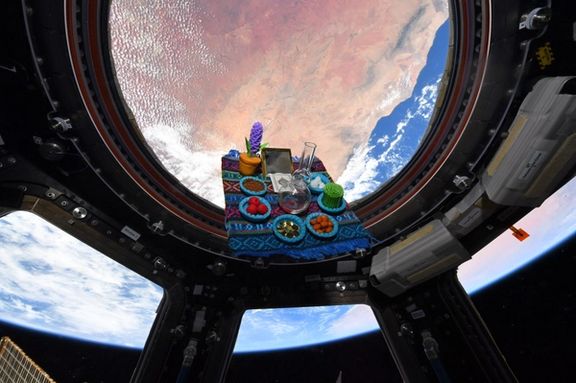
Iranian-American astronaut Jasmin Moghbeli shared a glimpse of Norouz (Nowruz) festivities from the International Space Station (ISS) with the traditional Haft-Sin spread.
Iranian-American astronaut Jasmin Moghbeli shared a glimpse of Norouz (Nowruz) festivities from the International Space Station (ISS) with the traditional Haft-Sin spread.
Moghbeli, who returned to Earth a few days ago via a capsule, captured the photograph during her tenure aboard the ISS.
In an Instagram post, she expressed her initial anticipation of spending Norouz in space, stating, “I brought a Haft-sin with me …thinking I might be there for Nowruz. It would have been unique to celebrate the Persian New Year in space, but I am also very happy to be back home in time to celebrate with my family!”
Norouz, widely known as the Persian New Year, holds cultural importance for millions worldwide. Rooted in ancient Zoroastrian traditions, it symbolizes the onset of spring, embodying themes of renewal, hope, and prosperity. The festivities typically span around two weeks, commencing with the vernal equinox.
Central to Norouz celebrations is the "haft-sin" table, adorned with seven symbolic items representing various facets of life. These items include wheat sprouts symbolizing rebirth, apples signifying beauty and health, and garlic believed to possess medicinal properties and ward off evil spirits.
Beyond the revelry, Norouz serves as a testament to the enduring cultural heritage and resilience of communities that observe it. It is a time for families to come together, reflect on the past year, and embrace the promise of new beginnings.

Reacting to a UN Security Council briefing on the Yemen crisis, Amir Saeid Iravani dismissed statements made by the US and UK as "baseless allegations”.
Since November, the Iran-backed Houthi rebels have been targeting vessels in the Red Sea and the Gulf of Aden. They proclaim that these attacks will persist until Israel halts its operations in Gaza. The attacks began after Iran's Supreme Leader Ali Khamenei called on Muslims to blockade Israel.
In response, the US and UK have carried out several rounds of strikes against an array of Houthi targets in Yemen.
“The Islamic Republic of Iran categorically rejects these baseless allegations, considering them as a pretext utilized by the United States and the United Kingdom to advance their short-sighted political agenda as well as to justify and validate their ongoing unlawful actions and military aggression against Yemen,” the Iranian envoy said in a letter to the president of the UN security council.
While Iran’s military support for the Houthi rebels goes back to at least 2009, Tehran often claims it merely offers political support to the group.
As experts note, the growing Houthi-Iran “integration” has allowed the Houthis to turn from a local guerrilla group to a more sophisticated armed force able to strike ground and maritime targets throughout the region.
Early this year, American forces intercepted an Iranian shipment, carrying military aid to the Houthis – including drone parts, missile warheads, and anti-tank missile units.

UK, US call for UN action on Iran's Yemen missiles
During the security council meeting, the US and UK urged UN intervention through its maritime inspectorate to prevent more Iranian missiles from reaching Houthi-controlled ports in western Yemen.
Reports of Iranian ships circumventing these inspections are therefore extremely concerning. The UK calls on Iran to cease its unlawful support for the Houthis. All ships entering Hudaydah must comply and report to UNVIM for inspection,” James Kariuki, the UK ambassador to the UN said.
Originally established in 2016, the UN Verification and Inspection Mechanism (UNVIM) is a framework established to inspect commercial shipping bound for Yemen, aiming to prevent the smuggling of weapons and illicit goods into the country.
During the briefing, a missile reportedly launched by Yemen’s Houthi militia struck a vessel near the southern city of Aden, resulting in no damage. Concurrently, US forces launched missiles at Hodeidah international airport.
Meanwhile, Chinese and Russian envoys argued that the US and UK lacked UN authorization for their repeated attacks on Houthi missile sites.


Yashar Soltani, a renowned journalist and whistle-blower, recently disclosed that a substantial plot of land valued at around $20 million in a prime location in northern Tehran was transferred to a company owned by Kazem Sedighi, Tehran's ultra-hardliner interim Friday prayer imam, along with his two sons and daughter-in-law.
Official documents reveal that the company was registered as a non-profit organization just four months ago, with Sedighi and his sons holding a 60 percent ownership stake.
The plot in question was originally part of an aging cherry orchard owned by the Tehran Municipality. In 2003, during the tenure of the current speaker, Mohammad Ghalibaf, Sedighi was granted a 99-year lease to establish a religious seminary on the land. Additional parcels of land used for seminary expansion were acquired over the years, with much of the surrounding property owned by other state entities, including the religious endowments organization.

With the municipality's approval, long-standing fruit trees were uprooted to make way for the construction of the seminary (highlighted in orange) and in the neighboring orchard (highlighted in red).
Additionally, Soltani released documents on Sunday revealing that approximately $20,000 in monthly rent from one of the seminary's assets, a hotel in Mashhad, was directly deposited into the personal account of Sedighi and his son, Mohammad-Mehdi.
Pejam Mousavi, journalist, in a tweet posted photos of a luxury gym and swimming pool built in the lower ground of the seminary and asked for clarification about its revenues and their expenditure. There are now also demands for the disclosure of the lease agreement between Bank Mellat, owner of the hotel paying rent to Sedighi, and him.
Sedighi remained silent about the initial allegations for a few days but when he eventually spoke about the matter, he angered the public even more as he claimed that had had no knowledge of a company being established in his name, accused “a formerly trusted person” of forging his signature, and said he would sue “the person referred to and others involved in the matter.”
“They don’t want to destroy me, they have targeted the youth’s belief [in the Islamic regime],’ Sedighi said in an in interview with the state broadcaster (IRIB).
“I keep thinking what it would be like if I had someone to betray my confidence and transfer the ownership of a 4,000 square meter orchard to me [without my knowledge]!”, Vahid Ashtari, a member of Justice Seekers, a student activists group loyal to Khamenei, sarcastically tweeted.
“Will he remain silent? Will he offer an explanation to the public? Or will he return the orchard? It doesn’t matter at all,” he said in another tweet, pointing out that Sedighi of the Islamic Republic’s headquarters for enforcing hijab and morality.
Sedighi is not the only person trusted by Khamenei to be involved in corruption cases in recent years. Whistle-blowers have made highly damaging allegations of against several others, including Parliament Speaker Mohammad-Bagher Ghalibaf who is involved in Sadighi’s case and Ayatollah Ahmad Alamolhoda, his representative in Khorasan Razavi Province who also serves as the custodian of a shrine revered by Shiites, and is also father-in-law to President Ebrahim Raisi.
Sedighi has also come under fire from some fellow clergymen who fear the revelation of his corruption will seriously damage the reputation of clerics. Critics also demand Khamenei to be accountable for the deeds of those he has shown trust in and appointed to high positions, and also the entities under his control.
“On what grounds has the endowments organization given 6,112 square meters of land to Kazem Sadighi? Release the documents for the allocation of the endowed land to Azgol Seminary. Why do the entities under the supervision of Supreme Leader do whatever they want and are not accountable to anyone? Why is the Supreme Leader not responding to the public’s questions?”, Abolfazl Najafi-Tehrani, a cleric himself, asked in a tweet.
Reformist politician and commentator Abbas Abdi in a tweet criticized the state broadcaster, IRIB, which is also headed by a Khamenei-appointee, for giving airtime to Sedighi to defend himself in an interview at the cost of its own further loss of credibility.
Calling the revelation of Sedighi’s corruption “a fatal blow” to the public’s trust in the regime, prominent lawyer Ali Mojtahedzadeh said in a tweet “a hasty legal complaint and a few-minutes long, one-sided TV interview” would not resolve the issue. “There is a simple and clear way if there is really a will to be transparent: holding a public trial.”