Nationwide Gold Retailers Strike Continues Amid Tax Dispute In Iran
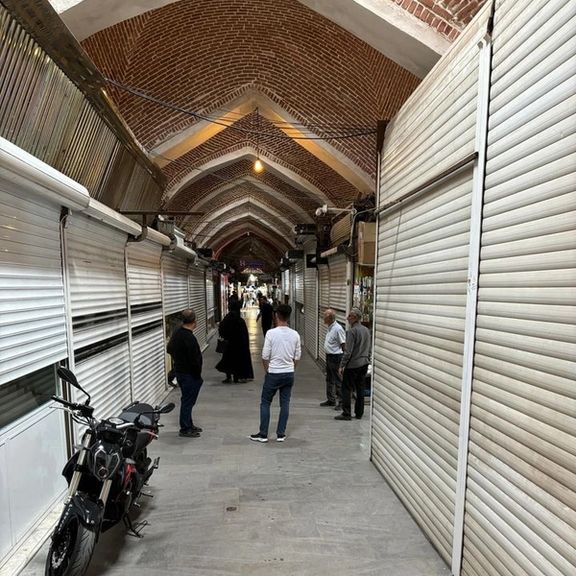
Gold jewelers across Iran continued their strike on Wednesday, protesting against the government’s new tax regulations aiming to impose additional taxes on the industry.
Gold jewelers across Iran continued their strike on Wednesday, protesting against the government’s new tax regulations aiming to impose additional taxes on the industry.
Many shops have either completely closed or are operating at reduced capacity as part of a growing nationwide movement that began on Sunday.
According to Donya-e-Eqtesad, many Tehran merchants are even holding off on selling their assets, fearing losses due to the current downward trends in currency and gold rates.
Nader Bazrafshan, head of the Tehran Gold, Coin, and Jewelry Union, highlighted that the reimplementation of the comprehensive trade system has been met with opposition from the sector due to its impracticality and concerns over potential future capital gains taxes.
In December, following a week-long strike, Ehsan Khandouzi, the Minister of Economy, acknowledged the industry's grievances and announced a step back from enforcing the registration of jewelers' information in the comprehensive trade system.
As the regime gears up to impose new tax schemes on various markets, including gold, currency, housing, and automobiles, tensions remain high, with significant impacts on the gold market already being felt.
It is the latest industry to go on strike amid Iran's collapsing economy and skyrocketing inflation as at least one third of the country is now living below the poverty line.

Khamenei and his loyalists in the Iranian regime have seen victory in pro-Hamas protests in American universities, and the Supreme Leader made sure to highlight this to his audience.
“Despite the extensive efforts of Zionists and their American and European supporters, the issue of Gaza remains the top global concern. Protests against the crimes of the Zionist regime in American universities and their expansion to European universities are signs of the continued sensitivity of public opinion worldwide to the Gaza issue,” Iran’s authoritarian ruler said.
Khamenei has invested 35 years of his rule to relentlessly campaign against Israel, the United States and Western influence, not only in the Middle East but also in distant places in Africa and Latin America.

In the process, energy-rich Iran has become isolated and cut-off from the global economy, gradually losing its economic viability, with a shrinking GDP, high inflation and dependence on China and Russia.
With heavy political and military investment on Hamas and other militant groups in the region, Khamenei seems desperate to showcase any sign of anti-Israeli and anti-Western public opinion at home and abroad as a sign of vindication for his worldview.
“The brutal and merciless behavior of the rabid Zionist dog proved the righteousness of the Islamic Republic's position and the Iranian people, and the massacre of thirty-some thousand people, half of whom are women and children, demonstrated the evil nature of the Zionist regime and the perpetual righteousness of Iran to the whole world,” Khamenei stated.
Claiming repression against protesters on US campuses, Khamenei said, "This issue has shown to everyone that America is complicit in the crime and an accomplice to the unforgivable sin of the massacre of the people of Gaza by the Zionists, and some of their seemingly sympathetic words are lies; therefore, the position of the Islamic Republic, which cannot be optimistic about the US government and trust it, has been proven."
Khamenei feels insecure after years of anti-regime protests by ordinary Iranians, whose social freedoms are being curtailed by Islamic restrictions and their economic status degraded by high inflation and lack of real jobs. He is most likely aware that especially the younger generation cares little about his anti-West ideology and yearns for living like their peers in free and prosperous societies.
Most protesters belong to Generation Z, ranging from teenagers to those in their early 20s. Hundreds of them have been killed by security forces during rounds of protests since 2017. Despite relentless propaganda by the government and dozens of state and religious institutions, there have been clear indications that many in Iran oppose the regime’s anti-Israeli and anti-Western ideology. From chants during protests and football matches, to graffities popping up on the walls and Israeli flags appearing in Tehran, some Iranians let the government know what they think about sacrificing their well-being to support militant Palestinians.
However, Khamenei insists on having no diplomatic and economic relations with the United States and continuing to spend billions of dollars arming regional militant proxy groups with the stated goal of driving the US out of the Middle East and “wiping Israel off the map.”


After his visit to China in January, Mayor Alireza Zakani told the City Council that he had signed several agreements including a deal worth 1.67 billion euros in the field of transportation. Various officials have named electric buses, vans, taxis, subway cars, and traffic cameras as part of the products to be supplied to the municipality.
Councilors who approved of a two-billion- euro budget for improvement of transportation in the capital after the conclusion of the contract on March 4 say they have yet to be informed of the details of the agreements signed by the mayor.
Tehran city government does not have access to such a large amount of hard currency which only the state can provide. The involvement of the oil ministry in the approval process of the deal suggests that the cost will be paid from funds accrued in China from Iranian oil imports. It is highly likely that permission for the whole project was granted by the office of Supreme Leader Ali Khamenei, if up to 2 billion euros is to be spent.
According to an editorial in Tehran Municipality’s Hamshahri newspaper on Monday, President Ebrahim Raisi, the ministries of industries, foreign affairs, interior, and oil, as well as the Central Bank of Iran, had knowledge of the details of the contract. This means a regime-wide decision-making process, suggesting oil money in China is involved.

China is Iran’s main oil buyer, defying US sanctions on Tehran, importing around one million barrels a day.
Hamshahri also admitted that the Chinese side had insisted on keeping the details of the contract secret due to US oil export and banking sanctions. Hamshahri’s editorial suggested that the Chinese side may decide to cancel the agreement.
Lack of transparency regarding the contract also raises questions about possible hidden dimensions of the agreements as it is not clear in what exact purposes the contractor has committed to procure equipment or deliver finished projects. This opens the door to the possibility that equipment and services with dual applications could be included in the contract.
Several Tehran City Council members walked out in protest and obstructed the council’s meeting on Sunday after Zakani evaded giving them clear answers regarding the details of the contract.
The meeting was held a few days after whistle-blower journalist Yashar Soltani published the signature page of the contract on his website.
Zakani claimed at the Sunday meeting that relevant authorities including the ministry of industry and the central bank were informed of the specifics of the agreement. Responding to council members’ criticism of the secrecy surrounding the contract, Zakani claimed that the details of the contract had been provided to two members, Jafar Tashakori-Hasemi, who refuted Zakani’s claim and walked out of the session, and Narjes Soleimani who said she was not convinced by Zakani’s responses.
Critics say the Chinese company, specializing in road projects, is ill-equipped for such a massive commission in the completely unrelated field of transportation technology. They are also concerned about secret conclusion of other contracts with China and possibility of corruption.
“We specifically demand transparency regarding the contract with China…It must be explained how many trips were made [by municipality officials] to China and how many officials went there, what issues were negotiated and what was the outcome of these trips, Councilor Mehdi Eghrarian told Entekhab news website Monday.
“One of my questions at the meeting [Sunday] was if the contract involved the purchase of other equipment. Mr Zakani says it did. So, the question remains, who coordinated [or approved] these purchases?” he said.
“We have a simple demand: Transparency of the Chinese contract. Why are you not making the contract transparent to us if you are not worried [of its consequences]?” the councilor said while calling on the media to help make the issues related to the administration of the capital clear and transparent.
As seen from the single-page document published by Soltani, the contract was concluded on January 30, 2024 with Poly Changda Overseas Engineering (PLCD), a company that specializes in construction of highways, bridges, and tunnels according to Bloomberg UK.
The same document shows that the contract was underwritten by Iran's Bank Shahr, which is affiliated to the municipality. Shahr Bank was sanctioned by the US treasury in October 2020.
Critics say Zakani signed the contract without due processes such as tender announcements and prior approval of the city council. The mayor and other municipality officials claim this was meant to expedite the supply of the much-needed equipment to transform the capital’s transportation system to an electric one.
The mayor of Tehran is a hardliner politician who began his political career during his student days at Tehran University after the Iran-Iraq War (1980-1988) in which he participated as a volunteer. He consequently became the head of the Student Basij Organization of the Revolutionary Guards (IRGC) and was personally involved in the bloody crackdown on students on Tehran University’s campus in 1999 alongside security forces.
Zakani specializes in nuclear medicine and university professor. He was elected to the parliament three times and in 2013 stood for presidency for the first time. He ran against Ebrahim Raisi in 2021. Tehran City Council which is under the full control of hardliners appointed him as mayor of Tehran soon after the elections.