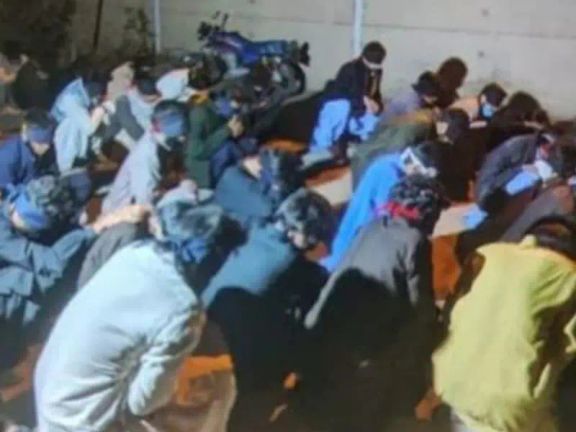
Eight students from the Anwar al-Haramain religious school in Sistan-Baluchestan have been arrested by the Revolutionary Guards (IRGC) accused of supporting insurgent Sunni Baluch group Jaish al-Adl.
The campaign of Baluch activists reported that on Saturday, military forces launched a raid on the residential home and religious school of Mowlavi Fazl ul-Rahman Kouhi in Rask. During the raid, the forces confiscated mobile phones and apprehended eight students.
The report further highlighted the absence of a judicial warrant during the raid, which involved breaking into the home and religious school owned by Fazl ul-Rahman Kouhi, currently incarcerated in Vakilabad prison, Mashhad.
The IRGC accused the suspects of involvement in attacks against police and Revolutionary Guard stations in December and April.
Jaish al-Adl has carried out dozens of large and small operations over the years against Iranian military forces, particularly the IRGC, including cross-border attacks and abduction of border guards and security personnel as well as bombings.
The government in Iran considers Jaish al-Adl a terrorist organization. The militant group says it seeks greater rights and better living conditions for ethnic minority Baluchis.
In mid-January, the Revolutionary Guards launched a missile strike on Jaish al-Adl positions within Pakistani territory. The incident strained relations between Iran and Pakistan, leading to retaliatory actions from Islamabad within Iranian borders. However, both countries have since declared a resolution to the tensions.
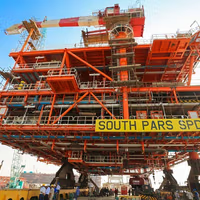
While Iran's efforts to become a regional transit hub over the last two decades have failed, talks are reportedly underway with 21 countries to launch free economic zones aimed at boosting the sector.
Presidential advisor Hojjat Abdolmaleki, who also serves as the secretary of the Supreme Council of Free Zones in Iran, claimed that the Islamic Republic has signed memoranda of understanding (MoUs) with six countries in this field. Although he did not specify the names, he mentioned that the Taliban is interested in investing in Iran’s Chabahar port, near Pakistan’s border.
His claim coincided with Iranian authorities seizing the first Afghanistan-Turkey rail freight transit through Iran since April 20, while officials made contradictory statements about the reasons behind the seizure.
The train, carrying 1,100 tons of talc minerals, traveled along the Khaf-Herat railway, which was inaugurated last summer in the presence of Taliban and Iranian officials. It arrived at Iran's Rozanak station on the border with Afghanistan on April 20 but was halted there for reasons that remain unclear.
Following this, Iran made a peculiar move by detaching the locomotive and relocating it to an undisclosed site.
While officials have yet to provide clarification on this matter, the Minister of Roads and Urban Development, Mehrdad Bazrpash, signed multiple Memoranda of Understanding (MoUs) with the UAE on May 2, encompassing the transportation sector. This occurred during the inaugural meeting of the Joint Economic Committee, marking its first convening in a decade following tensions between Iran and certain Arab states.
The Arab states, including Saudi Arabia, Kuwait, and the UAE, resumed diplomatic relations with Iran in 2022 following their ceasefire agreement with Iran-backed Houthi rebels in Yemen.
Iran’s transit plans
Iran has signed multiple unsuccessful deals with foreign countries over the last two decades in an attempt to become a regional transit hub, encompassing cargo, oil, gas, and electricity agreements.
One such agreement is the North-South Corridor, intended to facilitate the transit of cargoes from India to Afghanistan, Central Asia, and Russia, but it has yet to materialize.
India also signed an agreement to develop Iran’s Chabahar port as a part of the North-South corridor in early 2010s.
India partially initiated the Chabahar project and has been overseeing it since 2019. Though, apart from a few humanitarian shipments to Afghanistan, it has not yet facilitated the transit of any goods through Iran to foreign countries. This is largely due to Iran's failure to complete the 630-km Chabahar-Zahedan railway over the past two decades.
Iran has also failed to complete the 162-kilometer Rasht-Astara railway, which is intended to link with the rail networks of the Republic of Azerbaijan and Russia.
Tehran is additionally burdened by US sanctions and enduring tensions with both regional and Western states. Consequently, Iran managed to transit only 1.5 million tons of foreign cargo via its rail network last year, primarily consisting of Turkmen sulfur.
This volume represents a mere 20% of the international rail freight passing through the Republic of Azerbaijan, for example.
China has also omitted Iran from the $1-trillion "Belt and Road Initiative" project, opting instead to transit its goods to the West via the route through Central Asia, Azerbaijan, Georgia, and Turkey.
India has also excluded Iran from its transit routes priorities by signing MoUs with UAE and Saudi Arabia in 2023 to launch the India–Middle East–Europe corridor.
In terms of the logistics performance index (LPI), the World Bankhas ranked Iran among the poorest countries. Last year, the Islamic Republic ranked 123 of the 139 countries compared, marking the lowest score among all neighbors, except Afghanistan. Even Iraq outperformed Iran in terms of LPI, ranking 115 globally.
Iraq is preparing to launch a huge transit project from The Faw Grand Port to Turkey's borders. The Faw Grand Port in southern Iraq, developed 80%, will be the largest port in the Persian Gulf. The port is being built by the South Korean company Daewoo on the Faw Peninsula, south of Basra, at a cost of about $5 billion and is projected to be completed in 2025.
Iraq plans to invest $17 billion to complete transit routes from the Faw Grand Port to Turkey. This initiative gained momentum when Iraq, Turkey, UAE, and Qatar signed a Memorandum of Understanding (MoU) to develop this project on April 22. Turkey itself ranks 11th globally in terms of logistics market value with $100 billion worth in 2023.
Amid an Iran-backed blockade of the Red Sea, an Iranian warship has crossed the equator into the Southern Hemisphere for the first time, media in Tehran reported on Saturday.
The IRGC-affiliated Tasnim news agency announced the news of Shahid Mahdawi, a container ship converted into a fighting vessel, crossing the equator, for the first time in Iran's naval history.
The vessel, which officially joined the IRGC Navy in March 2023, weighs over 2,100 tons and measures 240 meters in length and 27 meters in width.
In February, the IRGC conducted a test-launch of medium-range missiles from the Shahid Mahdawi, which it claims can strike targets up to 1,700 kilometers (1,050 miles) away. The launch marked the first instance of Iran sending a naval ship on such a long-range mission.
The presence of the heavily armed vessel raises concerns about regional security, particularly in light of Iran's recent hijackings in the Strait of Hormuz and military activity in the Gulf of Oman, and its support for the Yemeni Houthis who have been blockading the Red Sea region since November.
Iran allegedly operates spy ships in the Red Sea, including the commercial cargo ships Behshad and Saviz, which have been linked to espionage activities without any direct confrontation from the US, despite awareness of their operations.
Iran retained its position as the second highest country to imprison writers amid the country's nationwide uprising, second only to China, according to the 2023 Freedom to Write Index.
Released on Friday by PEN America, the latest report echoes the results of last year which found that Iranian authorities continue to detain authors, many of whom are associated with the Woman Life Freedom movement of 2022.
The regime’s crackdown during the Woman Life Freedom movement that was sparked by the death in police custody of Mahsa Amini in September 2022, saw the deaths of at least 550 Iranians and the arrest of tens of thousands, including scores of journalists and writers.
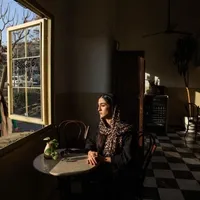
In 2023, Iran remained the leading jailer of female writers in the world, with 15 women being targeted for their writing and advocacy against the mandatory hijab and other laws discriminating against women, according to the Freedom to Write Index. Nobel Peace Prize Laureate Narges Mohammadi and poet and activist Sepideh Rashnu are still behind bars.
Jamshid Barzegar, a former member of the Iranian Writers Association (IWA), told Iran International: “The Islamic Republic has become accustomed to its one-sided narrative, which excludes the voices of others. The regime does not allow writers, artists, and journalists to form and express their opinions.”
Beyond writers, the artistic community has also been targeted, from directors and actresses to songwriters and musicians. In April, Toomaj Salehi, the dissident rapper who had been rearrested in late 2023, was sentenced to death, sparking a global outcry.
The Islamic Republic has a long history of imprisoning writers and artists, including execution. Baktash Abtin died in prison in January 2022 of COVID-19 complications after he was denied timely treatment by officials at Tehran’s notorious Evin prison. The Iranian Revolutionary Court sentenced him, along with two other writers working on a book about the IWA's history, to six years in prison in 2019 for "spreading propaganda against the system" and "assembling and colluding against national security.”
“Incarceration is merely one tactic in a broader array of repressive measures that include short-term detentions, spurious legal charges, and conditions on release such as job losses and restrictions on social media use,” said Karin Deutsch Karlekar, director of PEN America’s Writers at Risk program.
"The problem extends beyond prison walls. The Islamic Republic systematically bans books and thoughts and puts economic strain on its citizens, ultimately leading them to exile,” explained Barzegar.
The Freedom To Write report comes alongside similar figures from the 2024 World Press Freedom Index just released by Reporters Without Borders (RSF). Iran's targeted repression of journalists has led to the country's appalling ranking in the RSF Index placing it 176th out of 180 countries assessed. The RSF ranking places Iran below China, and just ahead of North Korea, Afghanistan, Syria and Eritrea.
The ancient archeological site of Naqsh-e Rostam, located in Iran's Fars Province, risks collapse after severe damage inflicted due to ground subsidence recent heavy rainfall.
The site, close to the famed ruins of Persepolis, is home to the tombs of Achaemenid kings such as Darius the Great and Xerxes and showcases a vast array of rock reliefs from various Iranian dynasties.
Extensive subsidence has occurred with fissures reaching depths of 50 to 70 centimeters and forming within 10 to 15 meters of these invaluable historical monuments. Despite efforts to fill the cracks annually with sand and gravel, they persistently reappear, posing a continuous threat to the stability of the rock face and the ancient artworks it houses.
Iran claims teams specializing in monitoring, protection, restoration, and archeology have been urgently deployed to manage and mitigate the impact of the environmental damage. "We are committed to preserving this cornerstone of Iranian cultural heritage," Alireza Askari, an official of the complex said on Friday.
The preservation of the sites has been a contentious issue in Iran, particularly since the 1979 Islamic Revolution, which saw a shift in the attitude towards relics predating the Islamic era.
Just last month, the Deputy Minister of Iran's Cultural Heritage expressed concern about a lack of funds for maintaining critical sites.
“Last year, the financial resources allocated to the preservation and restoration of historical sites were 900,000 Tomans ($200) and monuments 13 million Tomans ($3,000),” Ali Darabi said. “The fact that all this historical greatness and cultural heritage should be preserved and restored with this minimal budget is beyond me.”
With 27 sites, Iran ranks among the top 10 countries with the most cultural heritage sites in UNESCO's World Heritage List but amid a massive economic crisis, the regime has sidelined the country's cultural past in favor of prioritizing its military budget.
Almost two weeks after a death sentence handed out to Iranian rapper Toomaj Salehi, the Iranian diaspora took to the streets in Australia on Saturday to protest his death penalty.
Dozens gathered in Perth, Australia in a bid to raise awareness of the artist's imminent execution. Around 70,000 Iranian-born expatriates reside in Australia where the community continues to grow amid rising numbers of Iranians fleeing the regime.
At a revolutionary court last week, the outspoken artist who has become one of the faces of the 2022 uprising, was sentenced to death for supporting anti-government protests, charges that his lawyer, Amir Raeisian, claims were previously dismissed.
The Iranian diaspora has since protested and demanded his release on four continents, from Australia to Europe and North America.
Salehi's opposition songs became emblematic of the nationwide Woman, Life, Freedom movement, sparked by the death in the custody of Mahsa Jina Amini for the alleged improper wearing of her headscarf in 2022.
Following his sentence, a worldwide outcry has erupted. Politicians, including the US State Department and Australian, Canadian, and French ministers, and organizations, such as the United Nations and Amnesty International, have since condemned his harsh verdict.
Activists and political prisoners, such as Narges Mohammadi, the imprisoned Nobel Peace Prize laureate, have also expressed concern about Salehi's imminent execution.
Mahsa Amini's mother, the icon of the nationwide protests, also condemned the outspoken rapper’s harsh sentence: “Let Toomaj breathe so that his mother and the mothers of my land don't die.”
In the latest attempt on the domestic front, hundreds of Iran-Iraq war veterans and their families appealed to Iran's leaders not to execute Salehi amid Iran's record numbers of executions in the wake of the uprising which has posed the biggest threat to the regime since the founding of the Islamic Republic in 1979.