Public Outcry in Iran as Government Ramps up Internet Disruptions
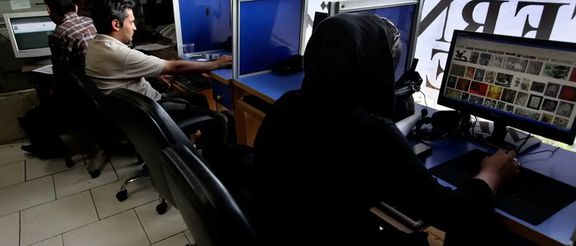
The tightening of internet restrictions in Iran has caused widespread disruptions and a slowdown in internet speeds, impacting various regions across the country.

The tightening of internet restrictions in Iran has caused widespread disruptions and a slowdown in internet speeds, impacting various regions across the country.
In voice messages shared with Iran International, Iranian citizens are expressing their frustrations and emphasizing the impact of the disruptions, highlighting the government's use of internet control as a means of suppression.
A report from Filterbaan, an organization monitoring internet access in Iran, noted that since Sunday, there have been significant disruptions in access to various data centers within the country.
Human rights groups, including Amnesty International, have said that the disruptions are a way for the Islamic Republic to suppress dissent and cover up its human rights violations.
Amid reports that he plays a central role in censoring the Internet, Iran’s President Ebrahim Raisi, spoke at the inauguration of an optical fiber project in the city of Qom.
Despite those reports, Raisi instructed the Minister of Communications to ensure that internet speeds are continuously improved.
"No one, even those in the gaming industry, should be annoyed by the internet. These annoyances are not good," Raisi said.
Assessments by Filterbaan suggest that the ongoing disruptions result from government policies aimed at deliberately not developing external bandwidth in proportion to user expansion, along with repeated increases in internet prices.
These measures are part of a broader strategy, Filterbaan says, to establish a comprehensive national information network that forces users to rely on domestic platforms while restricting access to VPNs.
Due to government filtering policies, platforms like Instagram, X, Facebook, and Telegram have long been inaccessible in Iran, impacting millions who cannot work and affecting numerous small businesses that rely on social networks.

Australia’s High Court has ruled against the release of an Iranian asylum seeker, who has been in immigration detention since he resisted deportation in 2018.
Identified only as ASF17, the Iranian man argued that his detention was punitive.
He has also claimed that deportation would pose risks due to his sexual orientation and that he feared indefinite detention.
The Iranian man’s lawyers had hoped to use a precedent involving another asylum seeker – a Rohingya man. That ruling found that the indefinite immigration detention for people with no reasonable prospect of deportation was unlawful.
In ASF17’s case, the court ruled that since there is a "real prospect of removal" his detention was lawful.
Australia’s High Court seemingly differentiated ASF17's case based on his non-cooperation.
The court stated that ASF17's return to Iran could be facilitated if he agreed to cooperate with the process of obtaining necessary travel documents from Iranian authorities.
"He has decided not to cooperate. He has the capacity to change his mind. He chooses not to do so," the justices noted, unanimously agreeing that his detention remains lawful under such circumstances.
Australia’s Immigration Minister Andrew Giles supported the court's decision, emphasizing that the government had vigorously defended its stance.
He highlighted the case's implications for broader immigration policies, stating, "We welcome today’s unanimous decision of the Court, which has found that individuals who are not cooperating with their own removal are able to remain in immigration detention until they are removed from Australia."
Australia has a policy of mandatory detention for all unauthorized arrivals. The policy applies to those who arrive without a valid visa, including asylum seekers who often resort to dangerous sea journeys arranged by smugglers.
Once intercepted, individuals are typically placed in immigration detention centers while their refugee claims are processed. This process can be lengthy, sometimes lasting for years, which often results in significant mental and physical health issues among detainees.

Iran might already possess a nuclear weapon, an insider politician in Tehran said on Friday, after remarks by a senior foreign policy figure the day before about a possible change in nuclear policy.
Ahmad Bakhshayesh Ardestani, re-elected to parliament in March, conveyed to the Rouydad 24 website his belief that Iran's decision to risk attacking Israel in April stemmed from its possession of nuclear weapons.
Moreover, he drew attention to remarks by Kamal Kharrazi, senior foreign policy advisor to Supreme Leader Ali Khamenei on Thursday, who said that Tehran will change its nuclear doctrine if Israel attacks its atomic facilities. For years, the Islamic Republic has insisted that its nuclear program is entirely peaceful, despite enriching uranium to 60-percent purity, which can only have a weaponization purpose.
“In my opinion, we have achieved nuclear weapons, but we do not announce it. It means our policy is to possess nuclear bombs, but our declared policy is currently within the framework of the JCPOA. The reason is that when countries want to confront others, their capabilities must be compatible, and Iran's compatibility with America and Israel means that Iran must have nuclear weapons,” Ardestani was quoted as saying.

Clearly putting Iran in the same trench as Russia, Ardestani added, “In a climate where Russia has attacked Ukraine and Israel has attacked Gaza, and Iran is a staunch supporter of the Resistance Front, it is natural for the containment system to require that Iran possess nuclear bombs. However, whether Iran declares it is another matter.”
The conservative politician, hailing from Isfahan Province, representing a district close to the Natanz nuclear facility, is a trusted regime figure, because he was allowed to run and win in the tightly orchestrated March parliamentary elections.
Ardestani, 63, has served in the government in various capacities since his youth from the early 1980s, and was a close ally of former President Mahmoud Ahmadinejad. It is not clear if he is a member of the hardliner Paydari party, dominating the newly elected parliament, but he also served a four-year term from 2012-2016 as an Ahmadinejad supporter. He is known as a foreign policy expert who managed foreign students sent abroad by the government.
On Thursday, Kamal Kharrazi was quoted by the semi official ISNA news website as saying, “If they [Israel] dare to strike Iran's nuclear facilities, our level of deterrence will change. We have experienced deterrence at the conventional level so far. If they intend to strike Iran's nuclear capabilities, naturally, it could lead to a change in Iran's nuclear doctrine.”
Kharrazi's statement seemed designed to be a deterrence to any Israeli plans to attack its nuclear facilities. Although he also threatened a change of doctrine if Iran’s existence is threatened, any Israeli attack will most likely be aimed at valuable strategic targets, not at obliterating Iran. It is possible that Supreme Leader Ali Khamenei’s advisor was referring to possible Israeli threats against the regime and its leaders, not the existence of Iran as a country.
On April 18, a senior IRGC commander had also warned that Tehran could change its nuclear policies if Israel continues to threaten to attack Iran’s nuclear sites.
“If the fake Zionist regime wants to use the threat of attacking nuclear sites to put pressure on Iran, it is possible and conceivable for the Islamic Republic to revise its nuclear doctrine and policies, and deviate from its past declared considerations,” said Ahmad Haghtalab, who oversees the security of Iran’s nuclear sites.

Over 100 prominent voices from the music, cultural, and human rights realms have joined forces to call for the immediate release of Iranian rapper Toomaj Salehi – a dissident sentenced to death over his support of nationwide anti-regime protests.
Signatories include international artists Coldplay, Sting, Jade Thirlwall of Little Mix, writer Margaret Atwood, and former Iranian-British hostage and campaigner Nazanin Zaghari-Ratcliffe.
“No artist should be subject to any kind of judicial harassment for exercising their right to freedom of expression, much less be sentenced to death,” their statement said on the Index on Censorship’s website.
Toomaj, known by his first name, has been a long-time critic of the regime in Iran and rose to further prominence when he spoke out in support of the 2022 Women, Life, Freedom protests in Iran.
Over the years, the rapper gained a considerable following through his music and lyrics, which criticized the Iranian state and its human rights violations.
He was one of the first dissidents abducted and detained in the Iranian authorities’ crackdown on the nationwide demonstrations.
“We are living somewhere horrific. You are dealing with a mafia that is prepared to kill an entire nation in order to keep its power, money and weapons,” the rapper told CBC News in an exclusive interview, shortly before his arrest.
Toomaj spent over a year in detention, which included 252 days in solitary confinement.
"As artists, musicians, writers and leading cultural figures we stand in solidarity with Toomaj Salehi. We call for his death sentence to be immediately and unconditionally quashed and for him to be released from detention without delay, with all other charges dismissed. Art must be allowed to criticize, to provoke, to question and to challenge authority. That is both our right and our duty as artists,” the statement by the world renowned figures read.
Following Toomaj’s release on bail in November 2023, the rapper recounted his experiences of torture in a video posted to YouTube. He was quickly re-arrested on charges of "corruption on earth."
Isfahan’s non-independent Islamic Revolutionary Court sentenced the rapper to death on April 24.

While the May 10 runoff parliamentary election appears to be a non-event for most Iranians, a politician suggests that widespread dissatisfaction with the government may lead to a very low turnout.
Gholam Ali Rajaei, an aide to former President and Expediency Council Chief Akbar Hashemi Rafsanjani told reporters in Tehran that the luckiest winner in Tehran may get through to the Majles with around 50,000 votes.
Explaining the reasons for the general apathy, Rajai said that people know they cannot expect too much from individuals who are elected to the Majles with the votes of only 6 to 7 percent of eligible voters.
According to Rouiydad24, it is not only this reformist politician who is pessimistic about the turnout in the runoff elections. Even Conservative media outlets in Tehran are echoing similar sentiments. They argue that the general public's mood does not reflect the typical enthusiasm seen during election periods. The March first-round elections already recorded the lowest turnout in Iran's post-revolution history.
The official turnout in March was 28 percent in Alborz Province, 30 percent in Kordestan Province, and 34 percent in Tehran. However, observers believe actual turnout figures were much lower.
Rajaei emphasized that runoff elections in Iran historically witness low turnout. However, the exceptionally low participation in March underscored Iranians' protest against the government's management of state affairs.
"There are too many problems that have left no peace of mind for Iranians. Election is no longer an issue of interest for the people who have so many financial problems and their livelihood is shrinking on a daily basis." Rajaei said.
He added that the economic chaos in Iran is directly linked to the government's foreign policy and its attitude toward the international order. Iranians have come to believe that the current government in Iran finds rapprochement with the world impossible.
Only an efficient parliament working hand in hand with an efficient government elected in a competitive electoral system may be able to solve some of Iran's problems, but what can lawmakers who entered the Majles with 6 or 7 percent of the votes in their constituency do, he retorted.
Rajaei also suggested that the government is happy about the current situation because there are no lawmakers who would criticize its performance.
In another development, questioning the legitimacy of the current electoral system, Ali Asghar Pourmohammadi, the former head of the Iranian state TV's Channel 3, who will be competing in the runoff election, told Khabar Online website that the conservative political group Shana (short for the Islamic Council of revolutionary forces) had assured him that he would be elected in the first round with all others on its list but this was not the case. "They told me to enjoy myself and go on vacation and to rest assured that I will be a winner," he said.
Pourmohammadi charged that a number of President Ebrahim Raisi's cabinet ministers make the final decision about who wins in the election. Meanwhile, criticizing the parliament and the government for their failures, Pourmohammadi said Raisi and parliament Speaker Mohammad Bagher Ghalibaf are in the wrong positions: "Ghalibaf would have made a better President," he said but did not elaborate on his views about what kind of Speaker Raisi would be.
He said in an apparent allusion to Supreme Leader Ali Khamenei or his aides, that "prominent individuals in the system suggested that I should run in the election as my presence at the Majles will be helpful."

The US State Department has labeled comments by the advisor to the Iranian Supreme Leader as "irresponsible" after he warned that Iran could change its nuclear strategy if threatened by Israel.
The US is committed to preventing Iran from developing nuclear weapons, State Department spokesman Matthew Miller said at a press briefing on Thursday.
Earlier this week, in an interview with Al Jazeera, Kamal Kharrazi, an advisor to Iran's Supreme Leader Ali Khamenei, warned that "if [Israel dares] to strike Iran's nuclear facilities, [Iran’s] level of deterrence will change."
"As the President and Secretary have made clear, the United States will ensure one way or another that Iran will never have a nuclear weapon. We continue to use a variety of weapons – or sorry – a variety of tools in pursuit of that goal and all options remain on the table," Miller said in response.
Despite the warning from Kharrazi and Iran’s repeated noncompliance on its nuclear program, Miller acknowledged that diplomacy remains the preferred route for achieving a sustainable resolution.
The spokesperson did point out that diplomatic efforts are currently hindered due to Iran's recent escalatory actions and its lack of cooperation with the International Atomic Energy Agency (IAEA).
In recent months, a number of officials close to the Supreme Leader have threatened that the Islamic Republic has the capability to build an atomic bomb.
“We have no decision to build a nuclear bomb but should Iran's existence be threatened, there will be no choice but to change our military doctrine,” Kharrazi said, who previously served as Iran’s Minister of Foreign Affairs and currently leads the Strategic Council of Foreign Relations.
The statement comes shortly after the visit of Rafael Grossi, the director-general of the UN nuclear watchdog, the IAEA, to Tehran.
Grossi reported that there was “no timeframe or deadline” for Iran to resolve its nuclear issues, but he emphasized the expectation for Iran to take swift action.