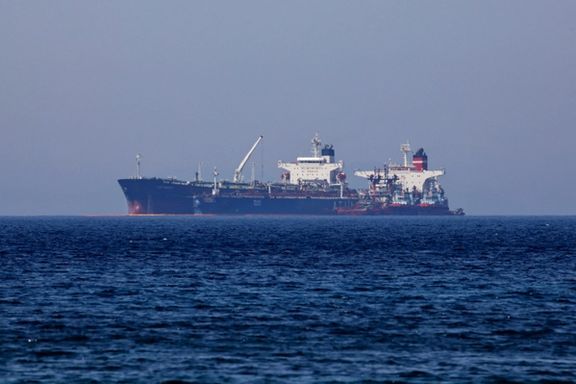
The Liberian-flagged oil tanker Ice Energy transfers crude oil from the Iranian-flagged oil tanker Lana (former Pegas), off the shore of Karystos, on the Island of Evia, Greece, May 26, 2022.
Although Malaysia refutes US claims of violating sanctions on Iranian oil trade, Iran International has obtained additional evidence suggesting that shipments to China are indeed originating from Malaysia.
Malaysia’s Prime Minister Anwar Ibrahim said on May 14 that there was "not one shred of evidence" of ship-to-ship transfers of sanctioned Iranian oil off Malaysia, amid U.S. concern that Iran was using Malaysian service providers to move its oil.
A senior US Treasury Department official said last week the United States saw Iran's capacity to move its oil as being reliant on providers in Malaysia.
Despite China officially reporting "zero" Iranian oil imports in its customs statistics, it is importing approximately 1.5 million barrels per day of Iranian oil, according to all oil trade monitoring firms. This oil is often rebranded as originating from Malaysia, Iraq, Oman, and the UAE.
Statistical evidence
Chinese customs figures show that more than 1.1 million barrels of crude oil per day (mb/d) was imported from Malaysia last year, which is six times more than in 2018, when US started imposing oil export sanctions against Iran.
The most interesting fact is that the total daily oil production of Malaysia was about 650,000 b/d last year, 40% less than its export level to China. Furthermore, Malaysia’s own custom statistics put the total exports of crude oil and petroleum products at 186,000 b/d in 2023.
Kpler, an authoritative trade intelligence firm’s tanker tracking data shows Iran shipped 670,000 barrels per day (b/d) of oil to Malaysian waters in 2023.
A senior expert at Kpler told Iran International that the volume reached 800,000 b/d in 2024, which corresponds to more than 50% of Iran’s total oil export to China.
According to several reports in the past, Malaysian and international middlemen take the Iranian oil and after ship-to-ship transfers and rebranding, export the cargoes to China as Malaysian crude oil. Companies in Malaysia even for ship-to-ship transfers in open waters.
Malaysia seized an Indian and a Chinese tanker due to illegal ship-to-ship operations involving Iranian oil six months ago, after the advocacy group United Against Nuclear Iran (UANI), disclosed through satellite imagery that the two vessels were bypassing US sanctions.
Claire Jungman the chief of staff at UANI and tracker of tricky oil tankers, especially ones coming out of Iran, tweeted on October 25 that her organization identified the ARTEMIS III and Panama-flagged OCEAN HERMANA conducting an illegal ship-to-ship transfer of Iranian oil in the Riau Archipelago islands.
According to the ship tracking companies, ARTEMIS III is still at Riau Archipelago islands, while OCEAN HERMANA is located at East China Sea. It is not clear why Malaysia released the Chinese tanker, but still detains the Indian vessel.
The Malaysian Maritime Enforcement Agency also reported on April 24 that a tanker was seized due to “illegal anchoring” with Iranian, Pakistani and Indian crew, without giving further information.
Malaysia’s fears and interests
China's customs statistics show that Beijing had $190 billion trade turnover with Malaysia last year. Malaysia exported nearly $103 billion to China and imported $87 billion from China.
China is Malaysia's largest trading partner; but the important point here is that the United States was also its third largest trading partner last year with $65 billion turnover, of which $46 billion was Malaysia’s exports to the US.
Iran has no significant place in Malaysia's foreign trade. The statistics from the Iranian Chamber of Commerce show that Iran exported about $247 million of goods to Malaysia and imported $613 million during last Iranian fiscal year, ending March 21.
Malaysia finds itself in a precarious position between China and the United States. Enforcing American sanctions against Iran could upset China, its largest trading partner. Conversely, ignoring these violations risks repercussions from the United States, its third-largest trading partner.
Iranian authorities have announced plans to establish an academic program that centers on the Islamic doctrine known as the "promotion of virtue and prevention of vice."
While the "promotion of virtue and prevention of vice" (PVPV) is a teaching rooted in the Quran and a guiding principle of behavior for Muslims, it also refers to a key Iranian regime institution tasked with determining and enforcing its strict Islamic behavioral norms in society.
This week, Mehran Samadi, the head of the PVPV Office, confirmed the launch of the new university program, which is intended for master's and doctoral levels of study.
Though he admitted that the PVPV’s work often focuses on the hijab and chastity, he emphasized that other areas also require attention and enforcement of Islamic principles.
In 2022, it was instrumental in setting new and stricter “morality” codes for women that are in clear violation of their human rights.
It also plays a central role in setting up the monitoring and often brutal sanctioning of women and men who do not respect these codes. The behavioral codes are subsequently brutally enforced by sanctioned entities, primarily the so-called morality police.
The news comes amid unprecedented discontent with the Islamic establishment. According to themost recent polling, the “Iranian populace has undergone a secularization and liberalization faster than any society in the Islamic world, despite having lived under the rule of Islamists for decades.”
Amidst that backdrop, the country’s Supreme Leader Ali Khamenei, initiated the “Noor Plan” this year – a campaign aimed at stepping-up the already strict enforcement of hijab laws, which are considered by clerics a part of PVPV.
Under the directive, the “morality police” have increased their physical presence in Tehran’s central districts, patrolling the streets more frequently along with an expansion of the deployment of vans and motorcycle units.
The increased activityof law enforcement, including plainclothes agents, has led to a spike in violent confrontations, especially involving women who resist wearing the mandatory hijab.
The UN has labeled the Iranian authorities' crackdown on the hijab and the overall oppression of women as “gender apartheid”, while Amnesty International has called it a“War on Women”.
This renewed crackdown occurs nearly two years after the death of 22-year-old Kurdish-Iranian woman Mahsa Jina Amini, who died in the custody of the "morality police" after sustaining severe head injuries allegedly for not wearing a "proper" hijab.
Amini's killing ignited the most substantial wave of anti-regime protests since the inception of the Islamic Republic in 1979.
The sudden arrest of Sadegh Zibakalam, a vocal Iranian academic, may signal to other tolerated critics that they too, even if they haven't advocated for regime change, might now face the threat of arrest.
Iranian media widely reported that Zibakalam, a former professor of political science at Tehran University, was arrested on Sunday by security forces while en route to the Tehran International Book Fair to unveil his new book, titled "Why Don’t They Arrest You and What Will Happen Afterwards?".
In atweet after the news of Zibakalam’s arrest broke, Mehdi Keshtdar, managing director of the state’s judiciary news agency Mizan, denied the reports that he had been arrested on the street.
The judiciary insists that the 66-year-old academic was “summoned” to serve multiple sentences totaling three years for “propaganda against the state” as well as “spreading falsehood” on social media to affect the public’s opinion.
Zibakalam is known for speaking to foreign media on controversial matters.
The poster for Sadegh Zibakalam’s book event scheduled for May 12, 2024
His 18-month prison sentence for “propaganda against the state” by the Revolutionary Court in 2018 was for an interview with Germany’s Deutsche Welle which the court said was a "counter-revolutionary and hostile website."
In the interview, Zibakalam commented on the "disappointment of anti-government protesters with the entire regime apparatus" and said 70% of Iranians would say no to the Islamic Republic if there were a referendum to decide the type of government in Iran.
The title of his book alludes to allegations suggesting that, unlike other 'reformist' critics like former official Mostafa Tajzadeh, Zibakalam has been "immune" to arrest despite making controversial remarks over the past decade. These include his criticism of the country's nuclear policiesand its anti-Israel rhetoric.
This immunity was believed to be due to Zibakalam never advocating for the overthrow of the Islamic Republic.
“Who says we should destroy Israel?” Zibakalam who openly voiced his recognition of the State of Israel asked in an interview with historian and filmmaker Hossein Dehbashi in 2014. “It’s no joke when you write ‘Israel must be destroyed’ on your missiles’,” he said.
Zibakalam refusing to step on American and Israeli flags in 2021
“Israel has never said it wants to destroy us ... Even Palestinians recognize Israel. We are more catholic than the pope,” Zibakalam, who is supportive of the right of the Palestinians to have their own state, said in a debate in 2015.
In April last year he said “annihilation of Israel and fighting America” were not among the goals of the Islamic Revolution of 1979 and these slogans were often used by authorities to justify their failures.
In January, Zibakalam came under massive attacks from hardliners after he said Israel “does not kill innocent people” in an interview.
Many dissidents argue that not being arrested after such bold criticism is evidence that Zibakalam is “the regime’s safety valve” and his activities serve the authorities’ wish to show that freedom of expression exists in the Islamic Republic.
“Good! Zibakalam is NOT opposing the mullah regime in Iran but [is] in fact a willful propaganda stooge & proud Jew-hater. The regime parades him out in front of TV cameras often to claim they allow ‘criticism’ of their policies. He's a regime loyalist & a FRAUD!,” California-based Iran commentator Karmel Melamed tweetedafter Zibakalam’s arrest.
Others, including some of his critics, have risen to his defense in principle.
"Now that he has fallen from grace, I have always been opposed to #SadeghZibakalam, from explicit criticisms in class to heated debates face-to-face at conferences, and later by denying and rejecting his positions and track record in public. But today, I definitely say that his arrest is unacceptable, and he should be released,” Tirdad Bonakdar, a member of the Central Committee of the banned National Front, founded by nationalist Mohammad Mosaddegh in 1949, wrote on X.
Recently, Zibakalam said in a tweet that the security outfit at Allameh Tabataba'i University had not allowed him to enter the campus to participate in a debate to which he was invited by the hardliner Students Basij militia.
Within a day of his arrest this weekend, Zibakalam’s book became unavailable on Tehran's Digikala online shop – an Iranian e-commerce company. It’s unclear whether the book sold out or if the retailer was instructed to remove it from its online platform.
On Monday, Iranian military and security forces reportedly opened fire on a car in Sistan and Baluchestan, resulting in the death of one individual and severe injuries to two young children and a woman who were passengers in the vehicle.
The Baluch human rights group Haalvash reported that Iranian forces, positioned at an intersection in the center of Saravan city in several Toyota Hilux vehicles, simultaneously opened direct fire on the Peugeot Pars car from multiple directions as it passed through the area.
TheToyota Hiluxvehicles reportedly used in the attack are commonly used by the regime’s Islamic Revolutionary Guard (IRGC), and have also beenpopular with jihadist groups and ISIS.
"Among the five passengers in the car, a young man approximately 28 years old, suffered severe gunshot wounds. After he and others exited the vehicle, the security forces fired again, fatally shooting the man and critically wounding a 5-year-old child. A 3-year-old child and a woman were also struck by gunfire. A middle-aged man in the front passenger seat was the only one unharmed," reported Haalvash.
After the attack, military personnel reportedly swiftly removed both the injured and deceased individuals from the scene along with their vehicle, transporting them to an undisclosed location.
It’s unclear why the attack happened, with no official explanation provided at the time of this report.
The latest incident contributes to an ongoing pattern of reported violence perpetrated by Iran's security forces.
In March, 21-year-old Negar Karimian was killed by security forces who fired at her family's car in the province of Lorestan. Authorities later stated it was a case of "mistaken identity," as they suspected the vehicle of carrying narcotics.
Last June, 9-year-old Morteza Delf-Zargani was fatally shot when officers indiscriminately fired at his family’s car, in the province of Khuzestan. The child’s father said security forces shot at the vehicle without even a single warning and based on a false report of car theft.
Similarly, in January 2023, a 20-year-old student named Anahita Amirpourdied due to gunfire on the car she was traveling in, coming from plainclothes forces in Lorestan province.
According to the human rights organization HRANA, in 2023, there were 402 reported victims of military force shootings in Iran, resulting in 120 fatalities.
US National Security Advisor Jake Sullivan called Iran and its proxies “clear” threats to American interests on Monday, vowing that the Biden administration would do everything to counter those threats.
In a White House briefing focused on Israel’s war on Gaza, Sullivan said the US government seeks to prevent the current conflict turning into an “all-out regional war,” but would not shy away from any action, including “use of force when necessary”, to protect American people and interests.
“We will not let Iran and its proxies succeed,” he stated.
The Biden administration has been constantly criticized for not being ‘tough’ enough on Iran and its proxies. It’s also being pulled apart by supporters and critics of Israel, the former demanding unqualified commitment to Tel Aviv and the latter calling for using the US “clout” to rein the Israeli government and its onslaught on Gaza.
Sullivan’s briefing Monday may be seen as an attempt to counter both attack-lines and reassure both camps that the administration is doing all it can to protect civilians in Gaza while helping Israel against Iran and its proxies. Not many are convinced, however.
“Barack Obama's Secretary of Defense said that Joe Biden has been wrong on every foreign policy decision for the past 40 years,” said Republican Senator Ted Cruz on Monday. “Joe Biden proved this theory again when he decided to cut off military aid to Israel and to allow billions to flow to Iran.”
Biden’s Republican critics say his leniency and lack of determination to combat the Iranian regime has made it more aggressive, making the feared all-out regional war more not less likely. Also, many blame Biden and his team for the advancements in Iran’s nuclear program, which the UN watchdog says is closer than ever to the point of no return.
This issue was addressed Monday in another briefing –with the State Department’s spokesman Vedant Patel.
“[President] Biden and [US Secretary of State Antony] Blinken will not allow Iran to have a nuclear weapon,” he told reporters. “We continue to assess, though, that Iran is not taking any key activities that would be necessary to produce a testable nuclear device.”
He made the remarks in reaction to Sunday comments by Kamal Kharrazi, a senior advisor to Iran’s ruler Ali Khamenei, that the Islamic Republic would be left with no option but to alter its nuclear doctrine if Israel threatened its nuclear facilities or its existence.
Asked if these comments were a concern for the United States, Patel said, “We don't believe that the Supreme Leader has yet made a decision to resume the (nuclear) weaponization program that we judge Iran suspended or stopped at the end of 2003.”
Khamenei has indeed issued a decree against weapons of mass destruction. But it’s no more than a personal judgment based on an interpretation of Shi’i Islam that he can revisit and –if necessary– overturn at any moment.
Since early 2021, when the Biden administration opted for negotiations to restore the Obama-era JCPOA agreement, Iran has vastly expanded its uranium enrichment efforts and is now believed to have amassed enough fissile material for 3-5 nuclear warheads.
Australia is sanctioning five Iranian officials and three entities, over Tehran's "destabilizing behavior" and “activities” in the Middle East.
Iran's Defense Minister Mohammad Reza Ashtiani and Brigadier General Esmail Qaani, the Commander of the Islamic Revolutionary Guard Corps (IRGC) Quds Force are among those sanctioned.
The ministry's statementdenounced the IRGC as a "malignant actor" threatening both international security and Iranian citizens.
The sanctions also target additional Iranian officials, businesspeople, and companies involved in advancing Iran’s missile and Unmanned Aerial Vehicle (UAV) programs.
According to the ministry, these technologies have long contributed to regional instability by empowering Iranian proxies.
The IRGC Navy, which seized a civilian vessel linked to Israel under a Portuguese flag in international waters on April 13, 2024, is among the targeted entities, with Australia reiterating its calls for the immediate release of the ship and its crew.
Overall, Australia says it has sanctioned 90 people and 100 entities linked to Iran, saying it is committed to "deliberately and strategically apply pressure" on Iran to halt its disruptive actions and comply with international law.
The new sanctions align with measures taken by other nations following Iran's drone and missile strikes on Israel last month.
Australia has not designated the IRGC as a terrorist organization, despite imposing wide-reaching sanctions against the IRGC and its affiliates. This stance differs from the United States' decision in 2019 to label the IRGC as a foreign terrorist group.
Other nations, including the UK, Canada, and France, have also refrained from labeling the IRGC as a terrorist organization in its entirety, though they have imposed substantial sanctions.